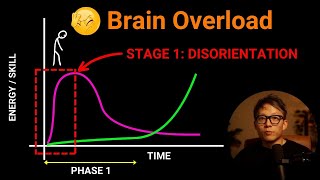
James Lim explains why learning feels overwhelming at first: your brain juggles admin tasks like navigation and tooling alongside actual skill-building. You forget these background processes later when they're automatic, which makes the initial curve feel steeper than it is. Immersion and time are the fix.
Chapters
But we need to know what's inside it. So why this lump? Here we go. It's all about this efficient learning. So remember this chart. Effortless mastery. This is where we're trying to get to. Now we're going to dive into phase one. There are two critical stages we must understand before we can become efficient and to avoid the common mistakes nearly everyone makes. So what is stage one? I call it disorientation. Imagine being blindfolded and dropped in a new city that you've not been to. How would that feel? Like, what would you. What sensations would you go through? What thoughts and feelings? Or imagine starting a new job like we touched on before. Or learning how to drive a car for the very first time. What is it like? Your brain gets completely overloaded with new information, so you're not even focused on the task. This is important brain overload. Your brain's unfamiliar. It can't use any existing patterns it has in its head. It's like starting from scratch for each action. When you're learning to drive a car, everything you touch there is a process that you don't know and you have to learn. And it can be really, really overstimulating. So you get overwhelmed, anxious, discomfort. Sorry. Experience discomfort and get exhausted. Now, this is where another counterintuitive error occurs. Remember I said how this, how this chart can look a lot smaller. You're thinking, why would we think that every time? It's pretty stupid, right? Well, no, it's because our brain doesn't count this admin, because the current operations that you're running in your life, you've already mastered the admin, all of the stuff you've done. If you've learned to ride a bike, if you've learned anything. The first time you used your phone, you didn't know where things were, how to get into the apps, how to get into settings. But now you do. You can do it with your eyes shut. So your brain doesn't count all of those mental processes. It has this box bias. When you do something new, it's like you forget, right? You've forgotten all of those processes. You have to learn. And the harder the thing you're trying to do, the more complex it is, the more of that admin that you're going to discount. Now in this lump, much of it is not progressive. You're not learning. When you're learning about how to open the settings in on your phone or your app, you're not making anything useful. You're not doing anything productive. You're learning these Background processes, but they're all necessary. For example, if you start a new job, orientation, might be, who do I ask for it? Familiarity. How do I use this software? You can't get started doing any of the content in the software until you know how to use it. Technical. How do I use the camera? I remember when I first got my dslr, I really was excited to start shooting. I had to spend about two months trying to figure out how to use a camera and I would still get everything wrong. Everything would be out of focus and everything will be dark. And the other one is the fundamentals. Forgetting what to say on a sales call, you know, knowing how to articulate yourself in an outreach email. Only once you've done these things does the real learning begin. And that's the point where you usually find yourself saying, okay, I can focus on my tone of voice, I can focus on my style of delivery. Okay, I can focus on the road, not just looking at the levers and the steering wheel and the pedals. Your objective is to get through this. It often just needs time and exposure. Immersion is really, really good for these specific components, which we'll touch on in a minute. So, yeah, you know, examples are mirrors, pedals, software, navigation, keyboard shortcuts, the mappings, the processes of your. Of your work and your business. Some foundation skills. You get this everywhere in music. It's scales and chords in it can sometimes be difficult to learn how to play melodies and harmonies until you can understand some of the basics. Working out, understanding the basic movements or knowing where the equipment is or how to use it. You know, the first time you go into a gym and you don't know how to turn the machines on or how to get the lock out and all this stuff. I still remember that. Now the next one, mistakes. This is a really important one. Program navigation and dead ends. This will be really key. So don't forget this one. Are you keeping a track of all the things I've asked you not to forget? Frustrating. And you have little return. So all of these things over here, you're not actually making any progress in the skill set. And your brain has discounted this already because it's already in very habitual processes. A quick example I'll give you for my content creation. I hate this screenshot. This is one of my first videos, but I'll leave it here for your amusement. I had no idea what I was doing. I couldn't even use the apps. And this was on TikTok to start with. Just the basic navigation. I didn't know how to do it. I was looking up YouTube tutorials on how to navigate through it, let alone how to use a camera and upload, because that came later. I couldn't think about the content for ages. It was so frustrating because I remember watching all these videos about how to create good content. I wanted to do that. I had to spend a few weeks just learning all this stuff. Just a quick important note. What about all of this research and knowledge? Where does that come into play now? This is where I talk about the learning fallacy.