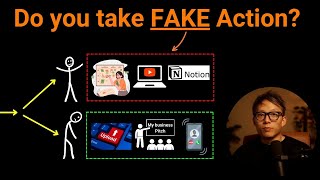
James Lim breaks down fake action: when you perfect your logo or endlessly plan instead of actually shipping. Your brain does this to avoid discomfort. The fix is smaller steps, no-escape conditions, and one real move forward.
Chapters
Are you really taking action on your goals or are you taking fake action? So what does this mean? For years I was always busy, but never actually moving forward. It completely wrecked my progress. Now, it wasn't until I faced a pretty painful, harsh truth and broke free from this trap that everything really started to change. And maybe it will for you too. So, part one, Fake action. What is it? Years ago, I was in this cycle of constantly coming up with business idea after business idea. Then eventually when I came up with one, I'd spend weeks thinking of a logo and color scheme for the website I create. Then I'd go down a rabbit hole of learning about logo design and color schemes. And on the business idea, I'd spend months taking courses about it, reading books and trying to figure out how to become more qualified in it. I then spent years researching how to make the Perfect video for YouTube. And if you've seen some of my previous content, I talked about how I created my channel and didn't post a video for over 12 years because I was still trying to figure out how to create the perfect video. And I constantly jump from idea to idea, getting excited by each new one that I come across. The harsh reality was that I had nothing to show and this was pretty painful. It felt like progress, but the results spoke for themselves. I had none. But you already know this cycle. So the more important question is why do we do it to ourselves? So this is part two. So we're going to look at our brain wiring. Our brains are wired to stay away from pain. It's a survival instinct. But your brain also recognizes your goal is pretty important because you keep saying so. This presents a conundrum. If you don't work on your goal, it'll be really obvious that you're not going in a direction you want to go to. So a red flag will be raised. And what would that mean? You might raise the priority and perhaps ask for help or get accountability to make you take action which will cause you more pain. And your brain doesn't want that. So it comes up with a pretty cunning way to make you feel like you're making progress by having your goal topic front of mind, but working around it rather than doing the action that's necessary. The bottom line is there's no hack to avoid the discomfort of taking action. Now, I would see this with clients. Many were stuck in the knowledge acquisition state, which I call intelligence flattery, where you feel like you're getting more intelligent by learning all about it. And in fact, you can probably talk about it too, but you're not taking any action there. They'd have shiny object syndrome. When we would look at their timeline and then we would go through, at what point did they jump to the new object? It was usually at the first sign of discomfort in the. In the project they were working on. And that's when they jumped. Many would take pride in crafting a plan, and it would be this really big, elaborate plan with mind maps and flowcharts and all of this. But they'd never execute on them. They were forever building portfolio projects for years, but never sharing it or going to market. They'd be looking for perfect job descriptions, but never actually reaching out to the companies. They'd spend time perfecting all of their work, but never shipping that work to see what people think and to take feedback. So what can we do? We need to confront reality. We must strip away all of these narratives and excuses that we make. And we can do this by being brutally honest with ourselves about the actions you know you need to take. Don't allow yourself to replace the important actions with the fake ones. If you are scared, that's okay, but face it, because we can work with this and try and figure out a way forward. If you have these fake actions, we end up working with things that are not the right things to be concentrating on. So how can we initiate taking action? This is the next piece. Once you place yourself in a space with no escape that you've got to take action here, you can get to work and we can start chipping away at the task. Now, an important client observation here is there's usually lots of different ways of making progress, and it's usually quite unique to the person. To make progress, it often required breaking down the steps further, usually because people were getting overwhelmed or feeling really stressed and panicked about trying to get started. So we had to find a way to move forward, but make it more manageable. You will feel resistance, but this is the right signal. Don't run away from it. It is not a sign to abort the whole project, especially if you're early on in the process. The exposure to discomfort will train your brain to be more tolerant to the discomfort itself. What we're saying here is your sensitivity to discomfort will reduce over time. So you'll make progress and progress will feel easier over time. And this is why you'd often see people who are making progress and they don't seem to be that phased by it. It's because if you've never taken any steps forward, that is when you'll be most sensitive to the discomfort. Once you start, things will become a bit easier. So ask yourself, what's one real action you've been avoiding that you know you need to take that will make real impact to your goals and get started. So that's all for this video. I'll see you in the next one.