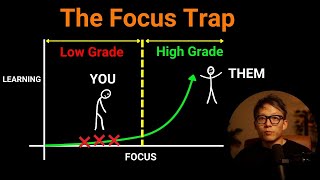
James Lim explains why juggling multiple interests keeps you stuck in low-grade focus, where you learn almost nothing. High-grade focus, like flow states, compresses hours of work into minutes. He recommends eliminating competing commitments and creating dedicated environments to actually make progress.
Chapters
How can I get the most out of my practice time? Advanced focus. Here. Yet another exponential chart. This is where you're in the flow and this is what I where I separate two areas of focus, low grade and high grade. This is where you're very inefficient and where you're very efficient. I realized that learning is not proportional. When you've got this low attention, you have very low learning. Have you ever tried scrolling on your, you know, trying to learn something on a computer or while watching YouTube or scrolling on your phone? It's really difficult to get into an absorption phase and we often end up somewhere around here. When you're in this high grade state, just think about this. When was the last time where you've been right in the zone? You got done in 30 minutes. What would normally take you a day or like half a day? It happens. I've heard this so many times of people. Low grade is where it takes all day to do one basic task. That's because your brain's just not switched on. The problem is you look at the overall time, you don't look at the efficiency side of things. So you can split these into two. High grade and low grade. Find your threshold, it's not linear. Now this is kind of anecdotally, but this is something that I've experienced and definitely so the clients, when I'm working with clients, an interesting thing is when we're in session, we can slide them all the way up here. We can resolve some, some of their problems in half an hour. What would have taken them two or three days. And the trick, there's no magic here. It's because they've been operating in this low grade state. And I've had a lot of experience to try and work people into this place. And it's really amazing to see because I can really see the shock on their face as to how much progress we end up making in a quite short period of time. One plus one, what does it equal? You're thinking two, right? 1.5. How does that work? When we are having low grade, what happens is we think, okay, I'm going to do these, I'm going to do three projects, project one. But you end up having this by default, low grade attention. You start project one and you have this place and you start by default with low grade focus. Project two, low grade focus, project three. And this is a problem with multiple projects. It's harder to create space for high grade focus. Well, why is this? When you're juggling stuff, I mean I've experienced this so many times where I'm trying to juggle so many things and I realize, oh no, I'm doing this thing again. I'm in the low grade focus state. I'm jumping from thing to thing, leaving myself half an hour here, 20 minutes here, shorter time blocks, very difficult to get into that focus state, less money to dedicate to each project. Now I'll tell you how this impacts it in a moment. You'll see. Think about what environments get you into high grade focus examples. It might be, you know, by yourself, taking yourself to the library, office or a studio to work in, working in classes, groups or communities, going to workshops or boot camps. Now you can see this is why I mentioned the money thing. Because if you're working on multiple projects, you're less likely with your money distributed across many projects. You can't spend lots of money on any one, which will often mean you don't want to spend or you can't. You're not able to spend on going to workshops and boot camps where it will be much more likely for you to get into that high grade focus state. And the same thing with instruction and coaching sessions as I was describing in the last slide. When I'm coaching, I see people make a move here. You know, I often can see them in session, sliding up this, up this line. And it's awesome to see. But yes, it comes at a cost, but sometimes it's really, really worth it for the output that they need. So remember what we're trying to do here. More efficient is increased learning per unit effort. That makes the whole process faster and a bit more enjoyable because this will get compressed down the next one. This is a big one elimination.