How to create a resilient plan for your goals (Simple goals system)
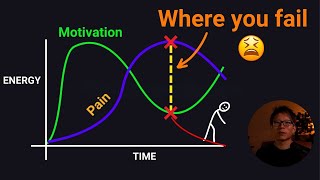
This content was created by James Lim. This content was uploaded by James Lim. This is a YouTube video titled "How to create a resilient plan for your goals (Simple goals system)" (created 2024-05-16). It is a single-speaker self-help/personal-development presentation explaining why bursts of high motivation often lead to plan failure (motivation curve) and how rising difficulty/discomfort (pain curve) causes people to quit. The speaker presents a practical system of setting an aspirational upper limit and a thought-out, easy lower limit to create a "window of operation" that preserves progress (using metaphors like glass vs steel, an island, and a steam train) and gives examples such as gym attendance to illustrate how to apply the method.
Chapters
What's the difference between people who can stick to their plans and people who can't? This is something I used to struggle with all the time. I'd make these really perfectly crafted plans when I'm working on my big life goals. I'd have big intentions. I'd set up whiteboards, mind maps just like this. The problem is they'd always fail for some reason and I'd just quit. In fact, the more motivated I was, the worse it seemed to get what was going on. So. So in this video, I'm going to go over why more motivation often makes you more likely to fail and why for certain people, failure of your plans, if you're working on your goals, is going to be inevitable. And I'll also give you a full system to keep you on track no matter what. This has helped me for well over 10 years and has helped hundreds of clients I've worked with. And it's been one of my most kind of famous little systems to use. But first, a quick question. What is more resilient? A or B? A this glass, bird or B, these steel beams. So we've got these two items here. Glass known for being brittle, fragile, delicate, but also represents perfection. And steel, resilient, can withstand, knocks reliable, but very plain and simple looking. Not something very attractive. This is how we end up making our plans. We make our plans out of glass. And what happens to glass? Easy to break. What happens? It only takes one hit before it completely shatters. Do you resonate with that? What ends up happening is something you start your plan, this perfectly crafted process. Exactly what you're going to do. Your calendars filled up with all of your to do tasks. And then one thing comes in and the whole thing breaks down. Ends up leaving you with no progress, failure and results in you quitting. Why do we do this and what can you do? So I want you to imagine you're on an island. You, this is the island and this is you. And your goals and dreams are over here. It's pretty simple. You just want to get to the other side of the island. And at this point, this is where we are most excited because the prospect of achieving our goals and dreams is just around the corner. But this is exactly where everything goes wrong. So we're going to jump into a training module where you will learn how to make resilient plans that will never break. At this point, you're pretty excited and highly motivated to get things going. This can be plotted on a graph. Your motivation shoots up here, so you're up Here. And then you say to yourself, I'm going to achieve all the things. So when we are at peak motivation, this is where we set our goals. But then it starts to fade and we end up with this kind of curve here I call the motivation curve. Now this just a side note, this is the fast burn type of motivation, right? It's that fleeting feeling. It's not the kind of underlying one we're talking about. So it comes and goes in waves just like this. It's only natural that this happens, but it is a bit of a trap. And this is what I talked about very early in the types of motivation that the Fastburgh motivation causes trouble. It's a fast track to unnecessary failure because you are setting goals with the highest expectations and it's not the average, it's not how your motivation levels are going to be over the long term, adding to the fact that you probably want quick results. So you say here, where we set your goals, I'm excited. Want quick results. And you feel driven and motivated. You don't see the inevitable drop coming here. And so you fall, you pick yourself up and then this is where you give up and you walk away. Now, unfortunately, this is not the end of the story. There's a second component to this, what I call the pain curve. So you come up with the idea. Now you want you to imagine that the other graph is still taking place here. You come up with the idea and you say again, same thing. I'm going to achieve all the things, high expectations. But here you haven't experienced any pain because you've not really started yet. Do you remember this coming back to this, all the goals, this is where you set things up. So you've got all of these goals that you set up now and you feel very excited, but your pain level is very low. So you begin and what happens? Oh, wow, this is pretty hard. And you feel the struggle. It starts to increase pretty rapidly, exponentially. Even discomfort rapidly rises. And now you're here, now you're here. You've got max pain. This is where you've been going for a few weeks. Let's say a good example would be working out. This is where you've been going for say three or four weeks and your body is aching so much you can hardly walk. You've got muscle soreness everywhere. Maybe you've even kind of strained some muscles as well. And you're here. You now feel pretty exhausted. You're exhausted when you're walking around. Also, you've probably not seen many results yet. You start to doubt yourself because you're feeling exhausted. You're wondering, how am I going to keep this all up? Now what happens is typically adaptation occurs at some point and you start getting used to it. But the reality is people give up at this point at the max pain, they don't persist past this point. They never get to experience it. So you end up falling. Now, if you combine two, the pain curve and the motivation curve, you end up with this. At this point, your motivation has faded away and your pain is at the max. This difference here is how much kind of willpower, effort and discipline you need to keep it going. And a lot of people just can't take it. It's too much. Now, even the strongest people, what happens is people who are really, who are still quite resilient, well, they just set bigger goals up here, which makes the pain higher and then eventually it breaks them. So they end up just giving up at some point here. So I see a lot of people at some point, some people who break really early, some people break later, but eventually they are breaking from their own plans. The problem is the plan itself. So people would say, here, I get to here. This is so much harder than I thought. You expect too much from yourself. Plans are harder than you anticipated. Why do I keep making the same mistake here? You say I need to get there quick, but that idea makes you're making your pain curve even worse. If I take small steps, it's not really progress. Motivation curve tricks you into setting goals beyond your capability, as does the feeling of lost time. And the pain curve is often forgotten. So you get this, so you get the pain curve. You come up here and then you fall at max pain. And here your motivation fades and then you drop off and then you give up here. So it's actually quite likely that you're going to fail. So how can we get around this? Here's a solution. So I call upper and lower limits. This is a client favorite color concept especially. It works very well at the beginning. So what happens is over time we set your goal and we have an arbitrary. We define this as fairly high difficulty because of your motivation cycle, we immediately label as an upper limit. It's easy, it's intuitive. As soon as you state your goal, assume now it is your upper limit. We've got something called a lower limit here. What is this? This is something that takes thought and it's challenging to decide. It must be higher than zero. So you've got to be doing something, but it must be very easy to do. So Once you really think about this, this is where all the action is. So most people just work with the goal side and there's no room, there's no buffer. So we're creating this other one here. Now we have an upper and lower limit. This is what we create, a window of operation. So when you're motivated, you can go for your upper goal, but when. Yes, when you're energized and excited, go for it. But when your motivation fades, we can lean on our lower limit. You might be feeling exhausted or you need some more rest. So what about without a lower limit, when your motivation fades, you've got nowhere to go, right? There's nowhere else to go. You're just going to fail this because this is the only objective that you got. You end up with exhaustion, burnout, and then failure of the plan. Just to help you visualize this, I want you to imagine a steam train to get the fire going. You throw fuel into the fire and it will get strong and bright, but you must keep adding fuel to keep the train going. It's easy when you're motivated, you're fresh, you know, you've not been lugging any fuel so far, so you just keep chucking it in, very easy. And then something happens on the train, right? One of the carriages, you hear an emergency, so you have to go and attend it, but only you on the train. So you've got to keep the fire lit and you've also got to address what's going on in one of the carriages. You're distracted from the fire. If the fire goes out, the train's going to stop and then you have to start over. Now, usually things like getting fire started is very difficult, very energy intensive, very inefficient, and the train's not moving, so the train is now stationary. That is no progress. And now you've got to do a cold start, which is usually very tiring, very demotivating. Your lower limit is there to keep the fire going. What are we talking about here? We're saying, is there. Is there something you can do to. Maybe before you go and tend to the carriage, throw one straight shovel of fuel into it, but do that every 15 minutes or half an hour, rather than chucking in every minute to keep the fire going, go and address the carriage and then you return back and do another shovel or fuel. Why is this important? It allows you. It keeps the train moving so you keep seeing progress. It's easier to maintain something that way. This is motivating and adds to the confidence because you See, the train doesn't stop even with stuff going on the other carriages fires are always hard to relight and they consume a lot of energy. Now, what we're talking about here is emotional energy. When you try and get things started again, your own projects, it consumes a lot. Just to pull this into practice, example, going to the gym or working out. So you say, I want to go four times a week. Assume that is your upper limit immediately, because it probably is because you're excited. We plot it up here. This becomes your upper limit. Then we say, what is your lower limit? Now, this is where it requires a little bit of thought. What represents progress and feels easy. It's a hard one to get right. But you might say twice a week or perhaps once a week. You decide. But remember, the objective is not to let the fire go out. So rather than going from four times a week to zero and then giving up on your plan, can you create a lower limit you can still hit even with stuff going on in your life. It'll take a bit of practice. And here's some tips for setting upper and lower limits. The upper limit is designed to be aspirational and quite exciting. And it's usually the one that you come up with intuitively. So you don't need to think about it. But your lower limit is the one you need to think about. It must be easy and not overwhelming. And the reason it's difficult to think about is your desire for instant gratification. And to see results won't allow you to think about a lower limit, because that usually feels like you're not making much progress. But this is how you make it resilient and keep the fire lit much more important. So now if you want to think about what would make a good upper limit and what would make a good lower limit, if you were to set this out over the next four weeks, you might say, go to the gym four times a week. How confident are you that you can actually do it? You want to be around a 3 to 5 out of 10 for that. And your lower limit, your confidence should be very, very high. 9.5 out of 10 here. So to go once a week, surely you can manage that. If that's the case now, it could be once every two weeks or something like that. It doesn't matter. But you have to find your particular limit. What happens over time, this is what happens. It doesn't stay static. They both tend to increase. When I came up with this concept for myself, I saw it happen with me. I'd train Once a week, my upper limit might be twice a week, my lower limit would be once a week. Then eventually my lower limit became twice a week, upper limit was now three times a week and, and I'd slowly add days over the years. And so you often find your lower limit eventually becomes your upper limit benefits. So why do we do this? It allows you to change gear when needed. When you've, when you're motivated and you've got capacity to do it, push for your upper limit. Then you'll make loads of progress. But when you're pushed, when your back's against the wall, maybe you're exhausted, you're tired, you're stressed, something's come up in life. You have somewhere to go towards your lower limit where you have still defined, you're still making progress. This also there's another side benefit here, that it actually makes you more aware of your capabilities because you're now thinking, no longer in binary, you're thinking more fluid, you're thinking, huh, this level of exhaustion means I can go this amount towards my upper limit. And when I'm very exhausted now, I have to really lean on my lower limit and maybe next week I need to lower my lower limit. That's actually quite a common thing I see with people. I'll talk about that shortly. And it inspires confidence because you start seeing yourself. This helps you show up. It helps you show up more regularly and in more situations. Questions to ask yourself Are you in a high motivation state when setting goals? Most people are, I am for sure. I totally admit that. How unrealistic are the goals you usually set for yourself in the past? How long does it take for the motivation dip and pain peak to happen for you? You know, does it often take one or two weeks? For me it's about a couple of weeks. Think about possible lower limit goals for previous goals. What could you have done? So when you fail this in the past, last time you tried to run, say intermittent fasting, or you tried to go to the gym every day, what could you have changed about that to create a lower limit instead? A lot of people I see would maybe try and go to the gym five, six times a week and when they don't hit that, they have one week where they had a lot of stressful work to do and they only manage to go twice a week or three times a week and they think, ah, you know what, my plans, my plan's not worked, maybe I'll restart this in two months instead of that. What could you have assigned your lower limit? It might be two times a week now you've got a limit. So those, those times when you were really stressed, you're still within your window of operation and you still could have hit those twice a week, that twice a week target are your upper limit goals usually very lofty. So key points here.
More from James




The mental system I ALWAYS use to transform myself. Warning: Simple, not easy.


Why you lost your confidence and how to get it back - Thrive and Decay: [Full training]



5 PAINFUL truths to improve your life (you're probably not ready to hear them)


Why you always feel conflicted when making important decisions [Three Monkey Framework]