How to harness the perfect level of motivation to achieve your goals
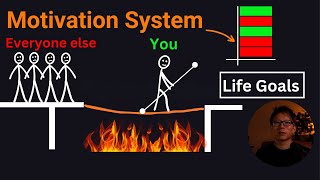
James Lim separates motivation into fast burn (intense but fleeting) and slow burn (deep, sustained). He explains why you need a stack of personal reasons to push through the action threshold, and when to use pain-based push versus pleasure-based pull motivators.
Chapters
But first we need to quickly clear something up. I'm going to talk about two types of motivation. One type, which I like to call fast burn motivation. And second type, slow burn motivation. I want you to imagine this fast burn motivation is like this. It's like burning paper. Burns bright, very flamy. Takes a big volume but fizzles out pretty quickly. And there's slow burn motivation. Like the coals. You get this deep glow in it, but you often don't see big fire around it. So let's talk about this fastburn motivation. It's powerful, like a surge. You fit that feeling. It makes you want to act in the moment. A sensation, but it's fleeting. It disappears as fast as it arrives. Slow burn motivation, it's resonant like a rumble deep inside you. It's a conscious, conscious a reason. It's your why. Anything to do with a deep reason why is really powerful. And that's what we kind of attribute to this slow burn motivation. It's not surge like it doesn't fade. It's like this background rumble. The problem is it is that background rumble, right? Often is not. It's there and constant, but it's not screaming at you. So how to use them? Fast burn, it's useful to instigate the good catalyst, but generally a bit of a troublemaker because it convinces you that you really want to do something. But it's only in the moment. Slow burn, it's the one you want to focus on. It's hidden, it's quiet. It takes mental effort and energy to cultivate it. Just like real coals, you actually have to take quite a lot of care and attention to get them lit. I've been there hundreds of times, struggling to light coals. Focus on the slow burn. Slow burn is the key. Light the coals. It takes effort to light. Use fast burn when available. Sometimes you can actually use fast burn to throw into the slow burn to flame it up. Back to the problem. So we're at this edge, right? And you're already questioning things. We need something to push us over the edge from a distance. Many reasons get you motivated to move closer. Imagine you've got a couple of reasons here. I'll make more money. And this is what you think it needs for you to take action. So you think these couple of reasons are enough. But what happens when you get closer to the edge? Everything changes. The amount of this like kind of desire to move, you need to actually move shifts upwards here, what I call the action threshold. But these are what the reasons that you came up with originally. So and so this is essentially what happens. So just, let's just picture him. I'm feeling energized. I'm excited. Fast burn motivation. You start realizing you don't want to do this. Your brain is kicking in and it's trying to save you from doing something silly or what it feels is dangerous. Even though you need to get to the other side. And those reasons are no longer enough. There's just not enough power. It's kind of like a car battery here. And we fall for the same trap time and time again. We get motivated away from the edge. And we get to the edge, we can't do it. There's just not enough power. So I don't know if you've ever heard this before. Like trying to start a car engine. Yeah, it's not starting. It's just not quite enough. That's what I want you to imagine. So what can we do? It needs a boost, right? Just like you would give a car engine, a car battery, a boost. Generic reasons often don't resonate deeply with, you know, with most of us, they're often what you should want to do, what others tell you to want. But these don't grip you at that core level. As a personal example, this is a funny one. My professional qualification, I was told I should do it and it would be good for me in some way. I really, really tried to convince myself, but it just really. I really struggled because there was no core motivation inside me. I just didn't want to do it. It was like it felt like pulling teeth out. Whatever it is, you need to have core motivation somewhere in there. Otherwise you will really struggle. So we need to find a way to get to this point, your jump point, what's actually needed. You need a motivation stack sufficient to move you at the jump point. It's no good thinking away from the edge. We need to think about that pain that we get at the jump point. And we need to stack the motivation factors to match that. They have to be personally meaningful reasons because those are the things that increase your motivation. So let's look at your slow burn motivation drivers. They're usually internal drivers. Deep, meaningful, and painful. Often they resonate to your core. Frustrations, irritations. They have to be deep here. They're often around something only you. You can feel, others don't. It matters to you and you alone. You might be wondering, why is there so much effort? Why are we doing so much work here when you can always seem to hit work deadlines that you don't even care about. It's actually different because they're external forces. You've got this deadline behind you and your boss screaming at you and this is what gets you across the other side. And then you fall. Deep, emotional and powerful motivators are usually present here. You might not realize it, but I'll just go through them. This is what you just have usually one big reason. If you let things go, you'll get fired. You lose your job. What does that mean? Lost reputation, no future work because it's going to affect your references. Therefore you've got no financial security. Therefore you have an inability to survive letting people down. So these are. So your brain has clocked all of this and again, threat to survival. So these are actually all slow burn motivators keeping you going. Many of them are kind of external, so it's much easier to move your boss, your client, stakeholders, business partners, friends, acquaintances, colleagues. But we're talking about our own projects, so it's different for our own lives. We have to create the force somehow. Why? A lot of the reasons that drive you are gone. Getting fired. Well, if you're working on your own project or your own side hustle or your own idea, you haven't even started yet. Lost reputation. You don't have a reputation yet because you haven't started no future work. Again, you haven't started. No financial security. Well, you don't rely on this inability to survive. You don't need to do this thing to survive. Letting people down. You've probably not told many people about it, so the reason suddenly dropped down here. So you can see we're again below this threshold. Okay, so next we'll go on to the carrot and the and the stick. It's about push and pull factors. Pleasure versus pain. Which should you choose. Bottom line, use whatever works for you. When do they work? So let's look at the positive, the pleasure, the pool side of things. Examples of motivation driving your actions. So sometimes if you're looking to go on holiday, I've just used a couple of examples here, just the kind of stereotypical ones. Looking to go on holiday. This is where you're motivated to do something fun and exciting. And so you'll spend your evenings and your weekends doing your itinerary for your holiday. Your work gets done early so that you can go home and sort out all of your plans, sort your travel insurance, all in your own time. Admin and project management. There's lots of work to go in there often, especially if you go for a big traveling trip. Your total motivation is quite high. So you'll go and do it. It's personal only you feel it. So if you tell some friends who don't, who are not interested in going on that type of holiday, they won't feel it right. And they'll be like, I can't believe you're doing all of that work. It matters to you, right? Attributes. It's a very well defined goal. There's a lot of clarity in what you're doing. There's usually a firm deadline, there's usually a date, 1st of March, immediate personal cost. If you don't do it and you've booked your holiday and you sorted out everything to make it work and you've paid for stuff. If you don't finish the organization, you can't go. So there's a feeling of, there's this loss aversion. Now in an ideal world it would be great if we could just use this positive fuel. But a lot of long term goals, they don't have these attributes. There's often no firm deadline because these are long term goals. There's no immediate personal cost because if you don't do it, nothing happens immediately. So going back to positive motivation, here are some of the typical drivers that a lot of people would talk about. So live the life you want. Having an aspirational life, a mission you really want to achieve the freedom it will give you, the reward you will get, the people you will help. Some personal examples. Do what I want, when I want. So build a life around what I care about most. Take control of my time, build something of my own and make money from it. Create my own environment, a safe haven. Be able to directly help people and see that and see the results. So yeah, this is a really personal thing and very, very positive. Sometimes it's not enough. You have to use whatever fuels you. The reality is that sometimes this is too much. It's much harder than you thought. Having that is not enough. This is when sometimes we need these push factors or negative. Some examples it might be stresses from work, arguments in relationships, just overwhelming amount of stuff to do and you want to get away from it. There's a need to get away. It's painful emotions, how you feel that should be not felt, how you feel physical. Sometimes you get, it's symptomatic. Now I used to suffer a lot with stress. I used to get some very, I used to get these things called ice pick headaches and it disappeared after I, after I left my job. Now I'll come to that later. Now Push, motivation, getting away. You want to be free of the pain you are in in some way, yeah. I needed to be out of my situation. It was just not. It was not for me. For other people it's fine, but not for me. The burden being lifted. The feeling of no longer having to deal with your current situation. I hear that a lot the people in environment you will have escaped. So if you're in a particularly toxic environment, you want to get out of it and no longer feeling trapped, how would that make you feel? And then you can start to look at the push versus pull. I remember this gut wrenching feeling every Sunday. Feeling really anxious and stressed about Monday morning. Just made my stomach turn. I'd be so sensitive to stress. I talked about the ice pick headaches. Dreamed of a life without this. Oh, it'd be so nice if I didn't have to deal with that. You gotta do whatever it takes now. Emotional resonance. We are driven by the emotions we experience. You really have to observe yourself. You need to see what drives you. I can't answer this for you because you know, I've seen this with, with people I've worked with. It's so different for every, every particular person. One thing drives someone really strongly and then the same driver has no impact on someone else. You must look into your past and see what has moved you. That's a good sign and something you can use to drive you going forward. We have a lot of friction to overcome at a jump point, so you will need it.
More from James




The mental system I ALWAYS use to transform myself. Warning: Simple, not easy.


Why you lost your confidence and how to get it back - Thrive and Decay: [Full training]



5 PAINFUL truths to improve your life (you're probably not ready to hear them)


Why you always feel conflicted when making important decisions [Three Monkey Framework]