How to make friends as an introvert - How I designed a way to make friends
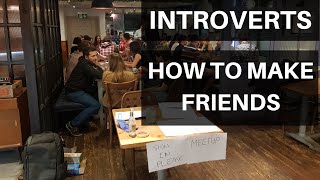
James Lim shares a method he designed to make friends as an introvert, called Project Friend, which takes about two months. He recommends finding people through shared-interest groups on Meetup.com, attending smaller knowledge-focused events, and reaching out to individuals afterward rather than trying to connect randomly.
Chapters
If you're an introvert and the thought of going out to make friends is overwhelming, you just don't know how to approach it. Or perhaps you've tried and failed. This video might just be for you. I'm an introvert and have struggled with these challenges for as long as I can remember, at least up until the last few years. At that point I decided to challenge myself and attempted to design a method that I could use as I had limited amounts of energy. In this video we'll discuss the problem and why it needs to be considered carefully. How your introversion can actually serve you, how to maximize your efforts of finding new friends, and actionable steps you can take. So I'm part of a few introvert communities, online Facebook groups, and in person. One topic that comes up time and again is is the difficulty in making friends. I often hear numerous suggestions ranging from just get out there or don't bother to why don't you joke with people in a supermarket? I literally can't think of anything worse. Or join random classes or start new hobbies. Now I think the problem needs to be broken down a bit. The typical approaches are generally ad hoc and quite opportunistic, all relying on random occurrences. This presents a few problems for introverts. In particular, you're generally not a fan of social situations where you can bump into a lot of people. You have limited energy to engage with people when you do meet them, and you're probably more picky about the types of people you will get on with. So focusing on a problem a bit more. It's all about probabilities and focusing your efforts and limited energy. I'm going to concentrate on this element because other guides talk about a general approach to to making friends and I think it misses a crucial point which helps you manage expectation that this is all based on probability. You will meet people in the right situation, but simply not connect with them. This is okay, but more about this later. Now, in any bunch of people, you're only ever going to connect with a tiny fraction of them. The probability of finding a friend is probably quite small, say 1 in 20, and that's kind of 5% or worse. Now you're an introvert, you have limited amounts of energy to engage with new people. Places known for groups of people, parties, clubs, networking events can be overwhelming, at least for me. You may have limited capacity to speak to people at these events. Say you only have energy to meet one new person a week. Well, to find a new friend that's going to take you nearly six months the problem is pretty clear. Just looking at the odds of finding friends based on this, it's not looking good. Add to the mix your introverted traits and the existing ways of meeting people, you have a bit of a problem. Now if you've got limited amounts of energy which say extroverts have a lot of, you can go buy these kind of random, random attempts at meeting people and simply by playing a numbers game you probably will connect with people. And so some people can find it easier to make friends. But if you're limited, well you need to focus down and that's the issue for say me and I definitely felt that being quite introverted myself. So I want to look at the introvert trait challenges. The first one is new environments can be overstimulating. Socialising takes a lot of energy and you have limited quantities. You're probably picky, you don't like small talk, you overthink situations. We also have some strengths and those are you're probably a good listener. People really appreciate that you connect well one on one and you consider things before you open your mouth, which some people fall foul of all the time. So from this we can start to figure out what we might need to do and design a solution. I'm all about design, as you may have seen from other videos. So I looked at ways to optimize my approach so I don't waste all my limited amounts of energy and get really disheartened when I don't find, when I don't find anyone. Start with common interests. There are actually numerous ways to meet people so I'm going to focus on a method. Know has definitely worked for me and I've spent years optimizing it for myself. So think about that 1 in 20 probability we talked about earlier. Well, this is based on a random selection of people. Improve your odds by finding shared interests. Say if you love reading and you find a book club about your favourite genre, you're more likely to find compatible people. If you do it the other way around, I. E. You attempt to form bonds with randoms, those bonds won't be strong and you or they will lose interest in keeping the relationship going eventually. Now this point is crucial and simply not talked about in other guides. Prolonged and broad attempts at making friends means poor probability. You will actually convert. This means you will soon deplete your social energy and we already know it's limited. And your motivation to keep searching will will be all but gone once you come to this realization. Now this has been absolutely true for me and many people I know I've got burnt out by looking, get quite disheartened when I come home without finding people. So don't believe the hype out there that just having a glance at a few ways to make friends that you'll get there. It's simply not like that. You have to put in a hell of a lot of work. Now remember you. You don't have to be knowledgeable in a subject to get involved, just genuinely be interested. I found people are incredibly welcoming if you can simply show that you would like to learn about what they're interested in. Also people with knowledge, they love sharing it, especially if they're passionate about it. And then you can go from there if you don't think you have any interest. Spend a few minutes with a pen and paper, see what you vaguely give a shit about. Or go in your Google History tab and see what you search for. Maybe not. Maybe not a good idea. Action make this a project. In fact, I called it Project Friend. If you want to maximize your chances, you have to treat it like you would a work project and apply proper focus and attention. So you can set aside a few months. So set aside two months to work on Project Friend. Attending or connecting with people and events. Don't make it indefinite for now at least because you will get lazy about it. You will have to push yourself out of your comfort zone and you will have times when you go and you won't connect with anyone. But this is okay. Remember you are playing a numbers game as well. So key points. Find groups of people that share interests. Connect with those groups in person or online. Reach out to individuals who you get on with a bit better than others. And you always feel that. Think of this as a project for two months. So we're going to talk about some like simple action steps, a suggested kind of linear set of instructions. You can swap different tools depending on what you like to use in terms of platforms. Facebook, Twitter. Meetup. So this is based on my experience and a method I know has worked for hundreds of people, many of whom I have communicated with directly. Number one, we're going to use Meetup. Go to meetup.com search and join groups that interest you. There are loads of groups out there. Then sign up to an event. Third, go to the event. Now let's get real for a minute. The third point, going to the event, that's bloody hard, especially for introverts. I've been there. When I went to my first meetup, I got to the front door and turned around because I was so anxious about meeting new people, I couldn't face it. I had to walk around the block before returning and luckily bumping into someone who looked as petrified as I did in this kind of narrow staircase. I plucked the courage up to ask him if he by chance was looking for the meetup and he said yes. We walked over together to the group and the rest is history. Anyway, more on that story in another video. Since then I have been to hundreds of meetups over the last few years and I now run multiple events for different groups, including an introvert group. If you're interested in finding out my experience with meetup events, drop a comment below and click the subscribe button to keep up to date, as I'll be posting some videos on my experiences soon, particularly one about running an introvert meetup so it's aimed at introverts. Here's a few tips and pointers if available. Pick an event that has an actual knowledge theme, a talk or presentation, or something you're interested in. You might not have ever tried it, but it does pique your interest. Find groups that you think are are likely to attract other introverts. This is the friendliest environment and it's definitely been the case in my experience. If you can find a friend to go with you, take them, force them if you have to. It will reduce your anxiety loads and then you can try going yourself in the future. If you do go by yourself, post in the comments of the meetup to see if anyone else is new. You can often do a first timer pre meetup meetup 30 minutes before an event start. There are others out there just like you and this works really really well. It works well for some of the groups I run. The next point is all about making this easy. Take baby steps. Don't listen to your friends who say just do it and go to the and jump in and head to big networking events so far out of your comfort zone that you'll feel overwhelmed with the whole thing. That will result in you leaving feeling pretty despondent and hopeless. This is a real problem and you may have experienced it already. Now, if you've never run a marathon or perhaps you're not even a runner, it's probably not the wisest idea to adopt a marathon runners current training regime. You'd probably do some damage and at least not want to go training again. You start with a beginner's running program or similar. You should approach this whole process with the same care. Use your judgment with this whole process. Unfortunately that's a lot easier said than done go and actually try these things. That's it for this video. Drop a comment below. And if you're interested in learning other real and practical methods to help find your way in life and improve your life, click on the subscribe button and hit the notification bell as I'll be releasing a lot of new content over the next few weeks. See you next time.
More from James




The mental system I ALWAYS use to transform myself. Warning: Simple, not easy.


Why you lost your confidence and how to get it back - Thrive and Decay: [Full training]



5 PAINFUL truths to improve your life (you're probably not ready to hear them)


Why you always feel conflicted when making important decisions [Three Monkey Framework]