How to set a goal without sabotaging it (Full system)
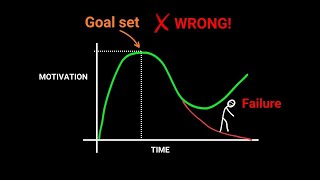
James Lim explains why ambitious goals fail: fast-burn motivation makes you set too high, then the pain curve hits and you quit. His fix is a window with an upper limit (your dream) and a lower limit so easy it's almost nothing, so you keep going when motivation crashes. Adjust both over three to five rounds.
Chapters
How to build plans that can't be derailed. Okay, why your plans fail and how to build resilient plans. This is all about brittle plans. How we create these amazing plans on paper, but at the first sign of turbulence, it just shatters and then you just end up giving up. How many times does it happen to you? What's the problems here? We struggle to stay consistent. When you execute, something throws you off your plans and you end up stopping. You shatter your own plans, you get overwhelmed by your own expectations and you have these repeated boom and bust cycles. Create a plan, it shatters, you give up, and then you wait a few months and then you start the whole cycle again. Common mistakes. I see getting excited at the start and making a big grand plan that you can't deliver on. Making plans look pretty and nice again on paper and over complicating it. Not anticipating a change in your motivation level, making the plan way harder than you can manage, and not anticipating life curveballs that will always come for you and always hit you. So the objectives here, we want bulletproof consistency over the long term. Want to be able to manage life's curveballs and still maintain progress because they're always going to come. So we need to be prepared, learn how to be compassionate to yourself in a practical way and give you a tool that will always give you forward momentum no matter what's happening in your life. Okay, remember this from very early on. We want to get across to the other side. At this point, you're pretty excited and highly motivated to get things going. This can be plotted on a graph. Your motivation shoots up here, so you're up here. And then you say to yourself, I'm going to achieve all the things. So when we are at peak motivation, this is where we set our goals. But then it starts to fade and we end up with this kind of curve here. I call the motivation curve. Now this just a side note, this is the fast burn type of motivation. It's that fleeting feeling. It's not the kind of underlying one we're talking about. So it comes and goes in waves just like this. It's only natural that this happens, but it is a bit of a trap. And this is what I talked about very early in the types of motivation that the Fastburgh motivation causes trouble. It's a fast track to unnecessary failure because you are setting goals with the highest expectations and it's not the average, it's not that, it's not how your motivation levels are going to be over the long term. Adding to the fact that you probably want quick results. So you say here, where we set your goals, I'm excited, want quick results. And you feel driven and motivated. You don't see the inevitable drop coming here. And so you fall, you put yourself up, and then you. And then this is where you give up and you walk away. Now, unfortunately, this is not the end of the story. There's a second component to this, what I call the pain curve. So you come up with the idea. Now you want you to imagine that the other graph is still taking place here. You come up with the idea and you say, again, same thing. I'm going to achieve all the things, high expectations. But here you haven't experienced any pain because you've not really started yet. Do you remember this coming back to this? All the goals, this is where you set things up. So you've got all of these goals that you set up now and you feel very excited, but your pain level is very low. So you begin and what happens? Oh, wow, this is pretty hard. And you feel the struggle. It starts to increase pretty rapidly, exponentially. Even discomfort rapidly rises. And now you're here. Now you're here. You've got max pain. This is where you've been going for a few weeks. Let's say a good example would be working out. This is where you've been going for, say, three or four weeks. Your body is aching so much you can hardly walk. You've got muscle soreness everywhere. Maybe you've even kind of strained some muscles as well. And you're here. You now feel pretty exhausted. You're exhausted when you're walking around. Also, you've probably not seen many results yet. You start to doubt yourself because you're feeling exhausted. You're wondering, how am I going to keep this all up? Now what happens is, typically adaptation occurs at some point and you start getting used to it. But the reality is people give up at this point. At the max pain. They don't. They don't persist past this point and they never get to experience it. So you end up falling. Now, if you combine two, the pain curve and the motivation curve, you end up with this. At this point, your motivation has faded away and your pain is at the max. This difference here is how much kind of willpower, effort and discipline you need to keep it going. And a lot of people just can't take it. It's too much. Now, even the strongest people, what happens is people who are really, who are still quite resilient, well, they just set bigger goals up here, which makes the Pain higher and then eventually it breaks them. And so they end up just giving up at some point here. So I see a lot of people at some point, some people who break really early, some people break later, but eventually they are breaking from their own plans. The problem is the plan itself. So people say, here, I get to here. This is so much harder than I thought. You expect too much from yourself. Plans are harder than you anticipated. Why do I keep making the same mistake here? You say I need to get there quick, but that idea makes you're making your pain curve even worse. If I take small steps, it's not really progress. Motivation curve tricks you into setting goals beyond your capability, as does the feeling of lost time. And the pain curve is often forgotten. So you, you get this, so you get the pain curve. You come up here and then you fall at max pain. And here your motivation fades and then you drop off and then you give up here. So it's actually quite likely that you're going to fail. So how can we get around this? Here's a solution. So I call upper and lower limits. This is a client favorite concept especially it works very well at the beginning. So what happens is over time we set your goal and we have an arbitrary. We define this as fairly high difficulty. Because of your motivation cycle, we immediately label as an upper limit. It's easy, it's intuitive. As soon as you state your goal, assume now it is your upper limit. We've got something called a lower limit here. What is this? This is something that, hold on, takes thought and it's challenging to decide. It must be higher than zero. So you've got to be doing something, but it must be very easy to do. So once you really think about this, this is where, this is where all the action is. So most people just work with the goal side. There's no room, there's no buffer. So we're creating this other one here. Now we have an upper and lower limit. This is what we create, a window of operation. So when you're motivated, you can go for your upper goal. But when, yes, when you're energized and excited, go for it. But when your motivation fades, we can lean on our lower limit. You might be feeling exhausted or you need some more rest. So what about without a lower limit, when your motivation fades, you've got nowhere to go. Right? There's nowhere else to go. You're just going to fail this because this is the only objective that you got. You end up with exhaustion, burnout, and then failure of the plan. Just to help you visualize this, I want you to imagine a steam train to get the fire going. You throw fuel into the fire and it will get strong and bright, but you must keep adding fuel to keep the train going. It's easy. When you're motivated, you're fresh, you know, you've not been lugging any fuel so far, so you just keep chucking it in. Very easy. And if something happens on the train, right, one of the carriages, you hear an emergency, so you have to go and attend it, but only you on the train. So you've got to keep the fire lit and you've also got to address what's going on in one of the carriages. You're distracted from the fire. If the fire goes out, the train's going to stop and then you have to start over. Now, usually things like getting fire started is very difficult, very energy intensive, very inefficient, and the train's not moving, so the train is now stationary. That is no progress. And now you've got to do a cold start, which is usually very tiring, very demotivating. Your lower limit is there to keep the fire going. What are we talking about here? We're saying, is there something you can do to maybe before you go and tend to the carriage, throw one shovel of fuel into it, but do that every 15 minutes or half an hour rather than chucking it in every minute to keep the fire going, go and address the carriage and then you return back and do another shovel or fuel. Why is this important? It allows you. It keeps the train moving so you keep seeing progress. It's easier to maintain something that way. This is motivating and adds to the confidence because you see, the train doesn't stop. It's. Even with stuff going on in the other carriages, fires are always hard to relight and they consume a lot of energy. Now, what we're talking about here is emotional energy. When you try and get things started again, your own projects, it consumes a lot. Just to pull this into practice, example, going to the gym or working out. So you say, I want to go four times a week. Assume that is your upper limit immediately, because it probably is because you're excited. We plot it up here. This becomes your upper limit. Then we say, what is your lower limit? Now this is where it requires a little bit of thought. What represents progress and feels easy. It's a hard one to get right. But you might say twice a week or perhaps once a week, you decide. But remember, the objective is not to let the fire Go out. So rather than going from four times a week to zero and then giving up on your plan, can you create a lower limit you can still hit even with stuff going on in your life, it will take a bit of practice. And here's some tips for setting upper and lower limits. The upper limit is designed to be aspirational and quite exciting. And it's usually the one that you come up with intuitively, so you don't need to think about it. But your lower limit is the one you need to think about. It must be easy and not overwhelming. And the reason it's difficult to think about is your desire for instant gratification and to see results won't allow you to think about a lower limit because that usually feels like you're not making much progress. But this is how you make it resilient and keep the fire lit much more important. So now if you want to think about what would make a good upper limit and what would make a good lower limit, if you were to set this out over the next four weeks, you might say going to the gym four times a week, how confident are you that you can actually do it? You want to be around a 3 to 5 out of 10 for that. In your lower limit, your confidence should be very, very high. 9.5 out of 10 here. So to go once a week, surely you can manage that. If that's the case now, it could be once every two weeks or something like that, it doesn't matter. But you have to find your particular limit. What happens over time, this is what happens. It doesn't stay static. They both tend to increase. When I came up with this concept for myself, I saw it happen with me. I had to train once a week. My upper limit might be twice a week. My lower limit would be once a week. Then eventually my lower limit became twice a week. Upper limit was now three times a week. And, and I'd slowly add days over the years. And so you often find your lower limit eventually becomes your upper limit benefits. So why do we do this? It allows you to change gear when needed. When you've, when you're motivated and you've got capacity to do it, push for your upper limit. Then you'll make loads of progress. But when you're pushed, when your back's against the wall, maybe you're exhausted, you're tired, you're stressed, something's come up in life. You have somewhere to go towards your lower limit where you have still defined, you're still making progress. And this also, there's Another side benefit here, that it actually makes you more aware of your capabilities because you're now thinking, no longer in binary, you're thinking more fluid, you're thinking, huh, this level of exhaustion means I can go this amount towards my upper limit. And when I'm very exhausted now, I have to really lean on my lower limit. And maybe next week I need to lower my lower limit. That's actually quite a common thing I see with people. I'll talk about that shortly. And it inspires confidence because you start seeing yourself. This helps you show up. It helps you show up more regularly and in more situations. Questions to ask yourself, Are you in a high motivation state when setting goals? Most people are, I am for sure. I totally admit that. How unrealistic are the goals you usually set for yourself in the past? How long does it take for the motivation dip and pain peak to happen for you? Well, you know, does it often take one or two weeks? For me it's about a couple of weeks. Think about possible lower limit goals for previous goals. What could you have done? So when you fail this in the past, last time you tried to run, say intermittent fasting, or you tried to go to the gym every day, what could you have changed about that to create a lower limit instead? A lot of people I see would maybe try and go to the gym five, six times a week. And when they don't hit that, they have one week where they had a lot of stressful work to do and they only manage to go twice a week or three times a week and they think, ah, you know what, my plans, my plan's not worked, maybe I'll restart this in two months instead of that. What could you have assigned your lower limit? It might be two weeks, two times a week. Now you've got a limit. So those, those times when you were really stressed, you're still within your window of operation and you still could have hit those twice a week, that twice a week target. Are your upper limit goals usually very lofty? So key points here, we unintentionally make very brittle plans and this is due to the motivation curve. Because we're so motivated, we end up having these very high expectations and no, nothing below. So all we can do is fail from these very high expectations. We set goals at peak motivations unrealistic for our capacity. We are blind to the motivation dip we experience and so we give up. We have a bit of amnesia here. So after that peak motivation, it dips and we often blame ourselves rather than just a very natural tendency for Motivation to dip. And this is why I said fast burn. Motivation is a troublemaker. The pain curve is delayed. We feel pain after starting. Pain is proportional to the expectation. So if you sign yourself up for six days a week for the gym and you've not been to the gym for a long time, if you do, if you complete one successful week, the amount of pain you're going to be experiencing will be very high. And that's what I mean there we crash when at the peak pain. So usually people's bodies are so sore after six days straight of going to the gym, they're like, I can't. My body can't do this. Well, because you've never been to the gym before, you probably can't. Combined motivation and pain curve causes us to give up. It breaks so many people, it's unreal. I see hundreds of people and they have created these brittle plans that were nearly always going to fail. And, and they had no, no flexibility within them. So of course there's only one way the plan can work and about a thousand ways the plan won't work. This allows you. This window of operation changes, flips it completely on its head. There are now so many ways it could work and there are much fewer ways it won't work. Now, of course, you can actually create a lower limit that is so close to zero that it becomes incredibly difficult to fade, you know, for it not to work. An example I had with a client was they needed to get some steps in the day, so exercise. They were really struggling with their weight and exercise and had lots of joint problems. So we were looking at a way to get them out and mobile. They had aspirations to do miles of walking every day. Clearly that was an upper limit way, way, way beyond what they should be doing. So what we did was to create a lower limit, which was just one to two minutes of walking outside the door just for, yeah, just for that period of time and come back. It became very difficult for, for, for her to not be able to achieve that. And then we were able to slowly pull this, pull this chart up. Upper and lower limits accommodates the, the psychological discrepancy there, this bias to create goals that are very high on expectation. The upper limit accounts for that. Completely convert your initial guess to an upper limit. Then think about what your lower limit can be and you want to be just above zero. Upper limit is your intuitive goal. Lower limit is a smaller step. Your lower limit takes a lot of thought. Our instincts try to overstate it. So it's not hard because it Takes a lot to calculate. It's hard because we have a tendency not to lower it enough. But your lower limit is the glue to the whole thing, the long term achievement of your goal. And it reduces overwhelm because you wake up and you're saying, you know what? I feel awful. I'm going through a bad period, but I can manage two minutes a day, you know, two minutes a day. Like a train. Avoid the fire going out because it's an ordeal to restart and a lot of work. Remember your confidence levels. Your upper limit is about 3 to 5 out of 10. Your lower limit should be so. You should be so confident at it. Nine and a half out of ten. Now, if you're struggling with confidence, all you have to do is just lower what that expectation is. So like I said, if you know, we were looking at walking miles as an upper limit, the first lower limit might have been to be walking for half an hour or 45 minutes. No, we went way, way, way lower. Single digits, just walking around the block. And I'm so confident in this that, that we can lower it that much because I know we can start improving it. If as soon as we get that traction point on the graph of exposure, we can start improving it over time, the window of operation will gradually increase. So please do watch out for these traps. What to do? Number one, State your goal. Define your first objective. This is immediately is your upper limit. Three, define your lower limit greater than zero, make it easy. Four, execute it and then see what happens. Five, Modify if needed. Often your lower limit is not lower, is not low enough. So you often need to nudge it down a bit more. That's okay. Worksheets. So I've got some great worksheets for this. I've used variations of this with lots of clients. So this will take you through the process of how to build up your upper and lower limits. And I'll also give you some trackers as well so you can set your upper limits and lower limits and tick them off. I've had lots of clients use this. I've also got PDFs that you can print out and stick up on your wall if you want. Or if you want to stay digital, you can, you can click these and so you can say, okay, my upper limit is number of steps in a day. So your upper limit might be 10,000 and your lower limit could be 3,000. Are you making those steps and you can just tick them off and see? And then after the week you can see, huh, I see. I wasn't able to hit my upper limit. I only hit my upper limit twice this week. See. Oh, that's why it's so hard. And I've got some examples here of ones you can use. So client stats and observations. Nearly every client sets lower limits too high when they first try it. Expectations tend to take time to recalibrate internally. I'm really used to this when I work with clients. I straight away I can see their lower limit is clearly not low enough. But we usually try it so that they can learn. So I want you to try that as well. That's why I said step five is to modify if needed. It takes an average three to five iterations to get your lower limit accurate. I would say the people who are more open to this as a concept are much quicker at getting their lower limit right. People who have had a habit of setting very high expectations of themselves and really struggle to let that idea go, they take a longer period of time to get that right. So try and be open to this. Remember, it's not a problem if you set your lower limit too low because you can always work to your upper limit. If you set your lower limit low. We can just recalibrate it after, after a week and then keep, keep tightening it and then, and then, and then raising it. What we don't want is to find out that you really can't, you can't triangulate where your lower limit is. You can't figure out where it is. It's more important to find out where it is when your lower limit is locked in. We see very fast progress and it's. As a coach, it's really easy for me then to see because I can then bump it up and I can make suggestions. You will have to do that yourself if you're, if you're working this through on your own. The tendency to operate toward lower limit than toward upper limit. Yeah. What we mean here is I noticed people ended up needing to lean on a lower limit far more over time. Usually in the first one week or two weeks it's a bit easier to get quite, quite a good, average in between it. But over time, people get exhausted, people get tired. Life curveballs hit you and you have to, you have to, you're forced to lean on your lower limit. Original upper limit becomes lower limit in around four to six weeks. If we do this right, this is what we see, which is such a cool thing I've seen this with, particularly for working out reading. So people need to study or they need to read. We start with, it might be 10 minutes of reading. So someone who's really struggling with reading. 10 minutes of reading is upper limit. Lower limit is 2 minutes. After a few weeks, the lower limit is now 10 minutes. Upper limit is 30 minutes and so on. And then eventually we can get to a point where lower limit is now 30 minutes. So easy for them. And upper limit is, you know, 90 minutes, like one to two hours. Personal observations. I still sometimes miscalculate my lower limit. I must. I will be truthful here. I still do it. I still get excited. So again, this is why I use these concepts on myself, because I still need them. Sometimes I would get really excited about a new hobby or a new activity, and I will think, huh, yeah, I can definitely manage that a few times a week. And I try it. So I can't do that. I don't have enough time or I'm too tired. So I always think, okay, James, come on, think. That is your upper limit. I know you want to do it. You know you're excited. But that is now you relabeled that as your upper limit. Recalculate your lower limit. I always had this thing I called new thing, naivety. It really is a thing. It's okay, but you must be quick to adapt to it. Anticipate at least five iterations before your lower limit is locked in. It helps a lot. I don't need this so much now. It's like two to three times. Hang in there. Sticking to your lower limit. It will pay off more than you can. Oh, what's the one? So here you realize it is always a pleasant surprise when upper limit turns into a lower limit. This is so cool. I mean, I see it for myself a lot. And it's amazing to see when clients do it where we are. Okay, we've now got upper and lower limits. These are real, practical, practical actions that you can implement now. Okay. It allows you to not get overwhelmed and allows you to keep going no matter what is being thrown at you. So, language, brittle plans. Yeah, stop making brittle plans. Turn them into iron motivation curves. Think about that curve. It goes up steep, and then it. And then it slides down. Peak motivation pain curve. Upper and lower limits. I really. Sometimes when I speak to clients, I will say, what are your up and lower limits? Yeah. And they. Or they will report back to me. Upper limit is this. This week. Lower limit is this. And that becomes a vocabulary that we constantly using. Window of operation. Sometimes when, if a client is going through a bad, like a very tough work period, we'll say, okay, we need to widen your window operation. Make sure you've got very, very comfortable lower limits here because. And you know they will report back. I think I need some lower limits. Can you, can you cross check them for me? So here, upper limits, five times a week, lower limit once a week, balancing on the rope. I'm going to give it a try once a week. Maybe you do it two times a week or three times a week, it doesn't matter. You've now got a window where you can be successful. As long as you're within once, one or five times, you're good. A real side note here. Once I learned to play golf, this is another story for another time. It was trying to impress my corporate or trying to further myself in the corporate game. When I first graduated, anyway, I had a coach and he told me, he was like, don't try and get it in the hole. Imagine a trash bin lid or a dustbin lid. This big. Really, really. Well, okay, much. But you can only see me here. Really big. The goal is if you get it in the hole, aim for the hole. But the goal is just to get it somewhere inside that circle. I always remember that because that isn't. That is a version of upper and lower limit. It was your lower limit to get it somewhere in that circle. You get it in there, you're winning. And that really helped me out. It was very, when I think about it now, quite transformational. Next up, making simple rules. This is vital for you to execute. Well, see you in the next one.
More from James




The mental system I ALWAYS use to transform myself. Warning: Simple, not easy.


Why you lost your confidence and how to get it back - Thrive and Decay: [Full training]



5 PAINFUL truths to improve your life (you're probably not ready to hear them)


Why you always feel conflicted when making important decisions [Three Monkey Framework]