How to stop making EXCUSES when working on your goals
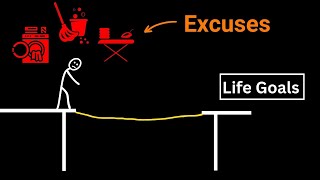
James Lim explains why you make excuses when fear peaks on hard tasks, and how to beat them. Write down your common excuses, create three counter-arguments tied to who you want to be, and rehearse them before you hit that moment. A client named Mark used this to stick to lunchtime workouts and training he'd been avoiding.
Chapters
How to stop making those last minute excuses. The escape artist. What do all of these have in common? These people have in common have a think they have the ability to escape seemingly impossible situations. So we look at, you know, we watch with wonder and we're like, yeah, I can't see how they can get out. But they always do. And they, and they always have a bit of a plan. They know how to do this. This is like us. The threat to survival is drives a need to escape. So these people who are with imminent death chained underwater need to get out. We want out. So our brain signals pain. We are also chained because when you're trying to do something really difficult, it's the same thing. And you're shuffling a little stick man all the way to the edge. We'll do anything to get out, to get away from it. We'll use all known tactics to evade capture. Don't underestimate the level of sophistication your brain will go to to get you out of this. At the jump point, your unconscious has the advantage and your brain becomes a mess and you forget you end up in this really vulnerable scenario because emotions start flooding out and it's like your brain can see you keeling over and it will pounce. And that's when these excuses come into play. Why do we make excuses? You might think it's obvious, but we need to really understand this to give us some tools to fight against it. We experience peak fear at the edge. The jump point. Anticipation of the pain, usually emotional, is imminent. Your brain is just desperate to get, is desperate to get out and it will do whatever it takes. It's simply trying to survive by design. And we've talked about this multiple times throughout the course. When you approach the edge, danger is imminent and the anticipation of pain is present. So this is you, your legs are over the edge. There's, it's like the neck. There's no more mini steps to do other than doing it. Fear of failure, unclear of what to do, lots to do, doubts, everything comes in. This is where you're experiencing maximum emotional pain. And so our brain says we're getting out of here, we can't do this. So it will do whatever it takes. How many of you end up saying this? I need to clean the house. Next minute. You know your whole home is spotless. Even if you don't like cleaning. This is a survival mechanism functioning correctly. This is not some kind of bug. This is a feature. Your mind protects you from perceived danger, discomfort and unease. This emotional response is normal. Our Brain is simply trying to get you away from things that are uncomfortable. Hopefully you've seen that as a theme here. Here we know ourselves best. And when you're at this point where the only thing next to do is expose yourself to pain, we know precisely what to do to avoid jumping. So typical excuses you come up with every time I need to clean that, I need to clean the house, I need to go and do these chores, I need to go shopping, plus poor responses to defend yourself to keep you going equals a win for the excuse. So you can only imagine there's kind of two teams playing here. There's the excuse team, the team trying to get you out of it and the team trying to get you to do the thing. Now I'll talk about a quick example just to demonstrate this. We'll talk about a client I call Mark wanted to work out, go to the gym and work on his career progression training. So he had lots of training modules that he had to do in the internal corporate system. But he made excuses every day, set a plan, but constantly evaded it, especially things like working out during lunchtimes. And he was frustrated because no matter the plan he'd simple, he'd simply wriggle out of it every time. This is a fairly common one. This one was just really burnt in my memory because we had to do a lot of work. He was a professional escape artist getting out of the things and he really struggled to understand why he would essentially self sabotage. But when you link it to what the brain is trying to, trying to do, it should start making a bit more sense. Now we were able to turn him around but we'll return to Mark's problem, how we solved it shortly. So we just need to go through a few concepts here revealing the illusion. So like a magic trick, when we know the illusion, it loses its effectiveness pretty quickly. So like, oh, is that how it was done? It's always the same tricks, the same misdirections. If you, if you look at how they reveal illusions, another magician would see it and ah, they're doing it that way. Yeah, it's like standard practices. If we know where to look, we can see what they do and we have a chance to catch or neutralize the trick before it has a chance to work. So it's the same thing with pickpocketing. If you, if you know what systems they use to trick you, you can beat them to it to our advantage. The same excuses always show up, they rely on the same systems and there are not that many systems. The excuses are fairly weak. The only reason it gets used because you're not, because you're not prepared for it. And it relies on an absence of any counters because you're so vulnerable in that moment. So building a system to neutralize. We need a clear and precise counter argument. So when the excuse comes, we must have a clear and concise. So a clear and precise counter argument. And we want it to align with our long term identity. The person you want to become. In an ideal world, you really want to have a few counters versus the excuse. And there is a good reason here. Because we struggle to hear the rational side of our own mind at the edge. Because nearly any excuse which is survival based, right, which is aligned with where your brain wants to go, which is the familiar. We need very good reasons to keep you pushing forward. The team who are pushing forward now, you must build this and come up with this stuff away from the edge during the strategy session you're doing with the strategist. Not when the performer is at the edge. You can't be building this stuff then remember they don't have much capacity. So a clear and precise counter argument, no ambiguity. You cannot have any ambiguity. There has to be a clear benefit in doing this. Always use previous patterns as evidence. I'll explain this shortly. Just be warned, your unconscious will try and pick apart every excuse. You've probably seen this happen. I'll go through some examples shortly. Alignment with long term identity. Whenever you come up with a counter versus the excuse, you have to align it with the person you wish to become. And you have to be quite again, quite specific with this important narrative. Staying will reinforce your old identity. So if you keep skipping your workout sessions, say during your lunch break, you are, every time you do that, you are reinforcing your old identity that you're desperately trying to get away from. That's a very, very simple rule of thumb to remind yourself every time you do that, you're not only being passive, you're actively reinforcing this old identity. Identity is built from the repeated practice of if you want to be a new person here, you must practice these new behaviors. Now. Counter stacking, short term pain avoidance excuses. So coming back to the reason why we need multiple counters versus excuse is because if your brain can avoid any pain now that is a big win for your brain. And so it weighs it, we can just say three times as powerful. So we need multiple strong counters. Now I do this all the time for myself. It's quite frustrating that you have to come up, you have to have very Strong, strong reasons at the front of your mind to overpower these excuses. Different day, different mood, you need different counters. Some day it's about the person you wish to be. Other days it's, it's an immediate consequence. The one I use with cold showers is one, the discipline of doing it, my long term identity. And in the very short term it is the dopamine that I will receive and the alertness I will get to be able to work on what I'm working on in the morning as a result of the, the cold exposure. And I remind myself as I'm about to flip, flip the lever, some examples working out. So here's the excuse. And then we got three counters here. This was done with a, with a real client. I don't have enough time. The time you spend scrolling on your phone is plenty. Exercise session only takes 20 minutes and you'll feel great. You always do. That has happened historically. And three, you want to be the type of person who take, who makes time for exercise. Some people think, you know, this, this definitely works with some people. It may, it may not work for, for everyone. And I've, I've had feedback around this that it's kind of, it's kind of obvious. So why aren't I doing it? Well, a big thing is the lack of articulation. Again, this, you're now in the strategist mindset. You know, you're sitting here watching the course. You're not, you're not in the state of mind where you're emotionally flooded. So this kind of thing can feel obvious. You actually need to have this rehearsed when you're experiencing those emotions. And that's why you need to have this stuff either written down or rehearsed in your mind. Next excuse. I don't feel like it and I'm not motivated. You rarely feel like it. Be the person who goes. Despite this feeling, every time you've shown up, you've always felt more motivated after. Regular exercise will help you sleep better and give you more energy. Yeah, this was actually a client's own words. Client Mark. This was his own, his own version of it. This was all about going to the gym during the lunch break. So you can see I need this time to continually to continue my work and finish my pending emails. If I don't work in this hour, I will not be ready for my evening calls. So that's the excuse that he had and we discussed this and so you can see his counters there. 90% of the time. You use this hour to watch television. Or eat and so on. So you can see that he wrote this and it was very difficult because we had to pick apart what excuses he was coming up with. Then we had to work through these counters. Now, these were very specific to him and his situation, but we were eventually to. We were eventually able to get through it. This is not binary, right? It's always a spectrum. And it's to what extent the excuse works and what extent the counters work. The counters will just help you nudge your way up such that the excuse has. You have more chance of overriding the excuse. And was it then one day you will say the counter and then you'll go, okay, I'm just gonna do it. So it's often not binary. You start sliding up and down the spectrum. So the more work you put on the counters, the more power it has. I mean, I see this nearly every day still with this, with this, with this horrid cold shower. I still have to say these, these counters nearly on a daily basis. I really dislike this cold shower thing. So, yeah, we had to neutralize excuses. They will always be unique to you or often won't make sense to others. It depends on what you value. Now, this is always quite interesting. The more it doesn't make sense to others, the better because it means it's really tailored to you and who you are and what you're dealing with. Now, this was a struggle for Mark. I remember going through this. This was a couple of years ago. It was. It was very tough. But we eventually cracked it when he was able to start staying a lot more consistent. So questions to ask yourself. What do you want to do and why? Why? Sorry? What are your most common excuses? Which excuses have the greatest impact on you? What counters can you generate for each of the excuses? So here's what to do. Remind yourself what you are trying to do and why. You really have to be clear about this. Again, has been another theme, really clear on what you're doing and why. If you really don't know why you're doing what you're doing, you'll have so little staying power it's nearly not worth doing. 2. What excuses do you use? Articulate this on paper, actually say it, write it down and go through it. You'll see. Remember, this is like what it is like watching an escape artist trying to get out or a pickpocketer taking stuff from people. You watch the video feedback and then you start articulating how they are doing it, exactly what steps they're doing. Why? Because it gives you a Chance to build defense against it in the future. And it's exactly what we're doing here. Three, respond with counter arguments for the excuse. Four, attempt the counters next time it happens. Five, update as new excuses come in. So as a new excuse come in, you just follow the same process, the same thing would happen with, let's say you, you know lots of these films with bank robberies. You watch how they do it, you see how they got in and how they took the money. Then you can come up with, you watch the playback, you articulate their process, how they found a vulnerability in the bank, and then you develop new systems to defend against it. It's the same thing here. A lot of people, you know, one of the reasons people have these really again, grand plans, brittle plans on paper. But don't do the tedious work like this to understand what happens on the ground. Key points. Excuses are a totally natural, natural defense mechanism. Your brain is just desperate to. Desperate to escape. Just like the escape artists. Your brain knows you. It is you. Excuses will be incredibly convincing. This is a, this is why it's so difficult. I have had, there's only been a handful of clients where we've not had to deal with this and I've worked with hundreds. So it shows how much of a problem this is. And plus I have this problem myself. So I'm always having to build defenses. I'll mention something else, I'm not sure if I mentioned it here. It is a bit like who's outsmarting who? When one, when the, say cops and robbers, when the robbers outwit the cops, the cops upgrade their defenses. Then the robbers outwit the new cop, the new strat, the new defense, and so on. Or like hacking the same thing. They look for an exploit, the people defending will then patch up that exploit. Then the hackers will find a new loophole, and so on. So the problem is this is happening in your own mind. So you're having this, you're having this fight internally and that's why it's a never ending cycle. So you have to learn this. You're always having to look for ways to patch, just like software is always being patched up. You have to keep patching your excuses because your ability to make new excuses gets more advanced the more it's patched up. Anyway. Articulate excuses and generate counters. Three counters, ideal per excuse. Do away. Sorry, do. Do this away from the edge where you have clarity. So we want to do this in the kind of strategy room, what we call the strategist position. Don't, please avoid this at the performer place when you're coming up with ways to defend. Remember the performer point. By the time you're at the performance stage, you're going to be too vulnerable. You won't be able to counter it. Combine this with a simple rule to help you move. Despite the excuse I was going to say something there, it'll come back to me, right? Worksheets and cheat sheets. Okay, this is a way to get through it. So the cheat sheets are pretty useful here because you'll see a collection of the common excuses I have heard from clients and the ones we've actually had to work through. I've only put a sample here, but in the Live Word document I will be adding more and more to these. Again, the worksheet, you just need to fill it in and it will take you through the thought process as well. Just like the strategist performer with the performer side. This is your strategist, me being the strategist for you here, passing you the worksheet so you can just fill it in and you can just go through each step and eventually you'll have a set of instructions for yourself that you can use. Okay, some client stats and observations.
More from James




The mental system I ALWAYS use to transform myself. Warning: Simple, not easy.


Why you lost your confidence and how to get it back - Thrive and Decay: [Full training]



5 PAINFUL truths to improve your life (you're probably not ready to hear them)


Why you always feel conflicted when making important decisions [Three Monkey Framework]