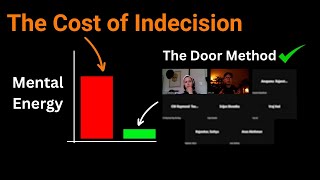
Decision fatigue drains you more than committing to a choice. Once you pick a door and act, you get feedback and momentum that stalling never gives you. Doing something, even imperfectly, teaches you more than waiting.
Chapters
I'm really heavily focused on energy. Right. Emotional and your work energy too, because it's really expensive in your, in your mind. If you are not sure about what to do, your brain goes to. It can go to 100% and you can feel your body just burning fuel just in the indecision. It's just going backwards and forwards. You really don't want to be in that situation much at all. If you are in that, you need to have. Well, you need to try and find ways to get off that. I will, I will kind of start sharing some systems around that because it's so expensive. Once you can find the direction, that indecision bit is about twice. Consumes twice the amount of fuel as doing the thing. So here's a classic example. It's choosing door A or B. Right. Standing at. At the junction between door A and B will cost you, let's say, 10 units of energy. Yeah. If you go through door A and you find out there's a dead end at the end, you could come back often and get into door B with less units of energy than sitting at the, at the, at the junction of door A and B. I have this a lot of clients. And again, this is another situation where I have to be quite forceful because of the intuition. The intuition is that it's better to wait at the junction of A and B for the answer to come to you so that you can deploy all of your units of energy into the right move. Yeah. But more often than not, if you were to just settle on one of them with the information that you have, go in the door, hit the dead end. That is new data for you where there's either a dead end or there's not. If it's not a dead end. Fantastic. Right. Probably 50% of the time, you, you, it won't be when it is a dead end, you hit it. More data, you come back, you've actually got more data now. So you know for sure not to go in door A. You go into door B consuming 8 units of energy. When you go in door B, you don't walk through the door with your head turned around 180 degrees looking at door A. Yeah. You can go down door B. Yeah, thanks for that comment. Oh, sorry, yeah. It's a direct message. You can go door B with conviction. And now I will admit this is a really hard pill for me to swallow still. Right. I. That's what I mean. It's this natural human instinct often works against us. And there are lots of reasons. Right. A general Theme is that your brain is trying to keep you safe all the time. Yeah. So even though it costs you 10 units of energy to stand at door A and B, you won't get eaten by the monster. Yeah. That's what your brain's saying to you, saying, oh, you stay here, you stay here. We won't go in door A or B. Yeah. We'll wait. But actually if you go in door A, there's usually. There's not usually a monster there. It's usually a dead like a wall. If there is a monster, you can just run back really quickly through the door and then, you know, go down door B. So that's another thing there really important moving. Yeah. The two phases of direction is you want a good decision making framework. So if you stay on door A and B, it's like you have this little folder with you and it says when you hit door A and B, do this, what color is the door? Right. Are there monster claw marks on the door? Right. And you can then make a better decision, which take you up to 60, 70%, then you make the move. Yeah. That's like a bit of a high level rule of thumb. I will go into a lot of detail about that because that's a very, very difficult one. But I can always say you can go faster if you make a decision earlier, come back. Yeah, it is. It's very counterintuitive. You okay if I share that direct message? Yeah. So a little point is. Yeah, there's no content about that yet. I will do some content about this. Actually. That's a good point. The other thing I think a lot of people don't realize is the training you get from going indoor. A, this is another thing. People miss a blind spot. So you know I said about throwing the ball. Yeah. The goal is not to get it in the hoop. The goal is to warm your muscles up in your arm so that you're biomechanically ready to start your proper training. It's like going indoor A warms your legs up and trains you how to open doors and, and like run away from monsters and stuff like that. There is a, there is a learning and there is insight to be gained from moving. And same thing with content. I mean, I can't believe I've been hired to help people create content. And they're people who create content. It's like, what's going on? They've been stuck at the door A and B. I just wandered down door A with no skills or anything. I just figured out how to evade monsters. And I just kind of got there. I'd, I'd really recommend that and I, you know a little funny thing is I did actually have some naysayers in the early days who told me that I wouldn't be good at making content and I'm not the kind of person to be making content and some of them, some of them are quite, I don't know the voice. These people, they were not being malicious. They were, they were being matter of fact which is any more hurtful because I am in the group have always been a naturally more quiet person. I'm not so extroverted. The irony is that I'm helping them with their content journey now. Some of them are paying me for it. Now the interesting thing is what's going wrong for them that I can help them with. Remember I talk about that disconnection. I spend a lot of time really thinking about empathy and compassion with my audience and what connects.