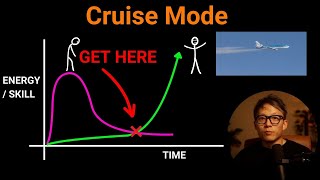
James Lim explains why people with multiple interests fail: they start too many projects instead of learning sequentially. The skill curve rises slowly at first while effort peaks early, so most people quit before reaching the effortless "cruise" phase. Three obstacles block the way: initial friction, energy demands, and boredom.
Chapters
Why do you keep failing the problem? Most people take off too many projects at the same time, trying to learn everything at once. Now I know this firsthand because I am really prone to doing this. The key, it's all about sequential learning.
Now we did cover this in a previous video, but I'll give a quick recap here. This is your skill level and you want to get up here at cruise altitude. Ideally you'd want to get there really quickly, but we know it's going to take some time to get there. So this is what we accept. But the reality, this is what actually happens. There's like a curve here, it's pretty.
Flat for quite a long time and.
Then it starts to increase. Now we might buy into this if it wasn't for this problem, the energy effort curve. What it looks like is this. This is you trying. Yeah, this is the effort you're putting in. It's very front loaded. It all happens at the front end. Now, again, see my other video, which I'll hopefully link up here.
It's a bit like trying to take a plane off. You need to get started. Very difficult, full throttle, seat belts, everything. And it's pretty, you know, it's pretty intense. And then you go up through the clouds, very turbulent, very bumpy, very difficult. And then eventually you get to this point, which is the unconscious habit. This is what it looks like along this curve. So I want you to imagine this when you start.
It gets really difficult at the beginning, very front loaded with your effort and.
Then the energy required drops away. Now I'll give you a hint to some points later in. It's like being in a new job who to ask for what, where the departments are and how all the systems work. But one of the big keys in this is we need to understand what the components are of this big lump. If we know all of the components of this, this will really unlock a lot of secrets to shrinking it. Most people get to this point and then they fall. This bit is nearly always hard, no matter what skill you're trying to develop.
And we're always saying, oh, that was.
Exhausting and totally unsustainable. Now a quick note here. Your brain is like a prediction engine. The more attempts you make, the more this becomes permanent. This is a really big problem, as you'll find out shortly. And this happened to me so many times when I tried to start a business. I keep doing this, I keep failing. It really started to make me believe that I was never going to be able to do it. Now at the same Time with this curve, if you quit around here, you've got a very insufficient skill level. It's all the way down here. And so you end up with lots of these half baked projects and it's kind of insult to injury because you've tried really hard, you've expended all your energy and you've got nothing to show for it and you just end up with loads of these. And I hear this, I experienced this and now I hear it so much from lots of clients. If you just hang in there though, you can slide along here and then you get here. So habits start to embed in your mind. It becomes an unconscious process and the effort experienced really drops away. Now a quick note. Do all the charts look like this?
No.
There are important other shapes which we will be covering in the advanced tactics later. But I just wanted to use this simple one for now. So we want to start climbing up this skill curve until we get up here. So we achieve the skill we require and we become a highly skilled and competent and valuable person in this. In this domain. Meanwhile, we also experience cruise mode where it's effortless and fun. So in terms of graphs, we want to try and get this point where you see the crossover. This is really, really important and this is what we're going to be basing a lot of this around. It's not as easy as it seems. So how do we get past this? Remember, the goal is to get here. You really, really want to get to this point. This is where you experience effortless mastery. Why do we never get here? Well, we have some obstacles. Our friend Arnie here. There are three key obstacles we're going to go over. One, initial friction two, energy. And that's both the work you do and the emotional energy. It consumes time. And so we see some symptoms from this. Initial friction usually results in a lot of procrastination. Consuming all of your energy too soon leads to a lot of burnout. And taking too. And taking too long to get here will lead to boredom. And in this stage, this difference, this yellow arrow shows the difference. If we are here, we have, we put lots of effort in but we have very little output in terms of our skill level. So it feels painful, it's frustrating because it feels like wasted effort. This is much harder to endure in real life. It's all well and good seeing it in a graph form, but experiencing this of trying really hard and not having any results is really painful. This happens to me every time and this is really bad in some of the sports I'VE picked, especially things like breakdancing. And there was a situation where I threw a. I threw a plastic dumbbell at a mirror because I hated seeing myself trying to. Just couldn't get the hang of it. And we just get into this state. It's so hard for contrast. If you can get to this point, you feel like this, where you have that effortless mastery, little effort in, very high output. It feels fun, enjoyable. You feel like you're in the flow, and it's really fulfilling. It's that kind of experience where you go out with someone who's an expert in their field, and they can just play around with it, yet they're still ten times better than you. So what is the obvious mistake here? Sabotage. Let's explain. So what happens is you try and load all of these projects at the same time, and then you add.