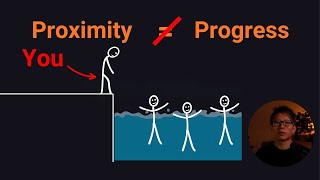
A motivational talk by James Lim explaining how fear and over-preparation (the “proximity trap”) prevent progress. Uses a swimming-pool analogy and personal anecdotes (e.g., delaying YouTube posts for years) to argue that real learning happens only by taking action, and outlines practical paths— incentives, escaping pain, tools/groups, and coaching—to force entry into action.
Questions this video answers
2006.
Over 12 years.
Chapters
Is fear holding you back? Are you scared to jump? When I was younger, I was always that kid who would be standing on the edge of the swimming pool waiting to go in. And I, I just couldn't do it. I'd be standing there in paralysis, quietly as other people would fly past me and dive in. They'd be splussing around and enjoying themselves. And there I was standing at the edge. You know, I was silent, but inside I was screaming, just go. Just go. What is wrong with you, James? Just get in now. I thought at the time I was just a kid and maybe I'll grow out of this. But the problem was it seemed to follow me into, into adulthood. This situation just kept popping up time and time again. I'd be the last person to answer the question, to volunteer, to make a suggestion or to put my opinion forward. It would, it would seep into my personal life when I wanted to develop an idea or start a new business. And it, it really, really held me back. You know, I really wanted to start a business of my own and to see how far I could take it. And I had these dreams of starting in real life communities, but I wasn't able to do it. And the same thing with posting on social media now. I'll show you some proof about this in a moment. It didn't go unnoticed because people around me would sometimes say, you know, James, you, you never try anything and you never go first and you never, you never jump in. And that was, that was pretty painful, to be honest. And it was not because I didn't want to. I did want to, but I just couldn't find it in me to have the courage to do it. And here's an example with my YouTube channel, which I started in 2006. So that was around when YouTube first popped on the scene. I didn't post anything for over 12 years, which, which was a killer because it's not like I, I sat there and forgot about it. I always wanted to post videos, but I just couldn't do it. So it was like me standing at the edge of the swimming pool for over a decade. The interesting thing is that standing on the edge made it worse because I became more fearful and I'd overthink and I could feel it. I'd be catastrophizing and imagining how everything could go really badly wrong. But there are some more hidden costs here. Every minute I was standing there, I was robbing myself of progress because I wasn't in the water. Others were splashing around and even though they Might not have been able to swim to start with. They were progressing through experience. And this, this, this pattern seemed to be the same everywhere I went. Others before me, going forward and practicing. Despite being really close to the action, I wasn't progressing at all. And you could just look, you can just focus on your own results and you can see what's happening. You know, I became obsessed with looking up. And if we were to follow this analogy, it would be, it would be books on how to swim or courses on how to swim, watching YouTube videos and taking courses and watching tutorials. It would actually be really fun because you feel like you're progressing, but ultimately you weren't getting in the water. And so, you know, an example here you see loads of videos on how to start a YouTube channel for beginners or. And I got really stuck in this trap. Proximity doesn't equal progress. This was one of my biggest, biggest lessons because I really, really fell for this. Being close to the action really can help if you have the right mindset. When you feel like it encourages you to move in, or when you're already taking action and you want people around you to challenge you. But it never substitutes doing the thing, just being around people. Sometimes I found that being around others who were, who were doing it, it actually made me feel worse because it actually just reminded me of how inadequate I was or how I wasn't able to do it, even though it was so easy for, for others. Now we'll probably go into the. The psychology of what was going on here in another video. But we'll keep moving for now. The turning point. Now the turning point for me was when I had a harsh reality check. It was when I realized that true learning only begins when you are in the water beyond the point. No amount of talking, thinking, reading, or watching stuff will help you. The reality was for me is that I was scared. I was concerned about the uncertainty. I didn't know what I was getting myself in for. The judgment from others and the fear of failure. There is only one outcome that matters. You getting into the pool. So how can we do it? And is there an easier, more practical way for us to do it? So there are some ways and we'll just go through them. The next part I'm going to talk about is about finding a way that works for you. Finding your way. It doesn't matter how you do it. Find a way into the water, right? You really, really have to focus on this. It's pretty obvious, but we lose that rationality when we are facing these fears. Ultimately, your method will probably be pretty unique to you because it will. It will be addressing the specific fears that you've got. So I'm going to go over three ways that I have generally categorized them, and it's been really helpful for me, and it's been helpful for clients I've worked with. So the first one is incentives. If we can make it fun and desirable, it can nearly help us and trick us into getting into the water. And this is when we can focus on being more playful with what we're trying to do or if. If it's desirable and we're really going after the freedom. And this may be something like working towards financial freedom. The other one is running away from something, right? Because experiencing pain is a really, really powerful motivator. It's a point where you feel like you need it, you need to get away from something, and that may be because you need to make money or you need to escape a really undesirable situation that you're currently experiencing. The next one is using tools and groups, finding a way to make it easier. And this can be using practice aids and using others. So if you can find ways to work with others who are around the similar ability as you and maybe going through the same emotional experience too. And this can also be where you can pick up training programs or group classes where people can take you through it step by step. And the last one is getting support. Now, I was trying to draw this to show someone helping you in, but it kind of looks like they're pushing you. In reality, sometimes you do actually need a push. It's is my favorite method. This is one I always use. So when I need help and I'm really, really stuck and I've got the instructions, but I can't find a way forward, I will always try and get some coaching or instruction because I know that is usually the most reliable way for me to get through something. I'll give you some examples. So this is when I was learning to take my snowboard to a higher level. And this is my instructor, Baden, and this was me. He was kind of guiding me, and it was so helpful. And. And he helped me unlock a lot of my capabilities in the park as well. And so this is me when we were doing some training drills in the snow park. And this is also about doing it with other people. Now I'll just give you some examples. When I work with clients, I often see people who are in that same situation stuck at this. Stuck at the edge of the swimming pool. Chris, for example, was looking for a big life change and really struggled to make the leap and end up moving country and setting up a whole new life. And it was really difficult. I remember the. When he had had to take the final plane across and it was incredibly apprehensive. And Joe had a really big. Joe had a similar issue with me on YouTube where he struggled to post content because he was really, really afraid of the judgment. We had to start from scratch. We built him up from zero all the way up to, you know, over 130,000 followers on. On TikTok. That was. I think it allowed him to, you know, once you're in the pool, you actually get to start progressing and so you get these unlocks and you can actually enjoy yourself in a swimming pool. And Jody was able to make a big life change and start to follow something she'd always been wishing to do. Whatever your version is, starting a new project, a business, taking that sales call or taking a big risk, find a way to get into the water. See you in the next video.