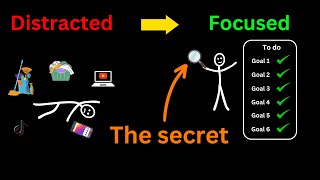
James Lim explains why long-term goals get ignored: your brain treats them as low-urgency noise. Boost the signal by reducing distractions and using the quick light method, short focused windows of 2 to 30 minutes that create real urgency and momentum.
Chapters
Focus how to eliminate distraction and gain focus on your goal problems. You can't seem to find time to work on your goal. Even though you know it's important, it never happens. You feel the weight of needing to get it done, but it doesn't seem to ignite any action. This is you here. You want to go over here, but then you end up saying after I've done all of these things, what's the problem here? Unfortunately, your long term goals. So the things that you're trying to go for, they are usually fairly low urgency and so your brain doesn't want to allocate mental resources to them. So what happens? Your goal fades and then you start to forget it. Days, weeks, months pass by. We all get this. Even I get this. It ends up in a really unfortunate downward spiral. I see this time and time again with clients. So what do we need to do? We need to boost the signal. We need to push the goal up, make it really loud, clear and constant. Remind yourself very frequently, use your slow burn motivation drivers to push it higher and higher so it stands out away from the noise. In this case, we want to reduce your noise, remove distractions. Things that are going on in your life that are, that can be pushed to one side, many tasks will get done. You know when you're prioritizing all of these admin tasks, you're making them more important. We have to push that down. Action often occurs when the gap is large enough or when your goal or your signal becomes very loud compared to your noise going on. I'll give you a very quick example. If you've got a very busy social calendar, you're constantly scheduling in when to see people and maybe you've got some hobbies and other projects people to meet. It's going to be very difficult to hear the volume of your main goal which has no deadline. It's really important to you, but it has no deadline. It goes on for a long time and not doing it today is not going to affect it. So we need to reverse it. We need to quieten down a lot of this noise and make the signal louder here. Remember your threshold of action. Again, we need to get it your signal, your goal higher, creating your signal. We need to think about what do you want to take action on? Why do you keep coming back to it. We can be tactical with this. If you go to workshops or you get coaching or you have deep reflection, that's when you can, you're in that quiet space. I noticed this when I work directly with clients. When we do A lot of this work, they suddenly realize, damn, that is really important to me. I really need to get moving. But left to their own devices for too long, sometimes they can forget. This is why when we go to workshops, we get so motivated. Reducing the noise. What distracts you from your goal? You need to identify those things. What can you do to remove or reduce them? How can you create quiet environments? Next, how do I carve out time for my goal? You can't seem to find time to work on your goal when you need to because you've got this busy schedule. There's a little trick here. We can create fire with moderate amounts of sunlight. How? By focusing precisely on a tiny point. You've probably done this getting a magnifying glass and setting light to things. I. I mean, I used to do that as a kid. It just needs to be moderately sunny. And then you can really focus something and create fire. Ignition becomes significantly easier. We can do that with our goals I call the quick light method. It's a bit of a hack to move quickly, you use urgency and importance at the same time, and it doesn't matter how noisy life is. I've dealt with this so many times with people who've claimed They've only got 20 minutes a week to work on their goal. Often I can say that's actually quite good because it creates the perfect environment for this focal point. How to do it? You just decide on a tiny window here, and I'd suggest kind of even really small. 2, 5, 15, 30 minutes. This could be weekly, daily, or anything. Now I'll go into versions of this and how to find these spots in the main module. You pick a space in the day or the week between two activities. That's often a really good spot to because you've got boundaries on either side and it creates forces. This focal point. For focus and carving up time, go to module three and beliefs. There'll be step by step on how to create a strong signal, reduce the noise, a system to carving out time and prioritizing time for your goal. There'll be some walkthrough examples of how you can do this, how you can set your calendars up and some traps you'll fall into. And as usual, worksheets, templates and cheat sheets, all based on work I've done with clients. So you'll see real examples. These are not just theoretical. Okay, next.