What if you took a different path? How to carry out Life Experiments (Full System)
James Lim explains life experiments: small, low-risk tests to explore different paths instead of overthinking. He walks through the method with a client case, then shares tactics like shadowing, short courses, and volunteering. Templates and trackers help you run experiments and gain clarity before big commitments.
Chapters
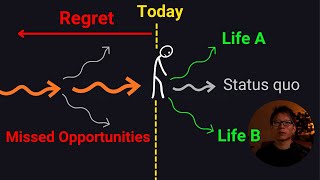
Have you ever wondered how different your life could be if you chose another path? The paths you could have taken, all of the missed opportunities, regret. So I want you to imagine this is you and this is life following you. And you have this option to continue with your life. This is your existing life. Or you could go down this path, Life two, an alternate path, or perhaps life three. The reality is, most of us, we just continue to choose the path we always know. And so we end up here. And then we have this option again. Life 1, Life 2, or Life 3. And we choose Life 1 again. And it ends up. And we keep going down this path year after year. And for some of us, not all of us, we can end up feeling quite disheartened. All of the missed opportunities and the regret, all the paths we didn't take. Think about what opportunities you have turned down if you hadn't taken that job, if you moved to that city, if you took the opportunity that someone presented to you. But even at this point, you have new opportunities appearing all of the time. You've got life one, life two, and life three. Now, obviously there are plenty more than this, but this is just a bit of an indication and it can really feel like this. This is something that I struggled with for a lot, for many years, and then eventually found a way to break away. So what could your alternate ending be? Now, this was exactly the path of Jody, a client of mine, one of my early clients, quite a few years ago. Now she felt stuck and in corporate life, struggling with only short vacations away, really desperate for nature and only a photo of a dream. 15 years of dreaming and she wanted to do something. The regret kept building up. She really felt this, this pain, the missed opportunities over the years. And it was 15 years. The option was to continue with life one, life three, or potentially this life. We've always got lots of ideas, but a lack of clarity and uncertainty prevents us from committing. And this is one of the problems I really struggled with early on because I'm so risk averse unless I've got a clear path. It's really difficult to, you know, to try and commit. If you've done the previous course we talked about in the three monkeys and the eldest monkey, a counter monkey, won't let you won't sign off on doing something that's too risky. So the problem is you will try and analyze the idea only to be stuck in the same place continually. So you have your idea, you get excited, you do some research and then you start doubting yourself and then you Have a break and then you go back to the idea and it goes around until you're just stuck. Now you will feel like you're doing something, but. But if you look at the results, you're just, you know, you're not actually making any progress. So you end up overthinking. And then you start having these. You fear failure and that's really exhausting emotionally and very frustrating. You're worried about making the wrong decision. Right? And I know that because I experienced that. And then nearly all of my clients would feel the same way, which is really difficult. It's the thought of the wasted time, energy and money to go down those routes and to find out it wasn't going to work. Now overthinking makes you feel worse and you still do nothing. So what can we do? Well, we can use a solution which I like to call life experiments. Experimentation, action and clarity. Break the paralysis of overthinking. This is a concept that has been so helpful one to me, but more importantly to all of the clients I've worked with. It has been the game changer. And it is a low risk way to explore breaking free from being stuck. And it starts the momentum which will really help you. The power of life experiments. It allows you to move quickly. Does your idea have a viable future? Can a side hustle earn an income? Find out if you actually like something. Do I actually like writing? It allows you to make informed decisions based on real experiences, like taking photos, but you don't like editing so much. It's an antidote to overthinking. It avoids the thinking trap. It allows you to test ideas safely. Experiments get you into action which give you clarity, the process. So I don't want to get too complicated here, but I'll try and keep it fairly simple. The idea is you want to figure out, you want to identify the possibilities, these paths that you could go down. Could I be good at public speaking? Then you design life experiments. You think about what could you put in place? Could you take some courses, join toastmasters, do some training? Then you refine the experiments over time. So if things start to work and you like the idea of it, can you do some advanced training? Can you sign up to speak to an event, speak at an event? Going back to the first point, if we think about identifying possibilities, we can start slowly fleshing this out into an established process. You want to start brainstorming potential interests or paths that you could go down, tap into what excites or intrigues you. Now, hopefully you will have done that from the values course we did earlier. Number three, Explore low risk ways to test the ideas out. We'll start there and we develop on this. So here are some of the classic and common examples. Think about what's something that scares you but excites you at the same time. That could possibly. That is a good signal for something that could be a good life experiment. So we'll just come back to Jody. So we went from this to this. Now you might want to pause this. I won't stay on this for too long. She had a dream of being able to go out into the wilderness and do this. And here are all the things that she learned over this period of time. It was absolutely incredible seeing this change from someone who was so scared for over 15 years. We'll dive into her story in a bit. Now there's probably something that you're wondering how interactive exercise idea possibilities for you. What have you been curious about? Think of three to five things you've always been curious about but never explored. Think about that. There's so many things that I have always been interested in and wanted to explore. One of them is trying to speak on camera. I've always wanted that. If you watched my previous course I talked about wanting to do this since 2005, 2006 when I started my YouTube channel and didn't post anything until 2019, 14 years. Dancing was a big one for me and it ended up being a really that became part of my lifestyle. I never thought I could dance then I ended up getting getting into breakdancing. Now don't worry if you can't think of any right now. List them after. Next we can look at how to explore these curiosities. Now just to remind you for a bit of comfort, I'm going through this as training. We will go through your exercises and drills later. There will be templates all ready to help you work through this. Creating mini adventures. So we can take a lot of the fear and any anxiety around by turning this into the idea of creating these little mini adventures that are safe to explore. We want to design them now we can lay down a bit of a process. Here we start looking at ways to explore some of your curiosities. Painting. I've always been curious about painting but never tried it seriously. I'll buy some basic supplies and commit to starting. Maybe take some courses. A beginner's course. And maybe I'll aim for painting one tiny canvas each week for the next month. I've actually just started this on the iPad. At the end I'll See how I feel about it now. So this little experiment, this is like a mini adventure for a month. Very, very low stakes. We're not trying to necessarily change career to become a painter overnight and set these big lofty goals about a future career in painting. We just set a mini adventure out to see how we gel with it. So even if your path feels vague, just write them down. You will find they evolve. And this is a skill set. You will get better at it, mapping your journeys. Okay, so we need to create multiple potential paths with different timelines. The idea here is you want to flex this skill. You want to get good at creating these kind of splintered paths of your life. So think of new hobbies, new skills, and small lifestyle changes you might be interested in. Consider how you could test these possibilities on a really, really small scale. Now, there are so many examples, but this is something I get clients to get involved with as soon as they possibly can. It's so important to get these moving quickly. If you're curious about writing, you could commit to writing a blog post each week. Now, you don't even have to post it, you just need to write it and just practice writing it in a word document. This is something, this is actually quite common request when I'm working with clients. They want to start posting some of their ideas and we will just start. Quite a few years ago, there was one client I worked with and we. And she wanted to start writing. And I remember I just set up a blog recently for myself, so it was very fresh on my mind. So what we did is on the call, we actually set up her own little blog, a little micro blog. And then we got. And then I helped her type some of her first ideas out and then we publish it. And it was so much fun and she was quite nervous, but we moved it so quickly and then we found that she took a real liking to it and we worked it up from there. So at this stage, you are building your ideation skills. So don't worry about committing, don't worry about this. This is just testing these ideas. Now again, don't worry about this. Even after this training, be going through lots of templates and easy to fill in worksheets. So let's go back to this, the three life paths. Now here's a bit of a systematic way in which we can start exploring these. If you're not sure about which way you could go. So we can say what if your life one, you continue on your current trajectory, maximizing it where possible. So this will be accelerating down that, that middle bit. Now, Life two. What if your current work role disappeared and you had to find an alternative way forward and to make a living? It's possible, right? Especially over the last year or so we've had lots of redundancies in various sectors and it's changing sectors every year. Life 3. What about a dream path that aligns with your deepest curiosities or passions? What would that look like? Now? Sometimes people are really afraid of approaching this. But just as an exercise, explore it. Because this is what now when I work with people there, there's, there's naturally some external accountability because I can help people go through this, this exercise, this exercise. But there's absolutely no reason why you can't work through this yourself. And I will guide you through this later. But you will find it really, it can be really motivating once you start and you start to see a potential path form in front of your own eyes. Now, what would each path look like if you went down this, what would you do now quickly, if you have done the course on internal drivers and the three monkeys, we'll just quickly touch on it here. Think about your three monkeys. Explore a monkey, worker monkey and a counter monkey. What would their ideal lives look like? Imagine if they could set life paths out. What would it look like if each one was more dominant? What would an ideal one look like? Once you thought about that, think about what a path would look like if all three of them were on board. What would that look like? Some examples are would say maybe you have resided to the fact that you've got to work really hard during the week. You can only live for the weekend. But a dream path could be, what if I were to do my thing? Just what if it was possible to find a way to make an income from that thing that I really enjoy too? And we're just playing with these ideas for now because they can be developed later. Here's an example. Life path. What about a potential new career, a change of career? You can split these infinitely. But I'll just give you two common examples that I come across working with clients. Some people want a gradual change. They want to see they're very risk averse. And so we safety and we optimize for safety here. Can we take on some mini projects? Do something for free. Maybe you're working in corporate land and maybe you've got an interest in video editing and you want to just test it out. Or photography, right? Maybe you want to do some portrait photography, wedding photography. Is there anything you can do for free or run these little mini projects and maybe potentially run part time. Can you start some light networking, start to get in touch with a few people in that area, look up groups, take relevant courses and slowly build this portfolio up while you continue everything else and then you slowly shift more time and energy toward it. This is quite a common one because I work with a lot of people who are very risk averse. So we have to be quite tactical with figuring out how we can make this work. We have limited time, resource and energy, but it is the safest way. It definitely takes longer though. The alternative is you go full commitment and this is optimized for speed because you want to change. Now I usually see a split here. Anyone in the career sector, which is one of my kind of target audience, they split quite heavily down here. Now these people want to leave their current job. They're really, really sick of it. And usually they've built a little bit of a buffer of money to keep them going for some time. So it allows them to take time off. So I've often come across people where they're about to go on a sabbatical for a year and we just catch them and we run through these exercises and say, what if you were to run some life experiments? Instead of that you can still go traveling but maybe you come back a bit earlier or you start to run some experiments. Now I've had, I've got three people in mind where we went through this and we suggested the concept of life experiments and especially one I remember, it changed her life. She was about to book a ticket to, to fly to the other side of the world. We ran through this and she said, I tell you what, I'll give it a try, let's work through this. And the plans were cancelled. We ended up shifting career completely and that happened within a few months. Here you can immerse in full time education, training, maybe get an entry level position or an internship. Free work for experience. Now here you just want massive amounts of immersion. That's, that's the key here. Now again, it's a bit of a caveat. The people I've worked with have generally built a little bit of cash buffer to keep their finances going. So you can afford to do this, but you do because of that. So an exercise we usually do which is beyond the scope of this is do a big finance, finance kind of projection. We try to figure out how quickly we need things to move, how much data we need to collect. So we really, really optimize for this to make this Work. Now, if you do go down this route, you do want to be able to move quite efficiently, Right. And quite rapidly work through this. Hopefully I've got enough in here to help you out. If you really struggle, just get in touch with me now here you want to really leverage contacts as much as possible. Now if you do not have any contacts, most of the people I work with who want to change career, they, they always say to me, I feel like I have no business being in this new sector. So you would not be alone. It would be people who are looking to get into sectors. I'll have to do some more content on around how to make these connections. Right. But the hint is people who are really enthusiastic in their sector are really willing to help people who are really enthusiastic too, even if those enthusiastic people do not have much technical knowledge. Yeah, it's the shared enthusiasm there. So, industry events, meetups and forums, which of these two, which one feels more aligned with you? Now I can tell you, I would say that's probably about a 70, 30 split, more towards the safety optimized one than the full commitment than a speed optimized variant. But I definitely get both. And it's very fun getting to work with both because they're very different strategies. Refining your experiments. So the next bit we want to start a plan. You then identify the steps and then you, once you have those steps, it will be easier to then break down those steps into smaller steps. Think about. So these are some tips really. What skills do you need? Who can you speak to? What challenges are ahead? Now just looping back, who can you speak to? That is such a crucial step. I put a lot of emphasis on this with clients because it helps you answer all of the other questions. If you speak to someone who is already very experienced in that sector, they'll tell you what skills to focus on early on. They'll tell you what challenges you're likely to hit very early on, especially as a newcomer. If you've done the course before, think about how your monkeys feel they should have something to say here. Now we want to expand. So once you've built your little framework out for each path, you start designing specific experiments to test key aspects. So this can be like work shadowing, short courses, small projects, volunteering. If you want to get hands on, let's say it's working with people, you may, you may speculate about what it's like to work with people in that sector. You won't be able to get an accurate answer there. That is where something like volunteering Will be really, really effective because you start to see what's happening on the ground. Work, shadowing. This is a really, this is one I always try and help. I'd really try and expedite if possible when I'm working with clients. We both don't know what this new sector is like, but there are usually some quite universal ways to get to yourself, to be able to shadow. Now, one of the things that's interesting about shadowing and free and no pay work, especially here in the uk, is it's much easier to do it without contracts or any issues like that. As soon as you ask for money or you get involved with that side, it's just too much friction. You want to lower the friction so you can get the data that you want, which is usually just to see what's happening, see what the job's like, define what you hope to learn, Take an educated guess at best. So I mean, this, this, you know, this is not just about work. This can also be about hobbies, right? Think about what would you like to learn? Maybe you want to learn how to video edit. Maybe you want to learn how to, how to do photography. Is there a photographer you could follow and just shadow for a weekend when they go out? How long to run the experiment? What resources do you think you need? Again, if you know someone, they will be able to help you set these things up and save you lots of time and heartache. So let's look at what we did with Jody. What we did is we, we, we really tried to speak to people in a sector who were firing out messages on LinkedIn, on Twitter and we were reaching out to some of her idols. Interesting story. Someone connected with David Attenborough. We did a reach out and it was, I can't remember which series it was. It's about seven years ago. It was one of the famous giraffe fights and we did a cold reach out to them and we talked and we really connected on the enthusiasm and got a conversation going. And that was vital because they ended up helping with explaining what was most important to emphasize what skill sets you need and what skills you didn't need. In the meantime, we looked up short courses and to take relevant training. And with those conversations we were also able to rule out some training that we would have expected to take, but that were not helpful for what we were trying to achieve. And then other things. A research, short trip, this idea. She had gone on some trips as vacations, right? So to enjoy it because she was trying to get out there anytime she could over the last few years and rather than just enjoy it and, you know, spend all the money that she'd saved up for a really nice holiday, we turned it around and we turned it into an investigation. We were going to go out and yes, it's not going to be enjoyable because you had some objectives, but the idea was can we find out some information and whether there were any threads to pull on the other side? And we had a whole bunch. I remember this really long checklist that I sent her out with and when she came back, we went through that information and to see whether there were any ways in using some of her transferable skills. And there were Now a simple example testing a new skill. Go into some simple ones. Maybe start by dedicating one to two hours a week to learning. Join a community or find an instructor in that skill area. Now, I did this with dancing recently. Evaluate your progress after a month and decide on next steps. If you don't like it, you can stop, right? But you need to start learning what a reasonable amount of time to run an experiment is. For now, this is, this is another example where you where it's really helpful to be speaking to someone with some level of experience. Failing that, there are so many good resources, right? Books, podcasts, YouTube channels. Find someone who's really passionate about their sector and look for ones who are very pro beginners and getting people into the sector, they will usually be really helpful. They'll probably have content on that. Failing that, reach out to them and I'm sure they will be really, really happy. I've sent a few clients that way and it's worked detailed example. So I want you to imagine you want to go down the life path of a freelancing career. So experiment is offer your services pro bono to build experience and get client feedback. The objective is to learn about client feedback management and refine your service offerings. So a lot of people who shift into freelancing from say a consulting sector or a technical sector, what you don't realize is there's a whole load of new skills you need to learn when you go freelance. And not to do with the actual job. It's more about running a business. You have to manage multiple clients. You have to figure out how to sell yourself. You want to try and experiment this to see whether or not you even like that as one and also whether you think you can do it. So this one, you may wish to commit to three small projects over the next two months and do them for free, right? Remember, you're trying to Get. The value you're trying to extract from these transactions is not money, it is the experience, the data that, the insights you will get. At the same time, you can measure your success, how effective you are by your client satisfaction. And of course, just a reminder here, it's your own comfort with the whole freelancing process. So many times I've seen people start wanting to start going this route or start a new business and they realize, oh, wow, I don't really like the business thing, it's too stressful, right? On the flip side, some people really enjoy that, the autonomy, the ability. If you're really good at your job and you really enjoy it and you like speaking to people, it is sometimes a really. It's an amazing pleasure to have clients who like you and you like them, right? And they pay you and you do an exceptional service and you just get each other. It's sometimes the most amazing feeling and something that I'm really blessed to experience. Start experiment. Start experimenting. Choose one small experiment to begin this week. Use the tools and templates provided to guide your process. So to help you, I've set out an experimental process for this so you can run your little life experiments. And I've done this lots of times with clients, so it should be pretty helpful. If you have any trouble with that, just get in touch with me. Remember, the goal is exploration, not perfection. So get started with some worksheet templates. I've got some guided worksheets and remember, same process, I go from beginner to advanced. We got level one, which is a beginner, level two intermediate, and level three advanced. They get more complicated as you go, but hopefully the level one should help you get started. I've got some ready to go templates and these are how to set experiments up. Now, over the next few months, as a bit of an insight, I'm going to be populating some of these templates with real client examples so you can see. And I'll also be giving the most common requests and lay out the templates for you. So keep an eye out for that. There'll be some progress trackers to track your experiments. That's also quite important. You want to see how you get on with that. Now you can use those ones or alternatively journal as you go. Now I will be. You know, the observation I've seen is you won't need to. Your intuition will tell you because when you run an experiment, your emotions will take over. If you don't like it, right, you don't need to journal about it because you Hate it, Right? If you really get on with it, you won't be able to stop talking about it, and that's all you'll think about, so you won't even need to remember it that much. However, if you want to be a bit more structured, I've had a lot of clients who, even though their emotions are running very high or low, they still like to do that. And I like to capture that because it's a little bit easier to structure the next steps and to be really efficient with our process. But to be honest, it doesn't actually matter. On average, I say about 80 to 90% of people. It's so obvious. After they run the experiment, there'll be lots of examples and cheat sheets, and it will be growing over the next few months. Right? So if you're in the beta test, expect it to grow. Final word. This is a discovery process, okay? So it's an ongoing thing, and it will keep developing. Each experiment brings you closer to clarity, so keep. Keep experimenting. If you're not clear, rather than try and think your way through to clarity, take action. First, design a little mini experiment. Get exposure to it. As long as it's safe and you can gain data, you will learn so much faster. Keep exploring, testing, and refining your experimental process. You'll become a master at experimentation. I absolutely love doing this. It's. It becomes totally intuitive over time, too. This process never stops. Okay, time to get your experiment set up. So I'll see you on the other side, where I will talk you through the templates. Anyway, good luck, and I'll see you on the other side.
More from James




The mental system I ALWAYS use to transform myself. Warning: Simple, not easy.


Why you lost your confidence and how to get it back - Thrive and Decay: [Full training]



5 PAINFUL truths to improve your life (you're probably not ready to hear them)


Why you always feel conflicted when making important decisions [Three Monkey Framework]