Why your current self must be destroyed to evolve into your new self (Version 2.0) [Clip]
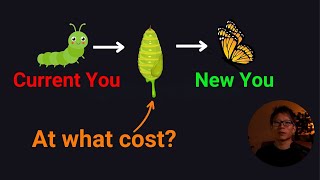
James Lim uses the caterpillar-to-butterfly metaphor to explain personal transformation. He introduces "goopification," the dissolution of your old self required for real change, and walks through a client named Chris who left toxic relationships, improved fitness, and moved countries after building a roadmap. Visualization alone won't work, he says, without concrete action.
Chapters
What part of your version one is holding you back? What frustrates you? What don't you like? Then the question is, who is your version 2 and how will you become them? How to become version two. So if you're here and you're ready to do this, we can start working through this. So I'll show you step by step. So the, the next section we're going to go through, it will cover who. Who. This is the definition of your version 2 and how to get there, the process and how to stick to it. Right. Because it's a transition and you will learn this. But first, metamorphosis. I'm going to tell you a bit of a metaphor here, quite important. Are you familiar with this caterpillar turning into a butterfly? Have you ever thought about how it happens? So just be clear, you've got these wings here. Now I'm going to take the picture away. So you see this? You've got. Is it a caterpillar with bolt on wings? It doesn't, it definitely doesn't look like this, does it? No, it does not equal a butterfly. They look very, very different. What is going on? Now? I know what you're thinking here. It's something to do with this, right? Okay. But what exactly happens? It is not what you think. Most likely. We'll return back to this after a very, very quick exercise. Okay, so first we need to think about. We want to start defining the version you want to become. What do they look like? We can start to visualize version two. Now this is quite important. Yeah, we need to combine the visualization and then the process to get there. And this is this end point we want to understand. This would be like selecting which mountain range you want to climb. So try and envision. Sorry, envision your version 2. What do they look like? What habits do they have? How does this version feel on a daily basis? Who inspires you? Now this is where it can be useful when you're doing this exercise. Now you can, you can go specifically to extract certain traits that you really like of people that you look up to. Think and write down these characteristics. What stands out the most? Now don't worry if you would struggle laying this out. I've got some templates and exercises and resources because I find these exercises quite hard when you just got a blank piece of paper. So I've created it where you've got lots of easy boxes to fill in and it's all guided as well. So step by step. So don't worry about that, but have a little Think about it. Now, here's a little clip of one of the worksheets. Okay, so I've got a quick client reflection here as an example. Chris, incredibly unhappy. Multiple areas, physical and mental health, location. So where he was like the city he was in. Relationships, really dark time, couldn't see a way out. And deeply unmotivated. We defined version 2, which allowed him to see a future self. It took a while because of that, you know, the place he was in and how unmotivated he was. But he knew he wanted to change, which is why he reached out. We really worked on unlocking the ability to build. Sorry, this. Once we had. Once we had been able to define his version two, it unlocked the ability to build an actionable roadmap. Yeah, this is really important when. And so I do a lot of work with people to try and try and build this vision because it helps me for a start, but it also helps you see where you need to go. If you understand the mountain range you want to climb, we can start figuring out what. What routes you need to take, what equipment you need to take for that specific mountain range. It's a bit like this. And we worked on it. We worked on it so relentlessly. It was. It was pretty crazy. And he became fitter, exited toxic relationships, and ended up in a completely new country. And I remember how difficult it was even doing the plane ticket on that week. It was pretty crazy. And emotionally, very, very, very, very challenging. But it was so great to see him on the other side. He set up a new life in a new country. And I'd say version 1.6. I'm still moving to version 2. Move to new York, to Rio was awesome. Now, having clarity will help motivate and excite you enough to start the process. Back to the question, have you thought about this? Right? What happens? What happens in this stage? So it actually happens like this. Now, I find this metamorphosis so fascinating. Now I'm going to take you through it. It'll be quick. What happens? Caterpillar, it's just munching away. Its job is to eat as many leaves as possible, get as plump as possible. And once it's done, when it's about to do this big change, it stops eating and starts climbing and ascending, and it leaves the world they know, stops eating, stops hanging around with other caterpillars and leaves. It forms a chrysalis. It's not a cocoon, but I really like this word. So I will be using cocoon later. I only found this after a bit of research on this. Now, what actually happens inside the chrysalis? Have a moment to think about it. What do you think happens? How does it turn into a butterfly? They look pretty different. Remember this? They look pretty different. Well, it actually turns into a green soup. I call it goopification. It dissolves what its current form is to make way for the new. And it's shedding its old self. It destroys itself. So what happens? The cells start to combine inside here. So you imagine a whole like a soup of cells and the new cell structure is pre programmed to start assembling itself, optimized for flight, to leave the branches and to fly wherever it wants to go. There's lots of energy in. But that's supposed to say no immediate result, as in none, right? So lots of energy is very energy intensive to make the change. And it can't fly instantly. There is a time delay here. Wings begin to harden and it slowly breaks out. New form starts to reveal itself. As it breaks out the old self, the. There's only a husk left. Can you see this? It's a husk. The old self is gone. New form breaks free. It's the same core material, right? It's the same. The soup is the same cells, it's all contained in that, but it's a different form and function. This is really important. Hopefully you can see how this maps across and we go from 2D where you're bound by the caterpillar can only walk on these twigs and branches, right? But a butterfly, it can leave and it can fly wherever it wants to. You can see how powerful this kind of concept is. Now cocooning, this is a really important stage because we spend a lot of time here. Now, again, technically, it's a chrysalis. It just doesn't have the same ring. So I'm not going to use it. I'm going to use cocooning. Lots of clients use cocooning too. So it's kind of a bit too late to go back on this, right? Leaving your existing world. It's about letting go of your current identity. A death of your old self. Now, just to explain what this means, it's. It's removing bad habits, people, environments, not serving you and limiting beliefs. We are looking to make this shift from all of that to the new. It takes an emotional toll as well because it often feels like you're going backwards. So you're leaving all of this stuff only to, to. To. To turn into soup. It's really uncomfortable, it's filled with uncertainty and you feel very vulnerable, right? Imagine how vulnerable this caterpillar feels when it's in this. In this cocoon. I definitely notice when I'm in this phase with clients, and it can be a few weeks up to. Up to a few months. We have, you know, I have to be really on the. On the ball for support and encouragement because it's really difficult. I see this live. So if you're going through this yourself, just know that it's. It's a very difficult process. You need to be really careful with who you expose yourself to. Now, a caterpillar, I also like this. The cocoon is by itself. When you're making these transitions, they are often quite lonely. Now, an example. It's about stop listening to narratives from others. Stepping away from environments you're familiar with, breaking away from the same excuses you make. Dissolving beliefs that are stopping you from taking action that don't have, you know, for example, that you don't have the ability or you're not talented. You don't take action due to fear of failure. Yeah, we're going to start dissolving some of these beliefs. Now. What happens is in this phase, when we start to get rid of all of this stuff from you, right. In the cocooning phase, the transformation begins. Cells are rapidly moving. So now we're going to be fluid between the metaphor here and you. Cells are rapidly moving, assembling themselves, combining, dissolving. And you will find this. I noticed this when I'm inside with someone while they're going through this stage. They're trying things, and some things are not working, and then they try again, and then they start to stick, and then we start to see some traction and eventually sticks. So later on, as we break out, despite the new form. Can you see that? You can see the butterfly inside. And there's a fight to break out of this old shell. It's such a powerful metaphor here, Right? So you can see how it's there, but it's not ready. Yeah, it's trapped by its old self, but it must break loose. There's a struggle, and it makes for stronger wings. Now here's a little visual. You can see the butterfly revealing itself. It's pretty cool. Quick reflection. What feels most challenging to you? Many people stop at this visualization, right? They. They think about this, this end point, you know, being the butterfly. But without actionable steps, steps, it will often lead to frustration and stagnation. I see a lot of people. So some people don't know who the butterfly is. And there are some people who have spent all of their time visualizing are not, not applying tactics and strategy for your daily life to make that transition. So this is what we're going to go over next.
More from James




The mental system I ALWAYS use to transform myself. Warning: Simple, not easy.


Why you lost your confidence and how to get it back - Thrive and Decay: [Full training]



5 PAINFUL truths to improve your life (you're probably not ready to hear them)


Why you always feel conflicted when making important decisions [Three Monkey Framework]