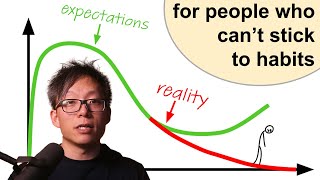
Three psychological traps derail goals: unrealistic expectations, the motivation curve, and the pain curve. The solution is setting upper and lower limits, operating between an aspirational target (3-5 out of 10 effort) and a minimal non-zero floor (9-10 out of 10). This creates sustainable habits instead of boom-bust cycles.
Chapters
Why is it that as soon as you set your goals, you immediately start struggling with them? You find it hard to stick to the actions, you get overwhelmed quickly, partway through something in your life throws you off track and you eventually just give up. Now what frustrates me is most people don't explain the psychological traps that cause you to repeat the same mistake over and over. And many don't provide a genuinely practical and actionable way that can stand up to the realities of your daily life. So in this video, I'm going to go over the three key psychological mistakes you make that cause you to give up on your goals, why you keep making the same mistake every time, and a quick and easy tool that's helped hundreds of people I've worked with. You'll be more consistent over the long term. You'll keep making progress no matter what life throws at you, and you'll learn how to be kinder to yourself while still moving forward. Number one Expectations. When we set goals, we often do so with unrealistically high expectations. This puts us on the fast track to failure from the very beginning. But why do we do this to ourselves? Be honest, it's not the first time you've set these goals and not made any progress, right? We often feel behind, so we want to get results quick. Setting the bar higher theoretically gets us there faster. And this is all because we have a sense of feeling behind. It's also easy to look past what we are realistically capable of doing right now. And often we don't want to accept it. We compare ourselves to others without thinking about what they've done to get to where they are and what practice they've put in. 2. The motivation curve when you set a goal, you're excited. The prospect of achieving your dreams. Your motivation is often at its highest. But it soon fades and everything just feels hard. And this continues until your mind eventually breaks and you give up. The problem is that you set your goals and all of your actions while you are in this high motivation state. And you can't keep up with your targets without being in that state. 3. The pain curve as you start, your brain quickly starts experiencing pain and discomfort. Pain is initiated by the very actions that you've started and it's all kind of fueled by the initial motivation. As time. As time goes on, your body and mind start to pay the price and feels the pain. Like sprinting off the line in a marathon, your lactic acid builds up. Same with our mind. Those 4am starts, the over restrictive diet plans, the intense exercise Plans, pain increases rapidly, causing physical and mental fatigue. You just get fed up. This leads to temptation as your willpower subsides. Our brains are not designed to tolerate pain way beyond our threshold for extended periods of time. Just think about trying to run with a cramp. Impossible, right? Why do we make the same mistakes over and over again? One, the more time passes, the more desperate we are to catch up. And so the higher the bar we set, this is instinctive. And setting a lower bar just doesn't feel like we're making any progress. It feels like we're going too slow. And it can feel frustrating, like we're just, yeah, not making any progress. Two, the motivation curve tricks you into setting goals beyond a level that you can manage over time. Three, we forget the pain over time, so don't make the appropriate allowances for it, like forgetting how bad the cramp was the last time you tried to run. So how can we ensure we achieve our goals at a rate that is both manageable and fast enough to feel like we're making progress and still exciting? We can use a concept I like to call upper and lower limits. Label the goal as your upper limit. This should usually be quite easy and intuitive. Now, the more challenging part, the identifying your lower limit, this should be an action or a target that feels easy or manageable, but still represents some kind of progress, I. E. Greater than zero or nothing, you end up with a band, your upper limit and your lower limit. You want to operate inside this band. When you feel like you want to make rapid progress and you've got lots of energy, head towards your upper limit, push there, and maybe until your energy, you know, kind of subsides. But when your motivation fades and the pain and discomfort starts to accumulate, you have room to breathe by adjusting down to your lower limit. And this is the real key of this concept. Your aim is to stay in this band. And remember, if you're in the band, you're making progress. For visuals, imagine you're on a steam train, and it's your job to keep it going. You keep shoving coal into the fire to keep it going. And in the morning, you've got lots of energy, so you shove more and more coal in there and the fire burns bright and hot. But something goes on on the train and you've got other tasks you need to do, and you're tired by the afternoon. You can't keep up with the rate in which you were going at that early stage. So what can you do? Well, there's like a minimum amount that you can Shovel in. Maybe it's one shovel an hour. You do that to maintain the fire. It keeps the fire going and keeps the train moving. Then when you have more time and energy, you can crank it up to the upper limit. And that's how this kind of operates. It's more important you keep the train going than allowing it to fully stop because it takes a lot more effort to get it all going again. Now for a real world example, let's take the gym. You might decide you want to get really fit. So you set a target of four or five times a week in the gym. And maybe you've been doing nothing for months and months straight away, assign this as your upper limit. Now think about your lower limit. What could this be? It should represent the the minimum that will still keep your habit going and is non zero. It could be once a week or possibly twice a week. Now, as long as you're meeting your lower limit, the gym habit is still going. And then when you're feeling more motivated on certain, certain weeks, you can push towards your upper limit. So what happens over time if you keep this up? Well, if you stay in that band, what happens? And I've observed this with hundreds of people, the band starts to move upwards. Your lower limit increases, as does your upper limit. Eventually you reach a point where your lower limit breaches your upper limit. And so what that means is now your minimum standard becomes what was an aspiring standard that you had in the past. You keep going and the band just keeps moving upwards. What this also does is it allows you to fully become self aware of what you're capable of. When you need a break, you can reduce down to your lower limit. And when you feel like you can push harder and make more progress, go towards your upper limit so you can be kind to yourself by not pressing too hard when your body and mind are not warranting it. So in summary, your upper limit should feel aspirational. It's usually the first thing that comes to mind. Reassign that as your upper limit. Your lower limit should feel easy and manageable, not overwhelming, but must represent progress still, so be greater than zero. I like to use a scoring system. This gives you a bit of an idea of how to set your upper and lower limits. When you identify your upper limit, when you really think about it and think how confident am I And being able to execute it, it should feel like a 3 to 5 out of 10. And your lower limit should always feel like a 9 or a 10. If it doesn't, if it feels like a 7 lower the lower limit even further until you look at it and you say, I absolutely can do this, no matter what condition I am, no matter how exhausted or what life throws at me. Over time, you get better at identifying your upper and lower limits in anything that you're trying in any area of your life. Keep practicing this and slowly you will find these bands just increase in every area. It's something that I do for myself and I get nearly every one of my clients to do, and it's worked incredibly well. So I hope you've enjoyed this concept. Drop a comment below if you've got any thoughts and I'll see you in the next video.