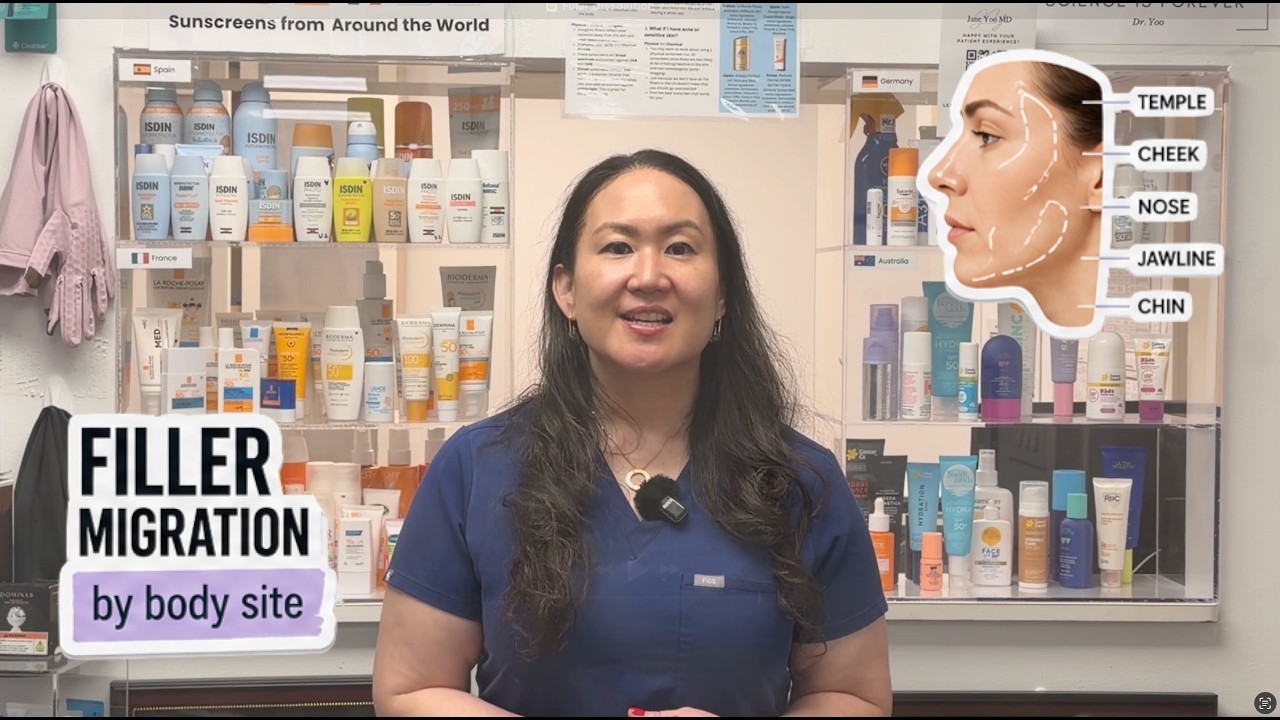
In this educational video, board‑certified dermatologist Dr. Jane Yoo explains why hyaluronidase, the standard reversal agent for hyaluronic‑acid (HA) fillers, cannot dissolve other injectable materials such as Sculptra (poly‑L‑lactic acid, PLLA), Radiesse (calcium hydroxyapatite, CAHA), silicone, PMMA, or unregulated biopolymers. She outlines the typical complications associated with each non‑HA filler—nodules, inflammatory reactions, granulomas, migration, and delayed tissue responses—and discusses how to identify the culprit product using medical records and high‑resolution ultrasound, describing the characteristic sonographic patterns for each filler type. For each material she reviews evidence‑based and experimental management strategies, ranging from intralesional corticosteroids and 5‑fluorouracil to the experimental use of sodium thiosulfate for CAHA, and when surgical excision or specialist referral is warranted. Throughout, Dr. Yoo stresses realistic expectations, individualized treatment planning, and the importance of accurate diagnosis before attempting further injections, positioning the “accurate map” of filler type, location, and viable options as the most valuable outcome for patients with complex filler complications.
Chapters
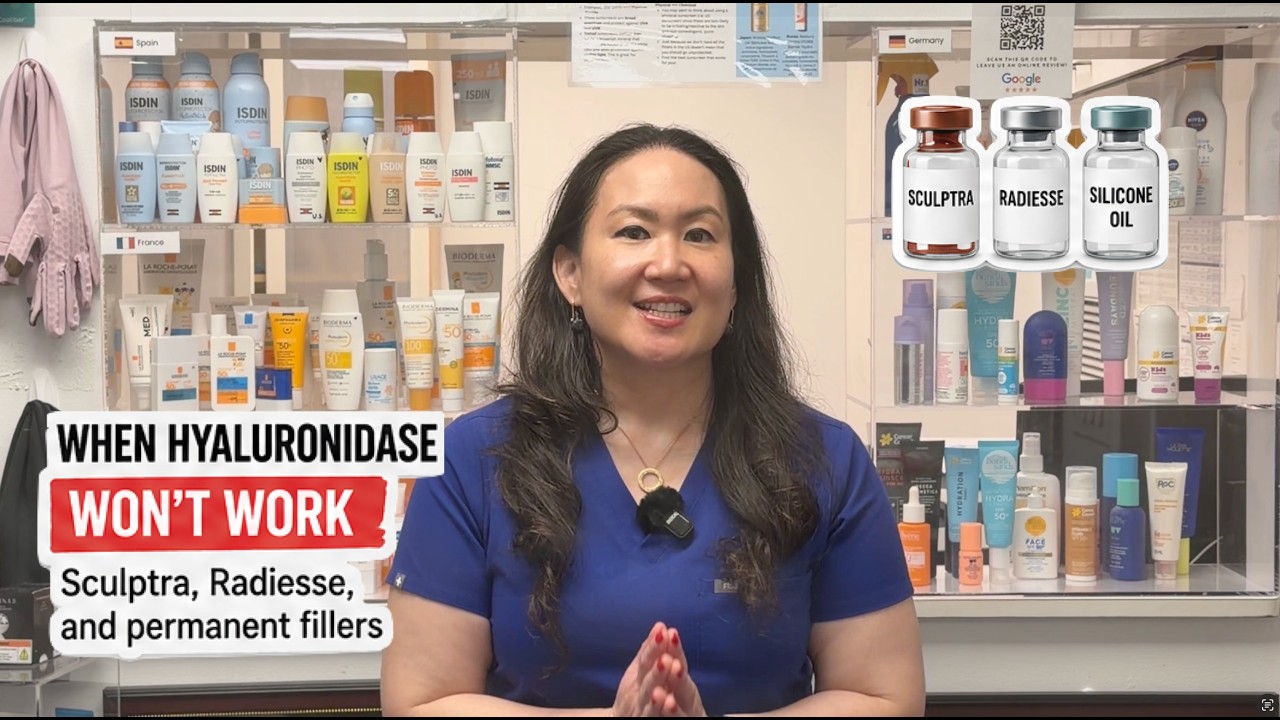
Hi everyone, I'm Dr. Jane Yoo, board-certified dermatologist and Mohs surgeon. Today I want to talk about one of the more difficult filler problems I see. What happens when the product in your face cannot actually be dissolved with hyaluronidase? These can be some of the hardest cases I treat, and I want to be upfront, there are situations I cannot completely fix with an injection, and neither can anyone else with a syringe. Hyaluronidase breaks down hyaluronic acid. It does not dissolve Sculptra, which is poly-L-lactic acid. It does not dissolve Radiesse, which is calcium hydroxyapatite, and it does not dissolve silicone, PMMA, or many of the unregulated injectable materials sometimes referred to as biopolymers. So if you have lumps, nodules, or irregularities from one of these products, repeatedly injecting hyaluronidase is not going to make the product disappear. Let's start with Sculptra. Sculptra is made from poly-L-lactic acid, or PLLA. It works differently from a traditional hyaluronic acid filler. It's considered a biostimulator because injected particles stimulate your body to produce collagen over time. That can be a very effective mechanism when everything goes as planned, but one potential complication is the development of nodules. These can feel firm, may be deep beneath the skin, and sometimes very palpable before they are visibly noticeable. There are several factors that have been associated with nodule formation, including product preparation, injection technique, placement that is too superficial, and treatment in highly mobile areas. The important thing to understand is that hyaluronidase does nothing to PLLA. Treatment depends on what kind of nodule we're dealing with and whether there is inflammation. In some cases, intralesional corticosteroid injections can help. For persistent nodules, treatments such as intralesional 5-FU may also be considered. Sometimes in combination with corticosteroids. And for a discrete, persistent nodule that does not respond to a more conservative treatment, surgical excision may be an option. But that becomes a different conversation because you're weighing the benefit of removing a lump against possibly creating a scar. Now, let's talk about Radiesse. Radiesse is calcium hydroxyapatite, or CAHA. It consists of calcium hydroxyapatite microspheres suspended in a gel carrier. Again, hyaluronidase does not dissolve calcium hydroxyapatite, and unlike hyaluronic acid filler, there is currently no established approved reversal agent for Radiesse. You may come across sodium thiosulfate if you research Radiesse reversal online, and I want to be very careful about how I describe this. Sodium thiosulfate has been studied experimentally as a potential way to break down calcium hydroxyapatite. Some laboratory research has suggested that that it may have an effect on the product, but other experimental work has shown much more limited results. So I would not describe sodium thiosulfate as an established Radiesse reversal agent. The evidence is limited, and this is not the equivalent of using hyaluronidase to dissolve hyaluronic acid filler. Treatment of a Radiesse complication depends on what the actual problem is. Sometimes observation and time are appropriate. Inflammatory nodules may require medical treatment, and persistent discrete lumps that do not respond to conservative management may ultimately require surgical consultation. Now, let's talk about silicone, PMMA, and what are sometimes called biopolymers. This is probably the most difficult category. Liquid injectable silicone and PMMA are permanent filler materials, And when someone has received an unregulated substance described only as a biopolymer, we may not even know exactly what was injected until we evaluate it further. These materials cannot simply be dissolved with hyaluronidase. They can also cause delayed complications. Patients may develop inflammation, firmness, nodules, granulomas, migration, or other tissue reactions years after the original injections. Management can be complicated and highly individualized. Depending on the material and the type of reaction, treatment may involve anti-inflammatory medications, intralesional treatments, or referral to a surgeon experienced in managing permanent filler complications. In some cases, complete removal may not be possible without causing significant tissue damage. That's why I'm very cautious when anyone promises a simple injectable filler fix for a long-standing silicone or biopolymer problem. So how do you find out what is exactly in your face? The first place to start is your records. If you know where you were treated, request your medical records. The product name and treatment details may have been documented, and having that information can save a tremendous amount of uncertainty. The second tool is ultrasound, and this is one of the reasons I use high-resolution ultrasound in complicated filler cases. Different filler materials can produce different patterns on ultrasound. Hyaluronic acid can appear as anechoic or hypoechoic areas, although its appearance can change as it integrates into the tissue. Calcium hydroxyapatite is typically much brighter on ultrasound and can produce posterior acoustic shadowing. Silicon oil can produce a characteristic appearance known as a snowstorm artifact. PMMA and other particulate fillers can have different echogenic patterns as well. These findings are not always perfectly definitive, particularly when someone has had multiple products layered over many years. But ultrasound, combined with the patient's history and physical examination, can often give me a much clearer idea of what category of product I'm dealing with. And that matters because before I inject hyaluronidase, I want to have a reasonable expectation that what I'm targeting is actually hyaluronic acid. If someone has already undergone multiple dissolving treatments with no improvement, I don't think the next step should automatically be more hyaluronidase. The next step should be figuring out why those treatments didn't work. Sometimes the answer is that the product isn't hyaluronic acid. Sometimes we're treating the wrong location. Sometimes what the patient is seeing isn't filler at all. And sometimes the right answer is a surgeon. There are cases I refer to others. If someone has a persistent nodule from a non-hyaluronic acid product that hasn't responded to appropriate conservative treatment, surgical excision may be the best option. And if someone has a complicated permanent filler problem involving silicone, PMMA, or an unknown biopolymer, I want that patient evaluated by a physician with experience managing these specific complications. These are not situations where I would promise that another injection is going to make everything disappear. One thing I've learned from treating complicated filler cases is that sometimes the most useful thing I can give a patient isn't an immediate treatment. It's an accurate map of what's actually happening. A lot of patients come to me after seeing multiple providers and hearing completely different explanations. They don't know what product is in their face, where it is, where they're having a problem or why the treatments they've already tried haven't worked. Being able to say, this is what we think is in your face, this is where it is, this is what we can treat, this is what we can't dissolve, and these are the realistic options, can completely change that conversation. Sometimes one of these options is to do nothing for now. Sometimes it's a medical treatment. Sometimes it's a series of treatments. And sometimes it's a referral to a surgeon. I'd rather give someone an accurate assessment and realistic expectations than keep dissolving something that was never going to respond to hyaluronidase in the first place.