
Ep. 123- Bryce Henson: From Franchise Owner To CEO
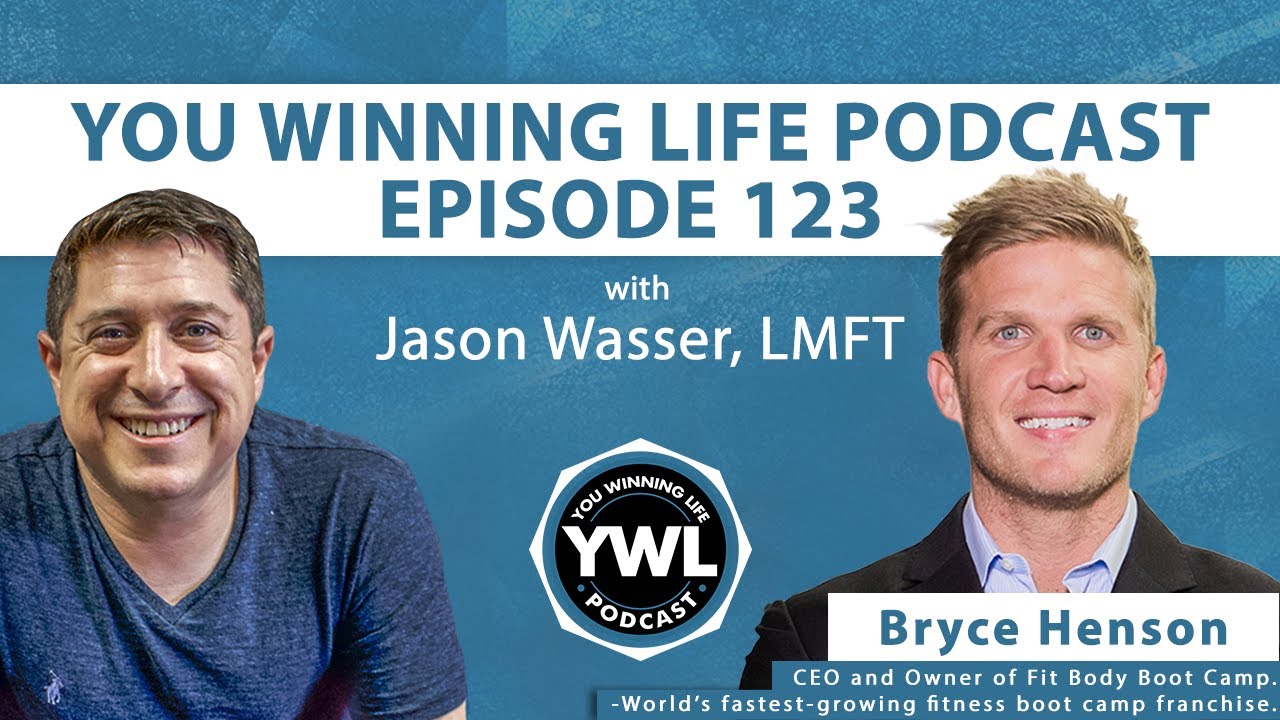
In this interview, host Jason Wasser, LMFT, talks with Bryce Henson, founder of the Fitness Franchise Podcast and CEO of Fit Body Bootcamp, about Bryce’s life‑changing fitness transformation, the mindset and habits that propelled him from a struggling sales rep to a franchise owner, and the leadership principles that now guide a multi‑million‑dollar fitness franchise system. Bryce shares his origin story, the pivotal 90‑day commitment that sparked his confidence, the role of coaching, accountability, and consistency, and how he leveraged core values and anti‑values to shape his personal and business decisions. The conversation delves into the due‑diligence process for buying a franchise, the importance of financial metrics, social proof, and authentic branding. Bryce explains how adopting the Entrepreneurial Operating System (EOS) and delegating tasks transformed his role from “working in the business” to “working on the business,” and he discusses the psychological shift from a “Superman/Superwoman” mindset to empowering a team. The episode also covers the impact of personal challenges such as alcohol addiction on his leadership, the significance of core values, and practical advice for aspiring entrepreneurs on mindset, systems, and leveraging franchise models. Listeners are directed to Bryce’s social channels and podcast for further resources.
Chapters
Hey everybody, welcome back. I'm really excited because today I have fellow podcaster Bryce Henson, who is the host of the Fitness Franchise Podcast as well as the CEO of the Fit Body Bootcamp, one of the world's fastest-growing fitness bootcamp franchises. He has over 10 years of experience in the fitness industry and owning 2 of the Fit Body Bootcamp locations. And his passion is spreading fitness to the world, in addition to mentoring fitness professionals on how to grow their business and change more lives in their local communities. He's a mastermind group coach. He coaches other fitness and business professionals. And we're gonna talk today about health and coaching and business development and public speaking and being an inspirational leader and living in your passion and making your passion partially your profit. So Bryce, thanks for joining. Really glad to have you. All right. So Bryce, welcome.
Thanks, Jason. Super pumped to be here. I appreciate you having me on.
So I'm super stoked because there's so many topics that we were pre-gaming and just going through your background, all of the different experiences that you've had, one in your personal life, two in this professional fitness life that I think that so many of the listeners can benefit from no matter what their background. So we can start wherever you want to start. I know that, um, this wasn't originally what you were doing. You were not originally, you didn't grow up, you weren't born the CEO of Fit Body. Food Camp. And, you know, one of the things that I love sharing with people and having my guests share with people is people end up doing things when they challenge themselves to things they never thought they'd be able to do, or putting themselves in roles, positions, careers, businesses that would never even be a consideration unless someone else challenged them to do that. So when you first started off in this fitness world, where were you? What was going on in life? What led you into deciding a franchise is something that you want to look into, and then how that developed into you becoming the CEO of this company?
Yeah, no, great question. And I'll first tell my origin story in terms of how I got in the fitness space, because I'm a transformation, I guess, beneficiary. And then from there, we can kind of dive into actually how I kind of ascended the ranks, if you will, became the CEO of Fit Body Boot Camp. But, you know, first and foremost, I'd like to tell people I'm from the Midwest, which would be partly true. I spent the first 10 years in Atlanta, And I have some stories there, but really, long story short, when I graduated from college, I was 21. I ended up getting a full-time gig, a sales position out in Los Angeles, California, after pursuing an internship the summer before. And there I was, moved to LA, the sunshine, the palm trees, the beaches, all the exciting things that California has to offer, but also being the plastic capital of the world. So, there I was, 21 years young, moved 3,000 miles from home, from the Midwest. And while I had a lot of good things going in California because of the job opportunity in the new area, if I am being honest with you, Jason Wasser, I had a lot more dark days than good. I didn't have professional skills to offer the world. I moved 3,000 miles from home. If your audience knows of or have been through a move, you can get homesick and lonely and all that, which I certainly went through. But more importantly, I just didn't have confidence, enthusiasm, that kind of energetic approach to life that I now do. And the reason was I wasn't fit. Fitness was not a focus of mine after 40 years of you know, keg parties and Taco Bell as a staple of my diet, not necessarily conducive to a healthy, fit lifestyle. So, you know, as I mentioned, I had a lot more dark days than good. And a fortuitous situation happened about a year after living in L.A., which I was kind of second-guessing myself, this, that and the other, maybe want to move back or try something new. And a good friend, actually best friend at the time, his name's Adam, I went to college with, moved to Southern California. And Adam, he was— he's not on the COVID of Men's Health, but he could have been. He had the six-pack abs, you know, the ripped physique, but the energy, the enthusiasm, the confidence. And I really looked up to that. And as it turns out, we ended up living together for a period of about 2 years. And after a few months of living together, I finally mustered up enough courage to be, you know, to say, hey, Adam, you know, you're obviously like a really fit guy. I see you go in the gym. Could you teach me a thing or two about fitness? And that's really when the light bulb went off. And so his response to me, Jason Wasser, was really, really, really strong. And I'm so grateful he did this because he said, Bryce, you've seen, you know, dozens I've had thousands of guys ask me how to lift weights or how to eat clean, but how many have stuck with it? Very, very few. So I will teach you what I know, but I need you to commit for a solid 90 days that you'll do everything that I tell you. Come to the gym with me, you eat what I tell you to eat. And after 90 days, if you want to quit, you can. But if I'm going to— if you're going to ask me, I need your 90-day commitment. And I said yes. And off to the gym we went. And Jason, man, I got to be honest with you. It was absolutely brutal the first month. I mean, I second-guessed myself. My muscles were sore. You know, anyone who's listening to this podcast knows like, especially coming in cold turkey, how challenging working out can be. Yeah. So from that point, I kind of stuck through it and, you know, 30 days turned to 60, 60 to 90, and then I started seeing changes. And over a period of 6 months, I just drastically transformed my body. I stripped around 20 pounds of body fat, put on 20 pounds of muscle, but more so than anything. And again, if your listeners here have been through a physical transformation like that, yeah, you got the physique, or I got the physique I was looking for, and that's certainly beneficiary. There's the confidence, the energy, the enthusiasm towards life in general. And I became one of the worst performing sales rep in my company to all of a sudden the highest within a 6-month period. Just changed my life. And really, that's what sparked the passion for me to enter the fitness industry.
I love that. So the transformation that people don't even consider of how they show up— and I actually am running a course, a 4-week workshop now called How I Show Up, and we start off with core values. As the first thing that, you know, I have this belief, and listeners have already heard this, but I can't— I can help you only once I know what your core values are. Because how do we know what the barometer is to judge what you want your outcomes to be and whether they're truly in alignment for you or for your culture, for your— right, whatever it is you're trying to accomplish?
Love that.
Right? So once we have that decided, right, so for you, you decided like, okay, I need to have a life of confidence because I'm not feeling so great about myself. And because of that, I know there'll be outcome, you committed to a process. So I, and I know this, like, that people talk about the New Year's resolution. We're now in February when we're recording this episode, right? The New Year's resolution, especially working out, lasts 2 to 3 gym visits, 4 gym visits, right? I'm sure there's a ton of people who bought Peloton in the last year and now that, you know, who are like, ah, can I sell this thing?
Yep.
The compounding interest of personal development is consistency.
Oh, amen.
So what did you find during those first 90 days where we all have those thoughts. I can't do this. My muscles are killing me. I can't believe I can't eat what I want to eat. I'm not capable of this. I know I'm not going to look the way I'm going to look. I'm not seeing the results that I want. It's not that instant gratification. What were some of the tools and the tips that you leveraged during that time to keep pushing you forward to that first, like, that first 90 days?
Yeah, great question. And to your point, it's consistency. That is the really sweet spot for me. There's, there's a book called Influence by a gentleman, a PhD named Dr. Cialdini. He talks about 6 weapons of influence. So social proof and authority, and there's a few others, but one of them is commitment and consistency. So when you commit to something, human nature tends to follow through that commitment, at least short term. So the fact that Adam was able to get my commitment, that kind of set the expectation that, okay, no matter what, 90 days really helped. Because if he didn't I didn't do that, or if it was, you know, left open-ended, I think I would have had a more challenging time. So that was number one. Number two was I committed to 4 days a week. Okay, so it wasn't like I completely overhauled— I was going cold turkey all of a sudden, 7 days a week, perfect eating. It wasn't that at all. It was, okay, can I commit to 4 times, you know, to go to him with the gym, you know, during that period of time? And then I cleaned up my nutrition about 4 days of the week. You know, being honest with you, the first, you know, 90 days, probably even the 6 months, the weekends were still a crap show. However, it gave me some consistency to build off of. So that would be, you know, point number 2. And then I think for me and Jason, I know you're in this space, but I'm a huge proponent and believer in coaching because that's what creates accountability. We all have blind spots. We all need, you know, extra support, especially if it's not your zone of genius. So what Adam introduced me to, when I look at this in hindsight, was he introduced me to lifting weights and the circuit training and nutrition and the clean eating, all those things that we actually do at Fit Body Boot Camp. So when I saw the model years later, I knew this is exactly what worked for me and worked for others. But the biggest thing that he introduced me to was that coaching and accountability, because if I was up to my own devices, being at that point in my life, which was actually 15 years ago in early 2007, which is crazy to believe, I didn't have the knowledge, the belief in myself, and actually borrowed off his belief. So that coaching and that, I guess, accountability was absolutely game-changing. And I'll finish the answer on this tone. Tony Robbins is famously quoted saying Progress equals motivation. So, you know, I didn't rapidly change or transform my physique in 90 days, but with consistency, with coaching, with commitment, and then also just seeing the results. But by day 90, I had a little taste and I saw, okay, this is actually working. Was I where I wanted to be? No. But that progress gave me more motivation to nail down those next 90 days, which then fast forward 6 months is really where the magic happens. Yes.
So let's break down that quote because, you know, everybody knows Tony Robbins. Yeah. And break that down because a lot of people think it's the other way around.
This is what I tell myself, Jason, every single morning. It's opposite. It's counterintuitive because, you know, people think, even for myself, I'm a fitness expert and a fitness professional, you must wake up just like super motivated, hit those weights every day. Honestly, I had a conversation with myself at 4:00 AM this morning when my alarm clock went. I did not feel like working out. In fact, most days I still do not feel like working out. However, what happens is I think Sir Isaac Newton, the founder of physics, one of his laws of motion really hit this in the head. A body in motion stays in motion, and the opposite is true. A body at rest stays at rest. So what happens is people think, oh, I'm not motivated. That's how it's going to be for the next hour when I'm working out.
And that's false, actually.
What happens is when you take that first step, the first probably 5 minutes of your workout, 5 to 7, is the worst by far. But then once you get in motion, according to Isaac Newton, and of course, you know, back to Tony Robbins, progress equals motivation, you become more motivated. And the last, you know, 75% of your workout actually goes relatively smoothly. So it's about starting. That's actually what creates more traction, momentum, and that momentum equals progress.
So what were some of the biggest things once you started building momentum? And I completely agree with that. And that's like, I know from my own personality predisposition that I get stuck in my stuck places. And the answer that I realized over the last 30 days or 60 days has been, do it anyway. Right? A dish is sitting in my whatever. Okay, I can do it tomorrow. No, no, no, do it now. Or, right, it is the do it now. And it's funny, like Nike does capitalize on that, right? That's the brilliance of their marketing. Oh, yeah. Right. And you probably know this, but Nike's real motto isn't "Just do it." That's their phrase or catchphrase, but their real tagline is, "If you have a body, you're an athlete." And a lot of people don't know that.
Yeah. Yeah, I know.
Right? Because we think it's "Just do it," right? But that's their catalyzing statement. But their mission is, "If you have a body, you are an athlete," which is such a— talking about that quote of flipping the Tony Robbins, right? And the way we think it is the way it is. That's an imperative, that's a paradigm shift for most people. And then when I heard it, because we're going to get into the entrepreneur stuff in a little bit, when I heard my coach Rick Sappio talk about that, right, if you create your core values and you hold yourself accountable to your core values, you're on, you're an entrepreneur and you're being entrepreneurial. So in other words, when you decide, when you decided that the business model of Fit Body Boot Camp aligns with what you knew to be true, and this was a way to hold yourself accountable to that personal development side of your life, you are automatically being entrepreneurial.
Oh, I love that. Yeah.
Because it aligned with what you saw to be proven true. And if I keep banging the drum on that over and over again, I will get the outcome, consistency, momentum, but alignment of values as I want to see it expressed in your situation, in a business and a community.
Yeah, 100%. And it's interesting, Jason Wasser, speaking of core values, and I just love exactly what you're talking about, we do quarterly trainings for our franchisee, we actually tour the country. We had one at the kickoff of the year here in Chino Hills, which is a suburb of LA, which is where our franchise headquarters are. We have a next one in May in Phoenix, and then we're going to Nashville and then Florida on a yearly tour. For all the technical training that we provide, the coaches training, nutrition training to be able to provide our franchisees better results for their clients, the number one thing we actually always teach on is the foundation, the core values, our mission, our vision, our values, because without that, like, nothing else matters. So we're just completely aligned alignment. I just think there's a huge takeaway for your audience around this topic. Yeah.
And I think this is like how many therapy clients, coaching clients, workout clients— when you're asking someone why you're— oh, I want to lose weight. Oh, I have a wedding. Oh, it's the holidays. Or, right, I need to get it off. That's not necessarily a motivating, sustainable, long-term, deep enough thing to get them to where they want to go.
It's not enough, actually. It's not enough. You actually have to go way deeper than that to pull out a driving force, whether it's confidence, enthusiasm, energetic life. Your spouse, you know, wants to— you want your spouse look at you the same way again. Those are the deeper issues, the fulfillment issues, the relationship issues, the life, you know, issues versus just the topical issue of losing weight or, you know, dropping a few pounds or, you know, shortening your waist size. So I couldn't agree with you more.
Yeah. And there's something in your life that drastically changed because of this. And you know, when we were talking before, you talked about getting rid of something that was affecting you in your life and changing your life around because Absolutely.
Do you want me to go there?
Let's go. Let's do it.
Well, for our audience, we were talking offline just about, you know, the variety of things that we typically speak on. Jason had some awesome questions for me, but one of the things I teach on is leadership. And there's 4 high-income skills that we usually teach our franchisees. Copywriting would be able to write awesome copy to move people. The presentation skills, we can orderate. Sales skills. And the third, the fourth one is leadership skills. And interestingly enough, when I got into this business as a, as a coach and a trainer, and a business owner for my first gym in 2012, which has been 10 years, I was equipped with my own transformation story. I had learned a lot institutionally through fitness and nutrition. So, I knew I had a lot of value to add, but I didn't really fully grasp the level of leadership that was needed, not only for myself, my clients, my team, and now our whole franchise organization. So, famously, buy into the quote that leadership is always the problem, it's always the solution. So, this all to say and kind of to storytell a little bit, Jason, on one thing that you just mentioned that I removed from my life. It's actually a story that is a blessing, but it was disguised as a tragedy. And I really, hopefully that hits home with your audience. If you look back in your life and some of the biggest stumbling blocks and challenges, if reframed and learned from those, can actually be the biggest accolades in your life. And this story is the same with me. And so, it's 2016 and I had a few locations of my business, Fit Body Bootcamp franchise locations off the ground. And it was a family thing. I incorporated my wife, my mom, my brother, and also my sister, she was leading one of the locations that we had. And, you know, kind of to even back that story up a little bit, my father was an alcoholic and it was a very, you know, we escaped a very traumatic situation when I was younger. So for me, it was a very humbling situation to realize that in my late 20s, after waking up from a blackout, I realized for the first time that holy smokes, I might have an issue with alcohol. And for me, it was interesting. And, you know, Jason, maybe you can, you know, some of your audience can relate. I always thought of an alcoholic as someone who didn't have a job, was homeless, was a bum, drank out of a brown paper bag. For me, that was just never the case. In fact, I like to classify myself as more of a binge drinker. So I would work really hard during the week. And of course, in college, you know, that was one thing. But even as like my 20s kind of came through, I actually drank less frequently, but with more intensity as I grew through my late 20s and early 30s. So I had this realization, and unfortunately, my sister, same genetics, same DNA, was affected by the same genetic disposition. And what I realized is going through a lot of challenge and struggle and whatnot is that I failed as a leader to lead her in the proper path of abstaining from alcohol, removing that from my life, because granted, it didn't cause the amount amount of like big chaos that it did in hers. But it could have been way different, and the luck of the draw happened a few times that, uh, you know, situation could have been different. But in any case, all this to say, um, to kind of conclude and really, uh, storytell, we had a challenge party at the end of 2016. We had the 6-week transformation challenge, a lot of results, and we finished it with, with an awesome event just to celebrate our clients. Well, as it turns out, there was drinking involved for— with my sister and the team. And again, uh, in hindsight, look back, I take ownership of that because I could have led by a better example, even though I didn't drink in that particular situation, just life in general. So after the event was done, I had to interject and it was just a very embarrassing situation. I had to jump in. My young team was drinking alcohol and it just wasn't a good look by any stretch of the imagination. So that next day I had a conversation not only with my team, but I had a conversation with my sister and I said, Emma, I love you dearly. You are an incredible soul. You've built this awesome gym on your back. You're just charismatic. Everyone loves you. But similar to me, we share the same issue, which is, you know, the problem with alcohol, just like our father, just like our father's father. And I said to her, I said, you know, I don't see a silver lining and a positive outcome if this continues. So forever is a long time, but we need to create an agreement that for the next 12 months, we're going to abstain from this. Otherwise, it's going to lead to more chaos that had ensued the years before. So this all to say, Jason Wasser, after I had that conversation with her, and it was probably the 5th or 6 serious conversations around the same topic, I went home. And I went home and I was defeated. I just, you know, after, you know, really challenging situation, I got to sleep and I woke up and I looked at the mirror and I had a deep, dark, heavy look at the mirror. And I thought to myself, you know, how am I going to expect my sister to do something that I can't even do myself? And I realized that in our society, and rightfully so, We'll actually confer— we have forgiveness in our hearts for criminals, but not hypocrites. And at that moment in time, I knew that if I was going to be the best, I guess, person and leader for her, that I actually had to lead first in moral authority. And I'm happy to report that was the last time I drank alcohol. That was over 5 years ago. And while I'm not fixed, it's a work in progress, I feel like I'm addicted to a lot of very healthy things, working out and work and all that. That, you know, the journey continues. But without that shift in my life, and without— by leading a better example for her, the situation, you know, I wouldn't be here today. So I think that's the message I want to share with you and your audience.
The profoundness of that is, right, we all have these similar things that we don't realize in some way that's holding us back from accomplishing what we can truly accomplish, from connecting how we want to connect, from being the type of person we get so stuck in those stories, especially intergenerational emotional themes. And I know, right, I am— I, the stuff that I'm unpackaging now at 43 that I started realizing maybe in my early 20s, but then I thought I was doing the work on in my 20s. And it turned out I wasn't, I was looking at it from the wrong perspective, or I was staying too stuck in a victim mentality about it and still blaming and still— right, the leader, I think the leadership thing is that full accountability, right? The more accountability you can take, the more of a leader you become, and that reciprocal process allows you to have more influence. I met people around you.
Amen. I mean, really, leadership, I define it, um, as, as, uh, someone who is going to take a responsibility for a problem that's theirs and not theirs as well. And that's really the definition, one of many, of leadership. And you just need to be able to, you know, hold yourself accountable in order to hold your team, your clients, your community accountable in whatever endeavor. So for me, I just saw a shining weakness in that. And while it was a complete tragedy, ended up having to part ways with my sister in a very tragic event after that situation. It was the worst thing that I probably have ever went through. However, there was a silver lining that it showed a weakness for me and it showed something I need to remove in my life to get to the next level. And to your point, Jason, you hit it. I mean, your audience, we're human, we're fallible, we have all issues. And whether it's alcohol, whether it's gambling, whether it's other addictions, it's pornography, there's something in your life that is not serving you. And it's time to wake up and say, okay, it's time to make a move if I want to get to that next level.
And this goes to a whole nother level of when I talk about the core values, people don't ever talk about their anti-values. And I love this add-on that if we really— right, life can change when you start living into these things. Like, I want to have fitness in my life, I want to have spirituality in my life, I want to have high-quality people in my life. But what are the, what are the anti-values? In other words, someone can show up or some situation can show up with this. But the way that I look at anti-values is it's a non-negotiable list that even if the core values are there, if 1, 2, or 3, or any one of these things show up that's on this anti-value list, it's still a no of engagement. Because the toleration of those things will eventually lead you to breaking your values. Because we do have a dispensation of like, I don't want to be an asshole. I don't want to be a dick. I don't want to be judgmental. I don't want to be— right? And I always like playing the difference between judgmentalness and discerning. And that's— and we can get into a whole conversation about the difference between those two things. But we always have like, I realized this in one of my coaching groups for young professionals, was people would rather continue dating someone else because they'd rather not make them think that they're the person who ended it, because they don't want to be considered the person who's the asshole, the bad guy, than being an asshole to themselves by staying in the relationship.
Yeah, yeah. And granted, I mean, Jason, you obviously have a ton more experience specific to that, but I've seen it, and you know, for my friends and circle as well. So very interesting.
Yeah. So let's jump into— you're going on this fitness journey, you're going on this personal development journey. So the space that we missed was getting introduced to Fit Body Boot Camp. Yeah, deciding, right? You know, you were already working out. Why and when did you know that you wanted to be a professional in this industry? And what was that process of like, okay, so I know I want to do this, What way do I want to go do it? Do I want to create personal training? Do I want to own a gym? Do I want to— and then what leads you to a franchise versus creating something from scratch?
Yeah, great question. Before I dive into the intricacies, I give a keynote at times, which I call the 3 Ps, which is pain, passion, and purpose. And I find that entrepreneurs, the most successful entrepreneurs typically have gone through something very painful or traumatic. They figured out the solution for it, and then it's become a passion of theirs. And then from there, it, you know, with time and retention and consistency, which is a common theme of today's talk, it then becomes, you know, your purpose. And I feel, you know, similar to me, that's how my journey, I guess, continued. So I was in pain, I wasn't a confident guy, I didn't have the energy, the enthusiasm, the vibrancy that I now have. It's because I didn't, you know, lack the confidence in my fitness and myself. So, you know, going through that pain point, solving that pain point, then created a passion for fitness and then ultimately has led it to my purpose here. And how that all kind of unpacked was after I went through that transformation, that 6-month journey in 2007, I continued to adopt then the healthy and fit lifestyle. And it wasn't until a couple of years later, I think in 2009, when I was working out at the gym and I'll never forget this, Jason Wasser, some dude walked up to me and he asked me how I did this at and what I ate, you know, in terms of my supplementation and my nutrition. And like a light bulb, it was crazy because my identity was becoming a fit guy, but I never thought in a million years that like, holy smokes, this dude's asking me, like, Bryce, holy smokes. So that's when that light bulb went on. And, um, you know, then I thought to myself at the time, I still had some limiting beliefs. I didn't actually think I could make fitness a full career, uh, because I was, uh, being the beneficiary of fitness, my sales career was doing well. So I thought, okay, maybe I'd become a personal trainer and help, you know, some people on the nights and weekends. So actually, that, that's what I did. And I enrolled myself and passed the National Academy of Sports Medicine, which is the gold standard of personal training certification. Um, I ended up picking up some clients and friends on the nights and weekends, which I trained just as more of a passion project. Um, and I think I updated my Facebook profile to certified personal trainer. And when I did, this named Bedros Koulian, who's the founder of Fit Body Bootcamp, a dear friend, um, you know, one of my best friends and a mentor to this day, um, started serving me ads about how to grow a personal training practice and how to, you know, get new clients and how to convert them to long-term members. So I ended up following this guy named Bedros for a period of actually 2 years. At that point, I then made a life transition. I ended up moving to South America for 2 years. I always wanted to wanted to learn another language and live a different culture, country and culture. So I scratched that box. But as I was living there and when I knew I was coming back to the US and California in early 2012 is when I started paying a little bit more attention to this brand called Fit Body Boot Camp that he was talking about in his email and whatnot. So from there, I did as much diligence as I possibly could. I was in my late 20s, 28 at the time, moving back to California. All the research I could find about Fit Body Bootcamp and Bedros, I did. And basically in the summer of 2012, when I got back, I, you know, came to our headquarters here and met Bedros himself and took the leap of faith and ended up putting down the money for my first territory, first gym. And a few months later is when, when I opened my first Fit Body location, which really then we can storytell. But that's kind of how my foundation and entry point to Fit Body Bootcamp happened.
So of all the awesome things that were in that sequence, The first thing that's in— yeah, like, there's people that I've met throughout my therapy, personal therapy development or skills journey, and then in the entrepreneur world, people I've met as well along that journey. And everybody has their own marketing things, and there's really— there's people somehow I get on their email list, or somehow they subscribe you without you wanting them to, and you get, you get off of those, right? But there's one or people in the personal development entrepreneur world that I religiously will check their stuff, and that I would only consider spending a high-value amount of money, like over $100, $200, $300, whatever it is. In other words, a bigger investment than just like whatever, to go participate or be part of their community. And their communication is so clear because they're creating— here's what's not Not just like, are you the type of person who's struggling with like— but it's so tangible with what you're going to get out of it. And it so speaks to that 80/20, right? That 80% of the people, they can go fuck off and we're not speaking to you. For the 20% that aligns to you, we want 100% of our people to be the 20, right? To be the 20%. Yep. What was it about the marketing? What was it about the copy? What was it about the message that was hitting you that made you decide that this is the this is the person you want to talk to and this is the business that you want to be aligned with?
Simply put, the first thing that comes to mind is the authenticity. So Bedros is an incredible marketer. He's a rags-to-riches story. He's really like the true American dream story, which I am as well, but he's in the traditional sense that he comes from former communist Russia, I guess Armenia, which is one of that's in the Soviet block in 1991. 1980, his family bribed the Communist Party to basically get to the US, literally came with nothing, just the clothes on their backs. And the first year, the first few years they moved to Section 8 housing, to Section 8 housing. They didn't have money for food. They literally, he was 6 years old at the time and his mom used to throw them in the dumpsters behind the local supermarket because there's food that is technically expired, but still can be relatively eaten. And especially especially for a family, you know, uh, escaping communism. So that all said, I think just the ability for him to craft a story and be authentic and share his vision and share like his background really, really connected with me. And then of course, you know, he went through his own fitness transformation and there was just a lot of, you know, great aspects of the Fit Body Bootcamp brand, the low startup costs, the, you know, the high, the ability to leverage yourself, the higher profit margins. So there's a lot of other things that went into it, but to your point, Jason, when you asked what was the thing that was compelling me, that attracted me in, it was the authenticity of the message. Yeah.
So then people are in it, like, so people are in a job, they're in a career, they're looking for something else. And right, franchises were kind of like, you know, in my mind going through this journey, it's like franchises are the MLMs of an actual legit business, right? And that's the negative stigma that it probably had. Can't be easy. '90s, and it can be, right? There are people out there who are doing that. What are some of the questions someone should ask to start sorting through? Because you have invested and you have multiple businesses within the business itself, and then you've also worked your way up into becoming the CEO. But what were some of the questions you needed to ask, or you were guided to ask, that helped you discern that this is a good investment, this is a good model, this is a long-term game plan for you that maybe someone doesn't think about or doesn't even know what to ask or to look for?
Incredible question. I mean, I think first and foremost, just the financial metrics. And I'm not a huge data-driven guy, but believe it or not, I feel like I stack myself with really strong analysts to compensate for this. But at the end of the day, you need to make sure from a financial perspective, the business model works, that you have enough capital and working capital to to get it off the ground. So it was a very easy business model to understand, which was really, really beneficial to me, especially that was my first entrepreneur endeavor. Second, it just fell in line with my passion. And, you know, nothing against Subway or any of the awesome franchises that, you know, do serve food, but, you know, fitness is a passion-based business. So I was really excited. I was passionate. I went through my own transformation, so I knew that that passion would lead me to success. And the third thing would be, was just talking. And at the time, there was only about 15 or 20 franchisees in the system at that point. This is literally 2012 was the first year of franchise. Bedro started in 2008, 2009, just after the housing market crashed. There was a licensee program. But any case, I talked to the 15 or 20 people. I mean, I relentlessly hounded them down just to talk about their experience. And we call that the validation process. And talk to other owners in the system. So, I would highly encourage you to, if you're listening to this and you're exploring opening a Fit Body Boot Camp or some other franchise, just to do your diligence. Make sure the numbers work. Have a real talk with yourself, looking at your own numbers to make sure that you can fund this, making sure that it's a business model and the industry is in line with your passion or something that you really want to do, and then talking to other owners. That did a lot for me because what it did is actually it verified because I saw the success, I saw the client transformations, I talked to owners that had success with the model, but really I believe that leadership starts with top-down in any organization. So it was also just getting some social proof and verification that Bedros, who was who he said he was, and by far, I mean, without a shadow of a doubt, everyone was raving fans. So those 3 things really checked the box for me. Gave me the confidence to move forward.
Yeah, that's, that's what it is. I think the due diligence that we either go over too much and therefore we become paralyzed by making a decision, or we just hope that it's going to work out and we don't do enough due diligence, we don't talk to enough people. And I see this all the time. I actually— people who are wanting to become therapists now, like, I used to be like, oh yeah, it's a great, you know, go to a great field, great program, here's a program to go to, here's a program that's not good, don't go to to. And now in 2022, I'm kind of like, I really am going to push hard into the person, be like, why do you really want to do this? Get a job at Starbucks if you want to talk to people all day and make the same amount of money, probably with benefits at the rate in that process.
Yeah.
And then grow into management and grow into— right, you can do therapy in different ways without having to worry about the liabilities and the case notes and the— if you take insurance and all that crap. And right? And God forbid, right, high-risk cases versus low-risk cases, which I'm— I'm not a mental health practice, I'm a personal development therapy practice. And I'll do couples and I'll do relationships, but I won't see certain types of situations. Right? The simplicity over the complexity model. Yeah. But a lot of people don't know that because you get the shit at the beginning. You have to take on all those things. And what's that like? And do you know what you want? And do you have a business mentality? All these these things that people don't ask where now I'm more likely to turn somebody away from, in my opinion, from this field because you need to have all these other sides, right? So the branding, the marketing you said was part of this package that's worked into simple done-for-you opportunities.
It is. But Jason Wasser, to your point, I think that's so sage advice because while someone may have an interest, at the end of the day, do they have the mental capacity, especially when you're To your point of all the risk of being an entrepreneur, I mean, that's real. And at the end of the day, shit is going to hit the fan. Not everything's going to go perfect. That is just the way of the warrior, the way of an entrepreneur. So not only do you have to have all the analytical aspects, the branding, the marketing, the finances sorted out, but you actually have to just really be honest with yourself. Do you have the mental capacity to keep on going when the going gets tough? Because I probably have 3 3 or 4 big make-or-break stories. And one of my gyms, literally the city wanted to shut me down because of permitting. And there's no handbook for that. There's no, from a franchise perspective, I had to dig deep, get resourceful, going to the city, making my plea, talking about how we inspire fitness and change lives. But all this to say, Jason, is you do have to have the mental capacity and fortitude. You got to be honest with yourself to make sure that whatever endeavor that you're gonna actually pursue that you can execute.
Yeah. And I think that goes back into the idea of like having a business versus being an entrepreneur. And I really worked my way through this the last couple years about owning a business makes you entrepreneurial, but it doesn't make you an actual entrepreneur. In other words, there's the thought process of that. And, and, and not everybody, right? Just because you start a business doesn't make you the CEO either, right? A CEO is not a solo— you're not a CEO if you're a or solo practitioner. Like, I'm not a CEO, I'm a solo practitioner. I have two associates, they're virtual, right? They get their clients and I, you know, it's a piece of the pie at some level. Every, listen, at the end of the day, everything is multi-level, right? But I'm taking the risk, I'm creating structure and creating things. But what I want people to realize is when they talk about like, especially the social media, you know, the last couple years of like, ah, I'm gonna be an entrepreneur, I'm gonna be an entrepreneur, but you're doing this hustle that everything does go back to systems. Everything goes back to structure. Everything goes back to methodology. Everything goes back to, yes, you can create money. You can create, I can create money when I'm working, but am I creating money when I'm not working? And I think that's more of that like E-Myth mindset of right entrepreneur, manager, technician. And I'm having this conversation with a lot of my clients, like, oh, I wanna start a side hustle. I'm like, no, you wanna start a side hustle. Side technician job? Because you're already a technician during this day and you want to be a technician when you're not working on your days off. What about making— building that up to making something where you hire people who are also off and you hire them and you structure an organ— oh, I didn't think about it that way.
It's a different ball game. I mean, a huge fan of Michael Berger's work for that reason, right?
So yeah, so how do you see that? Like, one of the reasons, you know, of you going from a personal trainer to a gym owner to now a CEO, how did that mindset shift? And what— did you have like any aha moments or like realizing like, oh, I no longer see it this way, I have this new awareness? Do you have any experiences or examples of when that kind of— those little micro nuggets kind of shifted for you? And like, it's like, oh, I've been doing it the hard way my whole life, or oh, this is the way that we're taught to go to work for 40, 50 then retire, right? But we stay in that one little thing. Yep.
So for me, it's interesting enough, there's two big aha moments that really helped me with my ability to actually rise the rank, become CEO of this awesome organization. And it comes down to leadership, which we talked a little bit about, and then also to adopting— we talked about systems. We've— I stumbled upon this book called Traction, which is written by Gelland Gina Wickman, who's the creator of EOS, the Entrepreneur Operating System. And that foundation of EOS has just dramatically shifted our business in the last 3+ years to incorporate proper accountability, to incorporate proper communication, proper leadership, and more importantly, the systems and structure to run a multiple 8-figure business a year. Like when you factor in all of our franchisees globally, it's in North America. So I think those two paradigm shifts of leadership, which we talked a little bit about, a couple of stories that I had that really led me to believe that I need to be a stronger leader that leads by moral authority, meaning I talk my walk or I walk my talk, if I can say that correctly, in addition to the fact of having strong business systems at play. But for me, and maybe this isn't the answer that you're looking for, but Jason Wasser, I really do feel that I was inherently, I knew that, okay, while fitness is what I want to do, I was passionate about it, I also knew that one of the things I had to do very quickly is to get myself off the training floor because I was working in the business. And really, from the very beginning, I knew that I want to build an empire. So I kind of had that a little bit factory installed in me already. I just needed to learn the leadership, the communication, and then the business systems to be able to help me elevate innovate and work on the business, in the words of Michael Gerber of E-Myth, instead of specifically working in the business. And I think with that factory-installed mindset and some of the learning lessons of leadership of business systems of EOS really helped me ascend the ranks and talk to you as our CEO.
And I think the mindset behind all of that, of shifting from like, I have to do it all, to being able to bring other people in, one of my buddies calls it the Superman, Superwoman syndrome in that regards. And I playfully call it the Colonel's secret recipe. God, someone's going to find out the recipe to do it and they're going to steal it and run away with it. And I think that's those two paradigms, the Superman-Superwoman syndrome, and I can't release the Colonel's secret recipe.
That's so powerful because I was that way for a long time and I was so guarded if a new coach was going to basically like open a competing business. And now I'm like, holy smokes, good luck. I will support a million ways to the moon, but it's the execution. It's not the secret recipe. And I think that shift happened. And for me, it's interesting, probably the biggest shift that I had in my younger entrepreneurial endeavors is there's a lot of people that want to work and help support you build your dream. And I think because I always had that CEO business ownership mindset, it blew me away. Actually, it still humbles me to this day realizing that the vast majority of people and probably for good reason, shouldn't open their business. Like, it's challenging, you know, you've seen this, the data behind it. As an entrepreneur, you have to conduct the whole symphony, if you will. There's a lot of people that really want to stay in their lane, be really strong technicians, and really, if you're a good person, you have strong passion, if you're doing good work, want to support you. And I think for me, that was probably a big learning lesson that I learned probably 1 or 2 years in, and that really let me realize that, okay, it's okay that I want to coach every session. It's okay because other— there's people that want to coach, there's people that want to do nutrition, there's people that want to do administrative work. My job as a leader and entrepreneur is just to arrange the symphony, get out of the way, and let the team execute, right?
And that's part of their purpose and their mission. Like, some people really are experts at bookkeeping, some people are experts at— right? And, and by not— by us keeping that on in our role and take— we're taking away someone else's purpose, right? And yeah, Yes, we're leveraging time for money. But if they're an expert and that's the top of their capacity and that's what they were put on this earth to do, and it's not like, oh, one job is better than the other.
No, right?
It's really about we're taking away, we're not allowing other people to live in their purpose by us taking that on and hoarding all of the positions in our— and that's why when he talks about the org chart, right, Michael Gerber, about the org chart in the business, yeah, you might start off doing all of those things. Things. But I'm not a copywriter. I don't know how to write really good copy. I don't know where— I have a website that I go to for hashtags. Is that the best type place to go for hashtags? I don't know. It's working relatively okay. Right. And I don't know what's gonna get me into the algorithm or not get me into the algorithm. And when I started deleting fake followers, I lost my Instagram account a year and a half ago, and I got to restart a new one from scratch. Right. So So that has to be done by people who are experts in that. But I see so many business people, oh, I need to do my social media and oh, I need to do work on my website and oh, I need to sit at Starbucks for 8 hours learning this thing. Okay, but is that making you the better at the best thing that you're best at? Make more money on that and then refer out.
Delegate the rest. And there's people that want to be awesome copywriters and want to be awesome administrative leaders and want We want to do awesome in our business, nutrition coaching. So to that point, take a step back and let your team run and know that the power of delegation is actually what's the truly most impactful thing for an entrepreneur. So definitely on the same page there with you, Jason.
And maybe just to wrap that up with why maybe some people will benefit from a franchise versus starting a business by their own is because the leverage is there. It's the proven method, at least in the ones that people are doing the due diligence in and seeing what you're saying.
Right?
The leverage is there. You don't have to start from scratch. It's a plug-and-play, and that's going to take away all the areas you don't have to be an expert on, because that's why the franchisee has invested all their time, effort, money into creating that structure to make it leverageable and more simple at the end of the day for everybody else that's investing in that business.
Amen. I mean, we have 15 years of trial and error and proven systems and processes that, you know, someone who's going to join our franchise, as an example, is getting the handbook day one, which took us 15 years to evolve. And bigger picture as well, the value in any franchise system is also the network within it, because we always like to say we can create faster than the other competition can copy. And we're in any given situation, we're doing 5 to 10 tests, or there's a marketing campaign, what's email copy, what's a program that individual entrepreneurs just not going to have the ability to execute against. So from my leverage perspective, from a network perspective, and the proven model, for me, and it's not for everyone, franchising isn't for everyone, but for me, it was just a huge, huge win. And there's a lot of people in that same boat.
Awesome. So for everybody who's been listening and there was even just one little nugget of something that you loved and want to grab more from Bryce, Bryce, where can they find you? I know there's a few different websites and a few different places in the podcast, so throw those out to everybody. Absolutely.
Well, I appreciate it. Both my social handle and my website are all in one. So, Real Bryce Henson, not to be confused with Fake Bryce Henson. So, that's where you can find me on all my social channels, Real Bryce Henson, and the website's realbrycehenson.com. So, that's the best way to connect and would love to stay in touch and add value for you and your audience any way that I can.
Awesome. And if anybody out there really did benefit from the show, please do me a favor, go on iTunes, usually is the main one. Just leave us a positive, favorable rating. And also go to Bryce's podcast, and that's called the Fitness Franchise Podcast. So there you go. So anybody's interested in that world and what it's like to grow, and then there's other— I saw some of the topics on the show, and you don't have to have a franchise because there's so many different marketing skills and other stuff that you talk about. But if you're into that world of marketing and scaling and growing, there's some really good episodes on that as well. And Bryce, I really do thank you for hanging out, and I'm excited excited for the success and growth and the journey that you're on.
Jason, thank you so much, man. This was so pleasurable. You're an awesome host, and, uh, just really appreciate you taking the time.
My pleasure, brother.
More from Jason


Howard Behar Starbucks Former International President Heartwarming Story #kindness #shorts





