
Ep.124- Life Hacks From A CEO Sleep Evangelist with James Swanwick
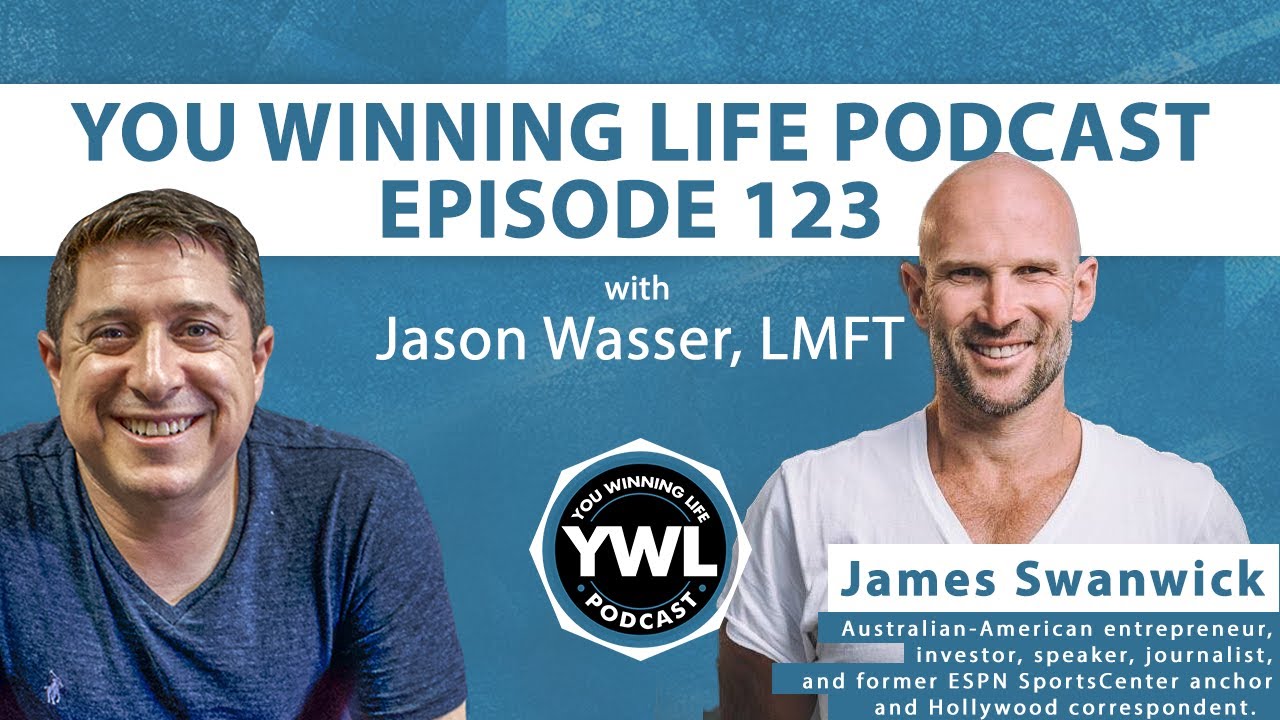
In this episode of the You Winning Life podcast, host Jason Wasser interviews Australian‑American entrepreneur James Swanwick, the creator of Swanwick Sleep’s blue‑light blocking glasses and the Alcohol‑Free Lifestyle program. The conversation traces Swanwick’s unconventional journey from a promising newspaper reporter and ESPN SportsCenter anchor to a global health‑focused entrepreneur. He recounts how a 30‑day alcohol‑free experiment in 2010 sparked dramatic personal changes—weight loss, better sleep, and a new career opportunity—and led to the founding of his Alcohol‑Free Lifestyle coaching business, which has helped over 20,000 people. Swanwick explains the science behind his Swannies glasses, differentiating clear, yellow, and orange lenses and how they interact with circadian rhythms to improve sleep quality. The discussion expands to the broader health impacts of alcohol, including B‑vitamin depletion, disrupted melatonin production, and weakened immunity, and how eliminating alcohol can break this vicious cycle. Practical entry points are offered: a 30‑day challenge, podcasts, and coaching programs. Swanwick also shares how living in Bali, with its beach, community, and natural environment, supports his biohacking philosophy. Finally, he outlines his marketing approach—podcast, TikTok, and Amazon sales—demonstrating how he reaches a wide audience with his health‑optimizing products and lifestyle guidance.
Chapters
Hey everybody, and welcome back. Today's guest is James Swanwick, who's an Australian-American entrepreneur who focuses on helping casual drinkers reduce or quit alcohol. He has a background of being an investor, a speaker, journalist, former ESPN SportsCenter anchor, and Hollywood correspondent. He's coached thousands of people to help them improve their lives and performance by adopting an alcohol-free lifestyle. He's the author of the 30-Day No Alcohol Challenge and Project 90, which is an online program providing support and coaching for individuals eliminating alcohol for their lives. He's also the host of the Alcohol-Free Lifestyle Podcast. And how I know him is the creator, along with his brother Tristan, of the popular health brand Swanwick Sleep. Which produces blue light blocking glasses to improve well-being and sleep quality. The company has sold more than 150,000 pairs of its Swanny glasses, including to me, and they're worn also by pro athletes in the NFL, Major League Baseball, and the NBA. It's been featured on major shows like Kelly Ripa, The Today Show, and Forbes, as well as being recommended by some of America's top sleep doctors. In his early life as a journalist, he was reporter for Robert Murdoch's News reporting on worldwide news, and he has been featured in The New York Times, Associated Press, Wall Street Journal, Sydney Morning Herald, Daily Telegraph, The Sun, and The Courier-Mail, especially when he worked from 2010 to 2012 as an ESPN SportsCenter anchor. Welcome to the show, James. That was such a ridiculously awesome background that you got. All right, y'all. So welcome back. And as usual, I am trying to hit some all-star spectacular guests that are hitting all of the topics that you guys know that we talk about, which is psychology and spirituality, integrative medicine, and entrepreneurship, which seems 4 very different backgrounds. But for me, I see those as the pillars of what we need to tap into in order to have a successful life. And as you heard in the intro, we have James Swanwick, who is just hitting all of those with home runs. And James, welcome, and I'm glad we're getting to hang out tonight.
Jason, thank you very much. It's great to be here.
So I know we've had people from all over the world at different times and places in their life, but you're hanging out in a really cool place right now. So you want to tell everybody where you're at and what's going on? And are you on vacation, or is this your new work location, or is this—
Yeah, I'm in Bali, Indonesia. I'm in a place called Canggu. I have been living in Bali on and off for a couple of years now between Venice Beach, California, Brisbane, Australia, where I grew up, and also Bali. So I kind of bounce between those three locations, and I'm in Bali at the moment.
That's awesome. Yeah, it looks a little bit like South Florida outside my window, but probably a lot nicer than, than where I'm at. So, but I'm glad we're taking this time to do this. So, you know, there's so many different places we can start, but I always love The story of when someone knows that there's something bigger and greater out there for them. And when they figure out what some of those beliefs that they've carried or self-limiting stories that they may not even have realized that were there, that were in their way, that then allowed them to become something greater, better, bigger than what they even dreamed was out there for them. And I know you've had multiple stages of your life that have been pretty cool. And you've gone from reporting and sports, and now you're doing a lot of sleep study and recovery and alcohol, stuff like that. So when did you— like, growing up, like, did you already know what you wanted to do? Was that path apparent to you, or did it start kind of revealing itself bit by bit?
It revealed itself bit by bit, but I can say growing up in Brisbane, Australia, uh, the expected path for me was to finish high school, get a college degree, get married, get a mortgage, get a home and live in the Brisbane suburbs. And certainly 90% plus of my school friends did that. That always, I always felt resistance to that, internal resistance. And so when I was 23, 23, I made the decision to leave what was a great career at the time. I was a newspaper reporter and I was being earmarked for great things. I would probably eventually become a chief of staff or an editor of a Rupert Murdoch-owned broadsheet newspaper. But at age 23, I said, you know what, I'm going to go and live in London for 4 years and backpack around and see the world. And, you know, some people, including my parents at the time, were aghast that I would give up a career that I'd already been in for 3 years at that stage. And there was a recession going on in Australia at the time as well. And so the idea that you would quit a job during a recession to go and take the risk of not knowing what your future was overseas was, you know, something that people just kind of raised their eyebrows at. And so truthfully, I didn't know what was going to happen. I just knew I wanted to see the world and do something else other than what was expected of me societally, certainly in Brisbane. And, you know, piece by piece, I kind of over the years, over the next 20-something years, I was subjected to new health techniques, different ideas and perceptions, different ways of seeing the world, different cultures.. And all of those, being exposed to all of those different people and different cultures later on helped me to develop and build and produce these businesses that I have created now, which is helping people to sleep better and helping people to reduce or stop alcohol. So it wasn't my plan as a young man in Brisbane to say, one day I'm going to go and help the world by helping them sleep better or quit drinking because At the time, I was a societally acceptable drinker, but I think making that first choice to break free of the societal expectations and go overseas is kind of what's led me to this point.
So what was the steps? Because as I'm sitting here thinking, I grew up in South Florida, and after high school, I spent 2 years in Israel, which was not the most common thing for the average American to go, you know, to maybe to go to Europe for a semester, but to go live in the Middle East for 2 years is definitely a little bit more of a significant thing, but it was ingrained in a certain segment of the Jewish community here in South Florida, or actually in America, to go and spend a year studying abroad. But to go and like backpack and already be in a career, to already be post, right, post-college age, and then go do that, that's a much bigger risk, like you were saying. So do you feel like that there's some type of like societal, like, norms that, that maybe even though your parents gave you a difficult time for it, that might be more of like European thing or more of like non-American to be more acceptable at some level to be able to do that?
Yeah, I think as an Australian growing up, we are so geographically cut off from the rest of the world. You know, we're down under is the cute term for Australia. And so some of us, or I would say many of us, many Australians I mean, have an insatiable desire to go and explore or go walkabout, as we say in Australia, if we're going to go explore domestic Australia. So I think for us, it is ingrained in many of us to quote unquote escape the motherland of Australia and go and venture and take a trip and be subjected to new cultures and new horizons. And I think that's That's very much ingrained in us. And also I think probably because, you know, Australia was built as a penal colony, you know, all England sent all of their convicts to Australia years ago and it's going from the Northern Hemisphere at the top down to the Southern Hemisphere at the bottom. It's such a long journey. Maybe there's something ingrained in us as well to want to go back to the real motherland from 200 or so years ago, which is let me go and explore where my ancestors came from. So even though I got resistance from my parents, you know, I mean, at that stage, I'm still a— when I'm 23 years old, I'm a man, right? I can make my own choices. But nevertheless, your parents still play a pretty big role in your life, or at least they did for me. So, you know, while I got that resistance from them, I think that generally most Australians would go, oh yeah, that makes sense. Yeah, you went overseas and you went traveling and You went and saw the world. And that's why you find so many Australians, at least as backpackers, you know, scattered all over the Northern Hemisphere.
So on that journey, right, you started finding new things, experiencing new things, hearing new things. And again, like being in South Florida, one of the things I joke about, one of my clients came into my office a bunch of years ago, and they're like, I realized this thing about South Florida, about at least, you know, certain parts of America, but more specifically here. It's a sunny place for shady people. And that there's a certain type of attraction to certain type of environments that bring forth certain experiences. And I joke that I love going out and asking people what's the last book they read in South Florida. And seeing how— I always give it bad, but it's a lovely place. But it's kind of like we're not known to be the intellectual epicenter. Of the world, or the— it's great, you know, if you want certain lifestyles. So I know that that party drinking lifestyle that starts off at college continues into your 20s, 30s, and 40s, because a lot of the young professional society of which, uh, that are listening to this podcast are embedded in and stay in for 20 years. So when you figured out this drinking code, right, this thing that's kind of like socially acceptable, right? I found that as I was getting older, I'm like, well, now I can afford to buy a nice bottle of scotch that, you know, has to be a minimum of 18 years old or 20, right? Or whatever it is. And that became a thing, even though I'll have one scotch every 2, 3 weeks. But there's still that mentality of drinking in relationship to some type of cultural status, social status, financial status, or just partying and chilling. How did you start unraveling that in your mind as you started journeying, going through, you know, some of the business stuff, some of the the new stuff, just being you, where did you start unraveling that?
So I was a societally acceptable drinker growing up in Australia, in Australia. And I had a couple drinks at the end of each day on weekends. When I was younger, certainly I would go out and drink more heavily. But, you know, in my late 20s, early mid-30s, I was what you would describe as someone who society would say, oh yeah, you, you drink fine, you know, you have a couple glasses of red wine, a couple beers, you'd share a bottle of wine over dinner, no big deal. But what I realized is that as I was moving through my 30s, I wasn't sleeping as well. I put on about 20 pounds slowly over the course of about 18 months. My skin started to look weathered. I was irritable. I was tired. I was lacking in energy. And I thought to myself, and I realized, wow, this kind of lifestyle of just having a few seemingly innocent drinks has finally caught up with me. And I remember I was in Austin, Texas in 2010. I was at the South by Southwest Festival. And I had two Bombay Sapphire gin and tonics at an industry party on a Friday night, went back to my hotel, went to sleep, woke up in the morning, and I didn't have a hangover, but I just felt blah. And by blah, I mean I was like, I could taste the gin in my mouth. I was tired again. I was like, ugh, took a bit of energy to get out of bed. And I looked in the mirror and I didn't much like what I saw. I wasn't rock bottom. I wasn't waking up in a ditch. I didn't get a DUI. I wasn't making an ass of myself. I wasn't getting arrested. But 20 years of consistent socially acceptable drinking had finally caught up to me. And that was when I made a choice. And that choice was I'm going to take a 30-day break from alcohol just to see how it feels. And in 30 days off, I lost 13 pounds. I slept better, and I got an audition to be a SportsCenter anchor on ESPN, which is a pretty famous sports TV show in the US. And I got that job, and I just thought, well, 30 days without alcohol has really worked wonders here. I think I'll just keep going. And I literally haven't picked up a, a drink since. I haven't had a drop of alcohol since 2010.. And during those 12 years, I've generated clarity, focus, energy, great sleep, created 2 businesses, and I'm just a better person. Not to say the people who drink consistently aren't, are any better or worse than me. It's just for me, I've had a life with alcohol and I've had a life without.. And without feels so much better for me. You know, I did this for a number of years and people would ask me these questions. Is it true you don't drink? How do you have a good time without drinking? And I just, I got tired of answering the question. So I thought I'm going to create a business around this and actually just help people. And in 2015, I created a business called Alcohol-Free Lifestyle. We've helped about 20,000 people now to stop drinking. It's very empowering. It's fun. It's aspirational. It's the exact opposite of what I perceive AA to be, which is dark and depressing. And, and, um, and, uh, yeah, it's a, it's, it's a, it's a lot of, it's a lot of fun, and it's the gift that just keeps on giving for me.
So as people are hearing this and they're like, hmm, I might want to try this, and I know you have different challenges and different things, so what are some ways that people can start getting introduced to just the entry-level idea of like maybe, right, I know there's, you know, different times throughout the year, like, well, we're not going to drink this month, or we're going to go to the gym every— right, there's all these different challenges. So what would be some ways, right, you said, because it's more fun, it's not AA, it's not about, uh, this judgment of one way or the other, what would be like some of the entry-level ways that someone would be open, or they should be, could be open to experimenting or experiencing this with you?
Yeah, so first thing I would say is I have a podcast called Alcohol-Free Lifestyle Podcast, which is in Apple Podcasts and on Spotify. Certainly, I would invite you just start listening to a few episodes there if it speaks to you. But more than that, I think, you know, doing a fun little 30-day challenge is just that. It's a fun little challenge, and it's a great entry point, and it gives you a glimpse of what an alcohol-free lifestyle could can feel like. And certainly I have a program which is called 30-Day No Alcohol Challenge, which you can check out, or you can just, you know, do these Dry Januaries or Sober Octobers. There's lots of them out there. What I would, what I would maybe not warn against, but what I would just want to make be clear on is that when you do a 30-day challenge, it is a great glimpse as to what it feels like, but people tend to then celebrate on day 30 or day 31. By going and having a drink or returning to exactly the same level of drinking that they had before. And while it's amazing that you've experienced 30 days without alcohol, I think that the intention is misplaced, because if you are wanting to celebrate with a drink on day 30, then I think you've missed the point. Um, because all that really means is that you're depriving yourself of something fun for 30 days. And you're telling your brain and your unconscious that not drinking is unpleasant and drinking is pleasant. Whereas I take a different approach, the exact opposite, which is I think that drinking is unpleasant and not drinking is amazing, and that's the gift. So, uh, so I say that not, not hesitantly, not, not in terms of a warning, but just maybe as an invitation that instead of looking at doing an initial 30-day challenge as something that you finally get to escape from, I would look at it as— I would invite you to look at it as, I'm going to do these 30 days and just see whether this is something I would want to continue with as a lifestyle ongoing for many, many years. And it doesn't have to mean that you stop entirely. For a lot of people, quitting entirely works for them, and that's, that's amazing, and that's worked for me. But it can mean that you only drink on occasion. I would also warn against saying you only drink on a special occasion because that implies that drinking alcohol is a special occasion, and in my view it's not. Because in my view, all alcohol is, is attractively packaged poison, because alcohol is a toxin. It's filled with toxins. And it— there is zero nutritional benefit to alcohol. Zero. Um, and a lot of what I coach people on is, uh, engaging with people socially, having fun, enjoying romantic dinners, enjoying social functions, going to a wedding, going to a party, having anniversaries, and celebrating and having fun without the alcohol. But people think today that you you need the alcohol in order to have fun and to go to a wedding and to travel and to reduce stress. What I, what I coach and what I teach is enjoy an alcohol-free lifestyle. The reward is the alcohol-free lifestyle.
I love it. As, as I'm hearing you, one of the things I'm reminded of is, um, when you said the nutritional value, that there's a lack of nutrition, there's no nutrition. In it and B vitamins, right? B vitamin complex are all— a lot of them are connected to stress handling. And one of the things that depletes vitamin B quickly in our nervous system, in our body is alcohol. So it's that catch-22. I'm stressed, so I'm going to go grab a drink. And therefore I'm going to deplete my B vitamins. And right, it becomes that vicious circle and our B vitamins are there to help us stay calm, relaxed. And what is it? I think the research shows that 1 out of every 10 people with a vitamin B deficiency, significant vitamin B deficiency, has what they deem neuropsychiatric concerns, significant anxiety and significant depression. And yet people go, right, and think, well, I'm gonna have a drink to take the edge off. I'm gonna have a drink at the end of the day, right? All those things that we think are going to be stress reduction are actually contributing to the worsening of our emotional well-being.
You're right, Jason Wasser. Yeah, you're absolutely right. And the reason people still do it though is because it creates— the drinking alcohol creates the illusion that it's helping you. It's a temporary and illusionary feeling. Temporary and illusionary. So yes, you have a drink and you— and instantaneously almost you go Ah, it does give you that relief, it does. Mm-hmm. But it's, it's false, because what it's doing is, like you said, it's depleting your B vitamins even further. It's, uh, raising your— it's putting your liver and your body to work to try to flush out the toxins, which is now more taxing on the body. It now compromises your sleep. And what replenishes your B vitamins and what replenishes your body? Sleep, rest. But when you have alcohol, especially so close to bedtime, your body doesn't go into that deep restorative phase of sleep. And so you wake up in the morning feeling tired and lethargic, even if you have had 7 or 8 hours of sleep. You still wake up feeling tired and lethargic. Well, that's because you had alcohol before you went to sleep and your body was working instead of resting. And now what happens? Well, by mid-afternoon you crash, you're tired again, and now you're looking forward to just taking the edge off by having another drink, which gives you that temporary illusionary relief, which then keeps you stuck in that vicious cycle. So people thankfully are increasingly becoming aware that there are ways to relieve stress and anxiety at the end of the day that do not involve drinking attractively packaged and attractively marketed poison.
It's so interesting because I'm thinking about in the morning, to get those people going, they're drinking their coffee, which, right, we— I'm sure the research out there, people just can Google this— the amount of mold toxins and aflatoxins that are in coffee, which was the whole thing with why Dave Asprey started his whole Bulletproof Coffee company to— and why, like, really good high-quality coffee is being batch tested for molds. But the whole thing of the Bulletproof Coffee was you get this protein and you get this fat intake, which goes right to your brain, keeps you running smooth. You don't have that glycemic index crash. So I can see this happening on both ends, right? That people who are probably having those drinks at the end of the day to come down are probably having the excessive amount of caffeine and coffee in the mornings. To get them going. And this is yo-yo, that at some point it's going to snap. Meanwhile, through the day, they're moody, they're cranky, their blood sugar handling is all over the place. And they'll grab whatever they can grab to feed themselves to hopefully regulate if they're not even taking medications, and which, right, we know that the overprescription of that. So, this makes so much sense where it's a cyclical process where we're getting stuck. And then you add this sleep factor. So, let's go into that because, right, that's how I found you. That's how I met you, right? I stumbled upon your glasses and I have my case here with my awesome evening glasses, which I probably would throw on right after we're done, or I'll throw them on now. But got these for my evenings. And it's crazy because I traveled with them a few— from Florida to Philly for a conference. And I not only wore them at night, but the next day in the conference because of all the lighting, the halogen lighting, it was just giving me such a headache. And I felt such a difference. And I know these are the later evening glasses. I don't have the clear ones yet. But I felt such a difference even wearing these throughout the day. So let's talk a little bit about one, how you stumbled into this because I know this is such a niche product line. And I know Dave Asprey, right, is one of those people that also has— that's actually how I started hearing about this. And then I found you and I'm like, oh, this actually, I really like your product. So walk me through how did you stumble into this? What was your own experience with it? And why, you know, and then there's different types of lenses for different types of days and Let's give people a crash course in all of that.
Sure, sure. So yeah, I, I produce these blue light blocking glasses. You're wearing the, uh, the orange lens glasses there at the moment, which you wear at nighttime, and I'm wearing a pair of the clear lens glasses, which I wear for daytime computer use. Uh, back in 2015, I was in Palm Springs in a, uh, uh, and I went out to dinner in the, in the hotel restaurant with a friend of mine and he was wearing a very unsightly, ugly pair of Uvex safety glasses to dinner. And it was a very nice hotel restaurant. And I was looking at him going, what are you wearing? Like, what are you doing? And he said, I'm trying to block the blue light. And I said, block the blue light? What are you talking about? And he said, well, the light from the hotel restaurant is hitting our eyes and stimulating our pineal and pituitary glands and making it more challenging for us to sleep well later on at night. So, and he said, you know, so I wear these glasses with the orange lens. An orange lens repels blue light because orange is the opposite of blue, blue is the opposite of orange. I protect my eyes. And so what— and then he went on to say that when he goes back to his hotel room after dinner he'll be able to remove the glasses, turn off the light and fall asleep better and sleep better. And I was like, sounds kind of wacky to me, but I'll give it a shot. So I went back to my place in Hollywood, California at the time and I pulled out an old pair of ski goggles that I used to use every year in Park City, Utah. And I started wearing these goggles at nighttime while watching the TV series Mad Men. On AMC. And what I noticed was, as I was wearing these ridiculous goggles while watching Mad Men, I did notice that I started to get tired or sleepier quicker. And then ultimately, when I removed the goggles and then turned off the light and went to sleep, when I woke up in the morning, I thought to myself, yeah, I think I slept better last night. And anyway, I did this for a couple of weeks. And then a friend of mine texted me on a Friday night while I was wearing these things and said, hey, I'm out with some friends around the corner on Santa Monica Boulevard, come on out. And I had to get up early the next morning at 7 AM and I wanted to ensure that I had a great night's sleep. And so I was like, ah, do I really want to go out to this spa restaurant in Hollywood wearing a pair of ski goggles? But I really do want to actually protect my eyes. And that is where I got the idea in that moment, which was, how do I produce a stylish pair of blue light blocking glasses that I would feel comfortable and confident wearing in a Hollywood bar? So I guess you could say it was vanity that kind of helped inspire the current lineup of Swanny's blue light blocking glasses. So that's how it really began. I formed a company with my youngest brother Tristan we found some stylish pairs, we put the orange lens technology into a stylish frame and then in 2015 we launched the product. You know, we just came out a million miles an hour in the first year. We did about $1 million in sales just in the first 11 months alone. Dave Asprey interviewed me on his podcast which drove even more sales and it just really kicked off and fast forward to today, Our glasses are now worn by professional athletes and teams like the New York Knicks, the New Orleans Saints, Chicago Bulls, Manchester United, therapists in South Florida, therapists in South Florida, Florida Marlins baseball team wear the glasses. And, and so professional athletes are now wearing our, our Swannies blue light blocking glasses. As a sleep aid to ensure that they get a great night's sleep, which of course we know then will improve performance on the field during competition.
Incredible. So I know that there's the two, right? So you have the clear, which is the daytime, then there's a yellow, right? There's also a yellow lens, and then going into the darker lens, which I'm wearing. What do you know about the difference between, and the science between those three stages and how that will activate, or why would someone not get tired during the day? Like, if you're wearing the ones you're wearing, why, you know, why would that not kick in until later? Like circadian rhythm stuff, what's going on with all that?
Sure. So, so here's how I would say that. During the daytime, we actually want to be exposed to blue light. In fact, let me ask you a question, a quiz question, Jason Wasser.
Sure.
Uh, what generates the most blue light in the world? Like, what is the biggest emitter of blue light?
I'm assuming the sun.
It's the sun, exactly. So we actually want the sun, especially we want the morning sun, right? Because the sun in the morning tells our internal body clock, which is called our circadian rhythm, it's daytime, it's wake-up time, time to go. And so now your body starts to flood with daytime hormones and that we're alert, we're clear, we're energetic. Yes. And then at nighttime, when the sun goes down, our bodies and our minds want to rest, we want to go into that restorative phase. So we don't want blue light. And the biggest emitter of blue light at nighttime are screens, electronics, computer screen, iPhone, speedometers, traffic lights, the McDonald's golden arches, lights as you're driving along the freeway. There's too much artificial light at night. Now, being exposed to that artificial light at night means that our body and our brain mistakenly still believes that it's daytime, which means it does not turn on the melatonin faucet, which means our body is still being flooded with daytime hormones. That results in compromised sleep. Either trouble falling asleep, tossing and turning in the night, or waking up tired. Now, to answer your initial question, the difference between the clear lens and the, and the orange lens, you would wear a clear lens pair of blue light blocking glasses during the day when you are on screens to filter the blue light. So it's not going to block all of that artificial light, but it is going to filter it through. Now what that will do is that will keep you more alert on your screen for longer. It will reduce eye fatigue, uh, or headaches because we're staring into that blue light all day. But it will still keep you energized, still keep you clear. It won't make you sleepy. Yeah, it's, it's, it's essentially filtering a lot of that blue light that you're staring into because you're so close to the screen. However, at nighttime, the Clear lens cannot block enough of the blue light that is responsible for disrupting your melatonin production. Therefore, when the sun goes down, you must switch from the clear lens glasses to the orange lens glasses, because only an orange lens can block as much of the blue light that is responsible for messing with your sleep and messing with your melatonin production. Does that—
interesting. That makes absolute complete sense. But again, because I, I experimented with, like, I went like hardcore into it when I first got I got them about a few months ago, and I think it was around November time when I got them. And now we're in— what are we in? We're in March. So somewhere in some time, lost track the last couple years. And I went hardcore, like I wore it at night, then woke up the next day. I was halfway through this conference and this really— the lighting was so awful in hotel conference rooms. And I'm like, let me try this. My headache went away. I actually felt less tired during the day because it was also right, I was inside, so I wasn't getting any sunlight. But even when I went out that night, I'm like, all right, let me keep this on and keep this going exactly like you described. Went out to dinner, wore it in a restaurant, a really nice restaurant in Philly. So it does, right? You do prove the point that it's nice enough to wear to a nice place. So it's so interesting. And I did see, and I'm an awful sleeper. And then I got, you know, then I got the blackout curtains and I added that to my room. I did air purifier. I mean, I've really been stepping up my sleep game. And I noticed that my mood and my energy overall, I mean, there's still stuff to work on. But I know that little by little by little, I'm seeing these changes. That's why like, I was so excited that when you and I connected to have you on this, and I know, so let's talk a little bit about like the sleep and the stress and the pandemic as we kind of round up our time and, and putting this all together, right? It's kind of like multiple stages. You were just talking about melatonin. And I actually, my last client, we were just talking about this before you and I jumped on. And one of the research that I found during the pandemic about melatonin is not only is it something that helps aid this sleep production hormone, but it's actually a free radical scavenger. And most people don't know that. And one of the things in during the pandemic is that it was actually in the functional and integrative medicine world, it was actually one of the supplements that they recommended people take for their immune system during this pandemic, which is really— I wouldn't have ever thought that. But when it comes to protection from immune and viruses, that melatonin— so, right, doesn't this now correlate everything that you've been sharing with us? One, stress handling, dealing with alcohol, and of course, our immune system and liver enzymes and the ALT and AST numbers, which are liver enzymes, number connect to toxicity flushing in our body's ability to handle itself. Coupled with proper sleep hygiene, coupled with right now producing— helping our body produce melatonin. So now we're getting that increased immune functioning. Like, this is like a wraparound. You're, you know, you're, you're almost a doc. You're a certified doctor almost at this point. Thank you.
Thank you.
Yeah, honorary, uh, right. But well, you're a biohacker, right? I mean, I know that term has been, you know, you're in that space.
It's funny, biohacker. I mean, really, I just think medicine is just natural ways of living, right? You know, like biohacker is almost like you're manipulating nature to create something, whereas I think that the modern world, modern foods, modern exposures to certain things is manipulating nature. Yeah, yeah. Does that make sense?
So absolutely. And that's what I said, my office— I closed my office at the beginning of the pandemic And when I started seeing clients again, I didn't reopen an office when I started seeing clients again in person. So I see mostly on Zoom. But for the neuro-emotional technique modality that I was describing to you before, they're coming to me outside. And one of my clients is like, oh, do you think about getting an office again? I'm like, this is exactly how humans are supposed to be outside, like you are sitting right now. Like, this is like, well, what happens when it gets really hot in the summer? I'm like, I'll bring down water, you know. So I get you fully on that. And I, you know, I don't know if I'm going to resume going back into an office to do therapy because I'd rather do it outside on the grass next to a pool behind a golf court with lizards and iguanas and squirrels running around. And clients can bring their dogs and we can sit outside and we can sweat a little bit in the— and get some vitamin D absorption during our sessions.
Yeah, well, I mean, you said everything there. Nature, sun, outside, animals. We like to complicate things, human beings, don't we? We complicate things. But I can tell you one of the reasons why I chose to, why I choose to spend so much time in Bali. Bali is not a great time zone, I have to say, for doing business with the US. Okay, like it's the exact opposite part of the world. So there's an argument to say that I'm I am compromising my ability to do business because of an unfavorable time difference, unfavorable time zone. However, one of the reasons I choose to be here is because I can live so close to the beach. I'm literally 150 yards from the sand, volcanic sand, which has got a— the Schumann resonance is an energetic pulse that comes through the earth. And every day or most days, I like to walk along the beach at sunset barefoot. I like to— they've done studies that show when you look out at a blue horizon, as in the ocean, it's very calming. So it reduces stress and anxiety. I'm outside. The fact that I'm walking means I'm moving my body and I'm controlling my breathing. There's a very strong community of people here in Bali. And a lot of the research shows us that human beings reduce stress and anxiety when they feel part of a tribe, when they feel part of a community. People live a little bit closer together, people drive around on mopeds, so you can see the faces of people more. There are many coffee shops and, and places where you can walk in and you can bump into people. The food is, is beautiful. There's beautiful food, there's clear water. I mean, look, like any country, it has its problems, has its challenges, but I have designed, well, not designed, but I have stepped into an environment which I know nourishes the human being. And that is bare feet on the earth, on the sand, beautiful sunsets so I can appreciate nature, exercise, good food, tribe, community, and lots of sunlight, lots of beautiful Lots of beautiful sunlight, warm temperature. So, you know, I think that any financial loss that I might make from not growing my business as well or not being able to do as many deals because I'm not on a favorable time zone is canceled out by the fact that I'm just a happier person in general and happier people in general, the studies have shown, can create greater impact in the world, which can also result in greater revenues in your business. So yeah, I don't know, that's just kind of how I, how I look at it.
Well, it makes absolute sense because I think that's one of the blessings for me with this whole chaos that's happened over the last 2 years is literally the— I remember it was in March, like over the course of a weekend I was running a retreat with a buddy of mine for some other young professional entrepreneurs, and I sent an email out to my clients saying, Monday, our sessions are still on, but here's where you're going to see me. You're not coming to my office. And that was it. And then 3 months later, my lease was up and I moved out of my office. I didn't even go back. I went back in twice in those first 3 months. And the biggest blessing for me is now I don't know if I'm going to go back to an office, like I was saying, and I want to be outside. I want to be in nature. I live in South Florida. And if I move to, I don't know, wherever, but I think that's such a benefit where people are— I'm forcing them, I'm manipulating them in a healthy way. But, but I think that's the beauty of like if we can take advantage. And that's one of the things I saw at the beginning of the pandemic where people were going outside more, they were taking more walks, there was a sense of community. I saw it in my neighborhood at like 5 PM, people were like, it was packed with people walking. And it has, unfortunately, it's not like that now, because people are just back to their normal routine. But that was the beautiful thing. You saw community, you saw people's faces, you saw connection, nature, sun, whatever it may be. It's so important. And that's why I love talking about these topics with people like you, because it's so much— it's so simple. It's so simple. And we don't have to spend thousands and thousands of dollars to fix it.
I am in alignment with you on that 100%, Jason. Yes. Yes.
So let's give some— let's give some places where people can find you. I know you have your, your website, but it's alcoholfreelifestyle.com has a ton of cool stuff. You're your website, jamesswanwick.com, and also on Instagram, um, Swanwick, right? Swanies go— yes, from your website and Amazon, right? They're all over.
Yeah, yeah. If you just do— if you Google Swanies or Swanwick, uh, the glasses should come up. You can get them on Amazon or from swanwicksleep.com. Uh, podcast is Alcohol Free Lifestyle. And, uh, I don't know if you're on TikTok now, Jason, but I kind of entered the fray into TikTok, uh, about 3 or 4 weeks ago. And I don't know if this is impressive or not or whether this is, you know, flexing, but I put up a video and it's got about 800,000 views now on alcohol. 800,000 views? Well, it might be 700,000. I better check. But I put up about 6 videos and one of them popped and the other 5, you know, got lots of views, but one of them took off and the The video, in the video I say alcohol is shit. I hope I'm okay. I hope I'm okay to say that. And I had a little whiteboard, had a little whiteboard there and I said alcohol is S-H exclamation mark T. And I did a little 45-second video and yeah, I think it'll get a million views. But what's really interesting is 75% of the comments are people really chastising me and having a go at me and criticising me and saying that I'm uptight. Tight. And, and, uh, you know, but drinking's fun. And, oh, you know, but I produced 2 kids from alcohol. And there's some really funny stuff there, I have to say.
Good justifications is what I would call it.
And then, you know, 25% are saying, couldn't agree with you more, etc. So those statistics are probably about right. Most people are still going to have a lot of pushback over, you know, choosing to live an alcohol-free life. But thankfully the world is turning where more and more people are now increasingly discovering that alcohol isn't serving them, and that living an alcohol-free lifestyle can be socially acceptable. And not just that, but really welcome as an all-round lifestyle.
Love it. And also couldn't agree more. And I'm honored to have stumbled upon you and that we were able to spend this, this time together. And, and, and for anybody who's listening, right, it's It's like James said, it doesn't necessarily have to be that you have to go cold turkey and you can just try this process and see what it's like. And like, you know, for me, I'm always trying to experiment. Like, that's how I stumbled into all of this stuff, right? Like, I never had a, you know, a Bulletproof— I love coffee and I didn't have this type of coffee. And then, right, you go down different rabbit holes and you learn different things. Like you said, you go on your journey and you experience new things and spiritually and intellectually. And this is one of the platforms that I want to bring this to people too, because most people would never know. Anything about just the sleep stuff and different color lights and all those different things. So again, if there's any value that you got out of here, the easiest way is to go check out, you know, James's podcast, leave him a review, just like, hey, I heard you on the You Winning Life podcast. It was great. Just like, right, it helps us even though, right, it may not be a dollar spent. But if you're really into this and you really want to just go spend, right, a little bit, it's a small investment. It's not even so expensive. Your glasses are actually really affordably priced, and they're really good quality because I've banged them around a bunch and they haven't even scratched up. So you can go and get this one with glasses. But really, like, this is— these are the real deal things. Like, people are out here trying to make changes in people's lives, and, and we're making investments in people's lives. And we would take— just take 5 minutes and, and do some, do some reading and looking at the stuff that James is putting out. So James, thank you again for, for hanging out with us.
Thank you, Jason. You're welcome, and I appreciate you having me on the show. Thank you.
My absolute pleasure. We'll talk soon.
More from Jason


Howard Behar Starbucks Former International President Heartwarming Story #kindness #shorts





