
Ep. 126-Michael Serwa Doesn't Give A Shit If You Think He's Arrogant!
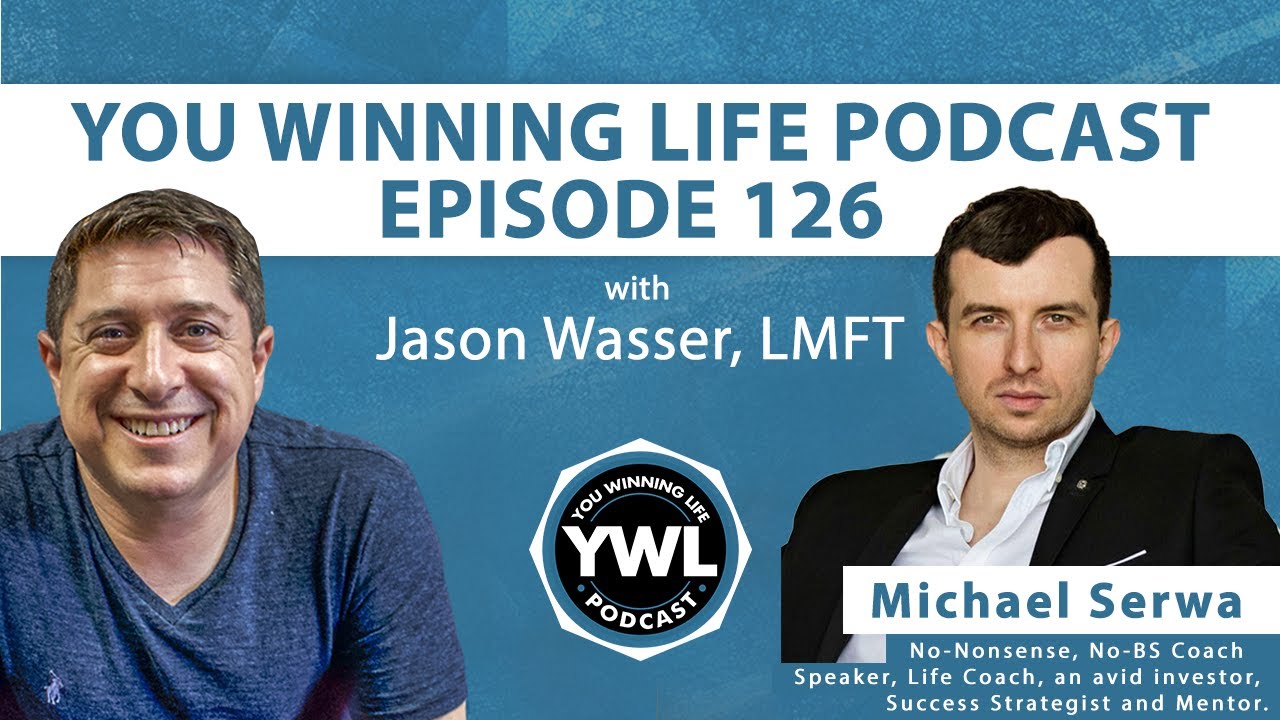
Jason Wasser, a therapist-coach from Poland, explains his no-bullshit approach to coaching and pricing. He follows the 80/20 rule: focus on pleasing a minority of true fans rather than chasing everyone. Jason doesn't care if people think he's arrogant, and uses controversial humor to build a tribe of people who get his style.
Chapters
Hey everybody, and welcome back to the You Winning Life podcast. Today's guest is the No BS Coach. His name is Michael Serra. He grew up in Poland and now lives in London and is working with incredible clients as a coach. We're going to hear about his journey, how he was impacted growing up in Poland and all the experiences that he had learning how to become a personal development expert. He's been featured in multiple magazines like GQ and he's been on other podcasts, interviews, and not only that, but he's also considered one of the highest paying coaches in the UK. All right. Also, I'm super, super excited for this conversation. Michael and I've been having some pre-gaming, some pre-show conversations because I was having some tech, some foreplay, some therapeutic and coaching foreplay. So I'm absolutely excited for this conversation with you, Michael. So thanks for hanging out with us today.
So am I, Jason Wasser. Thanks for having me.
So you're calling all the way in from the Queensland of London, England. Is that correct?
That's right.
Awesome.
So I know you loved my beloved city, not the city I was born in, but the city I chose to live in. And I feel that that's the city I'm going to spend the rest of my life in.
Incredible. When you and I were talking about both of our shared history, that my— on my father's side, both my grandparents were from Poland, from Czestochowa and Kielce, right? And you're also from Poland.
And yeah, I spent the first 22 years in Poland and then last 17 years here in London.
Amazing. Amazing. So when you came over, right, so, you know, one of the things that I love helping people realize is to stop playing small. I joke I'm 5 foot 2, so I've been playing small my whole life. So one of the things I'm like, and then when I see my clients, I've been since the pandemic, I've been pretty much mostly on Zoom. I closed my office and I'm seeing some people outside my condo for in person. I'm like, I just want to give you a heads up. I'm a lot taller on screen than I am when you're going to see me in person. Like, what are you talking about? And then they're like, oh, you really are.
So just to give you a heads up, yes, so you don't freak out.
Exactly. So coming from, right, coming from Poland to London, to England, right? It's a lot of different countries have different resources, have different mentalities, have different things that are kind of like culturally acceptable and appropriate and people tap into. What were some of the struggles or challenges of embracing newer, bigger thinking coming from maybe a small pond to a bigger pond as you started moving into the world that you are in, which is an expert coach?
Sure. So it was interesting because I'm from a big city in Poland. I'm not from Warsaw, I'm not from Kraków. So Warsaw would be the biggest city, the capital, right? Most people know that. Kraków will be the second biggest, most important city in Poland. I'm from a city number 3 called Wrocław, and it's a big city, right? So I thought I'm going, moving from one big city to another big city. Little did I know that my quote unquote big city in Poland, it's like a fucking village comparing to London. So first thing that hit me was like, shit, this place is massive. Right. And that's when you get out of the bus. I came by bus because I couldn't afford to buy plane tickets. To get here. So 27 hours on the bus, and then you take the Tube, right? The underground, the subway as you guys call it. And I think to myself, damn, this is huge, right? But one of the great things about Londoners in particular, so British people, but Londoners in particular, is that they don't give a shit where you're from, how you look, who you are, what you believe in. As long as you're not hurting anyone, you're good, right? So nobody has ever made me feel— now it's easy because, you know, I've done well, I dress like a Westerner as opposed to the way I came here dressed, like, you know, straight from the boat. Like, I looked like I was straight from the fucking boat, right? I didn't know it at the time, but looking back, I looked like straight from the boat. But even back then, even though I looked the way I looked, I could barely speak English, Nobody has ever made me feel unwelcome. Right. Right. And this is something I will always be thankful for when I think about this society, British society, and London in particular. And without a doubt, I do understand. And sometimes British people remind me of that because I do live in this little part of the United Kingdom called London. And it's like a country within the country, right? And when I hear about— like, I had a consultation with a guy from Iraq, I think he was either Iraq or Afghanistan, a few years ago, and he was telling me— lovely guy— he was telling me about how much racism he experienced in some town outside of London, and I just couldn't believe it. I was like, what? And looking back, it was just so naive of me to think that there's no racism in the UK. Only because you don't really experience racism in London, right? And then I was sharing that story with like my English client, and he said, Michael, listen, of course not everybody in this country think the way people in— like most people in London think, right? And I was like, yeah, like I should have known that, but like I was so surprised naively that that Muslim guy, uh, experienced so much racism. I just couldn't believe it, right? I was like, this is not like, maybe in Poland, or like in fucking, I don't know, but like, this is not happening in this country. And then, you know, it's just one of those stories that reminded me that London is, like I said before, almost like a country within a country. It's like an island within this big kingdom.
Well, and I think that really tying this directly into the work that you and I do, is that sometimes that's where our beliefs, our experiences, our programming becomes an island within its own island, a story within a story. And a lot of times, one of the things that I work with my clients on is they're talking about this thing that they want to achieve, and I help them realize that that's actually not the goal. That's just the mountain before the mountain. In other words, if that was no longer there, that story, that belief, that assumption, that expectation, that trauma, whatever it is, it wasn't there, what would they then be asking for? What would they then be wanting to work on? What would they then be setting their life's course about? And we all have these presumptions or assumptions about what we think is for us versus what you and I do, which is helping people get out of that way.
Sure.
So that's a perfect segue because you're coming in as, as a foreigner from a country that's not far away, and it's such a drastically different experience for you. And you've been able to accomplish so many incredible things. And now seeing how we help other people get out of their own way with their assumptions and expectations. So walk, walk me through a little bit. So how did you know that this field coaching was for you, that this is something that you wanted to commit your life to? And how did that happen? And what's some of the challenges and what's some of the advantages that you went through on that?
Sure. So I've always been interested in, ever since I can remember, not so much ever since I wasn't reading psychology books when I was a child, but I was reading psychology books. I remember reading Sigmund Freud's, I think it was autobiography, not biography, when I was 16 years old, right? So I certainly wasn't your normal teenager, right? So while I was chasing girls, so, you know, unsuccessfully most of the time. I was reading freaking autobiographies of people like Sigmund Freud, right? So the interest in psychology was always there. The interest in people in general, a curiosity around all sorts of people was always there. And then at 23, so a year after coming to London, I read The Secret. And that was my entry point. That's how I got into personal development. That was the first thing from within the field of personal development that I read or I came across, and that really sparked that interest in personal development. And then 5 years later, so at the age of 28, so I was working in fashion retail before getting into coaching, uh, since arriving in London for a few years, and then at 28, I already had a strong foundation as far as my understanding of personal development, number one, and also a strong foundation for a happy life for myself based on the things I've learned through my personal development journey, right? So I wasn't one of those coaches. I remember when I had this calling to become a coach, I went to this free weekend organized by the biggest coaching school, the biggest and oldest coaching school in the UK. And I got there and there were other, I don't know, 80 people in the room. And I looked around and I remembered thinking to myself, With some exceptions, all I see is a bunch of fucking losers. How on earth these people— and listen, I love everybody, right? I always say I love everybody. I don't like everybody, but fundamentally, on a spiritual level, I love everybody. I don't care who you are, I love you, right? Unless you give me a really strong reason not to love you, right? And I could count on the fingers of one hand people who I, you know, really, really dislike. And we talked about a few before we started, right? But other than that, it's like whether you're a loser or winner, I love you because I don't think I'm better than you just because I see myself as a winner and I see you as a loser. But even looking at the body language of majority, there were exceptions for sure. There were some really nice people, like quote unquote normal people as well. But even looking at the body language of some of those people, I mean, they were just like, some of them just like I thought to myself, first of all, I don't belong here. So sure enough, there were those trainers over the weekend trying to sell those diploma certificate courses, etc., right? So there was like a pitch at the end of day 2, right? And I went there because I, you know, at the time I knew I wanted to be a coach, but what I didn't know for for certain was whether I need a coaching qualification or not, right? So I went there to find out and see how I feel after doing this free thing, the introduction to those diploma courses that they were selling, right? And sure enough, I left with the conviction that I certainly don't need a coaching qualification. And it was interesting because one of the things they asked us to do over those 2 days was to pair up and coach coach your partner for 5 minutes, the person next to you for 5 minutes, whatever. So I coached somebody, I don't remember what it was and it was ages ago, but I remember after 5 minutes this person asked me, so how long you been coaching for? And I said, I've never coached anybody in my life. I mean, it's one of those stories like, When I understood what coaching was, I realized I've been coaching people my whole life, my whole adult life. It's just I didn't know that what I was doing was coaching. Even in fashion retail, my favorite bit was looking after my people, coaching them into being better at the job. I just didn't know it was called coaching.
Well, it's interesting because it used to be called leadership.
Right.
Right? And then this industry popped up with really sexy titles, executive coach, executive leadership, all these different things. So a lot of people are generically predisposed to having these skill sets in them. And what you're finding out, it sounds like, is that you already didn't know that this is what you were already pre-qualified and pre-talented for.
Absolutely, absolutely. So I had this suspicion that probably I don't need a certificate, and I knew that I didn't have to have it in order to start my practice because I knew that it wasn't, a legal requirement, but I wanted to be, you know, I just, I didn't want to just be a coach. I wanted to be the best coach I could be. So I thought if that's one of the things I need to do in order to get there, then so be it, right? But, uh, I was really underwhelmed with the whole experience. And this is me at 28. If I went there now to that room with that bunch of people, I would have to walk away like immediately.
Sure.
Because the energy was so low, like the caliber of those people was so low. And on the flip side, I thought, well, if this is my competition, I'll have no competition. And sure enough, I'm not saying I have no competition in the UK, but I have very, very small competition because there's just very few people who call themselves coaches or who think about getting into coaching that in my opinion have what it takes to have any chance of succeeding. Because unless you're gonna put a gun to somebody's head to pay you the money for coaching, you're gonna need to present yourself in a way that will make those people want to pay you, right? And it starts with your personality, right? And like how you come across, right? And part of that is that body language I was talking about, you know. So if somebody is just like that, I mean, who would want to pay a coach who's just like you know, the uncertainties written all over the body and the face.
Well, it's interesting while you're saying that, I love relating this to a multi-topic experience for people who are listening, because what you're describing that you walked into when you said like the vibe was bad, and the energy was low. And maybe these were people who weren't necessarily high achieving, they wanted to figure out, right, a lot of times people go and end up doing, you know, these processes because they want to do it for other people. But it's really about their unfinished business in themselves. So, so what I'm kind of hearing and kind of discerning what I love parsing apart is the people who are struggling with aspects of things in their life is probably because they're tolerating too much of a low frequency. And I mean, like, you know, like when we talk about low frequency, right? Sounds very hippie dippy, right? But, right, but you and I get it because we— that's our— we use that language. But we tolerate too many bare minimum entry-level qualifications into our life. And because of that, the outcome of our life stays at that very low-hanging fruit. And I just got off with a client and we've talked— I've implemented this idea of low-hanging fruit versus high-hanging fruit into their mind. So as they're going through dating and meeting people, I asked them to tell me about everybody they've met and to put them into a low-hanging fruit or a high-hanging fruit. And what I meant by that is, how easy is that person allowing them, allowing you to be in their life, to be intimate with them, to be physical with them, to be— how easy is it versus is there a pathway? Is there a process? Is it, do you have to work for it? Do you feel like you're, you can manipulate the situation to get what you want? That's a low-hanging fruit. So, when you're in that moment, you're 28, you're figuring this out, and you're like, okay, something doesn't feel aligned, something doesn't feel as great for me. So I know I can milk what I want from that, and then take advantage of it in a healthy way. Walk us through the process, because now you're doing this, you're in this world. And this is kind of what you're helping other people discern.
Also, sure.
Right.
So I'm not saying that I walked out of that room and I thought, I know it all, I'm ready to charge even £100 per session. That wasn't the case. I just knew that fundamentally I had what it took to do well in this profession because, as I said, you know, I looked around, it's like, this is my competition. Yeah. And you don't let me run— like, I I've never met a coach who wasn't a nice person. I've never— everybody in that room was nice. Every person in that room was lovely. But just like in the context of dating, if you are a straight male, they're saying the guys, the nice guys finish last, right? Nobody's gonna pay you just because you're nice if you're a coach, right? If you're a plumber, if you're a nice plumber, you're gonna do Yeah, that's fine. But if you are a coach and if you want to make some money from coaching so you can actually do it full time, then just being nice is not enough, right? Obviously people expect us, whether you're a coach or therapist, to be fundamentally nice and caring and compassionate, but that's just the starting point. Like I know that my clients, they want much more, they expect much more from me than just for me to be fucking nice.
Agreed.
They expect me to be nice. That's not like—
we're a dime a dozen. You and I are a dime a dozen, right? In other words, there— and I live near where I went to graduate school, is a 13-minute drive. So that means every year— and then there's my program, there's, which is marriage and family therapy, there's a mental health program, mental health counselors, and there's a psychology, PsyD program. So that means there's 3 programs every year multiple semesters churning out graduates. Right? So that means within a 30-mile radius, there's thousands of therapists. And then there's two other universities that are 15-20 minutes south, and then another one that's a half hour south, another one that's 40 minutes north, all have mental health programs, counseling therapy programs. So we like— I agree with you. So one, there's obviously, we have to be kind, we have to be nice, we have to be able to see what we need to see. But I think this is what applies universally to everybody. That plumber can be a really nice plumber, but if they're not insanely good at what their, their craft is, they're not gonna go too far, right? They're not gonna go too far.
So, so, you know, I, I— why, why all the coaches and therapists— I'm sure there's some exceptions, I just haven't met a coach that I would consider not to be a nice person, right? But yeah, you know, why they are so nice, all of them, is because you wouldn't— the way I, I explained to myself, like, you wouldn't think about doing that as a profession decision if you were a selfish prick, right? Just you think about becoming a life coach, right? It just doesn't make sense, right? You think about maybe like some, you know, some other profession, but not this one.
There's a genuine wanting to help other people.
Yeah. And I don't question that those coaches, they want to help, etc. But to your point that you've made previously, I do recognize, just like you recognize, that many of those coaches think that, okay, I can perhaps work or continue working on myself while I'm helping other people at the same time. So I'm not saying that I was, um, a finished product when I started coaching, but as I said before, I've already done 5 years of personal development before I decided to become a coach. I was in a good place, and I was cocky my whole life. So yeah, I was cocky.
So this wasn't your therapy? This wasn't your healing process?
No, absolutely not. I was already a cocky little shit when I started coaching. The only thing that was missing was professional/financial success, which is something that I achieved when I got into coaching. It took me a few years and, you know, I just dedicated myself to it. The money followed, and next thing I know, I'm the highest paid coach in the UK and I have enough money to afford everything I need. Right, right. And I had so much fun, but in the process— but I started very small. I started at £20 per session. I had 20 clients paying £20 per session. I had full practice basically before I felt that I'm good enough to charge more than that. Yeah, that I can justify charging. I didn't feel that it was right for me to charge any more than £20 per session, which is way below the UK's average or the global average, whatever, world's average for coaching, as you know. You know, even though I was overall a confident guy, I was in a good place, but like, I didn't know what I was doing.
So were you afraid you were not providing value over the cost that you were—
Absolutely. Absolutely. So to this day, I charge a little bit more than £20 per session now, but To this day, it's very important for me that I don't charge more than I believe I can deliver. And I like to think that— and sometimes my clients tell me, so I know that for a fact— I like to think that very often my clients get more value than what they paid for the coaching. Yeah. But I would never, throughout my career, I would never ask for more money than I felt would be the bare minimum of what I can deliver based on the knowledge and experience I had as a coach at the time, right? So as my confidence would go up, my fees would follow, right? And I started very small and I went all the way to where I am now, and I'm not done putting my fees up yet, you know? So this is—
Same, right? Same with me. I have this conversation. I do. I had this conversation twice. Last week with two different people, someone who's in the tutoring field and they've been doing it forever, 30, 40 years. And they're, they're serving higher net worth individuals.
Right.
And they're afraid to charge well, but they have this thing to pay and they have tuition to pay and they have their mortgage. That's not your problem. That's a story. Right. So, so this is a great opportunity. I think people like people who are working for themselves, or they're working for someone else, whether they want to ask for a raise, or they want to, or figure out, maybe if you're listening to this, and you are a small business owner, or you're a therapist or a coach or in the healing arts profession, I think this can apply to everybody who's not seeing their value. So is there some questions that you would ask a client if, let's say, they're struggling with this? I want— I need to ask for a raise, or I need to figure out how much I'm actually worth and how much I should charge. What would be some of the questions that you might ask in order to help this understand to them, to help someone get to that next level?
Sure. You see, one of the characteristics of my coaching approach is— I appreciate that, hence you asked that question, I suppose— that coaches in general ask a lot of questions and through the process of asking questions, they lead a client towards the answer. That's not my style of coaching. I tell people what to do, right? So I would tell a client, listen, I think you are undercharging yourself, undervaluing yourself. I want you to try charging this much going forward. What do you think? Right? So it's not— I still ask, you know, what do you think? And if they just go like, no, no, no, then—
Well, you hear the story once you say that.
Then I go into negotiation with them. You know, I'm a reasonable guy and all of that. But like I say, I would listen, I think you should ask for a pay rise. That's not really a question, that's a statement, right? Oh, Michael, but I've been, you know, and then so they have like, you know, stories, right? Objections. And then, you know, one by one, I would, you know, I don't always succeed at that, but I succeed at it, you know, 9 out of 10 times, whatever objection they might come up with, I say, listen, that's fucking bullshit and here's why. And sure enough, because especially now after doing it for over 10 years, I can smell the bullshit from a mile and I, you know, build this level of experience that allows me to overcome just about any objection a client can throw at me, right? So, and yeah, and obviously in this process of quote unquote selling people on this idea that they should be charging more, they should be asking for more money or or they should be expecting more from the partner, right? So this applies to everything, not just money, obviously, right? I will talk a lot about self-worth and the idea that I'm convinced on, which is how you decide your value not the market, not everybody else. And you know, let's be reasonable, right? Like I can say, oh, from now on I charge a billion pounds for coaching, right? So like I could say that, you know, and at least one or two people wouldn't be surprised. Yeah, that's something, you know, if anybody could say that would be Michael, but at the same time, I don't want to wait 10 years and work with no one until one crazy billionaire is gonna pay me a big, you know, 'cause probably it would happen eventually.
I know there is someone who would do that. That's the $1,000 hamburger in Hawaii, right? That— what, how many? Put it on the menu. Someone might buy it.
So Jason Wasser, this is like, obviously when I say £1 billion, like, I am absolutely convinced that I could have one client per year willing to pay the exact amount of money I make per year across everything, across the board. Right, right. But I don't want to work with one client. Right? So I know that if I was pitching people at this particular— there will be one person a year paying that, I'm convinced. Right? But then I would end up having one client. And here's the thing, I fucking love what I do. Right? It's not about— it's sometimes tricky for some people to understand because when you've done well already and when you say, oh, it's not about the money, it's like, really? You know, you're saying that from the penthouse? In the center of one of the most expensive cities in the world overlooking, you know, the biggest landmarks, you know, with a Fendi K watch on, you're saying it's not about the money? It's fucking not, right? Because if somebody said to me, you can go back to fashion retail and make 10x of what you're making right now, I say no thank you. Let me rephrase that. If somebody said to me, Michael, I have a business proposition for you. It's going to pay you 10x what you're making right now. I would only ask one question: is that some sort of coaching-related thing? No, no, no, it's not. Forget about it. Don't you want to hear it? No, I'm not interested. But it's— listen, it's 10x of what you're making right now, and you like nice things, you like, you know, expensive things. I do. But is it related to coaching? No, I'm not interested. Correct. And equally, if Swanny said you can continue coaching for the rest of your life, but you're going to be making 10 times less money than you're making right now, I'll still fucking do it. Right? Because you're right, spot on the money to begin with.
Correct. And this is where everything that I talk about with my clients is that purpose and that mission. What are they uniquely positioned to be adding value to the world that only they can do? And a lot of times it is finding out through their, through their story, through their trauma, through the stuff that they went through, that actually forged them into a really powerful, unique person. That if they start looking at the strengths of that story versus the weak— I'm a divorced marriage and family therapist, and I am— my clients know it, people who are now listening, if you didn't know this already, then you haven't been listening to enough episodes, people, right? I am not embarrassed that I help couples as my populations that I see. I'm really good at it. And I'm divorced, right? So I've taken my story, and here's what I've learned from it. And here's what I went through. And here's the things I can see, not just from my degree, but I see these signs in your relationship that will get you to where you don't need to be, where I went through. And if that brings value, then I sure as shit should own my— right? It helps me own my story even more versus being like, I hope no one finds out that I'm divorced. I hope no one finds out that I'm only 5'2", but I'm working with professional athletes. I hope, right, that I work with people that have ridiculously high net worth, but I don't have a million dollars. But I can help people who have net worth of $25, $50, $100 million in their businesses, right? So we have— so I think this is exactly what I, what I want people to hear from what you're saying is that this is just bullshit.
Yeah, absolutely. It's just a story. And since that's the case, since that's just the story, why don't you pick the story that is good for you.
You prefer, right?
If it's just a story and you can pick any story, like, listen, you know a little bit about my background and all of that. In theory, I shouldn't be where I'm at. I'm a fucking high school dropout.
Well, what story did you have to drop? What beliefs about yourself did you have to let go of to be who you are today?
So I would be lying if I said I didn't have a great childhood and great upbringing. Yeah, there wasn't a lot of money, but everybody around was just as poor, so I couldn't see any difference, you know? And I've never been hungry in my life, you know? Unless I was dieting, then I was, but that was self-inflicted, right? So I wasn't that poor, you know, it's just a normal Polish lower middle class family that I came from. But in terms of my sense of self-worth and self-confidence in general, that's never been an issue, right? In the context of dating, there was an issue for some reason, because I remember I came here and I was, like I said before, a cocky little shit, I had my first job interview and interviewing manager asked me how do I see my future in this company. I looked him in the eye, I said, I want you, I want like with the broken, I can't do this accent now, but in a broken English, I said, I look in the eye and with a finger like this, I said, I want your job as soon as possible, with a little smile. And he laughed and he laughed, right? And then 9 months after that interview, I took over his position, right?
Amazing.
So, so there was certainly no lack of confidence in general when it came, when, when it came to my ability to be successful professionally, right? And the same with coaching. Like, I knew, I knew as soon as I decided that I will be coaching, I knew that one day I would be the number one coach in the UK, and then eventually one day I'm gonna be the number one coach in the world, right? It's gonna take me a few years to reach the first goal, and it's gonna take me a few decades to reach the second goal. I knew that, right? But then at the same time, so that's like my professional identity, if you will, or professional side of things. But at the same time, when it came to women, I had that thing. So to, you know, to answer your question, I had that thing for years. I don't know from where, I don't know how I got that fucking virus, right? That bacteria. But I had that thing that I can't attract English girls because I'm Polish. I had that— I didn't have any chip on my shoulder on a professional level, but for some fucking reason— and it's not like, you know, I was dating this English girl and she dumped me because she said I was the fucking Eastern Arab. Nothing. You know, the British people—
self-created story.
So it was so self-inflicted, made-up fucking bullshit story that came from I don't know from where, but interesting enough is like how I got rid of that is, um, at the age of 26, I got to the point where I was fed up with my lack of success in a dating life of mine, and I decided to do something about it. And I thought, hey, since I'm gonna be learning this, I might as well become really fucking good at it, which is how I apply myself to things in general. It was the same with coaching. I was like, hey, looks like I'm gonna be coaching for the rest of my life anyway, I might as well be fucking absolute best I can be, right? So the same attitude, the same mindset has been used a few years before in the context of my dating life. And as a part of that process of becoming someone who is more attractive to women, um, I, I started to, to force myself— literally at the beginning it felt like forcing myself— to approach girls that I liked, women that I liked, on the streets, like in fucking galleries, on the fucking tubes, like everywhere I went, every time I saw someone I liked, I would make myself to walk up to them. And at the beginning it was shambles, like I was terrible, right? I was nervous, I was too much in my head, it was like, you know, like anyone trying anything for the first time, right? I was just as bad as a coach, almost as bad as a coach when I first started, right?. But this one time I approached this girl convinced that she wasn't English because I was avoiding approaching English girls because I was like, what's the fucking point? As soon as she finds out I'm Polish, it's gonna be game over, right? But because I had that limited belief, right? So I approached this girl because she looked like— I don't remember how she looked now, that was ages ago, but she didn't look English. English. So she was like, you know, like more kind of exotic looking, dark hair, whatever, dark eyes. But she was English. But I was like, oh shit, okay. So in my head it's like, okay, this is gonna be a waste of fucking time. But like, I'm talking to her and this girl asked me for my number, right? So, so, so, so, and you know this, sometimes it takes years of work to overcome a limiting belief, and sometimes all it takes is one event. And I went in that very moment, I shifted from I can't attract English girls because I'm Polish to English girls are the easiest for me to attract because this was the first time and one of the only times when a girl asked me for my number first. So it was just like this. It was from one extreme to another. And ever since I've been like, everybody fucking likes me because up to that point I was like, hey, I can 'You know, if I play my cards right, I can attract any woman I like, or I have a shot at it.' I mean, right, I can't, but I have it. I have a shot at it, at least, except for the English girls. And then from that point on, I was like, 'Fuck it, now the world's my oyster.' And, you know, right.
And I think while I'm hearing this, and I want to kind of break this apart for people who are listening, is, you know, when we're talking about being assertive, when you're talking about being confident, when you're— because you keep saying like, you know, I was a cocky motherfucker, right, all this stuff like that. But like, there's— there is something that is valuable about being assertive. So it's— so I joke that when people are like, oh, well, what type of therapist are you? I don't want— exactly, exactly. I'm an amazing therapist. No, no, no, no. Well, sure, sure. But like, what, you know, do you do couples? Do you do kids? You do— no, I'm an amazing therapist, right? What does it matter? Do you— what is the— right? In other words, are you looking either for someone to help you, or you're looking for an excuse for something not to be? The objection. Right? So, so I see this all the time. So I want people who are listening to this is that I remember I was at a conference, it was a business conference, and during one of the lunch breaks they sent everybody out to go— it was in Vegas, so you had plenty of people to go and do this at. And actually it was Grant Cardone who did it, right? For his 10X conference in Vegas a bunch of years ago. And he goes, I want you to go up to people and ask them what their net worth is or how much they have in their bank account. It's not my business. What? My money? We can't talk about it. But yet, if people are here for a business conference, and you're trying to solve financial problems for yourself, whether it's as an entrepreneur, whether it's as a business owner, whether it's as an employee, if you are not comfortable taking the conversation out of the bedroom— yeah, that you might not even have in the bedroom or even on your kitchen table conversations, to the world and you don't normalize it, then how are you going to get comfortable with it? How are you going to be able to talk about it? How are you going to be able to ask for something different? How are you going to be able to, to ask for help about it? So I remember my own story just relating back to this with finances. I remember when I was 25, 26, 27 years old, I had a buddy of mine that I met at a networking event, and he was a financial planner. And I remember he came over to help me navigate some stuff. And I was so embarrassed about what I didn't have. I was just finishing graduate school, I was just probably starting. So I had the student loans on one side, I was working 3 jobs, right? And I was maybe making $30,000, $33,000 a year in 2007, right? Living in a community which was— you need to have more money to— right? Like you are in London, right? Florida is also not cheap, South Florida. And I was so embarrassed. I was so— it was like nauseating for me to talk about money. But I'm a therapist and I'm helping people, right? And that was easy for me to talk about. But the business side, what my financial goals were, the audacity, the beliefs that I carried about people who had money.
Sure.
Right. Was so embedded in my psyche because of my own story. And then what the work I've done is I have a friend of mine who, God bless him, is incredibly incredibly successful. His company is doing over $200 million a year, and he's a— he's now helped other people with their financial success and created a book and a podcast about that. And I literally sent him my line items of all of my financial— 2, 3 months ago. This is all my— this is my business, different accounts. It's my, my brokerage account. This is my crypto account. This is my with no embarrassment, with no shame, with no fear.
Nice.
So it's interesting to see how we can all go through this, because I was the scholarship kid in high school. I went to school only because someone was willing to give me a scholarship. I worked 3 jobs. I've been on my own since I was 18, right? That's all the story to go to a place where I now have mentorship and guidance from friends who are 100x, you know. I love joking that like, oh, what they— what I made in a year, they're making in a day. Like, that's right. And they're really good genuine people too. Fucking awesome, right? God bless them because they're busting their balls and they're doing the right thing in that world.
Yeah, yeah, good for them.
So why shouldn't we take guidance and advice from those people and get really— we have to learn how to get uncomfortable to get comfortable.
Absolutely. And as you know, um, better than anyone, the first step towards the change is to recognize there's a problem. And the second step is to acknowledge that there might be a way out of it, right? And that's where we come in. And I would say to my clients, I'm saying, listen, you know, I appreciate that currently you believe that your back is against the wall in this particular situation. Let me tell you something, there's a way out of it, right? And we say in coaching that you can never take your client deeper or further than you've been yourself. And I find it to be true because, yes, I don't need to be a gazillionaire to help somebody else to become a gazillionaire because, you know, I might be able to still assist someone to become really, really wealthy without being really wealthy myself. But Sure enough, these days my clients don't come to me for help with their finances. You know, back in the day I worked with all sorts of different people, but my quote-unquote typical client today is already financially okay, and the focus on our work is primarily on making sure that the happiness level, the fulfillment level, matches the level of the wealth, right? To put it simply, right?
To align those two things.
Yeah. So the wealth is there, but the happiness is not nonexistent, but it's like medium, right? Like 5 out of 10, right?
It hasn't caught up yet. It's not—
Yeah. It is just something missing, right? And when there's something to do with relationships, and when I say relationships, starting with the relationship they have with themselves, right? Or relationships in a more general terms, or the fitness and health, whatever it is. We look at all areas of their life, and, and, and more often than not, they know exactly what they need help with. And if they don't, we find out what they need help with, and then we work together as a team, uh, on, on, uh, turning that around, right? And then the goal is, uh, for everybody I work with to reach what I consider life mastery, which is being happy, wealthy, and healthy all at the same time, right? I'm not impressed. I, you know, I remember like as a young man, like, oh, this guy is rich, or this guy has a beautiful wife or girlfriend, whatever. And then, you know, in my 20s, throughout my journey, I remember thinking to myself, I want all of it, and I'm not gonna stop. I knew that even though The Secret was the first book that I read, like I said, I, I was just about smart enough to know that sitting on my ass and visualizing shit, it's not gonna cut it, right? So I had to actually do the work. But you know what they say about Polish people, we work hard. So work ethic has never been a problem. So whatever goal I set for myself, I put a lot of, a lot of, a lot of hours, lots of sweat, not so much tears, blood and sweat, and, you know, uh, uh, uh, and occasional tears to to do whatever I had to do in order to get what I wanted, right? So nothing's been ever given to me, apart from a lot of love growing up, which I suppose, you know, one could argue it's the most valuable thing of all. But other than that, nothing's been handed to me. I had to work for everything myself. And guess what? I really enjoyed the fucking journey, right? Whether it was learning how to become the best coach I could be here in the UK, or or becoming better with women, or getting myself in the best shape possible. Yes, I enjoyed the, the, the, you know, the benefits, the, the end goal, the, the, the, the, the, the, the pot of gold at the end of the rainbow. But I also enjoy the journey, right? Because if you, if you work towards something that you— so, so if there is a goal that you have and you're dreading the journey, probably that's not a goal you want to focus too much energy on, right? Because Ideally, we want to set ourselves goals that, yes, if it's a fitness goal, like, not many people enjoy, like, going on a crazy diet and all of that, but if you get really excited about that goal, then you can at least try to get excited about the journey itself. And especially when it comes to goals like making more money or creating a great relationship with someone, then by all means, you want to do it in a way that you can, you can, you can, you can, uh, have a cake and eat it too. So yes, you get to that outcome at the end, but you enjoy the process. You want to enjoy the process. So I remember the first 2 and a half years of me working as a coach, I didn't take a day off. I didn't go and have any holidays. I didn't drink. I didn't date. That was the biggest sacrifice because I knew if there's one thing that can distract me, if there's one thing that can take me away from reaching my goal, is women, right? Because I just like them too much, right? So I've never been— I've tried all substances imaginable, but like, you know, like, there's still that one. Women is my favorite quote-unquote substance, right? So I knew that if there's one thing that can take my attention away from the fucking goal, yeah, it's women. So for 2 and a half years I've been pretty much living like a monk because I knew what the goal was. The goal was to become a 6-figure coach, the highest-paid coach in the country, and I was willing to do whatever it took, right? So 2 and a half years, no holidays, no days off. I was working 7 days a week. In 2012 alone, on top of my initial consultations and sessions and all of that, I've organized and given around 200 talks. Just to give you an idea of the intensity of that period, that first 2.5 years before I reached that 6-figure level. Right, right. But what I'm going with this, it sounds like, oh my God, this guy has sacrificed so much. Oh my, no dating, no drinking, no party, no days off, no holidays for 2.5 years. What kind of life is that? Jason Wasser, the best 2.5 years of my life. Yeah, I fucking love every minute of it because I just— you gotta enjoy the journey.
Right. And then it's like, I literally had this conversation with a buddy of mine. He's in New York, great guy. And we talked about the pullback from the last 2 and a half years of the pandemic here. And he's in New York. So they're more strict than they were in Florida. Florida is like the Wild West. And New York was very, very strict.
And it's lots of New Yorkers.
They have all moved to South Florida, right? They're all here. So please, please go back to New York.
So off you go. We're done with this.
Yeah, yeah, yeah. Shoo, shoo. So, but we talked about the value of how I realized at front, how I used to— we both were super involved. We actually met through our social circles for different retreats and conferences within the Jewish community. And I'm like, dude, I haven't been involved in anything in the last 2 and a half years. And I was speaking at these things and running meditations and doing the coaching therapy thing. And I was a public figure, and I just disappeared.
Right.
And if people didn't see my social media about my podcast or my practice, they would not know that I exist.
Right.
But what they have been seeing is I'm running a Zoom class on this thing, and I'm doing this thing tomorrow on marketing, and I have all my podcast episodes and all of the stuff that was so singularly focused that I realized how much people show up to events, not because that there's a goal for them, not because there's a healthy aspect of it. But it's because they don't realize that they just want to stay relevant.
Right?
And if they become irrelevant, what does that mean as far as their ego and their identity?
Couldn't agree more.
So I realized for the last 2 and a half years how much happier I've been when I'm seeing stuff on social media, And I'm like, these people just don't align with my values in the first place. Why was I continuously going to events that I didn't care to go to even when I knew I didn't care to go? But now I've— and I can use that pandemic as a legitimate excuse to just disconnect, but also take that time to work on myself. And I wonder, and this is something like, so like when you and I talk with our clients and like, well, we want to see where they started, where you want to see where they end up. But how many people did not take the this opportunity over the last 2 and a half years to go inward. To— right, everybody being, "I bought a Peloton," or, "I bought this," or, "I'm doing more reading," or, "I'm doing more cooking," or all this stuff that everybody did in the pandemic. But there's people that I bumped into, and I'm like, "Oh, I really hope something changed for them over the last 2 and a half years," and they're the exact same person that they used to be. And we're missing out on opportunities. I think that's one of the biggest things for this difficult time is that people took— there's people who took advantage of the opportunity to go inward. And become more self-reflective and work on their self, and people who just, oh, I miss being social, I miss going to events, I miss being that version of me, of how people can see me, versus who am I really.
Jason, I, I, I can't think of anyone. I'm sure if I, if I thought about it really hard, I would think about one person at least, but I can't from the top of my head think about a single person I know who isn't better off, not because of the pandemic, but now relative to before the pandemic, because it's— they just adapted. And that includes a client who's a serial restaurant/pub owner. So he had, I can't remember, I think 9 restaurants and pubs before pandemic. And now he— I bumped into him the other day, actually. On my way back from the gym, and I think he said he has 12 now because he was successful. Obviously, like, it wasn't great news for, like, especially restaurant owners at the start, but he was already established. He's a smart guy, he's a capable guy, and when you think about it, this was a great time to get new places, leases for new places at good prices.
Correct.
Because they were— everybody— and he had some cash, so he was like, being the smart guy that he is, he knew what most people knew, which is that this pandemic is gonna go away eventually. Yeah. So he was just buying. And some people, not me, proactive strategy, right? This guy was buying— he was buying locations for restaurants in the middle of pandemic.
Correct.
Some people thought he was nuts. I thought he was a fucking genius.
I agree with you. And I think that's really what I want people to hear is, is that we're, we're either being proactive or being reactive. For me, the proactive was the writing was on the wall of March of 20-whatever it was. And within the weekend, I was running a retreat for young, young, for young, young entrepreneurs with a buddy of mine. And that weekend, that Saturday night, I sent an email to all my clients, 'Your session is still on.' This was March, so this was like right a few weeks before everything. But people— but I remember like there was people I knew that already were in the hospital here in Miami. So no one knew what the hell was going on this time, right? There was no mask at this point. I was still flying, but like Target, the store Target, right, the convenience store, had like pallets of Windex wipes out in the middle of the store, right? Pallets, right, of just stacked. So no one knew what the hell was happening at this point. And I immediately, I made that executive decision. Our sessions are now going to be on Zoom. And I shared it not as like apologetically, but I shared it as in order to be the most successfully proactive for all of us to make our lives easier so we don't have to worry and we can take one chaos thing off. Every session that is scheduled is still on. I'm not canceling. I'm not changing. I'm not moving anything. Assume your schedule is still on. You're just going to show up here, here's the link. Of my full caseload, only one client who was non-committal to the therapy process in the first place was the person who dropped off. One client, no one else.
We were talking— I hear you— we were talking before we started recording about us being mavericks, you and I. So you see, I, I, I, I took it a step further. I, I, I run made, you know, business as usual. I said to my clients, I know there's a lockdown and technically you're not supposed to leave the house unless— but you can still come to my house if, you know, you're welcome if you want to come. Obviously we can move it to Zoom, and there was only one client who wanted to move to Zoom. Everybody else was still coming here because because yes, they knew they were breaking a rule, and I was, I was, uh, you know, I've been breaking rules my whole fucking life, so to me that was just like another, just, you know. But I was like, hey, listen, I totally understand if you want to move it to Zoom, I'm absolutely cool continuing face-to-face, we can social distance if you want, if you don't, I don't care. I was fortunate in a way that I, I had COVID right at the start, right? So I was like, oh, this is— and I knew it was COVID because I couldn't smell anything, so I knew that this is not a regular cold, right? So I got it out of the way. I was like, yeah, it didn't kill me, obviously I was still there. And, and, and, you know, like I said, everybody, or almost everybody, continued coming here, seeing me face to face, because most of my clients— not all of my clients, but most of my clients— are London-based. And some of them were in medical professions. And sure enough, because those guys understand viruses better than the rest of us, they were the least concerned about it because they were just like, "It's a virus." Well, the way you just explained it, it sucks, but we're not all going to die, right?
Right.
They knew what we knew, that it sucks, but let's try to continue with—
This normalization of whatever it may be, right? But the word that you used to describe it because I was fortunate enough to get it early on. So, right. And I think that goes back to the binary ones and zeros, right? To get it out of the way. So, but if we look at our, if we look at our challenges, our experiences, I'm fortunate, like, you know, it's like, I'm not embarrassed about what I went through in my relationship. It was awful. Awful. That whole stage of going through that divorce was awful. And I don't wish that upon anybody, even if it's, even if it's the healthy thing to do, it still is fucking awful. But now looking back, I don't have any negative energy. I don't wish anybody ill will. I'm like, it's such a clean, peaceful place. And I'm fortunate that that forced me to do certain work on myself and for myself that has nothing to do with the cause or effect of their side of the coin, but only to take ownership and accountability of my side of the coin. And I think that's kind of, at the end of the day, everything that I want my clients to hear is it doesn't matter what's going on in the world. What are you accountable for? What are you taking ownership over regardless of what you see anybody else do differently or not?
Totally, totally. And just, there's one thing I say more often than all the others in my coaching, in life in general, when I talk to people, is just be you. You know, like, as long as you don't hurt anybody, just freaking, you know, that's one of the things I love about London. Like, nobody keeps— like, as I was saying before, nobody gives a fuck if you are Black lesbian with a fucking piercing in all over your ears and your nose and your lips. Nobody gives it— nobody isn't like— no, nobody even like pays attention to it because it's just such a normal thing to be whatever, whoever you want to be, and Well, punk, right?
Think about the punk. The punk movement came out of where? It came out of New York and it came out of London, right? That was the punk, right? So, so right, there's all right. So, but those are mavericks. Those are people who have embraced, and maybe this is the sum of our conversation, is that when we learn how to get rid of the stories that we've been telling us so we can truly embrace who we authentically are, then maybe we all might realize that we're mavericks. We all might realize how talented or how, and I don't mean like unique, everybody gets a first place trophy. I'm not talking I'm not talking about that, but that everybody has a unique purpose to serve.
Totally. You see, I've never felt that I'm somehow special, right? And because I'm so special, I will have all those amazing things in my life. Yeah.
Well, that's narcissism, right? Those are narcissists, the people who believe that are the narcissists.
Exactly. So to this day, you know, no matter how cocky I might sound when I say certain things, I I'm as humble as I'm cocky, right? Like, I know myself, right? And everybody who knows me knows that it's that combination of those two things at the same time. I don't think anybody's better than me, but equally, I don't think I'm better than anyone, right? So what I was going with is I never felt that I'm special and, you know, I'm gonna change the world. And like, especially when I hear like somebody in personal development saying, I want to change lives of a million or 10 million or billion people. I'm like, shut the fuck up, you know, like, like, really, really? All right, I'm— listen, I'm a good guy. I don't wake up in the morning thinking if I could only change the lives of 1 million people. It's like, come on, just give me a break. Just, just stop repeating those freaking clichés. Yeah, just agree. And then, and then, you know, you learn about this person and then and then his own girlfriend or wife or daughter will tell you that he or she is an asshole. And it's like, he— they're talking about like, I want to change. Just why don't you start with your fucking neighbors?
You know, there's a therapist I was reading through Psychology Today. I very like— I get like rant— like, I don't know, whatever reason I get this subscription. And, um, or Psychotherapy, I don't know, whatever, some psychology magazine that I get. I'm flipping through it while I'm in the bathroom. Listen, whatever porn magazines do it for you, Jason, right, right, right, right, right, right, right. Yeah. Yeah, it was definitely not— I was just sitting there, right?
I was just sitting there like, oh, shit, magazines, you know, you guys, you guys are like, you know, self-indulgent.
It's self-indulgent. It literally has been sitting on my counter.
Have you seen the last issue of Therapist magazine? Oh my God, I don't even read it.
Yeah, right. I was like, right, look at me. I was just flipping through because I was just— because it was something about, uh, that one of the articles was when someone, uh, how do you help someone I was talking to a client about if they believe that someone in their family or someone that they love or care about should also go to therapy. How do you talk to them about helping them to help a person go to therapy? Cool topic, right? Or like, how do you, how do you know, hey man, you might need some coaching on that, right? A cool topic. So that's what I was flipping through. But then I saw on the side panel on the thin sidebar, there was an ad for a book and it was something about like narcissism. And I know the author. And I'm like, that mother effer. Is one of the hugest— that's my arch nemesis. That's my Magneto to my Professor Xavier, right? I know how unethical this person is. I know how many times this person has lost their license and got it back. I know the dangers of people who, who have worked with them as a client and have— or people have worked with this person as a therapist. This person is a narcissist, and he's writing a book on how to identify a narcissist. And I'm just like, do I call the publishing company and say, do you realize the danger that this person And are you— have you done your due diligence? And I'm like, what am I— what am I bringing? Like, where's my energy right now? What am I attending to?
Speaking of authenticity, you know, I mean, it's— yeah, but, uh, right, I gotta let the universe sort that out, not me.
Like, that's my own choice. Why am I so bothered by this? And we all have this, we all do this.
Totally, totally. Um, you know, I'm, I'm I'm the person to say I judge people all the time, except that I like to think that I judge them only on the merits of the character.
Correct.
As opposed to skin color.
Right.
Religious views, sexual orientation. I couldn't care less about any of that. But I do judge people all the time. Oh, but you are like— but you shouldn't judge people. Listen, I do whatever the fuck I want. That's what I do, right? You have a problem with it? Like, talk to me when I break the law, like properly break the law. I don't talk— I don't mean like not wearing a fucking mask at the airport, you know, that kind of rule. Yeah, talk to me when I really break the law, then it's like fair enough, which I won't because I know what the law is. Plus, like, hey, you know, I'm not really into like murdering anybody. Like, it's just not my thing, it's not my kink, right? Right. So, but beyond that, Let me just fucking decide. It's like I said something on Facebook the other day, something along the lines like how I would pay to, you know, for Putin's head or something like that. And this, and it's on my Facebook, right? And this guy, which I don't know, like certainly wasn't my client because my client, you know, they don't, they don't talk like that because they just like, they would probably, you know, hey, do you want me to chip in, you know, like for that bounty for Putin's head? And somebody said, 'Oh, you can't say that. Like, you can't say— like, you can't talk about, like, killing people.' I said, you know, and that's like, you know, him commenting under my post on my Facebook, right? And I said, 'Of course I can. I just fucking did.' Like, I do me, you do you. And as long as you doing you is not hurting me or somebody I know or people in general, I have no problem with you. You just do you. Do whatever fucking makes you happy. Don't let anyone, including myself, even if I'm your coach telling you what to do because you wanted me to— if you don't agree with what I'm telling you, don't fucking do it, right? Don't be a fucking sheep, be a maverick. And I agree with you what you said there, how everyone is a maverick to a, to a lesser or greater degree. It's just the difference is not like, oh, you know, you have to have a certain type of personality. It's Oh, it's easy for you to say, Michael, because you're an extrovert. It has nothing to do with me being extroverted, right? It's about having the balls to live your life on your terms. It's about having the balls to allow yourself to be yourself, to express yourself the way you want to express yourself, whether it's through fashion. If you are, you know, it's obviously my— there's nothing controversial about my fashion sense. Like, I know that. It's just like, you know, normal, right? But I know that certain things that I say or have said in the past would rub people off the wrong way. And I, I, and I knew it's gonna happen before I even said those things, right? So it's not like I was surprised, but I was speaking my truth, right? And I take criticism and rejection of some sort daily for breakfast, lunch, and fucking dinner. I have no problem with that. I got so used to being criticized and rejected and, you know, and I've been called too honest in the past. I've been accused of being too honest. Right? Right. I have no problem with that. You will find people who would say this guy's too honest, like he talks too much, his mouth is too big. I have no problem with that. But you're not gonna find anyone who's gonna say I'm dishonest, right? Because even my ex-girlfriend, one of my ex-girlfriends who caught me cheating, I owned up to it. And I was like, yeah, I fucking— I guess you got me there.
Yeah.
Yeah.
Well, I think that's where, right at the end of the day, integrity comes in where it's— I tell this to my clients where I'm like, I don't care who you voted for. I don't care who you slept with. I don't care who you slept with while you were voting. Don't be a dick.
Exactly.
Just don't be a dick.
Right? Exactly.
Everything else— I have friends who are complete opposites. I have one of my clients who I adore, one of my coaching clients, we are so polar opposites politically. But yet I can start off a session with a joke about my side.
Sure.
And making fun of my side of the things about what's going on in their local politics. And I'm like, oh, I didn't know so-and-so was— and I'm like, You know, and that's where, like, where you know that there's so much more commonality.
Yeah.
In those things. And also it's the idea of, like, just not taking it personally. Like, I love talking about making things inconsequential. So whoever in America— so if a certain president becomes a president again in a couple of years, okay, I still have all the things that I need to work on and control and I can handle and I can be with my clients and the things that are the highest priorities for me. I don't have control over that. At the end of the day, I do my due diligence and that's it. But if I'm going to spend like everybody does on social media, bitching and moaning and complaining and this and that and spending, I'm like, do these people, how do these people not have, do you have a job? Do you have a mission? Do you have a purpose that is bringing more value to the world? How are you spending all these days at these rallies and, and, and posting shit on social media that is just divisive versus uplifting? They think it's uplifting, but right on both sides, I'm talking about both sides of the coin. I'm like, don't you have a job? Don't you have a meaningful— that you have to just not jump onto this divisive thing in order to make your life of value, to see which camp you align with so you don't feel alone and lonely? But that's what we're dealing with. That's why you and I will never be out of business.
I have seen no doubt because, yeah, it's, it's, you know, I was doing okay as a coach for the first year and a half just fine, just like everybody else who's doing okay as a coach. And then I had this realization, right? So a year and a half, then I had this realization, hmm, nobody criticizes me. That's a problem. I'm playing it too safe.
Yeah.
And that's when I became the, the so-called no-bullshit coach. And all I did was I brought more of my personality, which was already there and has always been quote unquote, no bullshit. I basically brought it to my coaching. And guess what? My business has skyrocketed. Yeah, because no matter how— I mean, you know, without getting too political, I mean, how crazy was your former president and how many fans does he have? So you can be, you can be— it shows that you can be this crazy and this orange and still do well in life, correct?
So one thing, everybody aligns with what they align with.
Yeah, so, so like, you know, if there's, if there is, there's not many things I can, I can respect about, like, I respect about that guy, but, but, but damn, he did well, everything considered.
Correct.
He got the biggest, he got the biggest job in the world somehow.
So I can't be like, I can't hate on, you can't hate on everything, right? Everybody has something that they're And I remember tying that back in. I remember when I started doing all these Zoom coaching classes, these group classes during the pandemic, I leveraged that, right? Well, it's captive audience.
Yeah.
And a friend of mine, one, like, was so excited about my class and like, oh, I invited so-and-so, another person that we know. And she's like, she's like, why are you going to listen to him? He's divorced. I'm like, or I don't have a fear of commitment because at least I tried it. At least I went all in on it. Right? So I'm like, great. But I also know that, that, like, everybody has a story. Everybody has, like you said, their objection, their whatever it was. I also turned down that person from— I wasn't— that person approached me about, you know, getting to know each other at a deeper level. And I was not interested in any way, shape, or form about that person. So is that showing up and why they're saying that? Or was there a rejection? And I'm like, okay, cool. They're pro— that not— but yet all these other people are showing up for it. So they created their own objections to get any value. And for me, like, and I tell this to my clients, um, right, those especially who are different politics, I'm like, well, I listened to your guy the other day, I listened to this podcast, I listened to this, this person on the other side of the political or philosophical spectrum, because data is data, knowledge is knowledge, and I have the right to sift and sort through it. But I'm open to hearing the other side. I'm not going to reject because I'm sure there's some really amazing, brilliant stuff there. And there's some stupid stuff on my side. And there's some brilliant stuff on my side. And there's my side as if I own it, right? See how we even talk about it, language-wise, not my side. I've chosen through a series of experiences and data to sift and sort to where I'm at right now, that will continue to evolve.
But the idea is to— exactly, the idea is to be open to— I'm always open. I have my opinions about just about anything. Yep. And some of those opinions are really strong. But at the same time, always happy to have my opinions challenged, my views challenged by myself and by other people. Exactly.
As long as they're not a dick about it. Pour me a scotch. Let's have a scotch.
Right. And I'm more than happy to change my mind about stuff. And in fact, I change my mind about stuff. In Poland, there is the saying that only a cow doesn't change its mind. And since I'm a human, not a cow, I'm like, hey, listen, The fact I believed in that last year is something Ray Dalio said. He said, if you don't think you were stupid last year, it means that you haven't worked hard enough. Like you haven't evolved well enough. If you don't think at least like parts of your behavior from last year are going to trickle in, it means that you just, you don't grow fast enough.
I host— I put together an accountability retreat for my accountability group. We meet every week for an hour, and then every quarter we meet for 4 hours. And then now I convince them to do a once-a-year in-person, right? So we did it in December, and I said— we were sitting at lunch, I'm like, guys, I'm really serious about this. If we are talking about the same shit next year that we're talking about this year, we did not do the accountability group right. And I want to let you know that if majority of us, including me, aren't doing— are still talking about the same stuff, then we need to disband. Then there's not going to be another— we're not going to continue the accountability group. That's what— that's the level that I call it a day. Yeah, we're calling it— that's the— I want to be proactive and say that's what the level I want to be playing on. If you're not wanting that, then I know I'm in the wrong accountability group. And if I'm not bringing myself to that level, then I know I'm doing something wrong and I need to figure something out because I don't want to hold you guys down. And that's the— right, that's what really I think that's kind of right. That's why I love doing my podcast because it's about letting people into some of my thoughts and what I'm working on and how this is not about me telling people what to do in that regards of like, not the way they— I'm not saying like that you're doing this.
I'm saying like, right, right, right.
I'll leave that to you. No, but it's, but I don't know. I may even saying it from that perspective. It's just like, have you thought about this? Did you know this exists? Did you know that people out there who've gone through similar things to you have accomplished this? What is— what's the reason and stories and tools that you might not have even known existed? Because I'm you. For me, this is really a selfish undertaking. I get to meet really awesome people all over the world that I would never have access to if I was sitting in my little office in my second bedroom in my apartment in Fort Lauderdale. So really, people are just getting to hear my watered-down, right, thought process and take advantage of that if they want to take advantage of it.
But this is purely selfish if they're smart enough to want to take advantage of it.
Yeah, yeah, yeah. However it is. So good. All right. So we got it. We got to call it a day because I know you're, you're, you know, well, it's still late out there, but I got my, my next step of, of clients. Michael, I really want to thank you. This was— I love the rawness. I love the— this is definitely going to be a very different episode than a lot of my other episodes, but I think that's why it's so unique to have someone like you who's— right, you said the no bullshit, and right, we're not putting on a pretense, we're not putting on a mask, we're not putting it for the sake of social media. It's raw.
I'm not seeking controversy. I'm not trying to be provocative. I'm just being myself. And sometimes some people find it controversial, provocative. Yeah, that's up to you. Like, I'm just being— I'm just doing me. And I know, and anyone listening to that who already knows me, like, yeah, that's like— that's how he sounds every day, you know?
That's the 80/20 rule, right? If you piss off the 80%, but you have the 20% that really love you, those are the people, right?
That's your tribe. And that's like— yeah, like I said, I love everybody, but I certainly don't want to coach everybody. I don't want to date everybody, you know? I just don't have you know, love everyone from a distance, but be surrounded by, quote unquote, my people. And my people find at least most of my jokes funny, you know. So I don't even like— can I say this, or will I, will I offend someone if I tell this joke? Can I tell a racist joke? Can I tell a sexist joke? Are they gonna think I'm a sexist? No, my people know that I'm not a sexist, right? If I say a sexist joke, it's just a fucking joke.
I know there was a friend I had who I think is— they're such a lovely person, but I had to be a different person. I couldn't tell any of my— like, I couldn't just be like— I couldn't just be—
yeah. And it's tiring.
Is it?
It's exhausting because especially for a nice person, like you said, because if you're a dick, you're just being a dick and you don't even care, right?
But I care.
You don't want to— like, I don't want to offend anyone. So, right, in order to offend anyone, I, I need to make sure I spend my time with people who don't get offended by the things that I say.
Where even the least offensive version of me was still offensive at some level to that person, then like, all right, I just— right. And I'm, and I'm not choosing, right? Like you said, like, I genuinely care about people. I want people's—
why?
So I'm like, oh, I'm making this executive decision for their own well-being more than—
right?
Because they're not saying— because I know they roll their eyes. I know they're— and they're a really good person. And I, you know, I really, really do respect that person. Um, but I— at a certain point, I had to like just like I'm doing us both a favor and right and giving ourselves the right to do that. So those of you who are listening, I would love— I'm sure both of us would love to have some feedback on the conversation today in any way, shape, or form. What thoughts came up? What discomforts came up? What buttons got pushed? Love to hear some feedback. You know where to reach us. It's either @youwinninglife on Instagram or Jason Wasser LMFT. That one came back out of the blue. Dude, Michael, a whole nother crazy story about social media and being banned or shut down or whatever. A year and a half, my main Instagram account was shut down until it somehow magically— yeah, I wasn't even doing anything crazy. It wasn't even doing anything crazy. But Michael, where can they find you? Where are some places people can reach out and connect with you?
myname.com. And from, from my website, links to all the social media platforms I'm active on. Facebook is the one I'm most active on. Because I'm a Facebook generation. I'm 1983. And yeah, for years I was saying Instagram is for girls, I'm not going to get on Instagram. And then, but then I, you know, I got there at the end. Yeah, but it's the Facebook I'm most active on. And there's a link to my book as well if anybody's interested in checking that out. But yeah, MichaelSerra.com is the place to go to.
Beautiful. Awesome. Thanks, my man.
Thanks a lot. Thank you for having me.
More from Jason


Howard Behar Starbucks Former International President Heartwarming Story #kindness #shorts





