
Ep.143- Leading Requires Empathy with Heather Fortner
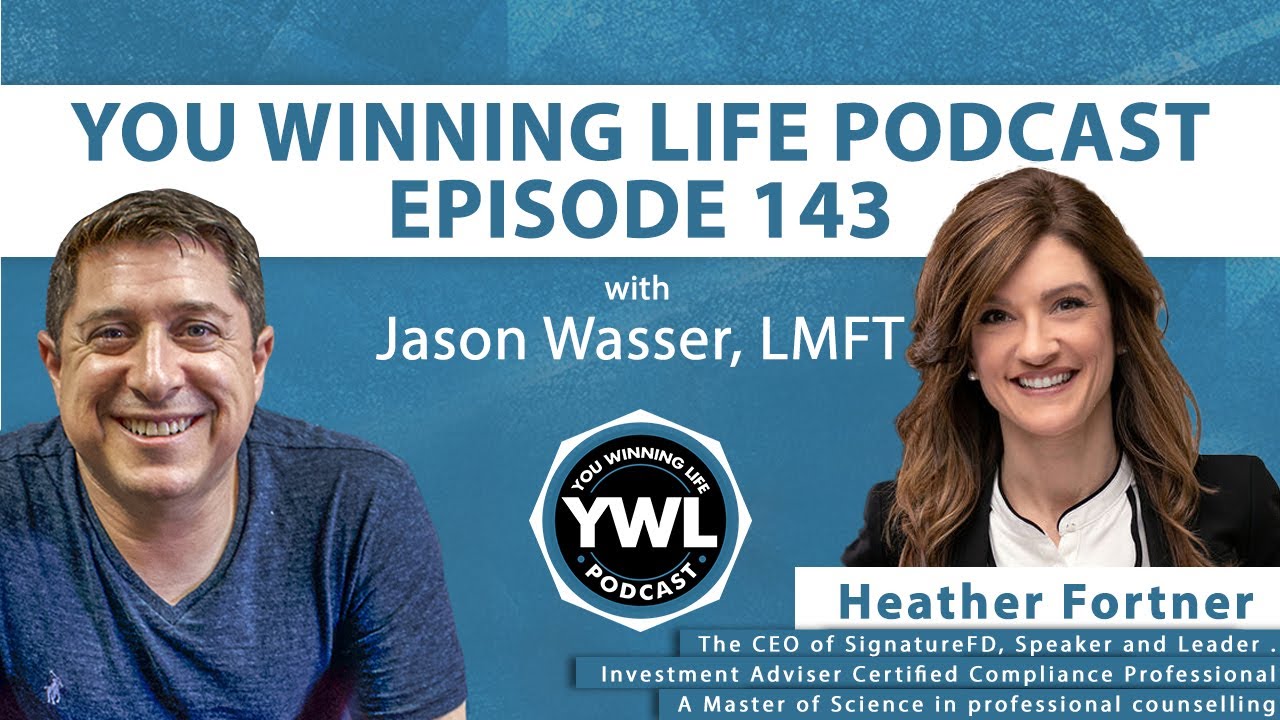
In this episode of the "You Winning Life" podcast, host Jason Wasser, LMFT, interviews Heather Fortner, CEO and partner of Signature FD, a financial‑planning firm aiming to serve 10,000 families. The conversation traces Heather’s 20‑year career trajectory—from joining the firm in 2003 as a compliance associate, becoming Chief Compliance Officer, then Director of Operations, COO, President, and finally CEO—highlighting how she leveraged a unique blend of finance education and a graduate degree in professional counseling. Heather explains how empathy‑based leadership, financial literacy, and relational communication can transform client experiences and internal culture. The dialogue delves into the challenges of being a woman in a male‑dominated industry, the impact of micro‑aggressions, and the firm’s response to racial injustice in 2020, illustrating how honest, safe‑space conversations are essential for DEI progress. She introduces the firm’s “Net Worth While” philosophy, which aligns clients’ financial resources with what they find personally worthwhile, and discusses practical tools such as generating multiple solutions to problems, building diverse “dream teams,” and fostering relentless curiosity. Throughout, both speakers emphasize personal resilience, the power of choice, kindness, and the importance of integrating psychology, mind‑body health, spirituality, and entrepreneurship for a balanced, purposeful life.
Chapters
So as you know, the many reasons why I love having this podcast is not only do I get to bring all this really incredible conversations to you, the listeners, to people in the community that will wildly benefit from the conversations, the insight, the experience that our Listeners have, but every once in a while you come across someone who is so incredibly passionate about what they do that it just is a really awesome reminder for me about why I'm so blessed to have this platform. And today's guest is one of those people. Her name is Heather Fortner. She is the CEO partner, chief executive officer of Signature FD, which is an incredible financial planning organization who who has a vision and mission to impact the lives of 10,000 families. And she completely believes in a coach with empathy leadership style, and she leverages her unique ability to harmonize people's passions and talents to build teams, lead organizations that deliver excellent and inspiring client experiences. This is a person who started off as Chief Compliance Officer, then moved into the president, and then now is now Chief Operating Officer, has navigated being a person in the field starting from scratch and working their way up a system and fighting the good fight of being in a male-dominated business and becoming the 2022 Most Admired CEO by the Atlanta Business Chronicle. She holds a bachelor's in finance from Kennesaw State University and a master's in Georgia State University, which we're going to talk about. I'm not going to ruin the surprise but it's not in the field that you think. She's an investment advisor and she is a graduate of the Schwab Executive Leadership Program and the G2 Institute. I cannot wait for you guys to hear this conversation. And as always, please do me a favor. If you haven't yet reached out to me, I would love to know who you are. If you're listening to this, I know there's tons and tons of people listening to the episodes every week. I would personally love for you to reach out to me. So simple. You find me on Instagram, Jason Wasser LMFT, or the You Winning Life, or directly on Facebook. Email also, Jason@thefamilyroomsfl.com. I would love to know who you are. One of the things that we're actually starting to plan for maybe in the end of 2022 or early 2023 is a retreat. And maybe even bringing some of the guests from our previous podcasts, but a mind-body integrative retreat that also tackles mindset, business, personal growth, and development. So I'd love to hear from you. And if you're interested in that, and as always, obviously, please leave a positive comment on iTunes. And without further ado, here's Heather. All right, y'all, welcome back. So of course I had it like the y'all just came out because I'm hanging out with, with a new friend in Atlanta, Georgia, my old, my old little stomping ground for a little bit after— I don't know, Heather, if you knew this, but I lived for a year, I lived in Sandy Springs.
Oh, there you go.
Yeah, I stumbled upon it. I was invited out for a wedding, and then I was out at a wedding, and I got invited to be a youth director at this really awesome synagogue in, uh, in Sandy Springs. Like, sight unseen, offer me a job and move there. Loved it. Love the community. I'm still in touch with a lot of people there, and it's, uh, one of the reasons why over the pandemic, as I went fully virtual, I got licensed in Georgia. So now I'm seeing therapy clients there in addition to my coaching clients. But, um, You know, there's an intro that was already about you, but like, I want to skip the intro because they already heard that. It was very generic. But let's just do a quick backtrack of your present title and the titles you've held just since you started. So, so everybody listening can get kind of a flow of the gravitas of this conversation that's about to happen.
Yeah, thank you. How long do we have? I mean, the, the funny part about my career— so I will have been at Signature FD, it'll be 20 years in February, and I don't think other than the very first role that I had that any of the other roles existed before I came to the firm. And that was just, I think, part of being on the ground floor of a high-growth firm. Uh, we were about $250 million in assets under management when I joined. We are almost $7 billion in assets now. I think I was number 6 or 7, a team member, and we're about 100 people now. So I went from— I kind of had two dual paths through the organization. So when I joined in 2003, I joined as compliance service. It was something that I, I just wanted in the door, and I knew how to do that role, and I thought, why, you know, I'll take that and see where it goes. It just so happened that in 2004, the SEC, which is the body that we're regulated by, basically said for everybody in our industry, you have to have a chief compliance officer. And nobody was really— I have to be honest— like super excited, unless you're like a securities attorney, about that role.. And so I just kind of raised my hand and said, you know what, I'll do that. You know, you send me to whatever training I need to go to, I'll raise my hand, do that. So I was the Chief Compliance Officer for 15 years at the same time that I helped build the operational platform of the firm. So I went from a Client Service Associate to a Client and Employee Relations Director, which I think is an awesome title that I totally created. And then to a director of operations, then to a chief operating officer, then to president, and now to CEO.
And the cool thing is that people don't know yet is that your master's degree has nothing to do with any of the finance world.
Awesome thing, right? So my undergrad degree, which it took me forever to get because I was actually a pre-med major when I started school ended up with a bachelor's in finance and then realized that I really missed the helping professions and that if I wasn't going to go to med school, one of the ways that I could help was in counseling and therapy and went and got my graduate degree at night, which was funny because I went to the founding partners and I was like, hey, so I want to go— I want to utilize this benefit that we have to get my education paid for. And they're like, oh, okay, so you're going to get a graduate degree in finance or tax. Like, yeah, no. So there's this thing, it's called professional counseling. And they're like, what? And I just had realized the value in my own life of being able to combine basic financial literacy with the ability and the art of communication. And, you know, I tell people all the time, I experienced growing up in my family, we just didn't have a lot. And I really think that there can be tension around money if you have it or if you don't. It's, they're different issues, but they're all issues and they require money as the thing that touches everybody. We all have to deal with it in order to function in today's society. And I don't understand why it's a skill that we don't teach. And so you're expected to go and operate in this world that's driven by this tool and you get no formal training in how to use it. So I really felt like being able to combine when you're working with clients, if you could combine that educational aspect of money and literacy and how it is a tool and it doesn't have to control you, you can control it. And you can do all these amazing things with it, with an art and an ability and a skill to communicate well around it, because the reality is that we all come with baggage around it, and your viewpoints are different than my viewpoints, and your experiences are different than my experiences, and they probably trigger something in both of us. If we can, you know, talk about that well, how much more healthy would families be? How much more healthy would our community be? How much more healthy would our world be if, if somebody could lean in there? So I was like, yeah, so I have this vision. Here's, here's what I want to do. And they were like, you know what, you go ahead, go ahead, like, go, go get that degree. And then when I finally completed it, I realized, which I honestly, I can't say that I knew going into it, but I realized that the value of that combination, uh, from a business perspective in working with teams of people and the organization itself was immense. It was just immense. And so I never quite made it into the actual clinical setting because I was like, you know what, I'm actually utilizing all of these skills on a daily basis in the corporate setting, and I love what I'm doing. So I was just very blessed.
Well, that's what I find so fascinating because my side of the journey is the exact opposite, right? I grew up in the nonprofit world, both as a kid going to different nonprofit programs and having scholarships through that, through my family's financial struggles, and then going off and living in Israel and then coming back and working in a nonprofit educational environment. So I really thought that was going to be my entire career. And I went into becoming a therapist with a nonprofit mindset that in order to do good, it kind of might be at odds about having financial sustainability and security, especially since I grew up here in South Florida, where the people I met who did have the financial stability and security weren't always the nicest people, right? And, and, you know, there were scholarships and stuff that I was accessible to, but I didn't know where those came from, because those are the people that were anonymous with all of that stuff or was behind the So a lot of my unpackaging around money and finance and even business as a person who— my family is a third-generation furniture business. I on purpose didn't go into it because of that mindset and other family conflicts. And now my brother and sister have taken it over and it's grown exponentially. But it's interesting that it took me years. It was only like 10 years ago, 8, 9 years ago, where a buddy of mine who's a chiropractor convinced me to go to this entrepreneur business. Program. And I'm like, but I'm not an entrepreneur. I'm not a business owner. I'm a therapist. And like, but you have a business and you're charging people, and whether it's insurance or cash, whatever. So that whole mindset, I realize now, years later, how embedded financial philosophies of lack, or I can't do this, or I can't charge this, or the struggle that a lot of helping professions have, that it's coming from a place of I can't be liquid, or I can't be— have asset management, and I can't have properties. And I'm seeing people just leave fields because they're struggling in one and have to go entirely to a different one because they've never figured out the both end.
So I'm wondering, like, there's this belief sometimes that we carry that being profitable is bad, you know, and that's not true, because the reality is that it requires profit to do good. And so there's, there's so much to unpack in what you just said. But if you extrapolate out the belief that the label doesn't define you, yeah, your experiences, they are a part of you, and they they shape perspectives and they shape beliefs and they shape how you see things, but they do not have to define. And so, you know, I think that's just been one of the most powerful realizations that I've been blessed to come to over the course of my career, which is, you know, I was that girl. I was that girl that turned down a full scholarship because I didn't know any better, and I just didn't want to go to that school because I didn't like Atlanta, and, and, you know, we didn't live here, and my dad had got transferred, and I didn't want to see all these people with the same school. And so I turned down a full ride.
Yeah.
And then took 6 years to get through, you know, 3 other schools to get my degree that I was working to pay for at night. I came out with a ton of student debt that, you know, I didn't have to carry. And then, you know, just kind of worked my way up. I wasn't like the most credentialed person in the world. I didn't know the plan from the start. I didn't have all the acronyms behind my name. And I was a girl, right? I am a girl. And so being in this male-dominated industry, sitting in that room, you know, I remember specifically the comments of, you're not, you're not even a professional, you know, and, and those things could have defined me, right? I remember, I remember the feelings and the thoughts and the, oh my gosh, like I don't belong here. Like I, I don't even know how I got here. What am I going to do here? And the reality is that In those moments, you can either let other people's issues and other people's comments and other people's labels define you, or you can choose to define yourself. And that was, for me, just the freeing moment of realizing that my future, it was my response. And that opened up the world.
Yeah. I mean, obviously going into this environment where, right, majority of the people, like you said, were, were male dominated. Do you think this is a regional thing as much as it is just like a, like, you know, 20 years ago, when you first started or so, was that like, is that a Southern thing? Is that a, is it, was this like a, just a global, I mean, we know the industry as a whole is very male dominated, but do you think that there was extra things that being in the South or being, you know, in, you know, even though Atlanta is a major metro city with everything that, right, it's amazing, amazing city. Do you think there was extra things that were tacked onto that because of where this was located?
Or do you think it was just— I absolutely think that. I, I, I still to this day, even when I travel places, like people comment on my accent, you know, and it's, it's one of those things. Like I do think there's a stereotype of women in the South. And I do think that, you know, the good old boys club, I know it exists here. I'm sure it exists everywhere else too. It probably looks different and it probably manifests itself differently, but it is a thing. And there was a real power for me. And, and, you know, I've spent a lot of time thinking about this specifically as we've thought about the diversity, equity, and inclusion conversation. Like, there is a power in simply being able to acknowledge the truth that's in the room. Yeah, it doesn't mean that it has to be hateful, and it doesn't mean that it has to be unkind. Or that it limits anything. But there is power in simply being able to acknowledge this is a thing. This is my reality. It does not diminish my hope. It does not diminish my authority or my power in the situation as a human. But it is a real thing that I'm facing. And then when you call it out and you state it for what it is, it seems to take some of the wind out of its sails.
Sure. Well, what do you think some of the tools are? Because I see this, and I just had two very distinct conversations about this topic with a buddy of mine who, um, is a partner in a major law firm, and a friend of mine who's a female rabbi. And she was like, in the '90s, in the '80s and '90s, she's like, we didn't even know what a microaggression was in order to even call it out, right? And, you know, the stuff that was said to her as a female versus being a male clergy, right, was was just like, I've never kissed a rabbi before, right? Like, you don't say— right, you're not going to say that to a priest. You're not going to say, like, you know, like, or a male, right? There was so many. And she's like, we didn't even know the term microaggressions then. And, and this person was saying how it was— it would usually be the spouse of the man who said that to be like, I can't believe he said that. Don't listen to him, he's so stupid, right? And then try to, like, sideways call him out, but there wasn't always a lesson learned. And when did you, when did you start noticing, like, whether it was people who are allies, whether it was, right, the DEI stuff, uh, when did you start seeing people in your career, in your influence, starting to get it? To start actually not just like, okay, this is a thing we need to do this because there's government regulation, or this is becoming the thing in the industry and we're going to roll our eyes at it and just put up with it. It's kind of like the harassment stuff of the '80s, right? And the '90s and today.
I was about to say.
Greatest Hits Radio. Yes, right. It's its own radio channel. The greatest hits of '80s, '90s, and today. Harassment doesn't stop. So when did you see or notice, one, allyship, people not just like giving it like, okay, yeah, great, I'll tolerate it, but buying in? And two, like, when did you start seeing other people who maybe would have previously— I wouldn't say offenders, but maybe not even non-conscious offenders be participating in it, like start to shift and change and move over to the proper side of doing things?
Yeah. I, I think that's a great question. Um, I think it was when I had the courage to address it for myself. It's like when you go to buy a car, right? You don't know that that model's out there until you decide you want that car. And then you see that car. Every— and I recently wrote an article for Inc. that was about my experience specifically around racial injustice. And in 2020, I remember I'd literally just been named president of the organization, and I was moving. It was June 1st. We were moving our home in the middle of COVID Literally the movers were moving in boxes and I got this text on my phone that was like, hey, you need to check your email. And I sat down on the stair and it was like, there were all these emails going back and forth in the organization about what our team members of color were experiencing here in Atlanta, because there were just, I mean, the racial tensions. Were off the chart high, right? And after having moved through that experience of, oh my God, like, this is going to be my responsibility to respond to and address, and I, I don't know what I'm doing. Like, after there's that, that moment, you know, there was this, this time frame of processing what was happening. And the reality was that I, I was aware. I, I wasn't stupid. I, I knew what was happening. I was completely privileged in the fact that I didn't have to engage in the conversation. It was not, it was not something that I had to do. And by choosing to step into that conversation because all of a sudden now it wasn't a choice. I had to do it. And, and I had to do it because I wanted to be a good leader. And I recognized that I didn't even know how to be a good leader in that situation because I was uneducated. And so for me, there was this moment of, I'm going to take a minute and I'm going to get myself educated. About what's happening here so that I can even speak with intelligence into the matter. I gotta figure out me first, right? And so to your question, when did things start to shift? When did the conversation start to open up? When— it's when you take responsibility for helping in a positive way to bring that conversation to the floor. And, and there was an enormous amount— I needed grace from people that were in our organization, from friends that I had, to, to say, I'm so sorry, I didn't even know that you were hurting, much less that I needed— you needed me to speak into this as, as your leader or as your friend. Like, first of all, please forgive me. Second of all, please educate. Please help me understand what it is that you're feeling, what it is that you're seeing. Why do you feel this way? Like, help me. May I have permission to ask the hard questions that, you know, I don't mean to offend. I don't want to offend. I want to understand. Right. And so creating, openly asking for that space to that safe place to have the real honest dialogue. I tell you, people, if I believe that people want that space, they want to understand things that they haven't before, that their intentions are good, and that our job as leaders is to create that safe space for people to lean into. It's not my job to have the answers. It's not my job to facilitate the conversation. It's not my job to be sure that everybody's comfortable. It is my job to create a safe place for that learning and that education to happen.
And that's kudos definitely to you and your clinical background, right? The, and, and it's so interesting you say that cuz you can, I mean, knowing that you're— I mean, just so people can understand how many miles you were away, probably from a lot of the stuff that was— I mean, it was right. It was Five Points. It was the, you know, Buckhead. It was not even right. Not even 3 to 5 miles from where you're located right now.
Right.
Right. So it's not like this is like 30, 50, 100 miles, 500 miles away. This is—
this is in our backyard, right?
This is— this is a jog away from your office. And I know that like, it's so interesting how, again, we're, we're, we're now in the end of July of 2022 and the polarization is just at its— I mean, of course it's going to get worse because this is just trickle. It's just the way inertia moves and to just be able to have those pausing conversations. And I, and I love it. I do have friends in Atlanta that are definitely politically very different than me. And it's great because we can just pull out a Scotch and have a conversation about policy. And we'll joke, we'll jab each other with other stuff, but it's more about policy than politic. And when you can have those type of people in your life, it's great, even if you don't end up agreeing. But at least it's like, let me hear you, let me try to understand. But I think, like, how do you— I mean, in corporate America especially, it's— I mean, the diversity is growing, the diversity is getting there, but there's still that— obviously it's, it's an exponential growth to what it used to be.
But let me tell you why I think it mattered and why for me I felt the responsibility that this was a conversation we had to have. So one, we're in the community, like this is our backyard, right? And, and I do believe that as citizens of the community we all have a responsibility. I, I believe that whether it's the small microcosm of our organization, as good citizens of Signature FD, we all have a responsibility. Culture is not, not driven by one person, right? It is all of us circling around our core values and holding each other accountable day to day to the adherence to those core values. And we have those very clearly outlined, but our brand promise is Net Worth While. And, and for me, as I was processing through this concept of net worthwhile, which is really the moment, the space where a person's wealth, their time, their energy, their resources, their treasures, it overlaps with the thing in their life that they find worthwhile. And in that sweet spot where you're, where you are mobilizing and integrating and activating your true wealth, for the purpose of, of achieving and pursuing your personal worthwhile, those things that you find. For me, there was this realization and this question of net worthwhile. It is about the individual. It is about— it is not something that we as an organization or as advisors are defining forth for an individual. It is something that they're bringing to us that we are helping to uncover, that we are helping to build around, so that whatever it is that's worthwhile to you, we can help you mobilize your resources in pursuit of those things. And so to me, it was, how can we stand here and say that racial injustice doesn't matter, the conversation around this doesn't matter, or the conversation around microaggressions doesn't matter, or the conversation around inclusion in our organization doesn't matter. Because guess what? If we say it doesn't matter internally, then we will never live up to the brand promise that we want to deliver to our clients. And so guess what, team? We have to get it right internally so that we can be the change in our community, our backyard. Like, I'm not focused on national, I'm not focused on global. I am focused on like this 4-mile radius block in Atlanta. Like, this is home and we're gonna own home. And so for me it was, and, and maybe it is, you know, part of just who I am. Maybe it's part of my, my training, but I don't sit with, with the unresolved truth and the hard conversations well. I want to get in there and I want to just work towards the betterment. I don't have to have a resolution. I don't have to have the answers, but by God, we are going to have the conversation. And so I think it's It's just, I have been so humbled and so bettered as a human for the way that these people have leaned into that conversation with me. And I believe that that is what will continue to drive some of our success in the community because guess what? I know there are like-minded people that want to join with what we're doing.
Yeah, well, if you underline everything you're saying as far as like role models at any level, whether it's business, non-business, corporate, non-corporate, it's, it's the word leadership is embedded in everything. Every field I think is some level of leadership, right? If you're a small business owner, it's to— right, you have to make your money, but you want to like do something. You're providing a service for the community. And the idea of leadership being the core I don't want to call it a core value, but it's a core pathway to helping people achieve what they need to achieve. It's a forgotten thing because we throw it out there. It's like, it's like the Lululemon. I always, I feel bad. Everybody who listens to my episodes, they always hear me knocking on Lululemon as like just a generic term of like, you put on the Lululemon pants and now you're a yogi. And I feel bad because I think it's a great company, but like, I just, it's the first thing that comes to my head, but it's like, it's this generic term. That, that we, that we use. But what does it now mean? Like, now we're talking, like, again, tying back into politics or talking into, like, even in the therapy setting, it's like, what's my job? My job isn't necessarily to lead, it's to create the space for me to ask a multiverse of questions from different perspectives, to push buttons and to flip you upside down and, and shake you a little bit and see what coins fall out of your pocket.
That's right. I like to call it relentless curiosity. You know, it is this, it is this just pursuit of, man, I, I have all these questions. You know, can you please, can you please give me some time and some grace to just be relentlessly curious together? Because quite frankly, like it doesn't, it doesn't do me a whole lot of good to be relentlessly curious by myself. Because I'm still as stupid as I was before.
Depends what books are in front of you and what podcast, right? But I agree with you because it's— I tell this to my clients all the time. And I had this yesterday with one of my couples. I'm like, the idea of one, grace, right? Of being patient, of not assuming that the person next to you is really trying to be—
Oh my God, that their intent is bad?
Right, right. Or that they're born— I mean, the whole idea of like, you know, this original sin thing of like they're, they're, you know, so therefore they're, they're here to screw you up on purpose is a whole different philosophical conversation. But, you know, I talk about that as a therapeutic paradigm of like, you know, I get to joke, like I'm Jewish, we don't have original sin, so like we don't look at things that way. Like, I mean, we have different type of guilt, so, you know. But, um, but the idea of like original— this concept of like stepping into something with the perspective, and I really do break it into exactly what you said, you can You can either be a judge, jury, and executioner, or you can be an investigative reporter. And I will have a conversation after conversation with my clients and just say, so which one of those two roles did you just come from with what you just said? And they laugh and they go, okay, crap, I just did that again. So it is muscle memory. It is getting unstuck from that because we do— our neurological brain is 4 times as likely to focus on negative than positive, right? That's survival instincts. But it is muscle memory training in the positive way too, to like, okay, I caught myself. Can we laugh about it? Can we be gentle? Can we give ourselves grace? And then flip the script and be like, so what I meant to say was, what I meant to ask was— and then I still find it over and over again. I'm sure you've seen this where they'll do that, and then they'll still go back into the default, and you're still doing it this way, or, you know.
So of course, I, I think the You know, the super interesting part about all of that is that sometimes we just fail to realize everything that you just said, the muscle memory, the skill. We are empowered to change. We have the power. I remember the moment. So I've been married before. I remember the moment I was— it was just a bad situation and divorce is just not— it was not— that was not in my plan. I have to be super honest with you. There were two things that happened in my life that were not in the plan. One was to become a Chief Compliance Officer and two was to get divorced. Like those two things, they just never figured into the cards.
But two of the best things ever happened.
And in that moment, I remember when that decision— oh my God, you know, the tears immediately turned off. I picked up my purse, I left the room, I went to my truck, and I thought, guess what? I have the power. Yeah, right? Like Heather, your life, how your life chooses to go from here, it is no one else's responsibility. Not one. You— there's a lot of crap in the rearview mirror. Like, there is stuff that you couldn't control. There are situations that were not your fault. There were things that happened that you wish had not happened. You made a bunch of stupid choices. Like, there's all that.
You can't play that country song backwards right now, right?
Like, you just Can't. I mean, and I was sitting in the truck. Let's be real. I'm driving a truck at this point.
Well, that already told me why you were going to succeed, because it wasn't like I got in my car. I got in my truck.
No, I got in the truck. And it was, it was one of those moments. I mean, it was a defining moment of my life where it was, girl, from here on out, have no regret. If I screw it up, at least it's going to be my screw up. If I don't get it right, if I do get it right, if I, you know, whatever it is, good, bad, indifferent, ugly, whatever, I am empowered to have the responsibility for myself. I can't control anybody else, but what I can control is myself. And I tell my 5-year-old daughter that all the time. I'm like, hey girl, you're the boss of you. Like, all these choices that you get to make You're the boss of you. You get to decide. I can't do that for you. But there are consequences either way. There are good consequences, there are bad consequences. And so I have just— I just in that moment leaned into, I'm gonna own my future, good, bad, ugly, pretty, whatever it is. I will live with no regret. And so bringing that mentality and that lesson and into this space where I want every other human that I come into contact with to feel that same empowerment, to recognize that you want change to happen in your community. You want your business to be successful. You want to make a change. And you guess what? It's okay. You can do it. Now, it's going to take a quality network around you. It's going to take good coaches and good therapists and good network and good friends and good partners and good— all of these things that you need to be intentional about building around yourself. But man, the choices that we have, that we have in this country that other, you know, other countries don't have, like, don't lose sight of that.
Correct. The theme that you just talked about, I've been talking about a lot with my clients. Is we don't have to make the things that are so difficult in our lives so difficult.
No, we don't.
Right.
There is elegant simplicity and it is a beautiful thing.
One of my favorite quotes that I got from my coach is the Oliver Wendell Holmes quote, which is, right, I wouldn't— I guess basically it's in paraphrase, it's like live, have a life of simplicity on the far side of complexity. Right. But it's like, right, I wouldn't give I wouldn't give a fig for complexity on the far side of simplicity, but I give my entire life for simplicity on the far side of complexity. And every, everything, just every problem that we have, every struggle that we have, every challenge we have, there's 14 different ways that can be solved way easier.
Exactly.
Right, exactly to the reasons you said, find your resources, find your tools, find your team. I have one of my clients who's into the entrepreneur space and really cool stuff. Just, you know, just really incredible journey over the last couple years since we've been working together. And I know that through our journey, like, we, we started resourcing instead of like him having to hire all these people. I'm like, well, let's just find 3 or 4 people in different worlds on podcasts and YouTube videos. And now anytime we have an issue that we need to solve, we assemble his dream team, his board of directors, right? Whether it's Oprah or, or Brené Brown or Tony Robbins or anybody like you know, Gary Vee or whoever, right? And like, we just do like a roll call. Okay, so what would, what would, what would, what would Brené Brown say to you right now? Man, I just, I just, I just haven't, I just need to, I just need to be compassionate and be more vulnerable.
She's amazing.
Right? Right. I know.
So she's like my hero, by the way.
She's a lot of people's spirit animal these days. Needs to be more people's spirit animal. So right, but that's It's like, but that costs nothing except an investment into creating. You didn't have to go to conferences and buy 1,000 books and do training programs and masterminds. And it's committing your time, effort, and energy to— like, and I really love— that's why this podcast has evolved into the 4 platforms of what I think people need for a successful life, which is the psychology side, integrative and alternative medicine, mind, you know, with mind-body stuff, right? Spirituality as it means to the person, however that shows up, and the lens of entrepreneurship. That's it, right? You master those 4 areas, you're gonna have a pretty darn good life. And you don't have to, you know, I mean, like, whatever, you know, it's, it's, you don't have to know those people or spend $10,000 to have a mastermind with them.
No, not at all. You don't. And I, you know, one of the things my coach, which it's so funny that the concept of coaching and therapist and whatever. It's like, let's be real. What you're doing is you're paying somebody to kick your ass.
Yeah.
And then pick you up off of the floor, dust you off and send you right back out there. Right? Like that's what I pay people to do. And it's so beneficial. Let's be real. But one of the tools that he has challenged me to use is, hey, listen, any obstacle or opportunity or challenge you are facing, The very first thing you have to do, Heather, is you have to come up with 6 ways, 6 completely different ways that you could solve for this.
Absolutely. Yeah.
And that process alone, right? Exactly to your point of you, you remove this emotional component of feeling like you have to react in the moment. You set it on the table and you gain some clarity and some space around innovative thinking, which your term entrepreneurship to me is the same thing as innovation, right? I just wanna be outside of the box. I wanna think creatively. I don't wanna be tied back to our original start to this conversation. I don't wanna be tied by all of these labels that people have thrown at me my whole life. You're not a professional, you're not this, you don't have the designations, you're not that, whatever, whatever. I'm not going to be constrained by all of that. That's their stuff, right? Yeah, that's all about them, not about me. And so how do I lean into, in my life, creating those spaces for me to be in, for me to be an entrepreneur, for me to create solutions that will work for my ideal outcome? And then how do I get as close to that ideal as possible? Right? Like, I'm probably not going to get all the way there, but by God, you better believe I am going to get as many resources that I can possibly get my hands on. Oh my gosh. Yeah. To get to that ideal outcome.
And that's the meaningful, that's the meaningful side of it. Esther Hicks in the law of attraction world says you're never going to get it all done and you're never going to get it all right. But going back to what you just said is that the— what is the beauty or the recipe of that is how do you do it? It's based on the core values that you proactively decide that for me, it's like I'm such an emotional person by default that what I've loved about the lens and the psychology of entrepreneurship is that it's allowed me to counterbalance so I can find different filters in which to solve problems. And, and I know that like I'm going to be emotionally compelled to be doing X, Y, and Z, or not doing X, Y, and Z. But when I look at it through a lens of core values, and it becomes a binary yes or no, it doesn't become an emotional decision, it becomes an intellectual decision. So, and for the other side of the coin, for people who are just like ones and zeros, and it's all binary for them, and to lean into the other side of the mind-body stuff, and coaching, and therapy, and leadership growth, and all those, and thought leadership stuff, that counterbalances that as well. And it's really interesting when you said—
and yeah, and all of that is the core of, of DE&I, which is more perspectives at the table create a better outcome. Yeah, like, that's what you're doing. You're, you're creating that for yourself. And then you see the benefit of it. And you're like, oh my God, I can't help but share that. I can't help but want to create that in these organizations that I'm leading or in my own community or where— wherever it may be that you spend your time, because ultimately you have now recognized the value that comes, right, in, in thinking about things different ways, having those different perspectives at the table, creating really those networks that speak truth and love into your world. Like, if we could just be kind, it's amazing how the world might change.
Yeah, what an amazing place to pause, because knowing us, there's 42 different topics we can tap into.
But talk to you all day.
Yeah, right. It's, it's— thankfully, it's, it's— let's say, I mean, this is, this is— you just hit it, right? And, and, and I do want to end with that. It's the kindness that is, you know, we're going through a very ugly puberty stage in our country. That's the best way I can describe it. It's just a really awkward, pimply, gross, smelly, sweaty, burping, farting puberty stage. I agree. Stuff needs to be, you know, cleaned up a lot. We need some minoxidil, OxyClean, we need some Clearasil pads. We need some Clearasil pads. So to get off some of the— but, um, but it's okay. We're a work in progress, and it's not, not justifying and giving excuses to anything. We all— every, every side, every person has their work to be done, and it's cut out for us.
And exactly right.
And then I, and I couldn't agree with you more that kindness is— it's it, it's it. And, and, you know, to quote, to quote, to quote a, a neighbor of yours, um, well, I, I will call— I'll, I'll call I'll say that he's Sarah Blakely's husband as opposed to the other way around. So Jesse Itzler, right, who is the co-owner of your local Atlanta Hawks team, one of his favorite. And I'm one of— I'm in one of his masterminds. He has this quote. He's like, I haven't come this far to only go this far. And I feel that, right? I see that with the diversity and inclusion stuff. I see it with what's going on politically. I see what's going on, like where it's with our own personal growth. We haven't come this far to only get this far. So the fact that we have to keep talking and keep dialoguing, keep meeting with people who are not us, listening to other things. I joke, I'm like, I'm like, I listen to people on the far opposite political spectrum and all, you know, their Instagram videos and their YouTube videos and their TikTok videos, and I'll listen to everything as long as it's clearly not, you know, stupid extremism. But I want to know, I want to know, I want to talk to those people. So I think the kindness is key, and you are incredibly kind to find the time. For us today.
And thank you for dealing with my crazy and the fact that I look, um, well, you know, whatever. It just is what it is, Jason. Like, take me or leave me. I tell people all the time.
Wasn't that a Rent song? Was that— that was Rent. Love Me or Leave Me. Wasn't that Love Me Baby or Leave Me? Yeah, that was Rent.
I tell people all the time, I am not a fine wine. I am an aged scotch. I burn going down no matter what. You either like it or you don't. That is to me.
So you're, so you're a Talisker Storm. So it's the sweet, the smoky, and the peaty all at once.
That is me. I've just come to own it and live in this space.
Love it.
Love it.
Love it.
Good.
So I'll definitely be honored to have you back again and we can pick up much more of this.
That sounds great.
Thanks.
Thank you.
More from Jason


Howard Behar Starbucks Former International President Heartwarming Story #kindness #shorts





