
How We Can Solve The Agunah Issue- Have We Got A Match For You Podcast w/CEO of ORA, Keshet Starr
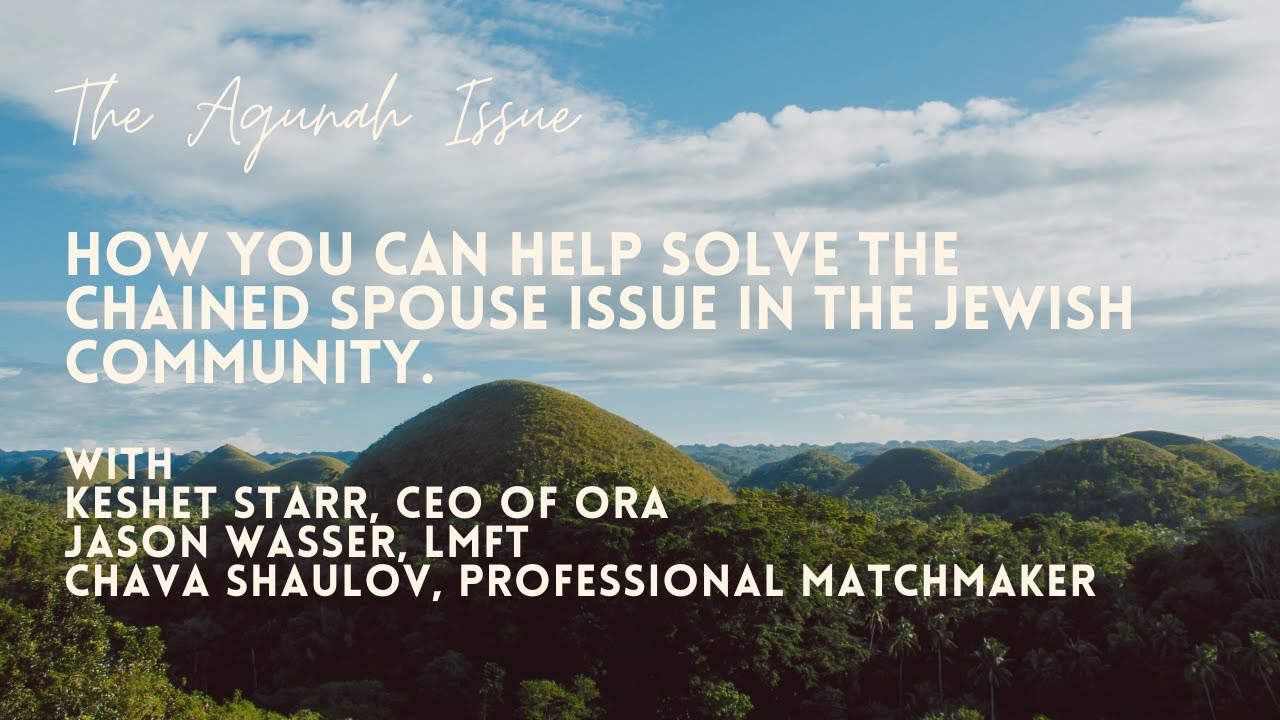
In this episode of the "Have We Got a Match for You" podcast, therapist and host Jason Wasser is joined by matchmaker Chava Shaulov and ORA founder‑CEO Keshet Starr to discuss the Agunah (Jewish get‑refusal) crisis and practical solutions. They define key terms (get, agunah, seruv), explain how halachic prenups work—binding both under Jewish law and civil courts—and why they are culturally essential. The conversation covers how prenups and post‑nups can prevent get refusal, the importance of normalizing them through top‑down rabbinic leadership and bottom‑up education (schools, matchmakers, social media). They explore challenges such as gender‑biased perceptions, legal complexities, and the need for a toolbox of interventions, including counseling, arbitration clauses, and community standards. The hosts discuss the current landscape of organizations addressing agunah, the limited full‑time staff, and funding needs, highlighting ORA’s international network (Chirut) and calls for increased donations. Finally, they provide contact information for ORA and outline next steps for listeners, including further episodes on related topics like parental alienation.
Chapters
¡Hola!
All right, hey everybody, so welcome back to another edition of Have We Got a Match for You podcast. I'm Jason Wasser, licensed marriage and family therapist in South Florida, and I'm with my awesome co-host, Chava Shaulov. What's up, Chava?
Hi, Jason, how are you? How exciting is this? Uh, I am Chava Shaulov. I am a worldwide dedicated and very passionate matchmaker, uh, from New York with a worldwide database. So thank you so much, everyone, for joining, and we have a special guest with us tonight. I'm so excited. Wow, so honored, so excited, right, Jason?
Yeah, I know we've been talking about this for a while. So hanging out with us tonight is Keshet Star. She is the founder and CEO of Ora, which is the Agunah Jewish divorce program that is just doing so many incredible things. I know right now a lot of you on social media have been seeing the campaigns that have been going on, and unfortunately there is all these campaigns going on, unfortunately. It's something that we have had to have talked about for a long time before this, but it's good to finally see people jumping on, doing stuff, taking some social action in this regards. But Kesha, first of all, welcome to hanging out with us tonight.
Thank you for having me. I'm excited to be here.
So let's reverse engineer the conversation because a lot of people, including some of my family members, like, oh, I've been seeing this Free Chava thing, this pink thing. What's going on with that. So let's reverse engineer what's happening now, and then we'll take it from what's, you know, that social media push, and then let's reverse engineer the story to you starting this organization X amount of years ago.
Definitely. And I will say, just as a caveat, I didn't actually start ORAI. I took the reins from some incredible people, but thank you all the same. So basically we're having this really, I think, extraordinary moment where it started with, a few social media influencers sharing about one specific case. And I feel like it's always hard to unpack why this case, this moment, this campaign, you know, has that sort of impact and really goes viral. But it's really, I think we can say it's officially gone viral, certainly in the FRIMM community. And it's jumpstarted so many conversations, not just about the original case that really got everyone talking, but about all these other cases and really about the issue in general. What we can do to make a difference. So it's this really exceptional moment that's exciting to see unfold every day.
So let's go through some keywords in case there's people joining in from different communities that don't necessarily have a background of the language or the words, the Hebrew words or phrases that we're going to be using throughout the conversation. One of them is get or aget, which is the problem, the most common word we'll be talking about tonight. The other word that is aneguna. So do you want to explain each of those two words and if there's any others that you can think of throughout this process?
Sure. So a get is a Jewish divorce and it's totally different from the civil divorce. So that's just a good explanatory piece. Whatever you get from court, this is something completely different. And without a get, you're really considered married under Jewish law, just as if— just as you were when you stood under the chuppah. And so if someone's not able to get a get, they they can't remarry, they can't really move on with their lives, they're very stuck. And an agunah is the term that we use for a woman who's stuck in that position. It actually comes from the Hebrew word ogain, which means an anchor. And I feel like it's a good visual that if you imagine sort of like a ship that's sort of anchored down, it can't sail away, it's stuck. That's really what it's like to be an agunah and to sort of be in this situation. And I'll say another term that comes up a lot, so that's helpful to know, is a seruv. And a seruv is basically a letter from a biden, which is another good word. That's a religious court. And it's a letter saying that someone's not cooperating. So a lot of times people will say, oh, is there a seruv? Where's the seruv from? What that means is it's an objective third party saying this person officially is not cooperating with the get process.
Awesome. Chava, do you have any questions you want to start off with?
Uh, not right now. No, I'm just really taken aback. This is a very important topic for the Jewish community, um, and I'm glad that we are utilizing our platform to make our voices heard and make the topic, uh, um, heard. I think it's a very, very taboo thing to discuss amongst the Jewish circle, and I'm really proud to bring this to light, and I couldn't be happier than doing it with you, Jason Wasser. So I'm really, really thankful to you. So you can take the lead. Thanks so much for the opportunity.
Sure. So one of the things why Chava and I were so eager to have this conversation with you is that her as a matchmaker in New York, she has an incredible, incredible Facebook group that I actually connected with her during the COVID beginning of the pandemic, and she was hosting an event for singles, and I went on it, and I'm like, This is some stuff I do. Do you want to partner on some projects? And our conversations and this podcast idea that we've now created, Have We Got a Match for You, is really about the stuff that really does need to be discussed throughout the relationship process, whether you are dating, whether you're engaged, whether you're about to get married, whether you are married. What are all the different prospects, conversations, things that needs to be put on the forefront from the emotional side to the practical side? And I know that I've taken this stance years ago. I'm divorced, I got divorced 10 years ago, but before I got married, I was the one, to my memory serves me correct, that pushed the conversation about doing the salah prenup. My ex was very eager and open to it. We were both very big advocates of this. And it was really around the time, we're talking about 2003, 2004, where this was just finally becoming a mainstream thing. So when we went through our divorce, which was about 10 years ago, there was never any, conversation for me or amongst my attorney or amongst my friends of like, what are you going to do about the get? And it was within a couple days of her going to the rabbi who does it here to request it. I think our meeting was set up within a week or two of that process happening. Now, our civil divorce was no long— was very far from being done. There was complications with that. But I think in the simplest way, because I had this intentionality of going into it how I'd like to go out of it, not that I planned on going out of this relationship, really did set the precedent. And over the years, I've become a massive advocate for this community, kind of getting in trouble sometimes for it, been called numerous things from the nicest being called a feminist, which I was very honored to be calling that, all the way to the other side of, you know, politically how this has now been co-opted as you're such a liberal, you're such a snowflake, all the things where this has become now a political thing. So I want to start off, I guess, maybe with what's the scope of what Aura can help with, what your organization can help with. Why should someone reach out to you? When should someone reach out to you? And then I want to again get into the, the dynamics of what a prenup is. And maybe that's really what it— we should start with that. What is a prenup? What's the difference between why a civil, uh, law American prenup doesn't protect somebody from a religious prenup? And why does someone need to get this contract? And then why would they then come see you?
I love that, and I love that you're a matchmaker, Chava, because this is so perfect. But basically, the prenup is a document that you sign before you get married that prevents the get from being an issue later on. And I can go into sort of the technical elements of what it is and how it works, but what is great about the prenup is that it's both a halachically binding document, so it's really binding under Jewish law, but it's also civilly binding. You can bring it into court and a court can understand and interpret interpret it like any other arbitration contract. And so it kind of gives you the best of both worlds. But I would actually say couples should sign the prenup because it's protective for them. But really the best reason to sign a prenup is that if you live in a community where everyone signs the prenup, where the rabbi won't marry you without a prenup, where your in-laws won't pay for the wedding without a prenup, that's a community where you don't want to be a get refuser because that community has really taken a stand that we don't want this happening here. And so we're going to take this preventative measure. So there's a huge cultural impact. And what we've seen at Ora actually is that as the prenup has become more and more normative in the modern Orthodox community, we're getting less and less cases from that community. Which is not to say that there are no messy divorces and no domestic abuse and that all of that is magically gone. Of course it's not. But what we're seeing is that the cost of get refusal is getting too high for that many people to go ahead and choose it. —and so less and less people are. And so that's really a profound impact. And the best reason to get a prenup is really, I think, to be part of that movement. And we're seeing a movement right now to be part of that cultural change. And what's different about the prenup versus a civil document is that, in a way, that if you almost have to ignore the term in your mind, because when we think prenups, we think like Kim and Kanye, you know, making sure that their 17 houses are distributed fairly. And that's not what this is about. That wouldn't work. Include things like that in this document. It's really not about finances. It's not about planning for divorce. It's really just about making a commitment to each other that I love you and I respect you. And even if the worst happens, and even if this relationship doesn't last, that I want you to have your freedom and your future. And I want that for myself. And I want to be part of a community that operates that way. And that, that's really the core of the commitment and the expression. And yeah, so I think the connotations that we can have around prenups, we almost want to put those away because it's not that kind of a prenup.
Right. And I think that's why it's so great why Chava is here, right? As a matchmaker in the community, you're getting involved so early on from the setting up process all the way through to sometimes even walking them down the aisle, right, that you've done. So part of this conversation is how much would it be great, right, Chava, and then there's this whole new industry of matchmakers who are saying, listen, you want to work with with us. This is part of the process. This isn't, right? Can we make this a zero-sum game? Because you're talking about communities that are making it a zero-sum game. And of course there's always rabbis for hire and there's always going to be beit dins, right? That are not always as ethical or honest, you know, because anybody can put together one of those. But how do we really now impress upon, like you said, to create a community standard And what are some of those communities so far that are doing outstanding when implementing this?
So there are— what I think is most successful with initiatives like this is that it has to be both top-down and bottom-up. That a lot of times you'll hear a lot of voices saying, well, we need rabbinic leadership to step in, and we do. And then you'll also hear a lot of voices saying, well, if I bring it up to couples and they've never heard of it and they're very intimidated and threatened by it, I can't do that every single day with every single couple. So I think it really needs to be both. The key is really normalizing it. When we present the prenup to couples and we really train rabbis, college teachers, you know, bride teachers, etc., to do the same, is that you're not signing a prenup for yourself. If you're signing a prenup because you think you're going to need it, then go talk to Chava, talk to Jason Wasser, and get more information and don't just jump in. But that's really not what this is about. You're signing a prenup because It's what we do that's part of Jewish marriage. And by you signing it, someone out there who's not you, who's gonna need it, will be protected. And really having that impersonal message that it's, it's not you, it's not personal, and to normalize it. We actually go into high schools and talk about the prenup and we like to do it at that age. We have a much more age-appropriate, you know, content curriculum than we would for an adult. Presentation, but we like to do it at that age because probably you're not in like that serious of a relationship, right? Even in senior year, you never know.
Depends on the school. Depends on the school.
Depends on the school. But that we want to try and get to you before you're even dating the person that you're going to end up marrying, because then you're like, OK, that idea makes sense. Sure, that idea is in your mind. And it's so much less intense and personal than when you're in a relationship and you have to talk about it and you're hearing it for the first time. So trying to just get at people early and just have it the norm. This is what we do. It's not a big deal. We don't wanna make it a big deal because that scares people off. And there are enough big deals with wedding planning.
So I'm always a big fan of solving bigger problems with simplicity. And, um, I'm wondering, right, cuz going from a course or, oh, you know, a couple hour long training or something like that, what do you think it would take in the day school system? To make this specific training with some type of, right, you're getting, you're turning 18 years old, we're going to have you do some type of, you know, agreement slash curriculum slash not just a 4-hour thing, but this becomes embedded in day school curriculum as part of a graduation requirement. How, and again, I'm not saying that this is like the way to do it, but like what would it take for that to become, you want to graduate from our day school, this is part of our brand, right? Because if the rabbis are behind it, the leaders are behind it, the rabbanim are behind it, whatever it may be, how do we make this something that we're going to extend our brand with you after you graduate, and we're going to make this some type of curriculum requirement and make that maybe not just a day school thing, but how do we, you know, the RCA and the OU and any of these schools that are backed or connected to it, how can we embed that more deeply into the culture?
It's such a good question. And I think the schools that do this really well, it's exactly as you said, it's part of the culture. I had a school we presented at that sent me a picture on Purim, someone dressed up as a prenup. And so she's like, I have to send this to you. But again, you have schools that are so invested that even 6, 7 years after someone's graduated, I can meet with them and they're like, oh, I went to such and such school. And I'm like, oh, so you heard about this 7,000 times. Okay. That they, it's really built in. I think that when it gets challenging with schools is that sometimes it's just a question of prioritization. There are so many issues and so much content they're trying to squeeze in. Are they really realizing how critical it is to get this information and making the time? And, and I think that schools have really overall been shifting away from this mentality, but especially when we're trying to get into more yeshiva schools, we do get pushback sometimes that like we don't want our girls to know that these things can happen. And so I think it also fits into this larger educational ideology question about like, how do we raise and train our students? Do we want to let them know that there are these bad things that can happen? Would we rather just sort of send them out? And I think for us, and I think this is such a critical part of the messaging around this, when we present to students, it's not, when you get older, you can become an aguna, good luck. It's really an empowerment-focused message where we're saying like, yes, there are these things that are happening that are a problem, and there are things that we're doing, and more importantly, there are things that you can do that make a difference, and that you can actually take some power here and take steps to protect you, to protect your friends, your family members, your cousins, whoever else is in your life, and to really send students with an encouraging message. And I think in general, it's so healthy for students to know that, yes, it's a big world and there are bad things that can happen, but I also have tools to find resources and make good decisions and navigate through those things, right?
Yes. Hi. So my question to you, I mean, taking steps forward and utilizing, um, different platforms to make, uh, to make awareness known, to educate singles out there before they get married on the, on the concept and the idea and the, the positive aspect of signing a prenuptial agreement for for, you know, in terms of the GET, what are the details on the GET, on the prenup? Like, what is— like, what is— what's the word I'm looking for? Like, what does it entail? What does it say? How does it protect both parties? And what happens if the couple is already married? How can they utilize it during the marriage?
Great questions. So basically, the prenup comes down to two pieces. There are two main things you're committing to. The first is that you're agreeing that if there's a dispute about the get specifically, you're going to resolve that dispute by going to a particular Beth Din or religious court. The default one is the Beth Din of America. Some people put in different forums to resolve that issue, which no one is excited about because that doesn't sound very impactful. But what actually happens in a lot of these really bad get refusal cases is that the couple get into this like loggerheads over which Beit Din they're going to go to to even discuss the get, and they can spend years stuck in a stalemate. And of course, as years pass, people get more entrenched. There's a lot of problems with it. So part of it is that you're already choosing where you're going to be if there's a problem, which you're now— it's like Monopoly, like you already passed go and got $200. And then the second piece is that it enforces a halachic support obligation. So the way it's set up is that in Jewish law, marriage is not just fun and games, but it's also responsibilities. And that if you're living separately, but you want to stay married, i.e., not give a get, then you have to pay your spouse $150 every day to represent your obligation in supporting them. And what that effectively does is it creates a financial disincentive to withholding or delaying the get, because for every day that you wait, it's another $150. That's about $54,000 $100,000 a year, and it just kind of piles up. So a prenup is not an automatic get, and a lot of people think it is, and sometimes they're a little stressed out when they find out it's not. There are a lot of both halachic and legal reasons why it can't be, but it's really structured so that it gives people an incentive to move it along faster. And one of the best reasons it works is that it kicks in early.. And what we see with a lot of contentious divorces is that as time goes on, it gets nastier. People get more stuck in their positions, they get less flexible. And also we want to make sure that a GET is never used as sort of an extortion tactic. Oh, you want, you know, the judge said we're going to split the house 50/50. You want the GET? How about we split it 90/10? And that's how you're going to get your GET and be free. And so by really pushing the prenup to the beginning of the process, we can make sure that the GET isn't used as leverage in an inappropriate way, that we're catching people when they're more flexible and more likely to cooperate, and therefore avoiding a lot of the pitfalls. And in terms of if a couple's already married, you can sign a postnup. It doesn't have the same sort of legal muscles that a prenup does just because prenups come with certain, uh, protections that only kick in if it's before you're married. But I actually think postnups are amazing for the cultural messaging. We've had couples host postnup parties, sometimes for their anniversaries. We've had couples married 50 years sign a postnup, and it's great because it really helps normalize it, and it helps show young couples that this isn't something you sign because you're insecure in your relationship, and that's not what this is about. And so having couples that are married and secure go ahead and sign it, it really helps sort of spread that messaging. Another question for you.
You see a lot of cases obviously on social media and various other platforms that influencers are liking and posting as their story on Instagram and Facebook, and they're tweeting, even publicly hosting different social gatherings to make this whole, you know, GET refusal process or situations very well known each community, right? So we see a lot of women dealing with many, many years of not receiving their GETs, right? Now, I do understand it works both ways, and I have singles in my network, men whose wives don't take the GET. So we have both sides of the coin. Not to say, not to eliminate anyone, you know, this is worse, this is not worse. It's not a competition. But do you see cases where women are not accepting the GAD and then the guy's stuck in limbo and unable to move forward?
We do, and we work on those cases. And so, yep, they do come in. I would say we see 95% one direction, 5% the other way. Those might also be the people that are calling us. But it— and I think honestly, a lot of women don't know that they can refuse to accept it. So it could be there are people that, that would be interested if they knew. But really, it can happen both ways, and it's domestic abuse both ways. And I would say in general, this is a much more meta topic, but I think in general, we really try, especially we have a helpline that people call early on in the divorce process, and we really try to encourage just ethical divorce tactics in general, that on both sides we want to behave ethically and responsibly and really move towards a resolution as, as responsibly as we can for everyone's sake.
Right. So there's also this, like, um, people, people ask for a divorce. Let's say couples go to the beis din and they ask for a divorce. The marriage is not working out for whatever reason. They both, um, you know, are being very cooperative in the situation. And let's say, for example, it happens when you bounce the ball in court, you know, beis din, there's going to be some sort of pause in terms of signing the get or signing the civil divorce. At what point does a woman, or does a man, claim that they're refusing my GET? Is 2 months enough time to say this? Is 1 year enough time to say this? What is— 10 years enough time to say this? Especially if there's court proceedings and there's different, let's say, assets. Let's say there's businesses that have to be split. Let's say there's relocation that's an issue. Like, at what point is it considered get refusal? At what point, at what stage of the divorce process?
So that's the hardest question to answer, only because there's a lot of different takes. There are people who say it's only at the end of the civil divorce. There are people who say if it's been 18 months— and there are halachic positions on this— once you hit 18 months, you're now officially, you know, dealing with get refusal. When it comes to our cases at ORAH specifically, and because we're an organization and we work in so many communities and we work with rabbinic leadership, We always have to maintain our credibility. If we are publicly on a case, it's because there is documentation from a Beit Din that someone is not cooperating, and that could come a year post-separation, it could come 11 years post-separation. So for us, that's what we need to move forward, simply because as an organization we've really chosen to work within the halachic system, and that is how we feel like we can create the most organic and long-lasting change. People individually can say different things, but what gets fuzzy about this is that you often have these circular conversations. So I was actually just speaking to someone about a GET refusal case, and they said, you know, so-and-so really wants to give a GET. And I said, perfect, that's what we want too, and we'll even pay for it. So let's talk, let's make it happen. Oh, well, there's just like a few things that need to be figured out. Okay, so they actually don't want to give a GET right now. But, you know, again, you'll see a lot of kind of fuzzy messaging because most people, unless they're not very bright, are not going to go around being like, yeah, I'm a GET refuser. I really want to control my ex. Like, this is awesome. Everyone's going to have a story. And as community members and just bystanders, it can get so confusing to sort through these stories. And so we really encourage, first of all, the reason baked-in documentation is helpful is that it takes you out of the he said, she said, and it gives you just something a little more objective. But also that as a general community policy, marriage is over, we want to see a gap. That we do recognize that there are so many other issues. And I have a lot of friends who work in family court and matrimonial, you know, on matrimonial law. That system is broken in many respects. So it's not that it's a perfect system by any means. But what we generally advise policy-wise is that you have an issue around custody, around finances. There are a lot of places to go to work those out. None of them are perfect, but there are different resources and different tools. And using the GET as sort of the avenue to work things out is very dangerous because it just opens the door for a lot of abuse, a lot of extortion, and especially with custody. We really want neutral third parties making final decisions if the parents can't agree. We ideally want the parents to agree, and if we can't have that, just for the sake of protecting children who are vulnerable, we want neutral third parties who are not as emotionally, you know, amped up as the couple are right now to make those decisions. Yeah, go on.
No, go ahead, just I'll ask after. So how—
so in the case where there's any manipulation already having, right, having that situation, um, so let's say the person says that they're not going to want to give the gap, right? They're not going to give or receive the gap until the other person signs a binding arbitration that releases them, that they won't take them to civil court, right? They go behind this and they do this thing, as well as taking to the bait and to try to go— let's say a person, um, right, they have debt. And they're like, well, I'll give you the get in exchange for— like you're saying, this leverage of even though I'm not paying you off, but I will leave you with this, but I'll give you the get. So how— like, so how do you navigate that when there's a civil binding arbitration, or they try to create a civil binding arbitration that basically goes against— because some states, except for maybe New York and a few other places, actually will recognize the Jewish divorce and make it part of the law, right? So how do you navigate the wording? So if someone is in a relationship right now, they want to have this conversation with the person, uh, right, that they're about to maybe have a serious step with, whether it's we're going to start talking about marriage, we're going to start talking about engagement to lead us to marriage, what would be some of the conversations beyond do you want to give— do you want— would you give me a get— do you want to do a prenup? Great, let's go sign this paperwork. What are some of the deeper conversations? What are some of the language that they need to be more sophisticated about in order to become an informed consumer to protect both sides.
Definitely. And so the prenup actually, in addition to the, the quick two elements that I talked about before, the prenup has these optional sections. And the way the optional sections work is that even though the standard language of the prenup is just addressing the GET, if you want to, you can also ask the BDN to adjudicate custody or finances or both.. And so that's a decision a couple can make. Now, most of the prenups that I facilitated are with students. And when you have like one beat-up futon between the two of you, the idea of even having children or property to then have to divide is like their minds are blown. And so most of the couples that I work with are again, so young, so far from that stage that they usually choose not to sign those sections because it freaks them out a little bit. But I actually think that when I'm working with couples and one or both parties have been divorced previously, it can actually be a really helpful and important conversation to think through what process did I experience, how did I feel about that, would I want something different. And it can be, again, a really helpful opportunity to sort of think through those elements because it really, it can be this scares us and we're nervous to talk about it, so we're just going to ignore it. And you can do that. But if you want to, it can be a springboard for thinking about what kind of process do I feel comfortable with? Do I feel safest in a religious court setting or in a secular court? Am I nervous about certain things happening? And I guess one thing I'll add to this as well, because I think it is important, sometimes a refusal to sign the prenup can be a red flag of abuse. And sometimes someone's never heard of it and it's brought up by their fiancé who might be very familiar and it's threatening. So I think it is really important that people feel comfortable asking questions. Anyone is welcome to call us and ask questions. We're not going to be offended. We once had a couple in our office for 8 hours debating whether or not to sign the prenup. They like went to get lunch and went to get dinner and asked us questions and just sat there sort of duking it out. And that's okay. But again, it's okay to have questions. It's okay to have discomfort about what does this mean or what are you trying to say. Sometimes it's indicative of a problem and sometimes it's not, but really creating space for people to talk through their concerns. And especially if you've been divorced previously, it's not abstract. People have real practical concerns based on what they experience and what they're afraid might happen in the future. And so And so just having a space to talk about those anxieties in a really honest way.
Actually, you hit a soft spot because I was also at once refused my GET. And this is why I am very proactive in this community. And I advocate for men and women both alike who are in this predicament. It has a very soft spot. Spot in my heart. But as a divorcee, baruch Hashem, thank God, I did receive my get after a long journey, including dealing with the bais din and given the runaround with numerous rabbeim in the bais din. It took me a long time, a lot of sweat, a lot of tears, a lot of weight loss, depression, anxiety, sleepless nights I couldn't function. I was petrified, um, you know, and I really feel as though there needs to be, um, a meeting of some sort with the older generation rabbinical authorities. Not to say that the new rabbinical authorities have any more or less leverage than the older ones, but I think word needs to get out. And I think as a divorcee the next time around, B'ezrat Hashem. This is, this is a very important thing for me. I will need to have that signed. Has nothing to do with my future husband or anything, chas v'shalom, with any type of negative thoughts. I just need to feel protected. And I think it's important for men and women alike to understand this. There's nothing scary about this. There's nothing— this is not an intense concept. This is something that's— it's a wonderful thing to be able to think about the other person and wanting them to be freed from the marriage and not held, you know, against their will and allowing them to live, you know, their journey. And I think this is a very, very important topic, and I think there needs to be a lot more awareness than that is going on now. Baruch Hashem, we have a lot of different platforms we're able to utilize our, you know, our, our, you know, our names in our, in our influential type of platforms, whatever you want to call it. And I think it's important. So I'm actually very appreciative of this podcast because it literally hits close to home. So if I get triggered, I'm sorry. But, uh, I think, you know, it's important, especially for divorcees, understand this. And I think there needs to be a little bit more awareness amongst the community where it's single first-timers, and it's a very scary thing to even wrap your head around. And I think, you know, the more education we provide, the better the understanding is. So thank you.
And I think it's so important to really internalize this. And we have this conversation with Rabbanim quite often also. It's not about a lack of commitment. And a lot of times when we think of prenups, we think of it that way. I have half my foot out the door, like when you're on the airplane and they show you all the exits, you know. And that's not what this is. And if anything, it's the opposite, that I love you so much that even if I have to protect you from myself because the worst happens and I'm my worst self in that moment, that's what I want for you, that I would never want you to suffer in this way. And I— again, it's really about love and care and commitment. And we've had some couples actually decorate their prenups sort of like people decorate ketubas, which on one hand can sound really, really unusual, but actually if you think about the ketubah, it's not so different. The ketubah is not, you know, I love you forever, I'm going to make you a banana smoothie every day. It's really about death and divorce. But in some ways, that's what Jewish marriage is, that we're not going to pretend that we're reading Snow White and everything's going to be like rainbows and unicorns no matter what. We recognize that life happens and that we have— part of loving someone is having obligations to them and wanting their happiness and success and freedom and prosperity no matter what. And that's where real love is. And that's what realistic love is. Maybe not romantic comedy love, but I think that's what true love is. And that reframe can help people feel good about signing it.
I see it in two ways. I always joke that the Disney movies need to end instead of with happily ever after. It should be, and next week they went to couples therapy, is number one, right? That's my longstanding thing. And number two, I wonder— there's a few different ways that I think that, like you said, the mental health side of this. One is, I was in my second year of graduate school when I got married. So if it wasn't from— I grew up very traditional, conservative, USY, camp or ma. We know that there's the clause in the ketubah that's added on as the addendum to make sure that this is not an issue in the conservative movement, the reform movement also. It's become something that I grew up with, that this was a problem that is only an Orthodox problem for the most part at this point. The Lieberman Clause solved that problem in the conservative movement. The fight back of, well, I love you, so therefore I would never cause you to be that much pain. Of course I would give it to you. Then, well then great, sign the paper, right? It's, I always like, that's the red flag at the beginning. No, no, no, it's fine. You don't have to worry about it. Well, if I don't have to worry about it, then sign it now. So we never have to worry about it again. And I'm wondering like, again, reverse engineering the problem is one of my favorite things to do is, it also goes back to social stigma in my mind, as I'm hearing and listening to this conversation, it's yet another issue that a woman has to solve love for culture. That has now been— because it's now become such a predominant and prominent issue, men wake up. Now men are finally getting on the bandwagon. And thankfully, I'm happy and I'm pissed off at the same time that it took so long, right? I mean, I'm happy that they're doing it, but where were you for the last 15 years or 20 years or 30 years? But, you know, I'm glad because now all the influencers— and I want to kind of like give them, you know, props, but at the same time, you know, This is why you become an influencer in the Jewish community. And you should have been talking about this, not because some woman in your way forced you to do it. So, you know, I'm frustrated, but I'm very happy at the same time. How do we make this? Because you said, right, majority of the cases that are coming in, yes, there are cases on the other side where it's women withholding to accept it. How do we take this away from being known as a women's issue to making it a Jewish issue to fully fully, completely, like, is there an answer to end this?
So in terms of how to make it, I think, more than a women's issue, I actually think if you sort of ask people, why do you care about this, of the people who are passionate and do care about this, some people will say, well, I care about women and women's rights. But I also think there's a compelling argument to say that I care about Torah and I care about halacha. I care about Jewish law, and that if I feel like I'm part of this system and I'm seeing this system used in a way that hurts people, and I feel like, no, that's not the idea, that's not— like someone followed the recipe wrong over here— then I have to do something. That I do feel that standing up on this issue, it's as much about standing up for halacha as it is about standing up for women, because it's really a manipulation and a perversion of Jewish law. And if we value Jewish law, we should have a problem with that. And we should feel a need to say, oh, that person doesn't speak for me. That isn't how I see this. And in terms of how to end it for good, what I truly believe, and we working at ORO, we get at least 3 emails a week from people saying, you know, I was in the shower and I came up with a solution to the Agunah crisis. So here it is. And now you can, you know, go send your resume out. And if only our goal is to go out of business, But I do feel that there's, there's really no magic bullet. Because even if technically we could find some perfect solution, the amount of people you'd have to get to agree to that perfect solution for it to be practical would make it pretty prohibitive. So what I think we need is a really good toolbox, like a well-stocked toolbox with different powerful tools that are each going to work in different ways. But to really sort of develop that variety and attack the issue from different respects. It's not as glamorous as sort of a one-shot deal, but the truth is I don't think there's a one-shot deal because a solution that only two people use is not a solution. That in order to work, it's almost like passing law in Congress. Like you have to take a lot of people out to lunch. You have to get a lot of people on board. It's not like you can just sort of write it and will it into being. And we don't really have such centralized leadership in the Orthodox community right now that if Rabbi X says this is okay, everyone falls like dominoes. We don't have that right now. So we have to go a little bit person by person. But I do think that thinking about it as a toolbox is powerful. Many, many people love to talk about the prenup and say, but what about this situation where it might not work. And what about that situation? And the truth is, I'm a lawyer, so I can't ever say anything's 100%. So I wouldn't tell you the prenup's 100% going to work because nothing's 100%. It's life. But if the prenup solves 90% of the cases, 97% of the cases, and we then use a different tool, a different toolbox of tools to address the other 3% or 10% or whatever we're working with, how much better off are we? Plus, when we factor in the cultural impact of the prenup, we get even further. So I think the prenup is the strongest because of the fact that it has that timing piece and that it builds in that culture piece. But there is a lot of work to do in the legal system so that when a couple is dealing with get refusal and they're in a courtroom, people know what's going on. Because what usually happens is that people hear religion and they're like, oh, I can't touch that. And they really separate themselves from the process. And so we're really working to try and educate, you know, judges and attorneys and attorneys for children. We're also trying to work with rabbis, college teachers, all of the people that— matchmakers, all the people that really help prepare couples for marriage and that are often the first phone call if something's going wrong. Those are really, really, really important groups to loop in. And really, again, just building in a robust set of halachic and legal and social tools. Social media is one tool that we've seen, you know, can be very, very powerful. Used to be Facebook. Now Facebook's not cool anymore. Now it's Instagram. You know, it shifts. Who knows what— where we'll be naming get refusers in 5 years. But really just having that creativity and that range of tools, because every case case is different, but having those options and, and I can't stress this enough. So I'll mention this also in terms of when to call Ora. Please get help early. I think that is the most critical thing. These cases get worse over time. They get worse as they go. If you don't have beaten documentation, we can help you with how to get that because it's really hard actually. And the beaten system is very broken in many respects. There's a lot of confusion over where to go and who's reliable and who isn't. So really just getting yourself information. Knowledge is power. If you understand how a system works, you can strengthen yourself as you go through it. And to really try and address cases early because the longer it goes, the less— it's like an illness that's progressed, the less options you have and the less effective any of those options are going to be. So let's, let's not wait till it's stage 3, stage 4. Let's get in early.
Well, that, that what you're talking about is really herd immunity, right? At a certain percentage of our community accepting this as industry standard, cultural competency, everybody's doing 80% of the community, 90% of the community is doing these standards. Those outliers are going to have so much pressure and it's all right to not be able to do it. And we're going to know earlier on, probably again, because of the education, because of the advocacy, because of the legal side, that those cases will hopefully become much simpler to solve. My next, and maybe as we wrap up, is the numbers. You're a organization. We know that there are individual people who are advocates and talking about it especially, but they're all wrapped up kind of within the same system and the same network. Over, under, how many different groups groups/organizations are there working on this issue? Probably whether— if you want to talk about just the United States, North America, and then maybe we can just Israel and the world, right? How many groups collectively do you think there are working on this issue? And within those groups, how many people do you think are full-time, dedicated, paid, salaried workers solving this problem? Because I think that's, again, a reverse engineer question is that's a funding issue. Right? If we're—
so let's start there. I actually love that question because one new initiative of ours is that we created something called Chirut, and it's basically a network of international agunah agencies. Because even though we're— many of us are in different locations, we're dealing with different legal systems, there's still so much in common. And we're generally all at such small organizations that it gives us access to just a larger pool of colleagues and resources and people to call when you need to complain about how frustrating the work is or anything like that. So I would estimate, and again, some of these are large organizations with numerous staff, some of these are sort of networks of local volunteers. I'd say maybe 10 to 15 agencies that I can think of off the top of my head in terms of full-time people working on this around the world. Maybe 30, maybe 50 at most.
And we're talking about on a numbers game, how many possible that you know about, a good note situations, and maybe even ones that like, based on the numbers you've seen over the years that haven't even made its way to an organization because of fear or because of intimidation, they don't have the resources. What's the, what's the ratio here that we're looking at? So we're talking about 30 professionals. To potentially in 2021, potentially how many open legit Agunah cases?
That's a very hard question to answer just because there's so much debate about when you become an Agunah. So every year the Israeli Rabbinate publishes numbers of Agunot and Agunim, and a million people write op-eds about why those numbers like don't really indicate the full story, and we just do this again every year. And part of the challenge is that if you count only people who have a letter from a beit din, you're going to get a certain number. Many of those people come to us, not all of them. Then you add in the people who can't get that letter from the beit din because the process has been manipulated or they went to a forum that really wasn't equipped to deal with them. Then you add in people who were technically not a guno but who gave up lots of things in order to get a get. Then you have people who don't even leave the relationship because they feel like, what's the point? I can leave, I'm never going to get my get, so maybe I should just stay. And so you really have— it's almost like if you drop a pebble in a river and you have these ripples, you really have these ripples of impact that are very hard to quantify. I will say, even as we've seen so much progression on the issue, especially in the modern Orthodox community, our case numbers have gone up, not down. Part of that is that as you grow in word of mouth, your caseload can grow. But we work on about 70 to 75 active cases. And we, you know, when we resolve a case, there is a case coming in. Like, we almost never have lulls where we're just like not getting cases for a while. And we typically work with another probably 300 at least people every year who are earlier in the process and who are trying to get information or may, might not be at the stage where they need our full-time case advocates, but where they're really trying to get information and structure the process to their advantage and just to really avoid long-term debt refusal. And so it's always so hard to answer numbers, but we know that the impact is huge. There are really not great statistics that can sort of prove it scientifically, but we see the impact. And there was actually a really interesting study done in Israel several years ago that looked at not how many agunot are there officially, but they asked women getting divorced in Israel how many of them were afraid of not getting a get, how many of them felt that the get was like a very significant factor in their decision-making around divorce, and how many signed settlements that deviated from the law to their disadvantage and found very high numbers for all of those. And so sometimes it's these other questions that can give you a sense of the impact. And I do feel that in some ways, for anyone going through Jewish divorce, we kind of know that this thing is there. And, you know, maybe it'll impact you and your life and your case, and maybe it won't. But I think that it does cast this shadow. In a way that impacts way, way, way more people than any study or survey would possibly capture.
Well, my, one of my reasons for asking this question is one, obviously I want people to donate to these organizations and to really see it as something that it's, it should be not just the day school, not just the synagogue and not just the gemach, but it should be to these agunah-based organizations is a massive thing. And why people— because it's not a sexy issue. And I think that it doesn't like— to have your name as the official sponsor, the so-and-so family or an organization is not so sexy. But I know that right now, especially in the entrepreneur world, there's a big giving pledge for millionaires and billionaires. And they're using that money dedicated to specific purposes and causes that are important to them. So I want to challenge people. People who are listening that if they, you know, if you know someone in your family, if you've been someone, if this is part of your life, I want you to take in consideration that these organizations and others specifically need help to run these services. And I know that if we 10x their funding, we will exponentially have more money to do advocacy and to do more education and to hire more staff and to process more because I think one of the questions someone asked me is like, you have your organizations and then you have the RCA. So like, you know, and how many people— I mean, based on what you know, like, what's their full-time staff over there handling this just from the RCA?
I would say full-time is probably pretty small. I think they have a number of rabbanim that are also, you know, rosh yeshiva at YU and doing this and doing that. But it is difficult to do this full-time. And I do think— obviously I'm a little biased because, you know, this is what we do— but I do think that again Social media moments come and go, right? There's energy, and then people are stressed about preparing for Pesach, and then they come back, and then they go, you know. But for any issue you care about, it doesn't just have to be this one, find the people doing the work every day and support them, because I think that is how you really get that long-term change. And I'll actually just do a quick plug because I thought it was such a cool idea and I joined it myself. There's an organization called My Tzedakah Fund, or I think mytedakah.com, or .org, but either way, you basically input how much you want to spend per month, and it gives you options of different charities, or is one of the available charities, and it can help you sort of distribute if you want to spend X amount per month where you're giving to who. And I think it's so powerful and important to realize that you don't have to be able to write a $10,000 check to make a difference. And by all means, if you can, call me right away and we will talk.
We prefer a $20,000 check. Yeah, exactly, exactly.
No limits. But again, even for those of us that are starting in our careers, or I work at a nonprofit, you know, but we really all have more ability often to give than we realize. We're giving more than we realize just because enough people run High Lifeline marathons and ask us to. And if we can— not that we should take away from that in any way, but I think that if there should be an open—
there should be for running these marathons, also for Aura and for these other things. And that's all I'm saying and putting it out there. And sorry to interrupt, but like, that's like, oh, like, it's not right. It's not sexy, right? It's not like, oh, you're doing— like, you don't— like, in those, like, then they're amazing organizations and they should have all their funding. But there's enough going around for all of us in the community that we can make a little bit extra, or you can dedicate your money directly to this. I do believe between financially solving this problem from from a legal and educational standpoint, creating retreats, creating educational programs, creating a book, creating a curriculum that is cost, right? That this all takes money, but I don't know, $10 million can put, can solve 99% of those issues. And the rest is now culture catching up to that. And I do think it's a, I think it's a $5 to $10 million problem to solve. I agree.
And I think it's such an important message as well, because reading especially stories of this person's waiting 10 years, this person's waiting 17 years, it can feel very defeating. And it's so important to realize this is a solvable and addressable problem that you have. Of course, it's a real problem. People are suffering. It's not in any way, you know, to invalidate what those people are experiencing, but it's so important to realize that this is a problem that we can solve. Like most problems, prevention is really where you see the most results in the long term. That if we're waiting till we get extreme advanced cases, we are going to be more limited in what we can do. But to really come away realizing that there is a lot we can do. And yes, it's tricky because yes, the concept of the get comes from the Torah, and we can't just erase it, and there's all these challenges. But it really is something that we have in our hands to solve, that we can make a difference and make a change. And I really would not have been able to do this for as long as I've been doing it if I didn't really believe that one day when I'm old and gray, I'll be telling people that I used to work on this thing and they'll be like, oh, that happened? That's crazy. Because it won't be part of our culture and our community anymore. And I know that we can get there.
I mean, so thank you. So I know we want to hold here. I know there's so many other topics we can get into which might lead us back to a future conversation— the mental health side, the parental alienation side, the— I, you know, there's just so much more of the education and, you know, and all these other things. So, um, I want for people to be able to reach you, to get your information. Where should they go?
So the best way to find ORA in general is www.getora.org. And info@getaura.org. And if you want to reach out to me specifically, you're super welcome to. I'm kstar@getaura.org. And you can also follow us on Facebook, Instagram, occasionally Twitter, although we're really more focused on the other two, and keep up with updates and programs. And you can bring our programs to your community and your network and we can work with you to create something that really fits whichever crowd you are trying to attract. So we really welcome that partnership, and we couldn't do what we do without having so many incredible people in the community who bring us out and support us and engage with us and ask us questions. And so don't be shy. Please reach out and connect.
Any, any final words from your, from your side of the country?
I think this was a very informative discussion. I think we've covered some ground, not all of it. Um, I think we still need to maybe perhaps discuss this a little bit further, like you mentioned, uh, on the parental alienation, because there is a lot of, um, using it as a tactic of, you know, playing ball and holding the ball in your court and just playing with fire. It's not necessary. So I think we should, you know, schedule topic number 2 with Keshet. I think it's important. Looking forward to that.
I would love that. And it's an important topic to, I think, really address thoughtfully and, you know, comprehensively. So I think that would be amazing. Absolutely. Thank you.
Yes, again, thank you so much for spending time with us. So for everybody who has been listening, those of you who are on the live stream, those you're going to be hearing this on the actual podcast audio, if you have any questions, obviously you can reach, uh, Keshet at Aura. You can reach out to me or Chava. You can follow us on Instagram at Have We Got a Match for You. And then on there, on that bio, you can see each of our individual Instagram accounts. You can— if you have any questions for anything that Chava is doing, uh, and anything that I'm doing in my other podcast, You Winning Life, um, and all the amazing programs that you're doing. And there's a little more stuff that we're gonna have a retreat when all this pandemic's over. Yes. So, uh, whenever it's over. So all that good stuff. But again, Kesha, thank you so much for hanging out with us.
Thank you so much. Have a great night.
Thank you for having me on.
More from Jason


Howard Behar Starbucks Former International President Heartwarming Story #kindness #shorts





