
The Ketotarian Way with Dr. Will Cole- You Winning Life Podcast Episode 80
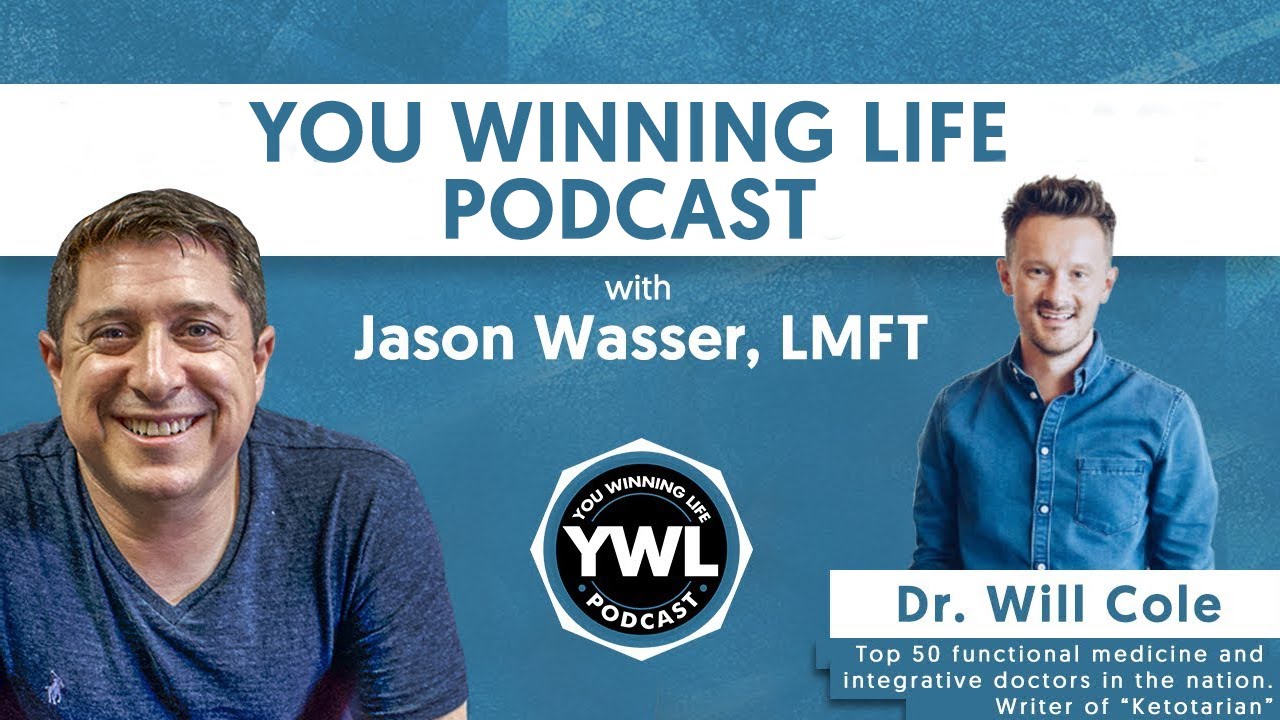
Dr. Will Cole, a functional medicine practitioner, explains his Ketotarian approach: a plant-centric ketogenic diet that uses beta-hydroxybutyrate to reduce inflammation and address root causes of chronic disease. He avoids diet dogma, emphasizing bio-individual testing and the core principle that you cannot heal a body you hate.
Chapters
Hey everybody, welcome back to the You Winning Life podcast. I'm Jason Wasser, licensed marriage and family therapist, certified neuro-emotional technique practitioner, and certified coach. I am here today with Dr. Will Cole, who is a chiropractor and leading functional medicine expert who consults people around the world via his webcam. And locally from his office in Pittsburgh. He specializes in clinically investigating underlying factors of chronic illness, customizing health programs for thyroid issues, autoimmune conditions, hormone dysfunctions, digestive disorders, and brain problems. Dr. Cole was named one of the top 50 functional medicine and integrative doctors in the nation and is a health expert and course instructor for the world's largest brands such as MindBodyGreen and Goop. He's also the author of the books KetoAryan, and The Inflammation Spectrum. Dr. Cole, welcome to the podcast.
Hey, thanks for having me. I'm excited to talk.
I always love going through the bio because you can see how many points someone touches on in their life and how much we're not one-dimensional in that which we bring to the table of what we're passionate about and what our purpose is. So let's start off with a little bit of the backstory. How did you decide to become a chiropractor? And, you know, when did you know that was for you? And when did you know that this field of integrative and natural health and wellness was part of your passion and your purpose?
Yeah. So I, I, what, what I was passionate about was always nutrition, uh, and health and wellness and using food as medicine and herbs and botanical medicine. And, and, and I would say clinical nutrition research, that was always my passion. So I picked a school that was integrative in that way. So I went to Southern California University of Health Sciences. In Los Angeles, which I felt like when you look at how medical doctors conventionally are trained, they're trained very little on nutrition and very little on, on sort of health and wellness in that way. So I thought the best way to become a doctor was to go to sort of go to the school that I went to, to, to get all of the foundational stuff, you know, anatomy, physiology, histology, cadavers, and like dissecting and knowing all the ins and outs of sort of that core healthcare practitioner stuff that we need to know as physicians, but it was a lot more emphasis on nutrition and a lot more emphasis on holistic health, but coming from an evidence-based standpoint. Most of my professors were medical doctors. We have acupuncturist and oriental medicine school at our school. So it was a good, well-rounded education where it was very integrative in many ways. And it was there that I heard of a guy called Datis Kharrazian who was older than I was. He had gone to my school though, and we were in part of the same school, and he was talking about this exciting field of healthcare called functional medicine. And even today, Datis Kharrazian is still one of the leading voices in functional medicine. He speaks for the Institute for Functional Medicine, IFM. He was kind of the guy, because he'd gone to my school, he was talking about this field, that really honed in for for me what that would look like. What would health and wellness nutrition look like for me on a professional level? And that was functional medicine. So that's, that's how it came to be professionally speaking. So I went, I graduated from SUHS knowing that I wanted to get into functional medicine and that's exactly what I did. I graduated, jumped right into a functional medicine practice in 2008. So That's 11 years at this point, 12 years almost, right? So it's, it's been a long time. And because I love to write and talk about this, and I was obsessive about functional medicine, there were people in other states and countries that were interested. Oh, whoa, they saw themselves in the things that I was talking about, whether that's autoimmunity or hormonal problem or gut problem. And that we started our virtual, like, telehealth clinic consulting patients via webcam way back then. We were one of the only people that were doing that at this point. And now today, telehealth and telemedicine is a lot more common. But back then it was not as common, but it was a way for me to reach the people that were looking for these answers that functional medicine was providing. But the access wasn't there. Still, the access isn't there, but it's a lot better than it was 10, 11 years ago.
So it's interesting that you started off on this path, you go to chiropractic school, and then you make this sharp right turn. Because the average assumption about chiropractic is that you either go because you have issues with your back, or you got into a car accident. And I'm sure there's probably a lot of work that you had to do to kind of dispel the myths of the power of chiropractic, right? Over the years.
Oh yeah, certainly. Yeah, I think that's a learning curve that our culture has to have. And just bringing cultural authority to the training that I have. I always find it interesting that you can— the standard model of care, conventional medicine, the doctors there, while brilliant in their own right and in their own fields, receive very little training, if at all, on nutrition. They're the gold standard bearers for many people when it comes to, when it comes to health and nutrition. But to me it's like, okay, that's not their tool. That's not their toolbox. It's not what they're trained for. Research shows that most mainstream doctors would actually fail a basic nutrition test. So it's not that I'm against that at all. It's just, you can't expect a gardener to give you mechanic advice. You know, you can't expect someone like you— I can't be— I'm not a surgeon and that, or I'm not going to, be giving out medications and put people on tons of medications. That's not my training. My training is to keep people healthy. My training is to find out the root cause of why they're going through what they're going through. So it's not better or worse, it's just different tools in the toolbox. And I really have been working over these past— this past decade to bring a cultural authority to people who actually were trained to get people healthy and not just disease management.
So that kind of fits into this idea that most people out there don't know about, which came out of the chiropractic world, which is the triad of health. Right? And you have trauma, right? Physical trauma, you have toxins, and then you have autosuggestion, which we now call emotions. And the component that you're really hitting on, which is an underlying layer, that the wrong biochemistry in your body can cause emotional dysregulation, the wrong biochem— you know, food in your system can cause your body to get all haywire. Can you talk a little bit more about that and how that applies to what you're doing? With your patients.
That's really the heart of functional medicine. My post-doctorate education and training is in clinical nutrition and functional medicine. So once I graduated, I didn't stop there on my education. I just kind of kept going. It still goes to this day as far as continuing education credits or just me loving this stuff and wanting to get as much information as I can as far as research is concerned and practical application for my patients. But the confluence of these factors are— this is really at the heart of functional medicine, of not— of looking at food and realizing every food we eat instructs our biochemistry in a unique way. But then we have to look at all the non-food things like stress and toxins and emotions and sleep and all of these epigenetic lifestyle factors that are constantly and dynamically influencing our health or lack thereof. So it really is so needed. This 360 comprehensive bio-individual view of human biochemistry and the complexity of human life is needed. Now more than ever because the, the anybody, like any doctor that's in functional medicine will tell you health issues are getting more complicated. It's not as simple as just saying, well, stop eating junk food and work out more. Like that's not going to work for the overwhelming majority of people with these complex health issues. It's a good starting point. Absolutely. But what do you do when you do the starting point and you're still struggling? And that's almost all of my patients.— if not every single one of them. They're beyond the basics. They're complicated. They're complex. And we need to rise to the occasion to give people the solutions and the tools and hear them and hold space for them in a place that they're fending for themselves and having to be their own doctor in many ways because the system is so archaic in many ways. They're not catching up to what their patients are actually saying. They're not even listening to them because it's not in the textbooks yet. So it's something that I'm passionate about. Immersive passion day to day is really digging into these complex cases. Many of them are autoimmune in nature, but we have to look at trauma, we have to look at toxins, we have to look at all of these things as well as food to give people an untangle— this tangled mess of autoimmune and inflammation that people are going through.
And it's so interesting how aligned we are with that coming from the therapy side. And then as I shared with you, I'm a neuro-emotional technique practitioner, and that came out of chiropractic. So I've been introduced to the rabbit hole of functional medicine and integrative nutrition and how that can affect everything that my clients are dealing with here when they think they're only coming in for a neck-up issue. And we're talking about autoimmune and gut and thyroid and sugar handling and all the stuff that will cause emotional dysregulation and other challenges that are going on for them. But at a certain point for me, and I wonder for you, the work that I'm doing becomes super spiritual because I know that it's completely tied in my purpose and my mission of one of the many things that I'm— not the only only thing that I'm meant to do on this planet, but of the bigger things that I'm meant to do on this planet. How has this been a spiritual practice, or has it become a spiritual practice for you?
It is paramount to you to divorce and separate your job, especially when you're dealing with people and not realizing the background, the ethos behind all of this. It's, it's just, it's not the whole picture. And I think ultimately that's the duality of functional medicine.— maybe the duality of a lot of different spaces, it's the science and the art. And the science is definitely important. It's one part of that. It is the labs, it's being evidence-based, it's doing comprehensive health history, it's giving people evidence-based tools that studies have shown and clinical application has shown to be effective. Absolutely, the science aspect is appropriate. But to divorce that from the artistic side, the art side of what we do, the art of health, the art of functional medicine. The art of wellness is important and the spirituality or the space in between the words or the life beyond the lab. That is the spiritual side that definitely is quite important for me. And it's the human side as well. And I think that, you know, there's a reason when we start the morning off, we see patients, almost all of our patients are via webcam or consulting, but my brick and mortar clinic is here in Pittsburgh and my whole team is here. And we start the morning off looking at the patient's schedule and we go over each case on the schedule. We're here 8 AM to 6 PM all week long. And we are looking at the case reviews and the labs and are they getting everything that they need? What's the latest update on these people? Because we run a concierge clinic, so we're talking to everybody in between visits and kind of making sure everybody on the team is well informed on what that person needs. So we have a good responsiveness and all that important stuff as far as case management that's honestly lacking, I think, for these complex cases, many cases. So we try our best to excel in that responsiveness and organization. But right after the case reviews, we go over, we go through the schedule, and we pray for these people, and we hold space for these people. And we're like, how can we be of service to these people that are going through serious things? And that, to me, is like— I've been doing that for 11 years, starting my day off like that, being here for my patients. That's what's required for not only me to give the best care that I can give for them. But it's also for us to be able to be good vessels to hold space for these people because they're going through serious things. I'm going to be a wreck holding on to all of that heavy stuff, so to speak, the trauma they've gone through or the physical health problems and the— but all of that's a lot of stuff to handle in a day. So we need to be good for ourselves as well as for them. Throughout the day. So that's paramount. Like, I don't know, if I didn't do that, I don't think I would be half the clinician that we are as a, as a clinic here, because it's so important for our work.
What I'm hearing from you say, which is the same on my side of the table, is that your— our clients don't have to be showing up in a life or death scenario in a session with us for us to know that if we don't help them handle this now, 5, 10, 15, 20, 30, 40 years from now, something massive will show up for them if they don't make a change in the trajectory the trajectory in which they're going. So I think that does lead to, on one side, a very spiritual lens of we are contributing to the long-term health and wellness of them and everybody that they're capable of affecting in their lives, but also the fact that we really do see a beauty in what we do. And a lot of people don't have that. And I like talking about that with different entrepreneurs and practitioners of that, the bringing your whole self and your authenticity into the work you do on a daily basis.
Yeah, it's so important because, you know, you're right, not everybody is blessed to have a job that they're passionate about. And I'm not saying that's going to be everybody's calling. Maybe they— maybe their job is just a job and they can leave it, and then it's their 9 to 5, and that's fine because then they can enjoy their life outside of work. And but I think a lot of times people need, no matter what they're doing, find the beauty in what they're doing, even in the mundane. I mean, doing case reviews isn't always like the most exciting thing in the world, but you have to find The spark in the mundane, because ultimately you have to be a good steward to what you've been given. And I think ultimately that's been, that's served me well too, as much as I can. I mess up every day as far as staying focused on this, but keeping your, your, uh, head down, stay in your lane and do whatever is called to you from you in that, in that day, in that moment. And it's, it's so interesting when you look at a busy schedule, like, well, that's a busy schedule. How am I going to get through the day? Like, Am I going to, you know, do all the things right? It's just when you stay focused and present and just in the zone in a way, there's magic that happens there. And it's not like, oh, when's the day going to get over? Or being distracted and thinking about other things. It's just how can you be the best you can be in that moment? And when you're dealing with people, whether you're in healthcare or maybe you are, you know, working in a bank or wherever you're working, you're working with people. Like see that person as like an opportunity to be a light to them. I think it's so powerful. And if you don't do it with people with your job, then, then be a light to your coworkers or be a light to, to someone you interact with.
And even more so try to be a light to yourself, but to figure out what that means. And I, and I know we're going to, we're going to get into inflammation next, but in a way, as a therapist, I see inflammation as emotional inflammation as well. And you as a functional medicine practitioner and a chiropractor sees it as a systemic situation. And so let's talk about that. Let's talk about the, you know, what is inflammation? Why is it so important? And what are people missing about this when it comes to their healthcare? I know for years I didn't know I had stuff going on that was autoimmune. And I knew for years I had gut-based issues that started in high school, and I thought it was just a food sensitivity to wheat and gluten, but it turned out to be a much bigger thing than that. But I know so many people that show up in my office and some of my colleagues like yours where they just go from practitioner to practitioner and they're either stuck with medication or they're told just not to eat that food, but there's nothing further and deeper. So let's break all that apart over the next few minutes.
Yeah. So inflammation is not inherently bad, right? It's a product of our immune system. It fights viruses and bacteria. Needed for human existence, for cell membrane function, for all that good stuff. But it's when things are thrown out of balance that problems arise. It's like a low-grade forest fire burning in perpetuity. That, that's a problem. That's chronic inflammation. It's burning too high for too long. And inflammation to the layperson, it may be a nebulous term, but maybe what is inflammation? Maybe they think of aches and pains, musculoskeletal issues. Maybe think of a migraine or headache or something like that, but really chronic inflammation is a lot more far-reaching than that. Chronic inflammation is tied to diabetes, heart disease, cancer, every autoimmune condition, mental health issues. I've been talking a lot in the speaking tour of The Inflammation Spectrum, my second book, about— we like to in modern thinking separate mental health from physical health, but mental health is physical health. Our brain is in our body and people— I mean, you look on PubMed, it's sort of the wealth of research done in the scientific literature today and over the past 10 years really looking at the cytokine model of cognitive function. Basically, how is inflammation impacting mental health? How's inflammation impacting how our brain works on a physical level? And this is the stuff that I'm talking about in The Inflammation Spectrum, which is just born out of me consulting patients and seeing how inflammation is impacting so many people and it exists on a spectrum from low-grade symptoms like maybe background anxiety, mild brain fog, mild fatigue, maybe some digestive problems like bloating or like food reactivities like you said, to the other end of the inflammation spectrum which is the full-on overt autoimmune condition or diabetes or mental health problem, some ICD-10 diagnosis code and then everything in between on the inflammation spectrum. So that's what the book's about. A culmination of the last 10 years of my clinical experience of seeing how inflammation exists on a continuum, educating people on that, and then giving them food ways and non-food ways to have agency over their wellness once more, to not be a victim to these issues because these problems are almost without fail improvable, supportable, reversible, healable things, and many people settle for feeling lousy because they think it's just them or normal. Just because something's common doesn't necessarily mean it's normal. Ubiquity doesn't necessarily equate with normalcy. When you look at statistics, yeah, look, you can— it's easy to find someone feeling more lousy than you are, but that doesn't necessarily mean you should settle for it, nor should they settle for it. Yet so many people just think that's their normal because it's their everyday. Uh, and I find so, so that's not the case at all. For the last 11 years, I know everything in that book are things that can change people's lives. So that's, um, if you can't tell, I'm a little passionate about that.
But I love it because I always tell my clients, don't confuse my passion for pushiness.
And I'm not pushy.
Right, exactly. But we're passionate about what we do, and that's why we are good at what we do, and that's why people are attracted to the work that both of us are doing. And it's so funny, I've had this conversation with so many of my clients when they talk about their emotional well-being and they come in for an NET session session, and 20 years of therapy happens in one session, or they're going and we're doing some of the nutritional stuff here, or they're— or I collaborate with another functional medicine practitioner who's more specialized than I am. And they'll come back and they say, I never knew what I could feel like without that being there, because I didn't even know that that symptom or that feeling that I had was not normal, because I was just so used to it.
Oh yeah. And then sometimes you see, like you were saying, when it starts going away, it's like even those smaller things Or it was a big deal to them at the beginning, as it should be, maybe whatever symptom you're talking about, that when you go 3 months in, you're doing like, you're checking in on them and they forget they even had it. What was once so important to them, it's so gradually dissipated. It's not that they forgot they had it. Maybe that's the wrong way of saying it. They forgot they didn't have it anymore. And then they say, whoa, when was the last time I had that? Oh, I used to have that every day, because it's such a gradual improvement. It's like all of a sudden they're waking up and they're not having it anymore. And it's really a cool phenomenon of what the body's capable of doing.
Yeah, I remember one of my— as I was getting certified in NET, I had the opportunity to work with Dr. Scott Walker, who is the creator of NET with his wife, Dr. Deb. And he— it was my first big— it was about the clinical research, their advanced training. And then he spent the next 2 days doing more advanced modalities with NET, and I volunteered volunteered, which really got me out of my comfort zone at that point. And I worked on something in front of 80 of my closest friends, 78 of them I've never met before, and something really deeply personal. And at the end of the working with Dr. Scott, in the middle of the whole seminar, the demo, I'm like, I don't really feel any different. He's like, okay, that's fine. A year and a half, 2 years later, I go through a present-day scenario. And I'm like, wow, that didn't bother me. And then I'm able to trace the cookie crumbs back. Well, that didn't bother me. And that didn't— but that How come that hasn't bothered me in a while? And I retrace it back to that time that I sat in as a demo.
So cool.
Walker, right? So I want people out there who are hearing this, that there are sometimes changes that are going to happen immediately. And we'll see that right by changing diet, by getting on the right nutritional plan, which we're going to talk about in a moment. Coming into doing the right therapy, you might have some quick, amazing releases. But there's some things that might take some time and that reflectively, you'll look back and you're like, wow, that's really really, really.
Yeah.
So I want to honor that space for the clients out there who may not be getting the immediate relief or have gone from practitioner to practitioner, that there is healing available to them when they commit to the right availability of what that could be. So I want to take this into the keto craze. And I know that you did write a book that kind of combines keto and vegetarianism. Yeah.
Or plant— plant-based diet.
Yeah. And What is your thoughts now on that? Everybody, or the people who are taking on a keto diet, and people out there who are maybe pushing a keto diet, that it is the one-size-fits-all for everybody. And what are the risks involved in that just general philosophy for any type of living and eating plan, and specifically the pros and cons of keto for that?
Sure. So Keto-Tarian, my first book, came out just last year. Um, it was born out of my own personal experience, like, um, in my own way of eating and the evolution and also simultaneously consulting patients and seeing the benefits of metabolic flexibility and the benefits, the clinical objective, like benefits of beta-hydroxybutyrate and burning ketones, not just burning fat and becoming a fat burner, which certainly I think is what is the entry point for a lot of people at it, why they're turned on or interested in the ketogenic diet. But actually, that's not the most exciting point for me. And I don't want to undermine— that is many people's major goal, and let, let that be their major goal, and that's going to be a benefit of it. But what really excites me is the fact that beta-hydroxybutyrate, the ketone that our body naturally produces in ketosis, is a signaling molecule. It's an epigenetic modulator. So it does cool things for our body. It lowers inflammation levels, lowers things like NF-kappa-B and the COX-2 and the NLRP3 inflammasome. It brings up these pro-antioxidant pathways that many people people have too low, like the AMPK pathway, the NRF2 pathway. It regulates mTOR, which is good from a longevity and anti-cancer standpoint. It has so many mitochondrial biogenesis, brain functioning, optimizing brain function. There's so many cool health benefits that I've seen in my own life as well as my patients' lives that are on this sort of protocols. Not everyone's on ketogenic. Not everybody wants that or needs that, but it's a tool to use. It's a tool in your toolbox that is has a lot of good benefits for people that need it. But I wanted to educate people on how to go keto the clean way and not just tons of bacon and butter forever and ever. That may work in the short term because you're off of the carb junk, junk food. But what does like 3 months, 3 years, 13 years look like down the road? I wanted to make this sustainable as a lifestyle change. We talk about going ketotarian, a mostly plant-centric way All whole foods based, real foods based, meaning they're from the earth. And there's many vegan keto, vegetarian keto, and pescatarian keto. So that's wild caught fish, fresh seafood, but still predominantly plant-centric. And then the vegetarian has, you know, option has wild pasture raised eggs and ghee, clarified butter. And then all the vegan keto options too, which is things like avocados and olives and olive oil, avocado oil, nuts and seeds. Coconut cream and coconut meat and all the vegetables under the sun. So that's a really clean, nutrient-dense food, a way of eating, but it's this sort of alchemy between the best of being plant-based and the best of being ketogenic. So I don't want to be so tribalistic in the sense that, you know, I see the potential pitfalls of conventional plant-based eating and I see the potential pitfalls of going conventional keto. And but yet there's good aspects to both of those camps as well. So why can't we have the best of both worlds? And that's really where Ketotarian was born out of. So there's like over 80 recipes and pretty pictures and meal plans and like all the science stuff at the beginning of the book so people can understand and get excited about this, this clean way of eating to get the benefits of ketosis, but do it in a sustainable way, in a practical way, uh, and a long-term healthy way. And then we talk about cyclical keto and seasonal ketotarian. There's a lot of modifications so that down the road— I'm not saying everybody has to be in ketosis forever and ever, but you have to build metabolic flexibility. Most people are only and always in sugar-burning mode, and I equate that with sort of kindling on the fire. Kindling on the fire will get you fuel, right? You'll have light and flame to burn throughout the day with kindling on the fire, but you're gonna have to keep putting kindling on the fire throughout the day. You're gonna have to do it 3 days, 3 meals a day, with probably snacking between meals to maintain that flame throughout the day. That's kindling burning. That's an option. And you have the cleaner kindling of like a whole foods diet that's predominantly starches and carbs and fruits and healthier treats. Or there's going to be the dirty kindling of the American standard Western diet with all its junk food. But there's an alternative and that's burning fat for fuel. That's like a log on the fire. It's going to burn longer. It's going to burn more sustainable and you can burn kindling when you want to then. You can still put the kindling on, you can still do a seasonal ketotarian approach. There's no problem with that, but you've allowed yourself to burn log and kindling instead of just kindling all day long, which is not sustainable. Hence the hangry epidemic of the United States. So that is what ketotarian was. And it's— I'm really proud of that book because I think it solved a big hole in that conversation, in the ketogenic conversation. Conversation.
Because I know people are very strict, like let's say like there's the Dr. McDougall diet, which is a lot of starches, right? And plant-based and no heavy fats and no oils and stuff like that. And where you can go to the other, could be the other way, it could be completely paleo and then you have keto and everybody's kind of fighting for the right space. How does a person determine what the right path that they should take, whether it is within one of those possibilities within the keto world of what you just suggested or even finding another meal plan, diet plan, life plan for them.
Yeah, I think people— and that, that's part of the reason why I wrote The Inflammation Spectrum, my second book, because I actually started The Inflammation Spectrum before Ketotarian. But I wanted to get The Inflammation Spectrum right and make it easy and accessible and understandable because it was a big broad topic of inflammation. But I wanted to talk about the bigger picture of of finding out what your body loves and what your body hates. So it was beyond food ideology or tribalism. It was like whether you're going to go keto or more plant-based, ketotarian or carnivore adjacent, you know, or whatever, you are going to do— you're going to know the best way to eat whatever way you preferred or wanted to eat. And that's what the Inflammation Spectrum is all about. It's bio-individuality, which is the heart of of functional medicine. So it's continuing that conversation that I began in Ketotarian, but I had it in a bigger way because it was beyond just ketosis and its ability to lower inflammation. We talked about different foods and the nuances of all of those. And then these non-food things like stress and toxins and social isolation and sleep and screen time and, you know, social media, all this stuff that is also influencing inflammation and how we feel and our health. Health or lack of it. So that's really the question that I'm having in the book is, is to, okay, for example, like if someone's ketogenic, they, there's, there's eggs in certain recipes or there are, there's fish or maybe someone doesn't do great on lots of fish. Maybe they don't do well on eggs. Maybe whatever the case may be, it's maybe they have to modify it and in The Inflammation Spectrum, we teach them how to find out the perfect food plan for you.
That's incredible. Because I know so many people will say like, oh, I really love or want to eat meat, but then they have like all these weird side effects from eating meat, but they like, they crave meat and are like, or they're like, I get really constipated. I'm like, okay, well, that's an iron-based thing, right? So we got to figure out what's going on there. But it's always the layer beneath that. Why would that be happening for you? Are there foods that you think that people should 100% never put anywhere near their mouth? And are there foods that everybody should be having as a, you know, that even they think like, okay, like avocados or more coconut oil or stuff like that. But because I know there's these, there's again generic advice that people are giving, but is there stuff that you think from your years of expertise that people should avoid like the plague and should absolutely completely also be in their fridge or their pantry?
Yeah, so the absolute avoid, honestly, I don't have an opinion on that because I have, I have opinions on what the research says to be the most likely problematic for most people, but it's the most likely for the most people, not every time for everybody. So the core 4 in the inflammation spectrum, I do, obviously I'm bringing the science to the reader to see, okay, look, this is what studies show to be problematic in a lot of people. So we talk about added sugar, we talk about grains, we talk about high omega-6 oils, like industrial seed oils, like canola and vegetable oil. And we talk about conventional dairy mainly, but dairy as a whole. Those are what I call in the inflammation spectrum, the core 4. So those foods are going to be problematic for most people, especially in excess. Does that mean everybody has to avoid it? Does that mean everybody's going to have a problem with all of those? Absolutely not. I can find examples where people have those and you'll get their labs, you'll get the quality of life, everything looks pretty good. They're getting away with that. But a lot of people are going to have a problem with most of those foods, if not all those foods. And then there's a more advanced track in the book that has the eliminate track. It's the core 4 plus 4 or more. And that is things like nightshades, peppers, tomatoes, eggplants, white potatoes, goji berries, spices, nuts and seeds, legumes, beans, and eggs. Again, those are all real foods, whole foods. There's nothing inherently wrong with those. But some people have problem with those. So I'm not making any broad sweeping over generalized statements and saying this is the magic plan. I want you to look at the research. These are the foods that I see might be most problematic as well as what research shows to be problematic for some people and for them to find out what their body loves and hates. And we teach how to do that, calm the inflammation levels down and bring it back in. So I guess if I had to pick the foods that you should avoid, it would be to consider to see what your body's individual tolerance is to sugar. Sugar, grains, high omega-6 oils, and dairy. But you may find that you could have different versions of those and we talk about the context of the type of dairy, the type of grains, the type of oils, the type of sugar, and the amount that you're having. And then you may be able to still have those in your life but should be vetted. It should be vetted at least.
And I love getting people's expression on their face when I talk to them about the concept of what a nightshade is and the relationship to the tobacco family. And then when you're talking about the other things like the beans and other stuff like that, the lectins, right, which is very big in the FODMAP diet. And inflammation and all that stuff like that. And they're like, their mouth drops. And they're like, but, but, but it's seeds and it's— and there's good fats and there's— but there's also this, this chemical, right, that it gives off that causes inflammation. And I love just that first conversation with clients where it's kind of like the mic drop and they're like, oh, I never would even thought about that.
Yeah.
All these things, right?
Oh my goodness. Yeah. Yeah. And then when you heal the gut and calm things down, maybe we'll introduce some of those things in. But in a reactive system, those foods can be reactive to some people.
Yeah. So we're gonna jump different topics because there's so much more we can delve down, and obviously there's so many great resources that we're gonna point everybody to, such as your books. But I want— I'm really curious about your shift from being a practitioner to the mindset and the practice of being an entrepreneur. You have a team there, like you said. You're writing books, you're speaking, you're doing all these incredible things. How did that pivot happen for you where you're no longer putting hands on people as a chiropractor and you're now doing much more on a bigger scale. So how did that come about and what was that process like?
Yeah, so like I said, when I graduated, I didn't— we started consulting patients via FaceTime webcam interfaces and in person via, for functional medicine really early on. So I never really had like a traditional chiropractic adjustment clinic at all. And not that I don't believe in it, I think it can be amazing, but it's just not— that wasn't my calling, it wasn't my passion, it wasn't my focus as far as the research research was concerned. So it just was a different component to my training, that's all. But it's still an amazing tool for people that— and I refer out many, many times for people. And because most of my patients are via webcam, it'll be— I'll find somebody in their own city that they can get adjusted for. I think it's an amazing tool to use. So that's always been the case as far as functional medicine for me since 2008. The difference is, I think, when you're talking about like entrepreneur and all of that stuff. My day job still is consulting patients, so if you look at my schedule, it's all patients all week long. So it's all the other stuff comes second to that, and my family too. So when, when I'm traveling and speaking for the book, it's a long weekend and I bring one of my kids with me, and I say no to a lot of things because it's not gonna mess up with my patient schedule. It's just not going to. I took a couple, like I had 3 patient days off for book launch week and that was the only time that I did that. Like it's rare occurrence that I do that. And because I can see patients online, it is kind of nice because I even, I was in a different time zone at one point and I still consulted patients from my hotel room. So I still, even when I was traveling for other stuff, I still fit in patients around that as well. So that's convenient for me. But the pivot is a natural extension of my passion. That's all. It's really not an intentional pivot. It's not like a, It's just another component to what I'm passionate about. So it's not only consulting patients and doing that, it's talking about that. So all the other things that I'm doing in the entrepreneurial space or beyond just consulting patients really just comes back to my heart and my passion of helping people with functional medicine and getting them healthy and being a good— being a part of that sacred responsibility of being a part of their health journey. So that's what I'm talking about. I'm talking about talking about the clinical experience, talking about the books which are a part of my clinical experience, it's just all comes back to the patients really for me. So all of that is that, and even like social media and like brands, we will only partner with brands that are in alignment with what I would use in my own life anyways, or that I recommend for my patients anyways. So it all comes back to just staying true to who you are, being authentic, and doing things that you believe in, you know, that you're passionate about. That's all that it is for me.
How do those relationships start getting developed with those brands and those media experiences as you start developing?
I really think it's just the power of probably social media because they would reach out to us and say like they saw that I'd be writing about some similar topic. Like maybe there's— I write about, for example, I write about adaptogens for their ability to help with the brain-adrenal axis and lower inflammation, improve cognitive function, things like nootropics. And then I would just write about it because the science is cool and exciting. I've seen it be beneficial in my own life and my patients. But then you, you talk about it in the interwebs, and then tons of adaptogenic companies come in and say, hey, like, can you, can you like represent our brand in some way or make a post? And the posts are supposed to be educational, informative, and quality stuff. So it's just an extension of me educating people and saying, look, this is a cool brand that's doing cool things in their space, and I've already written about it and talked about it. So look, there's an option. And that's a natural question that the consumer wants anyways, like, what brand do you recommend? Or, you know, if then I randomly found one, or I knew about them already and they reached out to us. So it's really, that's what it is. It's just whatever you're doing, do it, speak about it, talk about it, write about it. And then I think, like, I'm not willingly— I'm not intentionally going to these brands and seeking them out. So it's, they're just typically coming to us because traditional marketing is not working like it once did. You know, it's like the whole paper ad in the newspaper. It's not what flies so much. So they want someone that is an authority in their field, that it's authentic, that's real, that's providing good quality content. And I just think we are doing that for our space in our own way. So I think that applies to anybody because I see the same phenomenon happening to other people in different spaces as well.
Yeah, I just had this conversation yesterday with one of my coaching clients where they were talking about taking out a print ad. I'm like, it's the biggest waste of your money. I would say cut that, whatever that print ad is, you can just cut that in half, whatever that would cost you.
Yeah, right.
Digital marketing and be very specific because, right, it's kind of like putting a billboard on the highway. Who's actually looking at it? You know, unless you're actually using it as a nonprofit and the write-off and all those other things and you just need to get those, those numbers down. But if you're wanting to target Specifically, like, like, you know, when we talked about thyroid and autoimmune and hormone dysfunction and digestive disorders and brain problems, like those are 4 or 5 different areas that you already have a niche within an area. Now all these other things are going to come along with it. But if you say, this is what I handle, do you have issues in these areas? People out there are more likely to attract those people that they, that they want to work with. So as you're journeying through all of this, what have been some of the— and I know our time is limited— what are some of the challenges and struggles that you faced throughout this process?
I guess one of the challenges that I, I guess have is because I am focused on consulting patients and like I see the benefit of what we do and I see the lives changed and I see the amazing stories of lives recovered and people feel heard and listened to and given tools. Like it's so awesome to see that and then I forget that But not everybody sees that. And in our social media negative world, some difficulties that I've seen in relative context to life, it's actually not that important. But I've gotten over the years my feelings hurt on people saying something negative online or just on Twitter, just tweeting something nasty and mean. Because I'm like, whoa, I'm so focused on what I'm doing. I'm like, how could someone spin something like getting healthy into something negative? Or, you know, throwing around words like quackery, or, you know, it's just— it's to me like so hurtful for somebody that's just helping people. You talk to any one of my patients and you look at their labs, I mean, there's nothing quackery about that. And but yet that when someone says something mean about you, even though it's not true, it can get— can be hurtful that they don't see it. And I've just come to the point now where I'm not gonna I'm not going to say, you know, I'm not going to try to convince them otherwise. That doesn't work, but just love them, love, love them, pray for them. I mean, whoever says that kind of negative stuff, and it's not that even that common. I can't imagine somebody that really gets attacked online. It's not, it's very minor, but I guess when you are in the healing arts in that way and you are like a more of an empathic person anyways, I am more sensitive to that stuff, so it's better for me to not even be looking at that stuff in the first place. But the tides are changing. I think that when the Cleveland Clinic has a functional medicine center now and when most mainstream hospitals have integrative medicine and when my top patient base are people in conventional medicine actually. My top patient base are nurses, RNs, that are struggling with autoimmune issues or hormonal I think that speaks loudly. I think that speaks loudly, but when, when what we've been saying for 10 years is now being confirmed in many ways, both, both culturally, statistically, and in the research.
Well, one of the cool things about that specifically is that NeuroEmotional Technique partnered with Jefferson Medical and they have an integrative medicine department there. And Dr. Dan Monti, who's the chair of the department, is also an NET practitioner. So they just published in the Journal of Cancer Survivorship, which is one of the top Journal publications, how NET within a handful of sessions changes the brain because they did functional MRIs. And Dr. Andrew Newberg, who was originally at Penn, now at Jefferson, is one of the top neurological imaging specialists in the world. And also, which you might find really interesting, he is a pioneer in the field of neurotheology— what happens to your brain and body during religious and spiritual experiences.
That's cool.
He did the brain studies of all that. And now Jefferson Medical is teaching this to their entire medical department, like everywhere. Everybody's getting NET if you're right, as a part of your training and they're doing a certificate program now. So exactly in agreement that the tides are shifting. But I also know on the other hand, like someone like Dr. Mercola, who's a massive advocate in this field, is getting shut down and throttled. And his website views are getting throttled by certain providers and certain websites and certain other things because of of what they're calling misinformation about natural health. So we still have a big fight to fight.
Yeah.
To do the work we're doing. And I really do appreciate and value everything that you're bringing to the table. So my last and final question to you is a curveball question. And it's the, if you had the opportunity to sit with somebody for 2 minutes and you knew you were never gonna be able to see them or talk to them or have influence on them again, What is the collective wisdom or life advice that you would share with them that you'd want them to walk away with? Hmm.
Are these people going through health problems?
Or it's completely your choice of whatever you think they want, they need to be, and what they need to hear.
It's something that— it's a mantra in our clinic is that you cannot heal a body you hate. You cannot shame your way into wellness, whether that's mental health, which is physical health, or is it whether it's anxiety, depression, brain fog, fatigue, whether it's an autoimmune condition, phone, or all of that stuff. You can't heal a body you hate. So ultimately I think that sustainable wellness, which is what I do for people, has to be born out of self-respect, meaning that you have to love your body enough to feed it good things. You have to love your body enough to realize you're— to do acts of wellness. And I think that that way, that's the whole paradigm shift of going from a diet or a plan or a program or a book to let's find out what your body loves, let's keep doing that. Let's find out what your body doesn't love, let's not do that. And it's not about I can't eat these things or I can't do these things anymore. It's like, no, I love feeling better more than I miss that food. And that's the food piece, that discernment, that clarity, that freedom that comes with somebody that has— they know which way is up and which way is down. And many people are disillusioned and they're so filled with shame and stress and anxiety and trauma about things from the past or things in the present. You have to heal. There— you— so anybody that that I'm talking to at this point has to learn to heal their relationship with their body, heal their relationship with food, heal their relationship with themselves and maybe people that have done them wrong in the past to really move forward and be the healthiest versions of themselves.
Awesome. Awesome. So where can people find you? I know your books are everywhere, but where can they go? Again, if you want to repeat the names of the books and— Yeah.
Well, thanks for having me. I appreciate it. Yeah. Everything's at Dr. Willcole.com. That's D-R-W-I-L-L-C-O-L-E dot com. DrWillCole.com. And they can order Ketotarian or the Inflammation Spectrum. We offer free webcam or phone health evaluation if people do want to get a functional medicine perspective on their case. Everything's there. We have tons of free content too. They've like hundreds of articles that I've written over the past 10 years. Lots of free stuff too.
Awesome. Well, thank you again for hanging out with us. And if you're listening and you got any value out of this, you have any questions, obviously reach out to Dr. Cole's team from the functional medicine side. And if you again got any value out of this podcast or any other of our episodes, please subscribe. Please leave us a 5-star written review on iTunes. And even if you want to take another step forward, share, share this episode, share any of the other episodes with someone that you feel would have some value from that. And again, Dr. Cole, thanks so much for hanging out with us again today.
Hey, anytime. Thank you.
My pleasure.
More from Jason


Howard Behar Starbucks Former International President Heartwarming Story #kindness #shorts





