
You Winning Life Podcast Ep. 117-Dr. Shawn Dill & Dr. Lacey Book: There is No Glory In The Grind
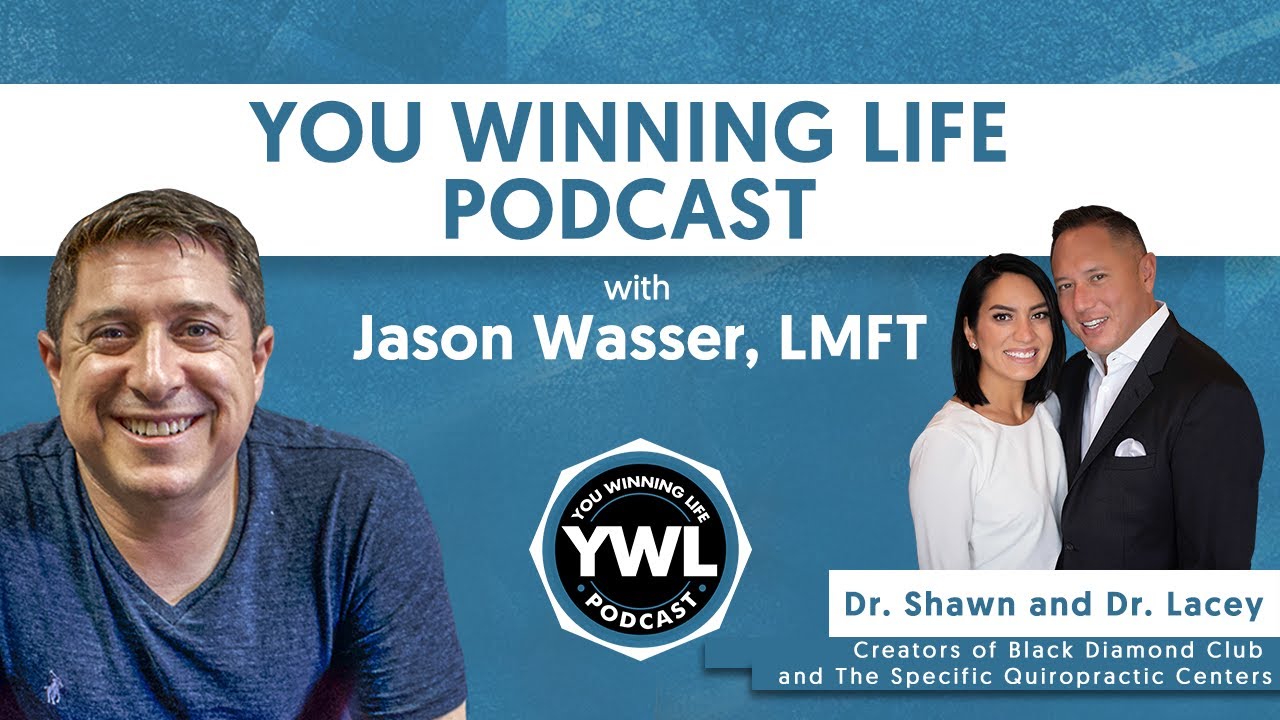
In this episode, host Jason Wasser, LMFT, interviews Dr. Shawn Dill and Dr. Lacey Book, two former chiropractors who have transitioned into entrepreneurship, coaching, and community building. The conversation traces their personal journeys—from a teenage encounter that led Lacey into chiropractic, and a family‑inspired injury that propelled Shawn into the field—to the realization that individual patient work limited their impact. They describe how they scaled a chiropractic franchise, the challenges of moving from growth to true scaling, and the complementary strengths they bring as a couple (vision vs. systems). Central themes include role definition, SOP creation, values‑based decision‑making, decisiveness, and overcoming limiting money beliefs. They introduce their community, the Black Diamond Club, and their book "None of Your Business," positioning entrepreneurship as a vehicle for personal development and broader impact. Throughout, they discuss practical tools (SOPs, role clarity, core‑value exercises), mindset shifts (from employee to entrepreneur, embracing discomfort, decisive action), and the importance of supportive communities for service‑based professionals.
Chapters
Alright, so everybody, welcome back to the You Winning Life podcast. And I happened to stumble upon through incredible connections of the David Meltzer world, which you guys heard recently, who was a guest on my podcast. I'm now being shuttled and shuffled all these incredible people in David's community. And, um, as I was doing my research, I found that there was so much overlap to what today's guests are going to be bringing. And Dr. Shawn and Dr. Lisey, uh, as you heard in the introduction, are entrepreneur coaches. They are chiropractors by training, but they're working in the business and entrepreneur and mindset and author world and programs and trainings and workshops. All the stuff that everybody who I know is listening to our episodes are trying to devour more of. So welcome, first of all.
Well, thank you. We're glad to be here.
I'm super excited, and I've been looking forward to this. And number one, I know you're no longer practicing what you went to school to do professionally. And this is something that I, I talk about all the time with my clients, whether it's therapy or coaching, um, is that we're trained in a system to have a perfect— go to school, have a lockstep profession, do that, hopefully make enough, save enough to retire. Maybe hopefully feel passionate about it for at least 2 or 3 years while we're doing it before we get burnt out. So I'd love to hear a little bit about both of your evolutions of one deciding to become chiropractors. And those people who know me well enough know that I'm a massive advocate of the chiropractic community, being an NET practitioner, Neuro-Emotional Technique, and a lot of other chiropractors have been on. But how did you both decide that this is where you wanted to be at that stage in life, that like, hey, chiropractic, and then each of your own little journeys as far as moving from chiropractic to moving into the bigger stances that you guys are holding in today?
All right, well, I guess I will start. I always say, and it's— I always start off by giving this disclaimer because it sounds so like cliché, but it's absolutely true. I say that chiropractic did find me. People hate that sometimes, but it's true. I mean, I literally was working at a bank. I was a bank teller when I was 16 years old. And this lady, she came to my window and she just slid me her card. She used to kind of always wait for me, my teller window, and she slid me her card and she said, Lacey, I really want you to work for me. And I was like, well, I never really paid attention to what she did, what her business name was. And I flipped her card over and she was a chiropractor. And I mean, at 16, I had no idea what chiropractic was. I hadn't heard about it. I wasn't in that world. And I was like, I don't know, I really like my job. And she said, just come to my office, come to my office, check it out. You'll see if you like it. And then, you know, Jason Wasser, she said something to me And I say this, this changed the trajectory of my life. She said, whatever you're getting paid, she said, I'll pay you more. And I was like, 16 years old, that's awesome, best deal, I'm in. And that started my chiropractic journey. And I worked in chiropractic offices for 7 years before I actually went to chiropractic school and decided to kind of be on the other side of the door, as I say. And that, that's how I got into chiropractic and through my own health issues and being able to overcome those through chiropractic care, it just gave me a conviction and a passion and a love to be able to take this thing to the masses. And so that's how I ended up in chiropractic.
Nice.
Oh, my turn. Yeah, first of all, I think that, you know, chiropractic is, is a little bit strange. I'll, I'll go ahead and admit that in the sense that, um, It's not a lot of other professions that somebody got into their profession by the profession. So it's not like, you know, I became a marriage and family therapist.
Yeah.
Well, you didn't become a therapist because you had all these massive issues. You see a therapist and you're like, wow, I should be on the other side.
Right.
You don't become a dentist because you got a crown.
You had so many cavities.
You were like, wow, I'm gonna be a— You don't become a brain surgeon because you had brain surgery. You don't become a criminal defense attorney because you you got off of a criminal charge. But for some reason, chiropractors become chiropractors because you went to a chiropractor. And my—
It is true.
My cousin was a chiropractor, and then I suffered an injury in high school. My parents took me to a chiropractor, saw great results. My cousin highly influenced me to go to chiropractic college. I think the other part, though, that's real important is then that transition. I was in practice. I graduated in 1995. I practiced in— the country of Costa Rica, where I had the distinct privilege of authoring the law that, and lobbied for the passage of the law that to this day regulates chiropractic in that country. So I'm super passionate. We're both hyper-passionate about chiropractic. And I think that transition really occurs when you begin to weigh the impact that you're having on the world. Some people, look, if, you know, some people have to practice and you have to see people. One person at a time because that's how we make— that's your contribution to the impact. But what I realized is I was in Costa Rica, I was doing extremely well. I came back to the United States for a homecoming at a chiropractic college. I was talking to somebody and they had no idea what I was doing, who I was. And I was like, gosh, like I'm making a big impact in this country of Costa Rica, which is great, but it's not global. It's not big enough for what we were trying to accomplish. And so at some point you realize that you are able to exponentially expand your impact sometimes by stepping out of practice and then assisting and helping others who are actually there in practice seeing people one-on-one.
Yeah. Well, I love that trajectory. And it's funny, I was, as you were saying, well, you don't go to therapy and have all these issues to become a therapist. But right. I remember, like, I mean, I went to therapy as a kid and, you know, and he was a super nice guy, but he wasn't necessarily the world's greatest therapist. It was just like, you know, it was that old school Freudian child psychology stuff. And he was super nice, super nice. And I actually wanted to reach out to him a few years ago, and I found that he passed away, to be like, hey, look where I am now. And like, you know, it's one of those things. But I remember, like, you know, my early 20s, I actually was referred to, you know, I was going through something. And I remember going to this therapist, I was living in Atlanta. And he asked me these questions that no other person has asked in a way that was just different languaging, different paradigms, different entryways into like, patterns and assumptions. And, and I'm like, what type of license, what type of therapist are you? And because of that, when I decided to leave the nonprofit programming campus and youth group and camps world, it was because of the way that that therapist asked questions was the type of training that I wanted to get as a licensed marriage and family therapist to look at things systemically, not pathology diagnosis-based, right? And I know one of the languages that we share is looking— chiropractors look at the entire system. It's not just vertebrae, we're dealing with the nervous system. You're right. All that's parasympathetic, sympathetic nervous system stuff as well as a billion other things. But right, there's a lot of assumptions of what therapists do. There's a lot of misassumptions of what chiropractors do. Absolutely. But that started my journey into, you know, just as a side note, I remember going— a friend of mine was a chiropractor, and I remember he was muscle testing someone I was in a relationship with, and he's like, oh, like, you have this injury that we found. That's not going away, but you hurt yourself at such and such age. And turns out that it was true. And I'm like, yeah, how come I can't do this as a therapist? Little did I know, a few years later when I started having panic attacks and someone's like, you should see this person who does neuro-emotional technique, who's a therapist. And I'm like, wait, that's what the—
that's the bridge.
That's what I was looking for.
And that was my, you know, a month later I did my first NET training, which brought me into the wonderful down the rabbit hole of all the other cool chiropractic stuff.
Yeah.
But knowing like what you just said, as far as like evolving your mission, evolving your purpose, right? The one-to-one, going back to how we're trained in society, it's you do that one-to-one trading time for money. I can— whoever I'm in front of, that's who I can help if we're in the service industry. When you started realizing, for each of you, it needs to be beyond the 6-minute, 8-minute, 12-minute, 14-minute visits, and I know I can do more, I know I can offer more, I know I have a bigger mission and purpose, when did that start bubbling up of like you're already doing something that's so powerful and helping and changing so many people's lives. When did you have the audacity to go bigger than that? And what doubts came up with that in your mind of like, no, I can't do that, or that's not really, you know, doable, or, you know, what was in that?
Well, I think for me, you know, I, I'm, I've always been extremely passionate about chiropractic. I mean, just hyper passionate. And when I was in Costa Rica, my first year in practice was terrible. I mean, I, by all accounts, would say I was a failure. It was an absolute— it was a failure. And then I had to make a decision. I was 24 years old when I graduated and I had to decide, like, do I want to throw in the towel or do I want to make an actual commitment and run at this? And so luckily, I committed. I stayed and it was very successful. My second year was wildly successful by all accounts. I was seeing about 200 patient visits a day. 5.5 days a week, was extremely full. And then I had this thing that entrepreneurs, not just chiropractors, entrepreneurs have this epiphany. And it was like, well, I wanna, I had grown, but then you enter into this world of scale. And look, super important, growth and scale are two totally different things. And so I decided that I wanted to have multiple offices. I was gonna start bringing other chiropractors in from the United States. A big challenge because in Costa Rica they speak Spanish. A lot of my docs were coming in, they didn't speak Spanish. And so that was a challenge we had to overcome. And so I got that taste of scaling, and I also got that taste of the setbacks of scaling. And when I moved to the United States, it actually made it a lot easier. And so I taught for a little while at Life Chiropractic College West, opened up a first office in Dublin, California, and then we began this project of scaling from there. And it was a lot easier. And today that's That scale has led to a chiropractic franchise that Lacey and I run. And so that's sort of that evolution. I think that all businesses to some extent go through that, right? Like we get excited, we want to grow, we want to see more people, we want to make more revenue. Then when we really want to double down, then we go into scaling, bringing in more people, more locations. And then if we could really master that, then we begin to understand, look, the amount of time that it's taking to manage all of these things is really hindering my ability to still be in adjustment room, in the consult, wherever, and see people one-on-one.
Yeah, makes sense.
I gotta tell you, because I'm listening to Shawn's story, and obviously, I mean, we've been together for a very long time, and we are so blessed to be able to work together in all capacities. But it wasn't as easy for me. So I just want to be transparent about that, because Shawn has always been a massive visionary and always kind of— he's always known This is my GPS coordination. This is where I'm going. And that's, that's his superpower, vision and strategy. And my superpower is, is systems and procedures. I'm a very logical step-by-step, there's a way to do things, which is great, because it works really well together and the things that we do. So for me, when it's like, hey, by the way, we're going to go from working in an office, and we're going to scale into this franchise, I, I had a little bit of trouble of like letting go. So I was like, well, no, we do this thing in the office, which a lot of a lot of people that learn their craft, they have trouble letting go to increase the velocity of success, letting go to elevate the business. And there was two things I had trouble letting go. The first thing was letting go of him because we were seeing patients together. And I was like, we're doing this together, but we needed to separate. And so that we could go on both trajectories, still build the chiropractic office, but scale the franchise.
And so in business, not in—
no, not in business, not the relationship end of your relationship.
Yeah. But so that was a really hard thing. And then the other thing is, was that little tiny voice inside that was like, hey, but you're still new, you're still new in this business. And I think a lot of people struggle with that. But the reality of it is a lot of times you've been preparing for this stuff your entire life. I mean, I worked in chiropractic offices for 7 years before I even became a chiropractor. I had more skill set under my belt than most people that have been running their own business for 10 years. And so it's like overcoming that little voice inside of you that says maybe you're not ready, and you have to tell it that you are. And so that was a big thing, and that really helped our success together as a couple and in what we were doing when I was able to break through that limitation.
It's so interesting you're saying that because I see it as kind of like the two sides of a brain and the yin-yang balance of like what we bring to the table. And I'm actually— one of my homework assignments for one of my couples is to create SOPs for their family, right? Standard operating practices.
Oh, we're big on that.
Yeah, right. Right. And well, of course you are, because that's what you guys teach, right? So, which we're going to get into in a few minutes. But right. But to bring it into a therapeutic perspective of like, people's lives evolves. Like, you know, if we talk about like pre-pandemic, post-pandemic, or whatever, whatever. So yeah, wherever we're at with that, depending on which way we look at it, right? So, but like, now we have to make these different assumptions about rules of engagement with life. And I see this with people either in business, I see this in families, I see this in couples, I see this in parenting, I see this with money, where what they made decisions on 4, 5, 10, 15, 20 years ago is not applicable or relevant today, but they're still making old-school decisions based on that, and it's not getting them further down the field. So one of my assignments this week was to grab a, you know, wonderful old composition book from the dollar store that we grew up with, and on the top of every page, Write an issue or something that's going on in the calendar, right? Hosting family over. And, you know, if you work from home now, which is a thing, right? If people are staying from family, what do you want them to know? It's kind of like you go to an Airbnb and there's a guidebook of like, hey, if you screw up the hot tub and the clip is broken, we're going to charge you $15 for this.
Why?
If Airbnb-ers can do it, why can't we do that with all the aspects of our life? So as listeners, you guys are listening. Grab a dollar, go to the dollar store, get a dollar composition book, and on the top of each page, put a challenge in life, an issue, an area that you want to figure out and come up with your 5, 10, 15, 20-step plan of how that gets handled. So when you're like in chaotic mode, fight or flight mode, you're like, oh yeah, I decided this proactively. I don't get— so when you guys were putting this into play, right, splitting up the practice, opening up a new plan, navigating your relationship. As a couple, right? I mean, that's a whole nother thing I want to get into today also is what did you have to put into place immediately to— because you said there's a difference between growth and that was the other word, Sean, scale. And scale. Yeah. So how did you— what were the things you guys had to put into play immediately to go from just growth to scale?
Well, first, I want to add to what you talked about because I think that, that was a knowledge bomb that you just said about what you were having couples do, creating SOPs for their life, for their family. That there was a couple pivotal moments in our life that we can directly attribute to, um, again, the velocity of our success. And one of them was role definition. And so when we decided, hey, I'm gonna still work in the practice for a while while you go and work on scaling this, this business, this franchise, um, we had to figure out roles very quickly. We always say it's very damaging and detrimental for 2 people to do the work of 1 person. And oftentimes, not just if you're in a relationship in business, but even in your relationship in home, at the home, that happens a lot because you don't have clear defined roles. And so one of the biggest things that we did, we sat down and we said, who's responsible for what in the business? Exactly what are you responsible to do? And then you stay in your lane. But the powerful thing that we did is we did that for our home stuff as well. Who's responsible for every task in the house? Who's responsible for this bill? Who's responsible for the laundry? Who's responsible to write the grocery list? Why? Because it made us so much more efficient and it reduced the friction and the wondering and the, did you do that? Should I do that? And the inefficiencies that we had, not only in our business, but our life. And that was really powerful for us. And it doesn't matter if you work together or not, you should be doing that in your home because it is a powerful moment for you as a couple or you as partners.
Well, I think that's the entrepreneurial lens. And I always like differentiating between being an entrepreneur and being entrepreneurial, right? You can have an entrepreneurial mindset and not be an entrepreneur because that really means at the highest level, you're not doing like we talked about the work that you were trained to do at that moment, trading your time for money versus having people under you and scaling and growing, right? That's at that point, right? It's becoming an entrepreneur versus being entrepreneurial, which I think is a mindset of how do you start doing these things? How do you start leveraging out? Like, I don't do my laundry anymore. It costs me X amount of dollars a month. It's 8 cups of Starbucks coffee a month.
Yeah.
And I have to see 2— 1 client for 2 hours to pay for my entire year of laundry at this point. Right.
That's amazing.
So, right, 2 hours of work versus X amount of hours of doing, right? And it's— and I never looked at it that way until I started this entrepreneurial mindset journey of What do you mean? But of course I could do it myself because it's going to, you know, it only costs whatever in my laundry room in my condo. And we start justifying and creating excuses that limit our potential success because we're again, this, this mindset thing. And I know, you know, this is so big in your, in your world of we are taught and indoctrinated by society at large to put our head down, and just drill through. And including what you're saying, you're seeing 200 clients, patients a day, and I mean, your body can't, you know, even if you're using an activator tool, which, you know, if you guys ever see the chiropractors with the clicky thing, that's a— it's called an activator tool, right? Or whatever you're doing, right? So you can't handle that physically.
And you—
so how, like, what would be step one for someone who's listening to get handled?
To get handled? To to start to put all these things in an orderly box. Well, first of all, I think that step number 1 is exactly what Lacey was talking about earlier is, you know, you have to define your final destination. Like you have to set your course. And we talk about this in our book, None of Your Business. If you have a GPS in your car and you fire up the car and start driving around, there'll be like the little map and there'll be a little blue triangle and the triangle tells you where you are, but but it's not telling you where you're going. Most people, I think, are going through life, relationships, business, et cetera, just kind of driving around. And sure, they can see where they are, but they don't know where they're trying to go. And so, you know, it's coming up with this idea of what exactly is my final destination. From there, we can begin to understand the step-by-step guidance. And oftentimes too, it's easy to live in the end. You know, a lot of people just never get there because they're thinking about what it looks like, you know, at the end of the journey. But sometimes we have to understand like we have to drive through a neighborhood or, you know, we're not going to just jump right on the freeway and understanding that. And so the next thing that happens though, I think, is a lot of people say, okay, I get what you're saying, but I'm overwhelmed. And Lacy and I talk about the idea that if some really overwhelmed, it's two main things. One, most people that are overwhelmed are probably overstimulated. You're trying to do 58 things all at the same time. You get on your computer, you're about to do this, you got emails, you're on social media. And then nothing gets done and you're kind of caught in this loop, right? So just eliminate the stimulation. And the next is oftentimes you feel overwhelmed when you just don't know the next logical step. You don't know what to do next. Oftentimes, you know, finding a mentor, getting in an accountability group, just something that will signal what the next thing is. Eliminate the stimulation, do that next thing, then see what the next, next thing is. And slowly you'll realize that, you know, you've arrived.
It's literally verbatim my conversation with my client this morning. I'm like, so things are— when you don't know exactly what you want and you feel like, but I don't have the time, it's because stuff is going to seep in to fill that gap. Because time is— time is not a thing that's out there. It is this like malleable, living, breathing experience that will seep in and put things in your way to fill that gap. That's sick, right? That ever— so if you're not, like you're saying, proactive, you don't know exactly where you're going. Even if there is a rerouting that comes up every few miles, but it's still going to get you to where you want to go, because life is going to try to reroute us, which is kind of that, that, like, you know, I would call that reverse engineering. And one of the things you're saying that I want to— that I share often is a lot of times people set a goal that's actually really just an action step, but because it's so big and scary for them, it becomes the goal. But really, I would now say, okay, great. So if you accomplish that, what will then that allow you to have, do, or be? And then that actually really is— oh wait, that's an action step.
Yeah.
Yep. I think that's really interesting too. Shawn and I, when it comes to, to relationships, we live by this concept of no compromise, which feels a little bit counterintuitive. When people hear that, they're like, what do you mean no compromise in a relationship? And, um, the one of the big things that we have seen in a lot of the couples that we work with is that their goals, like you said, not only are they action steps, but they're, they're goals that the strongest person in the relationship has created. And so it's not this connected, like, what, what you— it's not no longer what you're going after as an individual. And so one thing that we found too, to make sure that you're really able to decipher what your next logical step is, is making sure that you're going after the thing that you want. Because if you're going after something else that somebody else wants, man, it becomes really difficult to move forward. And so we encourage our, our couples, people that are in relationships or partnerships, to actually sit down and write their goals as individuals and then come together and figure out how both people can get it. Maybe the timeline's a little bit off for one person or the other, but figure out how you can both get it. And then when you're like, what's my first step? You know your goal and you can run everything through that like a filter to know that you are doing the right things and taking the right actions to get there. And that's helped us for a lot of clarity in that growth and scale mode is being able to do things that way.
So I'm cracking up for those who are not watching the video version and those of you who know me from previous episodes or know me in real life, for any of the classes I'm giving, the first thing I always start with, with everybody, with everything, is values-based decision-making. And one of my first session homeworks for my couples especially is do that. Here's my list of— here's a list of 200 core values. I want you to come up with what your lens is, right, for each partner. And then I want you guys to decide together what's the couple's core value so that when you start arguing and you're like, okay, but is this right? Can we throw it up against these 6 or 7 that you have defined with words and a sentence that you guys have co-created and then say, does it align or does it not? So then it becomes a binary decision, not a conflict. And when we do it right, that comes out of the business world, but it's so applicable to every single thing. And I'm even doing this, like, I've been like elementary school kids. I'm like, hey, like what? So I know things are important to you, like video games and sports and whatever, but like, like, what are your values? Like, what do you value the most? Like, what do you want to spend— like, let's say you had all the time in the world to play video games and all the time in the world to play sports. Why is that important to you? Why is it that you want to do those things? And like, oh, I like spending time with my friends. Okay, so friendship. What is it about friendship that's important to you? So we can really educate or inform or empower people through breaking that down. And I always go back to, even if you're working with them, right, as they go through your program, which I want you to explain in a moment what the actual program is that you can always go back and say, hey guys, what was that list you created first week with us? And if you ran it against that, do we really have a conversation that we need to have right now? Or is it already going to be answered by you just saying like, oh crap, yeah, yeah, yeah, that was stupid. Like, yeah, that completely doesn't align with our mission or values and our, and our goals.
That's fantastic. Yep, absolutely. We love that. Our, one of our mentors, Michael Port, he used to always say, all business problems are personal problems in disguise. And that's why, you know, we're so passionate about talking about this, because is, yeah, we're talking about entrepreneurship, but really relationships and the way that you do things at home and in the business, they're all intertwined. You can't disconnect them, right? And so I love what you're saying about this values exercise, because we're so good at doing that in our business, coming up with a mission statement for our business. You know, what are our core values for our business? And it's like, well, yeah, if I'm using that as a filter for my business, what am I using for a filter for my life? Because that's even more powerful.
So the terminology he uses is the red carpet, right? He has the— or the red velvet rope. Velvet rope, right? And am in my community, it's the doorman principle, right? It's all overlapping. But it's so true. And I talk about like, you know, the simplicity on the far side of complexity. And it's like, it's the doorman principle. Who and what are you letting in? And why are you feeling guilty that if you don't, even though it doesn't serve you, causes chaos in your life? And then what are the justifications and excuses you're holding on to, to keep yourself stuck? Because it's not their problem. It's only their problem if you let it in. It only becomes your problem if you let it in. Otherwise, it's their problem. Let them go handle that with their therapist and their coach. Let them go do their own, you know, their personal development program. It's not— you're not their therapist or coach unless you have a contractual agreement to do that. So I feel that's such a big issue in businesses and relationships and parenting and money stuff. And, you know, the crypto bandwagon, like, I think I need to get on it. But are you paying your bills this month? No, right? Don't put that $5,000 onto Dogecoin or Shibu, right? Right? It's so interesting, like how we're just set up to like the shiny object syndrome. And I know like your field and my field are very much like any other body in the helping profession. And this is where I wanted to segue into your program. But I want to lob this up to you guys to tell it so I can like make it really easy for you guys to convince everybody why your program is so great is, is there's the shiny object syndrome. If I take this next continuing education If only I specialize in this new modality, if only I get this right marketing tool, if only I— then I'll finally get there. Then I'll finally make that money I need. Then I'll finally have the freedom, right? I feel like there's that shine, especially, right? For sure, chiropractors have it. It's like, I'm going to do this thing and this— all your wonderful abbreviations for all your trainings and modalities, right? So, you know, and it's the same thing now in therapy, right? Now you have to become an IFS, Internal Family Systems, and all the psychedelic stuff that's It's like, now I can be right now. It's like, you know, if only I become a Brené Brown certified person, or, you know, it's always that. So what problems did you guys, you know, let me ask that again. You created a program, created an experience. What problems do you truly want to finally help people handle and solve through the community and platform that you created. And since we haven't talked about it, give everybody the name as well. And what the heck is it?
Well, you use the word and I love it. So the community itself is called the Black Diamond Club. And it's not so much a program as it is a community. And it's not so much Sean and Lacey as it is the members. And we wanted to create a safe space for service providers to be able to support and hold each other accountable in their quest to reach more people, make a bigger impact, and to create the lifestyle that they deserve. We wanted to create a community where— I mean, it's kind of a given that we all in the service industry want to help a lot of people, but we wanted to also make it safe and acceptable to have the the concomitant rewards that come along with that. I mean, there is nothing wrong with creating a phenomenal lifestyle as a result of your hard work and the impact that you have created on the world. And, you know, we wanted a place where if you were brand new in business and you made your first dollar, that you could come to the Community and say that, and people would say, that is great, and not say, well, wait until you see, you know, 3 years from now, come back and talk to me. We also wanted people that were made their first million or the first $5 million to be able to come and everybody cheer them on and say, look, you know, we're all trying to make an impact in the world. Um, the basis for what we do is based off of marketing, teaching, uh, service providers to fall in love with the idea of being an entrepreneur by learning marketing, sales. And we do an awful lot of work on mindset. I mean, in the pre-interview portion, you had talked about like, what are the things that you guys don't talk about? And we got into a lot of them. Yeah, um, but we are super fascinated, um, with relationships. We're fascinated with, you know, your mind, the way that we think and how that affects our, our business and how it affects our skill level. Um, and so back to your question, like, if I could only, um, I would just say like, if you, if you, if you would, and you know, and everybody says like, you know, Sean, we have programming that goes from $9.99 a month all the way to we do high-ticket events. We're doing a mastermind with Dave Meltzer on a private island, taking individuals to a private island, working with them over the course of 3 days. And so we have everything in between. And sometimes people say, you know, Sean, you know, I would if I could. And I always tell them, no, it's actually reversed. No, you could if you would. And when you're saying like, well, if I could only, the thing is is if you would only do, right? Like nobody's ever made an impact sitting on their couch, you know, just waiting for life to happen. Regardless of what it is, you're gonna have to get up and do. And if you get up and do, chances are, as long as you have good intentions, good heart, you're being positive, that you're going to be moving in the right direction. Maybe not the speed that you want to go or the velocity or the amplitude, but you're on the right path. What stops people is people are thinking about things. They're researching what the next program is or thinking, if I only had this, or thinking, if I only had that, and they're not doing a whole heck of a lot. That's why they're thinking, if I only invested in cryptocurrency. Well, if you're not able to pay your bills, you probably need to get up and do some stuff. Then you will have abundance, and then you can do whatever you want.
From there.
I love it. I'm grinning because one, it's so awesome to be spending time with like-minded people. And, you know, I'm working from home now. I closed my office at the beginning of the pandemic, which was a massive blessing. And, um, the only thing I'm doing in person is neuro-emotional technique, and I'm doing that outside by my pool, like under trees. And there's, you know, we got crazy iguanas here, like, so it's like Jurassic Park, but like I'm like, this is so much simpler. And it's so much easier. And I'm like, wait, and I'm making more money. And I'm helping more people. And I'm working less hours and, and all the stuff that you're talking about. And there's a lot of scary stuff in the world right now, because we're buying into a lot of scary stuff. And there is scary stuff. And in a way where a lot of us are using the, you know, if only when this is over, then I'll be able to, and there's some legitimate concerns and some other stuff. You know, I feel like I'm right down in the the middle line of all of that. And I remember when— and I just sent an email, I'm composing an email to a buddy of mine who was in my accountability group when I started my program I was doing. I had no clue who and what he was doing and succeeding. He was wearing khaki pants and an Under Armour polo. I had no clue that his company was doing $100 million a year at that time. And we're in an accountability group for a while, and his company incredibly grows, and he's doing a lot of cool stuff. And I sent him an email the other day just checking in because I'm like, hey, I I want your thought about this. And he was like, he just responded like, I'm so proud of you. And I'm like, you know, like, you're doing everything right. And it took me, because I got divorced at 30, and I was on my own since I was 17, 18 years old and working 3 jobs and, you know, taking any client I can take just to pay the bills. And I went on every single insurance panel because I needed the money at that time. Where, as the time of this recording, it's November 18th, next week, the day before Thanksgiving, my insurance panel will term out and I'll be full cash.
Right?
Huge for a clinician.
Huge.
Because we were trained, right? We were trained to be, oh, if you make six figures in private practice, you're doing great. Well, if you're making six figures as a practice owner, what are you taking home? It's $30,000, $40,000 a year, right? Which we can talk about in another time. But I know— how do I want to say this? Because this is like really I did not know then in the chaos before I started involving myself in this entrepreneurial mindset journey. One, my beliefs about money were completely off. I grew up in South Florida. I grew up a scholarship kid. I grew up with the people who had that weren't the greatest people. So therefore I had this unconscious belief about money that held me back from exponentially growing and scaling. That allow me to take in the $15, $20, $30 copays and the— right? And then how could I say no to those people, right? The same. It's like that old story, right? The chiropractor who had the, you know, leave what you want when you— right? You know those, you know those stories. So for me to journey into where I am now spending time, it's the story of when I reached out to Howard Behar from Starbucks, the former international president, and I just cold emailed him and I had an aha moment on that. If he said no, my life goes on as usual. But if he says yes, holy crap, I need to prep. I need to buy his book, It's Not About the Coffee, and I need to watch his YouTube videos. I need to ask him questions and spend time with— because this is the guy who brought frappuccinos to the market and made it grow all over the world. And right, so I realized this aha was the worst thing that someone can say is not no. The worst thing, and I'm being playful with that, is that they can say yes, and then you have to get off your couch.
Right. You have to do.
You have to do. And that's the only way is by pushing yourself into that uncomfortable place. So how do you— because Sean, you said a moment ago that like it's not going to always come right away and it's going to take momentum and it may not come as fast as you want. But do you see that, like, I want to figure out how I want to ask this question the best way. There are people I know who they get it immediately and they jump on immediately and they're 10x-ing it or whatever they, you know, whatever phraseology. And then there's people, it's like 3 years, 4 years, 5, it's marinating and marinating and then it pops. Is there a difference in those personalities? Is there a difference in their life experiences? Like, what are you guys have worked with so many people? What makes one show up one way versus maybe another way from your experiences? And then how do we push ourselves a little bit more?
Yeah, and you alluded to this a little earlier. You know, we live in a disempowered world. And, you know, through a bunch of reasons, media, all kinds of reasons. But what happens is disempowered people don't love empowered people, make you feel uncomfortable, right? And so what disempowered people people do is they try to disempower the empowered people because that's— you want to bring them down so you don't feel so guilty. Or, you know, you're like, what is wrong with these people? They're like running around, 10x-ing their lives. Like, it'd be easier if we all just played video games. And it's— I mean, and I think in the same case, like, man, when, if you're— when you're a therapist and you're talking to somebody, undoubtedly on a first encounter, the person across from you is a disempowered person. And they actually attempt to— you're in like a battle.
They attempt to disempower you as they're convinced, or even more so, they try to convince me about why their story is way more accurate than the possibilities that they can have.
Right.
And so this is the thing, is that we've just noticed that through life that successful people are decisive. They have the ability to process information and make and take decisions quickly and act on them. I mean, I just think it's that way in anything. And here's the proof of it, is that, you know, if, you know, if you, if you work in an office setting, if you can remember that, if you haven't been in the office for a while, you know, the worst question that, that happens every day is, what do you guys want to do for lunch?
And nobody can figure out what we're going to do for lunch.
And that is, that is proof of how disempowered the world is. And there's there's decisiveness in business and in life. That's the key. Process information quickly, make a decision. You might be wrong. Make a decision and act on it. And then if you are wrong, recognize that quickly and be able to reverse it.
And I got to interject here because I think that a lot of people are like, well, they're— when they look at other successful individuals, they say, well, they just have that. They just have the ability to do that. But decisiveness can be learned. Absolutely. We have seen that over and over. I mean, it's one of those things where it's the first thing you have to do is decide that it can be learned. So that's the first step. But, but the reality of it is, is, is, is we've run into a lot of people that maybe they didn't have that skill set. Maybe they weren't really good at making decisions. And then they come to a realization of, you know what, I'm paying these people to tell me what to do. I need to begin to act. They, they overcome the perfectionism that they're trying to achieve. There is the ability to acquire these skill sets. It's not unique to the most successful people on the planet. You can do it too. And I know people out there, they get discouraged because they, they are slow to move. They are slow to make decisions. They, they're too heady. They overthink things, but you can overcome that. And the second that you do, your trajectory, your velocity, your direction to success success is going to amplify, and you will, you will get where you're going exponentially faster. I mean, it's, we see it all the time. I mean, just go to Cheesecake Factory tonight, open the menu, 250 items, pick something, pick something, and just quit. If you hate it, you hate it, right?
You're not going to die.
Don't work on it. Just start small.
And it's not going to cost you that much either, except your glycemic load is gonna— you're gonna insulin issues. But yeah, right, we got to go back to our roots of like healthcare professionals here first. Oh my goodness, right? So, right, but, and I agree, and I, and, and it's the same thing. And it's so funny you guys, you just said that because I had this conversation again this morning with one of my clients about like time management, what I was talking about before. And I'm like, well, but if you were on Netflix last night, how many minutes did it take for you to decide what to watch? And then did you get off Netflix and then go to the Amazon Prime app and then still have another 7 minutes to decide? And then you're like, I can't find anything. So then you default to an old episode of Breaking Bad. But that's what we do in business. That's what we do. We have our default, right? Our default network, our default mode. And we go back to what our family of origin, our culture, our gender, our—
right?
All of that stuff is embedded that we have to try to work through and become aware of, right? Bring it to the surface, work on it, work through it, and then change and shift. And I know, like, when you talked about the decisiveness, like, that's such a— like, that's the name of the episode, right? Decisiveness will make you successful. And the one thing that I know that I had to transition from was that slow-moving, can I afford it? Am I gonna actually benefit from it? Do I know other people that have worked and done this with this person? And am I gonna get screwed, or is it gonna get me to where I want to go? And can they articulate really that this is where— because right, we now know in the social media world world. Everybody's offering, you know, join my mastermind and you're gonna be making a million dollars and I'm going to teach you how to sell the program that I'm now selling, right? You guys know those people. So, right, but that's what's scary now versus having, like you said, a legitimate community, having legitimate, like, good for all, rising tide raises all ships mindset versus I'm just gonna have you replicate and wash and repeat the wheel. But there's no real value proposition and connection and relationship in it. So does the decisiveness come with relationships? Is a relationship element, you know, you guys are doing this together, you're doing this as a couple, you're doing this as a, you know, all these different layers of your life. Where does the relationship factor coming in for, like you said, it's a community more than a program, but even someone who's not necessarily, they're thinking about doing something like Black Diamond, they're thinking about doing something with whatever, which, you know, anything they're doing, how can they understand that building a relationship with that community, with that person doesn't necessarily always have to happen with going away for a $1,000 weekend or $5,000 weekend and start just gleaning, like listening to your YouTube or your podcasts or a David Meltzer video, or right, to get involved into a community where the relationship may not be there yet, but they can start seeing the value of the relationship?
So I think if I understand correctly, I mean, the number one, we always say that we value long-term relationships. And so we have permeated that throughout the community of the Black Diamond Club. And so it doesn't matter if you're like, man, I want to check this thing out, but I don't know if I'm going to be a good fit. I don't know if I'll be able to go in there and I'll be able to assimilate. Like the reality of it is, is there's always somebody in there that's new, just like you. And people love that you come You come into the Black Diamond Club and you raise your hand and say, I'm brand new here, and people will begin to guide you. They'll say, welcome, we want to welcome you with open arms. How can we help? Here's our favorite podcast. Here's what we think you should listen to. So it's actually a little bit backwards. The community will help guide you on what you can learn and how you can grow instead of you trying to grow first and then go into the community. So I actually think in the Black Diamond Club, the relationships come first. And it's not something that you have to create. They will bring you right in. And so there's a lot of power in that because I think every person on the planet has a desire for human connection. We all desire to be connected somehow. And so I think that when you can go into something, you feel connected, you immediately elevate, um, in, in one way, shape, or form. And then you start consuming the content and consuming the information. And then it's only going up from there. But like you said, you have to get off the couch and you have to do one thing. And really in Black Diamond Club, that one thing is starting by introducing yourself. If you can do that, you're good to go.
Well, I would even say, you know, one of my favorite David Meltzer lessons, he's come up a lot today, but when he talks about what would you tell your 17 or 18-year-old self, and then the answer is ask for help. Um, and so look, like, if you have it all figured out, then the Black Diamond Club community is of no value to you.
If there's no community, it'll be No community would be of value.
Very, very good.
But if there's like one thing that you're like, I wonder, like, how do I do this? How do I market? How do I set up my emails? How do I do text? How do I, you know, have better retention? Where do I start? Then you go into a community and a lot of people are like, well, I don't know if I have anything to offer. Well, that's not— you should say, I don't know if I have anything to receive, right? So what do you set your expectation of what you want to receive? Come into the community and say, Hey, here's what I need. And then see if the community can fulfill that. And if the community can fulfill it, then you can say, wow, that was great. Here's what I have that I would be able to assist you with. And so sometimes people too, you get it, we get it confused as we're like, I don't know if I have anything to offer. I would say you should begin with, I don't know if I have anything to receive. If I have something to receive, I should just put myself out there and be open to receiving it.
Yeah.
No, I have to say that's interesting that you say that though, because going back to your question about decisiveness. I think that the, the difference in decisive people is exactly that they're willing to put themselves out there. And they're not worried about what it will look like. That's how you become decisive, because you're not worried about what the other side is, you're not worried about judgment, you're not worried about what people think, you're not worried about if you fail. And so again, decisiveness can also be learned through just doing, putting yourself out in front and not worrying about what's happening on the other side, that'll actually build that skill. And it's funny because I see all of those things go together.
And I see, right. And it also applies to any other aspect of life. And it's going to show up one place, it's going to show up another place. And I remember the buddy who was a chiropractor who brought me into the program that I've been doing. It took him like 2 years for me to show up. And at every neuro-emotional thing, Jason, you really should try, go to this thing with me, go, whatever. There's discounted ticket, whatever, blah, blah, blah. And I'm like, God, I just, one, I'm not an entrepreneur.
Right?
It was just like I was so far removed, and I was so stuck in that, like, chaos of just being a clinician thinking I'm running a business, but not seeing myself anywhere above it. I just couldn't even see the reality of anything being different because that's all we knew. And no one was talking— like, 8, 9, 10 years ago, no one was talking about this stuff, especially for clinicians. And I know it's much— it's pretty big in the chiropractic world, but the therapy world, it's finally— the last 3, 4 years, it's finally kicking in. And it was, and I remember sitting there and I remember the first afternoon they started talking about core values, the person who was running it. And I'm like, oh, so if I define my core values, I then hold myself accountable towards myself and have other people hold me accountable to that. And then I make the rest of my life washing, repeating that, that makes me entrepreneurial. Oh, okay. So if you're a mom at home deciding how you want to feed your children and what type of healthcare you want to provide, and that's the core values you decide. So that's being entrepreneurial for those type of people. And if you're a business owner and you only want to serve this niche and serve it right, then that's— it doesn't have to show up just in a business sense. It's actually what I now believe is that entrepreneurship is a self-development and personal self-development and personal actualization platform if done right. And I think that's the beauty of like circling back to the beginning of our conversation of knowing where— what we're trained to do, that we have to evolve past what we were trained to do and realize how we can grow and scale that, right? And saying like, okay, like, so someone's an intrapreneur, which, you know, then you can only go so much because you know that you have, you know, you know how far you can before the ceiling hits and they have to move to a different company.
Or—
but if you're being entrepreneurial even out outside or side hustling or whatever, right? To make so you can buy your crypto. I don't think there's any limitation, but we have to change that mindset. So with the book, because this is like an easy entryway. So if people aren't ready to go to a conference or not ready, but you have a book that just came out recently?
Called None of Your Business. It's available on Amazon. We also have a podcast by the same name, None of Your Business, on all of platforms. Yeah, those are very easy entryways to the world of Shawn and Lacey to explore kind of what we're about. Strongly encourage that too. You don't want to just blindly jump into something. We might be absolute raving lunatics or selling masterminds on how to sell masterminds. So you might want to check out—
I like that either.
You might want to check out some of these, some of these resources.
Right.
And again, there's nothing like it's, it's I was being playful with it because I know that there are people out there that are doing that and they're doing it with like ethics and they're doing it with like, find your niche because you would not know how to do this and it's just right under your nose and it makes sense. But as long as you're— the person who brought me to my program is like, I will never ask you to do anything unethical, immoral, or fattening. So, right, like, right, if we're teaching these things. And that's what I think the difference is in my journey of what I've discovered in all the different programs. And is there's a way of doing it where it's really only leading back to the people who are running it to make more money versus literally lifting everybody up. And those masterminds, right? Because that's the new, you know, it's a new Lululemon of, you know, of whatever, right? Put on Lululemon pants, you're a yogi all of a sudden. If you do a mastermind, all of a sudden you're a coach, right? It's, you know, the shit, guys, come on. So, right? But, but there is value in like teaching someone to teach their craft in an ethical, honorable way versus like manipulation. And I think that's what I think a lot of the indecisiveness is coming from. But I'm seeing today of people being afraid of being screwed over, ripped off versus what you said. There's a community. And if we teach you the community is important, if we teach you the value, if we teach you the connection, we teach you how to become more decisive through that. And we teach you how to do this for other people, then yeah, that makes sense.
Yep.
Absolutely.
Yeah. So y'all who are listening, I threw in my Southern, I don't know where that just came from, but anybody who's listening and they want to hear more, you have the None of Your Business book, you have the blackdiamondclub.com website, you can follow Dr. Sean and Dr. Lisey on Instagram and social media. They're very easy to find, but the Black Diamond Club is on all over social media. I'm sure that there's so many more wonderful things that we can talk about. I know we just got started. It's so awesome to spend, like I said before, like-minded thoughts, like-minded people. And I really appreciate the time you had for us today.
It was a blast. Thank you so much.
More from Jason


Howard Behar Starbucks Former International President Heartwarming Story #kindness #shorts





