
You Winning Life Podcast-Ep. 162-Creating a Vibrant Culture with Nicole Greer
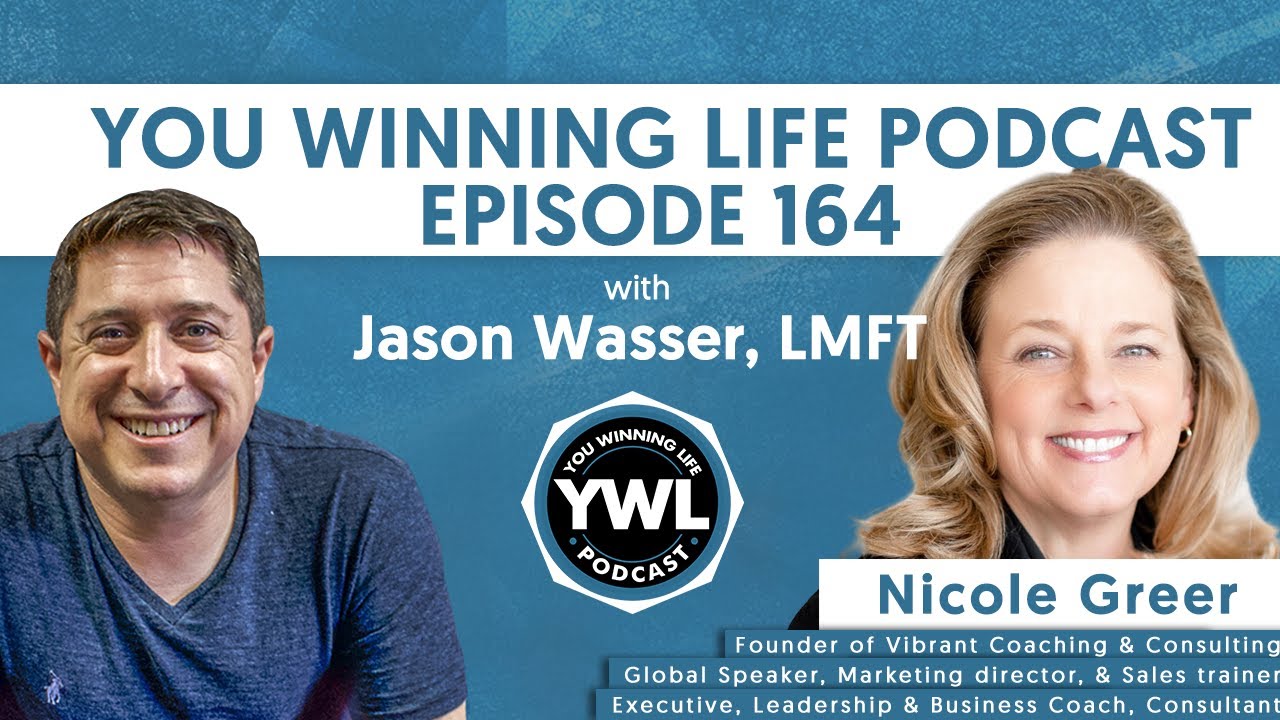
In this episode of the You Winning Life podcast, host Jason Wasser, LMFT, interviews Nicole Greer, CEO of Vibrant Coaching. The conversation covers the origin of the "Vibrant Coaching" name, Nicole’s SHINE coaching framework (Self‑assessment, Habit work, Integrity, Next‑right‑step, Energy), and how to build a "vibrant" organizational culture through clear core values, truth‑telling, and consistent accountability. They discuss practical tools such as the values‑based decision‑making worksheet, an accountability formula (clarify request, confirm understanding, set a deadline, define completion criteria), and the TILT model that balances likability with integrity. The dialogue also explores habit formation versus codependency, the six categories of personal energy (intellectual, emotional, spiritual, physical, social, financial), leadership communication, and the importance of mission and vision statements. Personal anecdotes illustrate how naming, mentorship, and overcoming limiting beliefs shape professional identity. The episode ends with calls to action for listeners to explore Vibrant Coaching’s resources and to share the podcast.
Chapters
Hey y'all, welcome back to the You Winning Life podcast. Today's guest is the CEO of Vibrant Coaching, Nicole Greer, who helps individuals, corporations, government entities, and nonprofits become the people they were created to be through defining and fulfilling a mission to work better in teams, and to exemplify excellent leadership. For the past 20 years, Nicole has worked as a coach, marketing director, sales trainer in many facets of her businesses, and she's worked with all kinds of people who led her to become the Vibrant Coach. She's also a speaker, trainer, facilitator, life and business coach with an edge. Very much looking forward to you enjoying and getting all the takeaways of all the different things that we talk about in today's conversation. And very much looking forward to hearing your feedback. So please feel free to reach out to us on all of our social media, Jason Wasser LMFT or You Winning Life on Instagram, as well as Jason Wasser LMFT on TikTok. Or you can just reach out to me in the email, jason@thefamilyroomsfl.com. And with no further ado, here's Nicole. All right, y'all, welcome back. So we have another exciting episode. And as you heard from Nicole's intro, she's worked as a coach and marketing director and sales trainer with many, many facets in professional coaching. And Nicole, first of all, welcome, and thanks for hanging out with us today.
Oh, it's my pleasure, Jason. Thank you for having me. I'm delighted.
I am super excited to have this conversation. And, um, right off the bat, let's just start off with you chose a really cool business name, which is called Vibrant Coaching. So I just want to start there because I think that, you know, whether when people start figuring out what do they want to call business, if they're going into their own thing or they're working during the day and they want to start a side hustle, whatever it is, right, creating a unique and catchy but not cliché business name is incredibly important. So I'm really, really, really curious about, one, how you decided to call your business Vibrant Coaching and what, just as an entity, kind of what it encompasses. So let's start there.
Okay. Well, I have a fantastic story about that because my first business name was horrific. But I sat down and I was thinking very hard, what should I name my business? And so I'm an old training director. So, you know, the last position I had in corporate America, I did a ton of training, and I thought, that's what I'm going to do. I'm going to take this new coaching, um, you know, thing I have in my toolbox, and I'm going to combine it with training, and I'm going to teach people. And so I'm like, teach people, okay, learning, okay, I'm going to put systems in their hands. So learning systems. And then I lived on the shores of the Catawba River, and I thought, Riverside Learning Systems. And everybody thought I did like I don't know, kūmān or something. I was some kind of like tutor. And so it was terrible, absolutely terrible. Well, then I went to a program, and when I was at this program, I was a student in this program, the facilitator asked everybody, you know, would you please write on this little card— there's one card for every participant— one word that describes this person, and then we'll give this little card to them at the end of the program. And so it's like, you know, the question was, and this is a very important question, Jason Wasser, most important coaching question ever. What is it like to experience you? So I'm thinking about, say, let's say Jason Wasser was in my thing. I write my little word for Jason Wasser and then for Joanne Wasser and for Michaela Wasser over here. I wrote all the little names down. And when the day I received my card, it said Nicole is vibrant, and it said vibrant over and over and over and over. And I was like, oh, I heard angels sing. And I thought, oh, this is a sign that the name of my company Wasser should not be this terrible name. It should be Vibrant. And so I just changed it up. And ever since then, I go places, people like, oh, you're that Vibrant lady. And I'm like, yes, that's me. And so that's where the name came from. So that's my little name story. But I, I think it suits me. I think I have some really great energy that gets off on people, and that's what they experience.
And that's so important because having these conversations often, whether I'm, you know, I'm working with some therapists who are doing their business development, some friends— a friend of mine is right now, uh, an integrative medicine practitioner and going into side practice, so we were thinking about the names. And a lot of these things, they were saying, "Well, I like this person's business name," and I'm like, "It doesn't indicate anything." I mean, it's cool if you're a corporation and you're doing this generic thing, but it doesn't indicate or bring life to what you're doing. And I think whether you're using your personal name, there still needs to be, "Well, what are they doing with you? What's the outcomes? What's the experience going to be like?" And I think you tapped into that. Right there, right? If hanging out and spending time with you is a vibrant experience, who the heck wouldn't want that?
Right? Right. Yeah. And I have a coaching methodology and it's called Shine. And so I have these 5 things that I work with people around, whether we're doing business coaching or executive coaching or life coaching. And just everything has just kind of been out of this idea that I believe inside of every person there's a mission and a purpose. We got to get that out of people and get them operating in that. And when somebody is operating out of their gifts and their skills and their purpose and their passion, then they light up that little corner of the world. And you wonder, why is the world so dark? Why is it so bad out there? Well, it's because most people are not lit from within. And so when you become vibrant, you're lit from within. You're like, I know my skills, I know my personality, I know my talents, I know what I'm supposed to be doing. And I'm doing it. And so that is what I want. I want the world to be vibrant. And I work with tons of companies and organizations, and I try to build what I call a vibrant culture, which means I'm trying to take each individual inside that building or that organization and get them lit. And when we have a bunch of bright people who are turned on by the work they're doing, man, we can get a lot of fun stuff done. It's a good time.
That's incredible. Because I see this, and I see this so common with not just in conversations with clients, but just from doing any groups and workshops, where the idea of knowing your inner purpose or knowing your inner mission, as well as not intermission, inner mission. I think people's life is on an intermission when they don't know their inner mission.
We've been on the biggest intermission.
Yeah, yeah.
And it's over. Intermission is over.
Yeah. It's a uniquely interesting time right now with, with, with the chaos and the economy and everything else going on, and we'll see what happens tomorrow. But putting that aside, I'm sure if you've been following the news, there might be some interesting stuff happening tomorrow. Um, if you don't Google that, and by the time people are listening to that, it's irrelevant what we're just talking about now. So strike that, reverse it. Um, but I, I, I, I, I have been involved in this business coaching community, and one of the things that they start us off with is if you don't know your core values, then you don't know what you're making your decisions on, and therefore things are coming at you and you're right, you can't sift and sort through the chaos if you don't know what your primary lens is, right? You're wearing a pair of glasses, so you know what you're looking at. If you take it off, it probably gets a little bit, right, a little bit, a little bit more hazy. So there you go, right? So when you're describing that, when you're going into a company culture, one of the things that I love seeing is companies that have their core values. But no one in the company knows them. Some, right, the person who created the business threw them down on some business plan. It's not in alignment with the outcomes and the goals of the company. They might be up somewhere, but A, they have again, like nothing to do with what the company is doing, and B, no one in the company culture knows them. So when you're building a vibrant culture, how do you, you know, whether it's a business, whether it's a family, whether it's a, you know, a startup, whether it's any type of connection-based relationship dynamic, how do you really implore people to focus on that and the necessity of the importance of that?
Yeah, so, um, you know, like, like you said, um, it's part of a business plan. So if I do your strategic plan with you, we're going to do that. But I think there's two things about core values. One is there are aspirational core values— there are core values we hope to achieve— and then there are core values that actually living out today. And what I suggest to organizations is start with the ones that you are actually living today. That's way easier. And so, for example, inside of Vibrant Coaching, one of our core values is figure it out. We have a very small team, and if you are not good at figuring it out, you can't work here because you'll be so frustrated. It may be hours before somebody can actually help you because we're all off training and doing whatever for 8-hour days. And really everything you need is on the Google, right? Like, you'll get started, you'll start going in some kind of direction. Plus, we don't ever start somebody out on a project without giving them some attention and intention about what they're supposed to do. So we will forgive and we will forget if you make a mistake, and everything gets to be messy if it needs to be. So I think starting with core values that are really real is important. Now, in terms of people getting their mission and vision, that is absolutely essential to moving in the world in a powerful way. And I know that for a fact because I coach people all the time who are in the wrong career. I bet you, you have the same thing in your therapy sessions as your people. I don't know why I woke up, I'm an accountant. What am I doing? Or I woke up—
or the wrong relationship or the wrong friend group or the wrong investments, right? The same thing applies to every aspect of our life. So I really—
yeah, yeah. And so, um, so if I to be bold and say what I do is I use my coaching methodology. And the first thing that I do is S in SHINE, which is self-assessment. So I don't know about you, but growing up, I'm 56 years old. So growing up, we were just like, this is what you're going to do. And we just said, yes, sir, yes, ma'am. And we kept moving or we would get hit with a wooden spoon or something. And so we can do therapy as soon as this is over.
That's a whole other conversation.
Yeah. But I just was like, okay, whatever you want me to do, I'll do. I just was trying to be the helpful little girl. Um, but people wake up and they find themselves there. So I, you know, even sometimes you'll be in your 40s or 50s and you're like, you need to slow down and you need to turn the mirror inward and do self-assessment. So you can do personality assessments, you can do skills inventories, you can do emotional intelligence surveys, you can do all sorts of different things that help you just kind of turn the mirror inward and figure, figure out what's up with you. So that's self-assessment. Now, once I've done a very good job with that, um, I typically move into the place where I start to help people work on some habit work because mission is not a sit one and done kind of thing. It's more like, now I'm going to get the habit in place of reflection. That might be through journaling or working with a coach or working with a therapist, working with a counselor, exchanging with a very mature adult friend who might be able to at least ask me some powerful questions. And then some habits of reading. So in your self-assessment, what did you discover? Now let's go out and read about what you've discovered. Let's get a little scholarly about this whole thing. Let's figure out what we can learn about the different things we found out about Nicole or about Jason. And then we move into the I. The H is habit work and the I is integrity work. Now, this is where we start to do mission and vision. So now that I've self-assessed, I've got some habits in place that help me continue to explore who I am, help me to continue to develop some, dare I say this, disciplines, consistencies in my life. Now I'm going to sit and I'm going to think, what am I supposed to do with this one wild and wonderful life? And I begin to put down my core values, but then also who I feel called to serve. And I think that's another thing that's kind of why the world is a little hot mess out there is because we're not thinking about serving others. We're more in a place of what's in it for me. You've probably heard this one, Jason. It's an oldie but a goodie, but people are tuned into WIIFM, what's in In It for Me Radio. And I think you should figure out what's in it for you. But I really think, as we know from like— here's an oldie but a goodie, everybody— back to Maslow's hierarchy of needs.
Oh, that thing.
Yeah. Remember this? Okay. Which I love his stuff. And so he said you're most fulfilled, you're most satisfied, you're most actualized when you find out your calling and your purpose. And it's usually when you're about something bigger than yourself. So we can begin to do that work by figuring out who might I serve with my skills, my talent, my personality, the things that kind of turn me on, and then how do I move in the world? And so earlier, you know, I got that feedback, Nicole, you move vibrantly. I was like, okay, what's that mean? So I had to sit still, right? And I had to do some habit work, reflect on it, journal on it, think about it, hold on to the word, live into the word for a year. You might have heard of that practice, having a word of the year. So I had vibrantly. For a year, and then I owned it. But you begin to say, you know, this is how I move in the world. So I have 3 verbs that describe how I move in the world. One is I'm an influencer. Uh, one of the things I learned out about my personality, and what Jason is learning right now, I have a lot of words. And so, yeah, influence is my thing. Also, I'm very good at change. You know how they say some people don't like to change? I absolutely love change. Don't tell. It seems weird, but I love it. I think, oh, this could be better, this could be improved. I love the performance improvements, right? So all about change. So that's, uh, impact. And then I just, I just have had this natural energy. You know, my brother used to call me a spaz, so I call it energy. So, so Nicole Greer, you know, loves to impact, energize, and influence. And so that begins to create your mission statement.
So as people are listening to what you just said, what I want them to do— and I'm happy to— I always talk about this values-based decision-making worksheet that is available on my website, and I'll put it— I'll link it hopefully into the show notes— where you can go and you can either do this like the way that you did, right? What would be some of the words that you can ask your closest friends, you can ask some family members, you can ask your, you know, someone in business with you, whatever it is that like know you well, and have them go up with 3, 4, 5 words and see what that consistency is. Like, this was at this workshop for you, and then use that as a lens say yes or no to things. Does it align with, you know, your enthusiasm? Does it align with your vibrancy? Does it align with your spirit, that energy, right? Does it allow you to have influence in the world? And the things that align with those things, we say yes to, and the things that don't align with those things, we say no to. And it's a wash and repeat process. And everybody has those 3, 4, 5 words that they can choose. It's not going to smack you in the face. You have to choose to own them. You have to choose to be willing to hear them.. And you can use that as that first stepping stone to have a lot more clarity and certainty. And I, and I, and I love it, the consistency aspect. There's two things I want to pick apart. One is a consistency, um, and I just heard, uh, Dr. Danny Dubin, who is a chiropractic business coach who's retiring— I heard him, a friend of mine brought me to this past weekend to his last workshop that he's doing He's like, it may not be my last workshop. It's the last one that I'm planning on doing now at 77. But right now it's my last one. So I got to experience him in his, you know, the best of the greatest hits of— and he used this phraseology, which I also heard from David Meltzer, consistent and persistent. And I think that's one of the big keys that you were just alluding to.
Yeah, I'm telling you, I mean, and we all know this, that habits will either serve our life or it will slay our lives, right? So it's just the quality of those habits that we have in place that are going to either build something up or it's going to tear something down. So for example, I was teaching time management last week at a manufacturing facility. And so I had up, you know this one, the Stephen Covey matrix, which was actually Eisenhower's matrix. So I don't know how Covey got away with that. But anyway, so it's this matrix, right? And so it says, oh, you should be working on Quadrant 2 activities, right? So quadrant 2 is where you do vision, you do mission, you do strategic planning, you do all these things. Quadrant 4. So Google this thing, it'll come right up, people. Stephen Covey's Time Matrix. And the quadrant 4, though, are like all the time wasters and the things that you shouldn't be doing, like scrolling on social media for hours on end or whatever. But one of the things I put on there was pleasurable activities and put a little asterisk. And so, of course, the whole room is like, excuse me, what do you mean by pleasurable activities? And I said, okay, okay, guys and gals, don't be mad at me, but one of the things about life is— and I had already talked about, because time management and habits, it's the same, it's the same session, you're just calling it different things. Um, I said, one of the pleasurable habits and activities that I see you all doing is as soon as I call a break, you race outside and you're doing this, or you're doing— you're vaping or you're smoking. Now, this is not me judging you. I'm just telling you, you spend a lot of time doing these two activities. And you could do that. You could do Facebook. You could talk to your daughter 3 times a day. It's whatever you want to do. But there, you know, it's about managing these things because these habits either serve you or they slay you. And we both know what happens if you smoke long-term. We, I mean, we all know it's on every thing, right?
It's cognitive dissonance at this point.
Yeah. Oh, oh my gosh, listen to him. That's right. So we have a distorted thinking for sure. So I mean, we, we just have to realize that habit work is, it's everything.
Yeah.
You know, what I do today, it makes my tomorrow. Period.
And I see it from a top-down perspective. One of the stories that he told over the weekend, which I've heard multiple versions of it, and I see this show up in businesses and relationships, especially in relationships. But if he was working with a chiropractic practice and your office manager, the person who's the first contact that a client or patient sees when they walk into an office, is on every break or anytime that there's not a client in the office, they're sneaking out and smoking a cigarette right in front of your doctor at your chiropractic office, that's completely contradictory to the ideals and values of what you're trying to get your patients to be doing. And if you as the boss hired that type of person, then there's some stuff that's out of alignment in the first place that needs to be cleaned up. And I do see this as a trickle-down effect. And I see it with when I'm coaching other therapists on their business development side versus their licensure and clinical skill side is You know, what are you letting in the door? Because a lot of times I'm in a WhatsApp group with some of my colleagues, and like, I kind of hear these same things over and over again. I'm like, well, how did you allow that type of person to become a client in the first place? Why are you continuously, okay, taking that population or that clinical issue if there's always every few weeks there's the same thing popping up? And their first thing is like, well, I really like that population. Okay, like, I get that. But it doesn't mean liking it and you should be serving it are two different things. And it may be also, I'm only going to take one client in that specific population, I'm not going to take 15 clients in that specific population. So I wonder from, you know, walking into a business or coaching situation with a person, how, how do you find the challenges that they have, with how many justifications and excuses said person or said industry or said business makes to stay stuck?
Yeah, well, so, uh, one of the things that, that you'll see if you look at any of my material is, um, uh, it says that Nicole has an edge, and they put it in quotes. And, uh, and then if you read further on, it says Nicole practices truth-telling, honesty, and candor. Um, and, and really, that is the only way you can move forward. So we're right back at the I in my coaching methodology, which is saying, you know, I would be out of integrity as a coach if I didn't tell you the truth about this, because I have to. And I can do it in a way that is gentle but forthright. And that keeps me in integrity and helps you be in integrity. So I was working with a client, and one of his employees said to me that he realized now, after working with me for a while, that one of their processes was in really bad shape. And he used a different name for it than saying really bad shape. And so he used an expletive and everything. And so when I called and talked to the head leader, I said to him, I said, I think I've had a breakthrough because, you know, your employee told me that, you know, he thought that the department in the area was a blank blank. And, uh, and I said, this is wonderful. And for whatever reason, that leader, um, got what I called, uh, hijacked by their amygdala. Like, they're like, what? It's not that bad. And I'm like, oh no, it is. And, and your leader just realized it's really bad. This is wonderful. Yeah, because we can't get better If we don't recognize what's wrong. Now look at that. I got the one leader convinced and then the next one says no. And so the only thing you could do is, again, I said, well, you know, we made a commitment. And so oftentimes when I work, especially with leaders, I'll say, would you like to make a promise to each other to practice truth-telling, honesty, and candor? And they always say yes. Now, healthy companies that I work with, they end up going into meetings and working with each other and they say, I'm going to do a— I'm going to do a Nicole Greer. And I'm like, oh, what's that mean? I asked him if they wanted to practice truth telling, honesty, and candor, and they said yes. I said, well, what happened? And they said it was wonderful. I think people just need to be warned or have it brought to their consciousness. I'm going to tell you something, but it's just like your mother or your auntie or your grandma or your tía or whoever your people are. They go, I'm going to tell you this because I love Yeah.
And it also pulls away. It's like pulling the carpet out from under, right? Well, like letting things still stand when you pre-qualify it. When you— and it's interesting how I see, let's say, with some of my couples, where I'll say to them, listen, I'm going to tell you at any given point, I'm never going to tell you what to do when it comes to, you know, if they're talking about getting separated or divorced, I'm never going to tell you, you know what, today's the day, you should just give up, right? But I will tell you straight up and say, if this doesn't change, within the next number of weeks or months, you will be, based on my years of experience, based on the thousands and thousands of hours I've seen couples, based on clinical research, based on stories from friends and other clients and stuff like that.
But you got data points.
Yeah, we have data points. And you can either choose to trust that and work away from it, or you can continue to stay in your stubbornness. So I've shared it with, like, I've said, you know, certain things when I pause the session, I'm like, listen, Listen, this is the apex right here. Either this gets fixed from this point or it doesn't. If it gets fixed, you guys have— right? And I see— and I will go into all the things that I have seen that will make it successful. But if those things don't— if those things get minimized and you don't work on this specific thing, those things don't matter anymore. Those things will cease to exist. So I've had majority of my clients respond to that favorably, and I've had one who who I intentionally poked the bear to see how they would respond to that, who threw back out, I can't believe I'm paying you X amount of dollars, right? And like stormed off the session for this. Like, this is not, you know, because I basically said, well, if your partner, if your spouse is so despicable to you, and it's really all of their problems, let's just call it a day right now. And we might as well just call it there. You might call a divorce attorney if that's really truly deep down what you believe. And they immediately turned it on me when they— what they've been turning on their spouse, right? So it's not— that's, that's a problem. That's a challenge. And those where you can see, you know, those of you who are in business, those who are working with people, the accountability aspect is huge. And I, you know, I'm having so many stories with that. I'm navigating conversation with a friend who's going through some stuff. And, you know, the dance of codependency, which I'm sure breaks into a lot of the world you see, especially in corporations and businesses, where someone has to take over the ownership and the responsibility for someone who's in a hierarchy that's above them is not, but then they only have certain power decision-making to solve a problem. And then their life gets frustrating and their life gets distorted, their life gets difficult, and they're compensating for what the boss, the owner, the leadership team isn't doing. And yet they also feel obligated because of that, but they also won't see the possibility of moving and going somewhere else either if nothing gets handled. So I feel like there's a lot of catch-22s in this situation. So how would you, how would you advise and navigate those, those scenarios, right, where it is, it becomes a double bind, right? I know this is a leadership issue, I'm afraid to tell them because they've done so much for me. I'm afraid of losing my job if I tell them. I'm afraid of having to start over somewhere else, or there is no other options for me to go somewhere else. So therefore, I'm just going to stay stuck and put up with it.
No, you can't do it, either of those. No, you have to, again, uh, practice truth-telling, honesty, and candor, and you have to have communication skills. So in the workplace, um, when, um, you know, well, first of all, let me say this: everything does rise and fall on leadership. If you have a poor leader um, above you, it is very challenging to, uh, move forward in a powerful way unless you have an incredible amount of emotional intelligence. They pay you pretty good money to put up with it. Yeah. And you can protect— please listen to that— protect the people that work for you, right? So I know plenty of people that are in that position. They're like, I've been here 20 years, the person above me has some challenges and blind spots, but that, you know, I can manage that person. I have the communication skills, the emotional intelligence, and the wisdom, you know, to do that. Uh, I can stay in integrity when talking to them, but then the people that work for me, I can create a nice buffer. Now, some people listening to that be like, you shouldn't have to do that. Oh, I agree. I totally agree. You shouldn't have to do any of that. But we're dealing with people and we're dealing with political maneuvering inside of organizations and that kind of thing. And again, if you have that emotional intelligence, you can do that. Now, if you're the leader and the buck stops with you, then you need to practice amazing trust-building, uh, process, and you have to set expectations. So I'll share this with you, Jason Wasser. So I would— this was shared with me, and it is so stinking good. Everybody's gonna be— we want, you know, well, we don't have cassette players anymore, not rewinding. What are we doing? Little mouse and move the little dot backwards, whatever that's called. Maybe that's rewinding too. Yeah, anyway, yeah, is that rewinding?
I think so.
So here's my quote for you: great leaders have to set proper expectations. Okay, so here, here's what I was told: uncommunicated expectations are a premeditated opportunity to be disappointed. So we have to communicate proper expectations. And here's my thing: communicate the expectations and then communicate them again, and then wait one more time, communicate them, put them in writing, and then say it one more time. I mean, like, you know, a bunch of times, um, you— and then you continuously do that, you know. And people, I've already told them twice. Great, tell them again, you know. So it's just, you know, repeating what you expect, right? Because people need to rise to your level of expectation, and they can't do it with just one nudge. They need several nudges. And that's what great leaders do is they empower and they talk to people and they champion people to become their best selves. Now, the other thing you mentioned was accountability. So one of the things we have to do with people is we have to hold them accountable. Well, I don't know about you, but coming up, you know, I was in the restaurant business first and then I was in the apartment management business and then I started my own business and people are like, you gotta hold your people accountable. And I was like, okay.
And then, you know, what does that mean? Right. That's such a generic term these days.
Yeah. And I was young and eager and I was like, okay, I'll do it. You know, but then I think what I did for a lot of years, especially since I was— and I'm not— I love being female, but here's the thing, like, I was 5 foot tall, I was female, I was like a little girl. People were like, she's so cute. And so, like, till I was 35 and got a few wrinkles, you know, everybody thought I, you know, didn't think much of me.
You're still the kid.
Yeah, yeah, right. And so, um, and so I just cleaned up after people, or I would ask them really nicely, you know, you know how you promised that to me, would Would you get that done for me? You know, and so I just, you know, I'm seething on the inside and smiling on the outside because, you know, that's what I was taught as a child. You know, if you can't say anything nice, don't say anything at all, which is terrible advice, but that's what Grandma Mert said. So I did what she said. But here's, here's the accountability formula that was finally given to me by David Cowan, who is like, I love me some David Cowan. Here's what he told me. He said, here's how you hold somebody accountable, Nicole, is that you say to them, I would like you to do this for me and set the proper expectations, because if they're uncommunicated, it's a premeditated opportunity to disappoint. So he says you need to communicate. Then you, then you say to them, just, just for my clarity, would you tell me back what I've just asked you to do? And so the person says, well, you want me to do this and no, and this and so, and this and so. And you say, oh, that's perfect except one little thing I just realized I should have told you is this little tweak right there. See that, put, put that in there too. Okay, because we don't often have the back and forth, and you don't have it all fully manufactured what you want done until you have a little combo. So don't go so fast with your accountability. Now the second question in holding somebody accountable is, when are you going to do it? But see, here's what people do with accountability, is they say, oh, I'll get it done real quick, and you walk away and go, okay, all right, you can't do that. You have to have a timestamp— Friday at 4, Thursday at 2, whatever. So, um, but that person can make it super roomy, you know, like, what would be good for you? And so Jason says, I'll get it done by Friday at 5. Great. Are you sure, Jason? Yes, I'm sure. Perfect. Yeah. And the third question is, how will I know it's done? And Jason is thinking, um, it'll be done. No, no, no, don't— you got to help a girl out. I need to know it's done, then I can rest and I know that's completed. Plus I want to celebrate with you when you get it finished. He says, well, I'll email it to you. And I say, great. Now, 5 o'clock on Friday, Jason emails me what he is due. And here's what I do, uh, I pick up the phone and I'm like, Jason You're amazing. On Monday we talked about you getting me the thing, and you got it to me exactly when you told me, exactly told me how it was going to be. I'm so glad you're on my team. Yeah, he's like, not a thing, Nicole. Now if he doesn't get it to me, do I call him? Yes, immediately.
Sure.
5:05, I call him up. Hey Jason, it's Nicole. You remember on Monday when we talked about this. And he's like, oh, I forgot. I usually only have to do that one time with Jason for him to go, oh, she's serious. Now, I was kind, I was gentle, but I was forthright, and I held you accountable. And you know what Jason Wasser will have for me either way? Respect. So I was like, I got taught that. I was like, I'm writing that down.
Yeah, it's— I, I see it as a reciprocal reciprocal obligation. It's not always one down, from the leadership down. And I had this years ago when I was starting to do some sports psychology consulting, and I was working with a high school baseball coach. And this was a legacy coach, right? This was someone who's been there for a while, who has great reputation. Not only just great reputation, but a huge heart. And it was in a community where where a lot of the kids also had to make sacrifices outside of school to help support family. So it was a different, you know, a population where the, you know, the income levels were challenging. So he was committed to raising up, you know, the skills and the personality traits and the attributes. It wasn't just baseball on the field, right? And we talked about, you know, them showing up to practice and the exemptions and, and obligations and how they have to show up on the field and being ready and their mindset. And I said, well, that's great. What are they, what are they getting in return from you? And do they know that? Exactly like what you've just indicated, right? This reciprocal back and forth. And we came up with a contract for them. This is what I expect of you, and in return, this is what you'll get from me as a coach, and this is what you'll get from our coaching staff. And it's, you know, do you need help with your homework? We're going to get you with the right people. Do you need— so you know that you don't have to wonder or worry or not have someone to talk to. These are the things that I'm available for. This is the things that our team is available for, the coaching is available for outside of practice time. And so they know that they have this reciprocal relationship, but they're just not showing up to win a championship. They're showing up because you— your, your, your, your mission as being a coach is investing in them, and they need to know what all that includes. And, and that was such a fantastic like the look on his face. I remember that moment. He's like, but I thought they, you know, I would think they would know that. I'm like, well, again, these are high school kids that don't really want to worry about it because they, they got the same thing at the house, right?
But the others are just thinking, this guy sure is nice.
Yeah, yeah, yeah. I mean, they all love him. I mean, it's taking what was so amazing about him and then amplifying that. And we're still in touch today, this had to be— I mean, we're talking like 2007, 2009, somewhere in that time from when we first met. So we're still in touch today. And it really did allow— because if you're talking about true leadership, and especially seeing it in the sports community where it's not just about winning, it's about the player development. And Tim Grover is such a good example of that with athletic training. He was Michael Jordan's coach and LeBron and Kobe Bryant's. And all these many, many other players, but it's knowing what their focus needs to be in the relationship with them and getting the best out of them. And I think that whole adage of "a rising tide raises all ships"—people throw that around, right? There's all these adages that people talk about, whether it's the Maxwell stuff or the Covey stuff or anything that's in leadership, you know, the conscious—what do they call it—conscious capitalism stuff. All of these things are unfortunately are just thrown around and become cliché. But to sit down and implement that, to sit down with someone like you to say, okay, now how do I want to make— what do I want this to look like in the next 24 months? What are the people that should be here that aren't here? What are the people that are here that shouldn't be here? And I think that's when you go back with the integrity word. That's such a huge thing of of bosses consciously saying, teams constantly saying, listen, this isn't the right field for you. I had to do that as a clinical supervisor years ago when I was responsible for someone postgraduate school to get licensed, and they would work with me. And I had to tell someone, I'm really sorry, I really— I know you've invested all this time and I'm now your third supervisor. I don't think, I don't think this is the world for you. I don't— for sure not private practice, maybe an agency job, but but I, but this person was getting let go from agency job after agency job, and I'm like, you might, it might be time. And I feel, bless your heart, you know, that's what we say, right? That's a Southern, that's a real Southern, bless their heart. But yeah, it wasn't even, it was beyond bless their heart at this point, and I had to, I had to protect the public also.
Yeah. Yes. No, so you, you, you have to be in integrity. So have you ever heard of the TILT model before?
It sounds familiar, but throw it at us since majority of people probably haven't.
It's really wonderfully beautiful. It's pretty complex, but it sets out that there's always a balance in a consciousness between two traits that you want to have. So while you want to be the supervisor that's likable and Jason, he's great, we love Jason, the balance of likability is the word integrity. And so, um, it's like at some point I've got to make an unfavorable decision and risk not being liked, right? And at the same time, I can't toe the line on integrity so tight that I have a noose around everybody's neck. Like, you know, there is gray area, right? And so now everybody hates me, right? So it's, it's that balance, right? So when we go back to the story I told where I had one leader, like, I told him the truth. I was the guardian of the truth. And that's the little persona on the TILT model that goes with integrity. I said, this is not good. He goes, I know, it's a blank blank. And I said, it sure is. And he was like, oh, we got lots of work to do. I'm like, we do. Now I told him the truth, and yet he likes me. But then the leader above him gets offended, and now he doesn't like me. Yeah. So it, you know, that it's the balance between Nicole's the guardian of the truth, and she— I do— God, I want you to like me. I want to get paid this week. I want to make some money so I can send my children to college. I mean, come on. Um, but I've got to find that beautiful, beautiful balance. So, and I love what you said, I was the guardian of the people who would consume at the agency. And so I have to say I'm sorry.
Yeah. And I do think based on what you're saying, and maybe this is the first time I've articulated it, and I'm sure it'll be a whittling and sifting and sorting process, but there is a fine line between giving somebody grace and just being codependent and that survival instinct, right? We talk about fight, flight, or freeze, but the fourth one that we don't talk enough about is fawn, F-A-W-N, and that's pleasing to appease. And therefore, just kicking the ball down the road to deal with later, releasing a little bit of the steam from the valve, you know, from the pressure cooker so it doesn't explode. But, but you got to still release more, you know, not taking all the steam out. So I think there is a difference between giving somebody grace, giving your team member grace, giving that person below you or above you grace, giving your spouse grace, giving that kid grace, and becoming codependent and just minimizing it, justifying it, avoiding it, kicking it down the road to put up with later. And I think that as a culture as a whole, we're stuck more in the codependence than we are in the grace. We might call it like, oh no, no, I'm just gonna, you know, they don't mean it, they don't ever, like, they're having a bad day and we should all give them the benefit of the doubt and all those things. Sure. But I also think too consistently we're stuck in that codependence let me fix it for them and take the ownership and accountability away from that person and diminish it by putting it on us, but then also not handling it and solving it either.
Yeah. And so you're bringing me right back to, like, we're talking about integrity, right? Like, make sure you're doing grace, not codependency. Well, then the next letter in SHINE is N, which is next right step. And so I say it exactly like that. Purpose, next right step. So let's say that somebody does a boo-boo or makes a mistake or whatever, and so you can give them grace, which I don't know what your definition is, but I bet you it's close to mine. My definition is unmerited favor, meaning you don't deserve it, um, you've done something naughty, you fell out of integrity, uh, or this situation is out of integrity. And so we have to have a next right step because the only way you get back in integrity or become whole again is to do a repair or a fix or a new strategy, put a system in place, get smart about things. And so you've got to designate a next right step. And I love the idea of just one next right step because that seems doable. Set a goal, a SMART goal, specific, measurable, achievable, realistic, timely goal. I love SMART goals, but I mean, it may not be appropriate for this scenario.
Right now.
We don't need 5 components to this thing. We just need like, you just might need to schedule a really good therapy session.
Like, that might like, and that needs to happen within the next week. Otherwise, right, there's— I just want to pause you for a second because I see this as, as a trajectory fixer. Because if it doesn't get handled, if it doesn't get addressed by the person who is— I don't want to use the word victim to it, but who's, you know, who is aware of of it, who witnessed it, who saw it, who was part of the outcome of that person making that challenging or poor decision, that by just saying, "You did this," and calling it out but not creating a plan of action still doesn't change enough the trajectory. And the whole goal is not to get you back to where you were before that happened because that's one of the choices that were made at that point that allowed that to happen versus how do you get to a much healthier place by putting that next right step to alleviate what caused that to happen in the first place?
Yes. And a lot of times it's like, I just need to make a phone call, or I need to say I'm sorry, or I need to whatever it is. It can be such a little baby step. It's not even funny. And I think we put big demands on people who need grace. Um, and really sometimes they just need— they do need some demand, they do need some pressure to move in a new direction, but it could be itty-bitty. Now they get that accomplished, then again we're right back to accountability. It's like, okay, all right, now you got that done. Yeah, what's your next right step, right? And then, you know, you know the old thing, you know, you take steps and before you know it you're taking leaps, before you know it you're running, you know, all that thing. And that is true for people. It's just like one little thing gets us right back on track. Um, and then the last part, and I'll just throw it in real quick, is this thing of energy. And I think a lot of people out there, um, don't know how that they have a ton of energy available, available to them. And they really have 6 energies that they can tap into because people are like, well, I don't know if I can do it. And it's like, okay, you got 6 energies that, you know, you could tap into to get this one next right step done. On. Um, and so quickly, their intellectual energy— what do you need to learn about this? So like, a lot of times people are like, should I go back to school? I'm not sure if I should go back to school. I'm like, have you looked at schools? Did you go? Just— I haven't done any of that. Okay, that's your—
let's do your due diligence right there with that one.
Yeah, one thing, that's just, you know, which school sounds good? Let's go look at their stuff, because it's gonna get you either excited or over— you know, it's gonna be like—
or it's gonna be an absolute hell and No, none of this is anywhere, right? Yeah, intuition.
Oh sure. But so there's intellectual, there's emotional energy, right? So you can do things to make your emotional energy better. Okay. And so, you know, one of them is like pet a dog, you know, play with a child. I mean, there's a bunch of things you can do, um, to, to boost your emotional energy. Then there's spiritual energy, and I'm not talking about religion, although I got one and I love mine. Um, but this spiritual energy, that's like, um, you know, what brings me to life, what takes me up the feeling scale, what makes me feel good, that is positive and good in the world, right? So you could, you know, go read a great book or something that's inspiring, or listen about somebody's life who overcame terrible things, or whatever, you know. So spiritual energy. Then you have physical energy. Um, here's, here's what I know, Jason, and you know this because you're coaching around it and counseling around it all the time. If you feel bad in your body, it is sure hard to feel good in here, in the intellect, in the emotional, or the spiritual. It's— sure, if you got aches and pains, that's what you're thinking about. Then you have social energy. Uh, the people you surround yourself with are huge. So what's your next right step? Get around some good people. And then finally, you have the, the energy of money. And money is not everything. Thing, but money helps a whole heck of a lot. And so if you know you have a couple, you know, thousand dollars in the bank in case something weird happens in the world, which Jason Wasser was alluding to earlier— I gotta go, I gotta, I gotta go now. Yep. Yeah. So a couple thousand dollars is a very fine thing to have. Um, and then to know that you don't have credit cards hanging over your head and you've got a roof over your head, you know, you have to have, again, self-assess your money, put money habits in place, get an integrity about your money, get some next right steps in place, fuel your energy. Because here's the thing, when I go to bed at night, I'm like, this house will be here tomorrow, no worries. Right.
When that's clean. When that's clean, that's— yeah. And all those things you said, the way you broke that down is so cool to me because I know you do a lot of the DISC and different other personality tests. I love the Enneagram personality test. And I mean, I've done the Myers-Briggs. I mean, I do, I use all the different lenses, right? I really, really have fallen in love with the Enneagram, or re-fallen in love with it because I got reintroduced to it a couple years ago. And I now have pretty much all my clients use that. And we go through it and we talk about their strengths side. And when you were describing those different types of, you know, the 5 or 6 different examples, like I can see, okay, Okay, so when you're talking about being around other people and connecting to other people, like, okay, so which personality tends to go and just at the end of the day, oh, my bandwidth is done, I need to go into my man cave? Oh, okay. So that could be a certain number. That's one of the numbers. Who needs to be leaning more into their creativity and more of their, you know, creative side of themselves? Well, that's a different number. Who needs to go and just take action and get off the couch no matter what? Well, that's a different number. Who needs to not look at everybody else's stuff, but reflect on their own stuff and not be so ambivalent? That's a different number. Who, right? So, so, right. And the beautiful thing about the Enneagram personality styles, especially when I use it with whether it's my couples, my individuals, my businesses, stuff like that, and different team members of their business, is that you can learn how to lean into your strengths and what pulls you under stress. And how to move through the different levels based on all this predisposition. So each of those are unique lenses, but there's also what should you as a person, right? So what should Nicole, based on her personality style, focus on? Because yeah, you should— let's just say, well, Nicole, this is what's going on. You've been really burnt out. You're working so hard and you have your team, but when are you going on vacation? That may not be the most significant, helpful suggestion. I mean, everybody should take a vacation. But what type of vacation, right? But what type of vacation? Should it be you being on a cruise and not having to worry about what meals to pick and where your ports of destino and just get off the boat and just go and go, you know, or just sit on the cruise and not do anything and just show up for your meals and show up for the shows and that, right? Should you do a tour? Should you do a beachside? Should you do a jungle? Should you hike? Right? Or should you do a spa one? All of those are different components. Yes, yes, yes. And yes, right. But knowing that person's particular, how they should vacation, how should they, should do their time, right, is so interesting to see. Because I know that we talked about these spheres of like, you know, are you doing enough for your spirituality? Okay, well, what type of spirituality stuff do you need, right? Some people do think they feel bad that they don't do enough religious stuff. But it's not about the religious stuff. It's about the mindful stuff. And they need to balance that. And some people who are too in the mindful stuff might need more of a particular dogma, the structure, right? A format, a structure, right? A dogma. And it may not necessarily be a particular religion, but it might need to be more structured, right? So there's all these money— what are their beliefs and assumptions about money? What does money mean? Is money— like you said, it's not money. I see it as currency and an energy exchange. Yeah, it's an energy exchange, right? So So it's so fascinating that when you and I are working with— I also want to know what that thing means to them. What are their beliefs about their thing and see whether they're aligned or not aligned, or even where their beliefs are, are keeping them stuck, right? And I have someone who, like, from a religious perspective, they're going through a, you know, they're going through a relationship and the partner's not really holding their end of the deal and accountability and showing up. And they're like, well, according to my practice of this religion, I can't get divorced. And I'm like, well, that's so interesting because I know thousands and thousands of other people that practice that religion, and that's— I didn't, you know, I'm like, I didn't know your religion or any other religion allows abuse, right? But yet your belief about that particular religion and practicing—
Jesus and all of them— yeah, us to be beaten down. No.
Yeah. So it's interesting how we create stories around how that keeps us stuck. And, you know, how do we of integrity push the buttons to say, is that really? And are those people that you're hearing that from, what are their relationships like? What are they getting? What's their agenda? What's their, you know, good agenda and challenging agenda? And how is that serving you? And are you waking up, like you said, feeling good, feeling authentic, feeling aligned, feeling mission-critical, feeling all those things? And we don't have to suffer, right? You see it in careers, you see it in businesses, all those things taking us back to the beginning of our conversation.
Yeah, we have so many choices. I think that's kind of the issue out there in the world is we have so many choices and then some of them are so beautiful and we don't take advantage of them. It's just absolutely crazy. Every coach should have a coach or they're a hypocrite. I know that's really strong, but I say it that way on purpose. Because, uh, you know, Nicole Greer is working on her, believe me. I've got a spiritual director, which is so fantastic, um, and then I have a business coach, and then I also have, um, a coach coach. And so when I work with these people, you know, they are, they are consistently helping me work on my core value, which is, uh, live a vibrant life. So earlier we were talking about mission and vision. So I have a little mission statement, Nicole Jillian Michaels] is on a mission to energize, impact, and influence people to lead a more vibrant life. I do that through helping them consider what is probable and taking action steps to make it possible. So that, you know, that, that's my, that's my cocktail party thing I say, or my networking thing I say. And, but it's really, really, really, really for, for true, right? And so when I talk to all those people in my life that listen to me me and, and say to me, can I practice truth-telling, honesty, and candor with you? And I'm like, oh yeah, go ahead. You know, they bring me back to that. You know, I'm not hearing energy, I'm not hearing impact, I'm not hearing influence. I'm sure as heck not hearing a vibrant life. You know what, talk to me some more about this scenario, you know. And then I start talking. And so, you know, it's that accountability, what we've been talking about all the to. What are you doing on this planet? You know, and, you know, the other thing we're not talking about, but I know you, you talk to people about their feelings, but coaches do too. Um, and we have this feeling scale. This is where I was taught it. You have a feeling scale, and at the top of the feeling scale is this feeling called euphoric. And, um, it's like, you know, this like so good you can't even get words.
You're like you know, you're just like awestruck and excited. It's a compilation of so many wonderful things, right?
It's like the day you— they call and they give you the job, or you get the promotion, or you buy the boat, you sell the boat to your—
sell the boat, yes—
get married, get divorced, whatever your stuff is, you're just so stinking happy. Okay, now this is not funny, as you know, because you probably could tell me a statistic that would blow my mind. The last statistic I heard is that suicide is at an time high. Yeah. Um, and so then there's the other part of the Feeling Scale, which is suicidal, and that's— it's not a joke at all. But here's the thing: when people identify that their life has meaning and that they can make a little dent in their corner of the universe— I mean, I tell people, at least influence the 8 feet around you, you know, the circumference around you. Correct. I mean, you know, don't try—
I talk about that all the time.
Yeah. Yeah, uh, but you figure out your mission statement and then you talk to somebody and you're like, I'm doing it, I'm do— I'm doing that Impact Influence Energize thing, I'm doing that. And then it's like, that, that's all I need. I am up here really close to euphoric. I mean, I'm— I mean, that's what this little thing called fulfillment And, and what you're getting lit with is like your energy, your passion, and then you do kind of get sparkly and vibrant, you know, as you move in the world.
And it's so simple because I know so many people talk about this, whether I think it was, uh, Jocko Willink, um, the Navy SEAL who has the— and, you know, I know Jordan Peters. I mean, there's a lot of people who talk about these like simple habits. Make your bed, make your bed, right? And, and I see, you know, I see people who you know, if I have a guest who's staying with me, and I'm ADD by default, I see it, my ADD goes on what's my highest priority of impact in the world, and my dishes are the least amount of impact on how I can put my mission and purpose out in the world, which I've had to change in order to just do it anyway.
Not this weekend while we have guests. Right, right.
No, no, no. Because it really was was a mindset thing of like the mission critical, which is me serving and me doing what I do best. And me doing dishes is not what I do best, but it's also something that just takes up a little bandwidth and chucks— takes away a little bit of RAM by it just being there and walking by it. Where if I just do it now and I make it a game of I'm gonna put on my timer for 2 minutes on my phone and beat the timer, that's how my ADD brain does it. Making the bed every morning, all these simple things. Like when you said we have control of the 6 to 8 feet around you, what does that look like in your life? And people can make those changes, and you will see the ripple effect. You will see. But my guess is you'll also see the chaos if those concentric circles are much bigger of chaos than 6 feet, if there's no structure, no order, no, right, no, no, you know, those type of things that are happening. But the joke that I wanted you— when you talked about, like, you selling the boat and getting the boat and the, you know, all that stuff. That's, that's the joke.
This huge lake, Jason. Yeah, I got a new boat. And you think, oh good, right?
Let me know when you sell it. But that's, that's the old joke is what happens when you, when you, when you play a country song backwards is you get the house back, the dog back, and the wife back.
I've never heard that. So that's the, uh, that's a good North Carolina joke, right?
That's a good one. So, yep. So it's, it's, but that's, but why are those things happening in the first place? What are the decisions that are causing those things to happen? And I see that, you know, everything happens within a system. Patterns are there, patterns are consistent. You know, when you talk about my mission is to minimize stress and maximize potential, but I'm, but I'm here to be a master distiller. I take the words that you use, which you don't even realize that you're using, and I'm like, oh, so what are you really implying by that? Because that's not in alignment with what you're telling me you want, and that word really means something else based on how you're kind of describing it. And let's clean all of that up. And I'm kind of hearing you talking about X, but really you came to me for Y. How come that's a distraction? And why did you make that the mountain that's in front of the mountain that you don't even realize is there? So, you know, really, I think what you and I are doing is like distilling down to what they want to get to the real true source. And then once you rebuild that source, then it's an unstoppable life experience.
It is. It totally is. Yeah, I have a, uh, ment— uh, mentor. Her name is Anne Staret, and, uh, she tells this story. Um, she's like in her late 70s now, and, uh, she grew up in a— here in North Carolina, you grow up in the mill town. And so they— we had all sorts of, uh, textile mills in North Carolina back in the day, and she took a test at school in the North Carolina public school system, and they sent a letter to the house that said, um, Anne is not college material. It's basically what it said. And we suggest that she get a job in the mill or consider like some kind of secretarial school or something. And so her mother took the letter and folded it up and stuck it in a drawer, but never told Anne about it. Sure. One day Anne found this letter and you're talking about, you know, distorted thinking and that kind of thing. So she read that, and for a long time, just like she knew she could do whatever she put her mind to, but like this dumb letter from some ancient archaic school thing sent her this and, um, took her a very, very long time. And now, uh, she's, you know, it was distilled down. She had had lots of great help and, um, coach, spiritual director, business coach, all these things. She's got it all. And now she's on a mission, and she has a retreat house up in Statesville, North Carolina. And her mission is to create a sacred space to tend your soul. And she'll tell you, the whole reason I had that experience is because my soul got ripped apart. I was told I was stupid, right? And I didn't think I was stupid. And, um, and she said so she learned to tend her soul and to find her purpose. And now she owns this beautiful retreat house.
Which is, which is incredible. And what a great, like, you know, just to wrap up with that, like, with my own story, I had a 1.8 GPA in high school, parents got divorced, it was, life was chaos. And, and, you know, thank God, I'm glad, because I would have killed them if they didn't. So it's, yeah.
And you're not behind bars, you're behind bars.
Metaphorically speaking. Metaphorically speaking, right? That was very, very metaphorically speaking, because they, you know, but it's so funny, like, now I'm like, oh God, they really are so alike, but they can't admit how much they are, right? So, you know, it's like, why? Anyway, so that's another session, another, another, uh, podcast episode. That'll be a different podcast. That's actually an upcoming podcast episode. Um, but the idea of knowing what I thought I wasn't capable of, if I continue, if I didn't have mentors in my life, if I didn't have people in my life that constantly pushed me that were not part of that narrative, that saw me not in those scenarios and situations but saw me showing up in different ways. That's what pushed me to becoming what it was. And, you know, the whole idea of like graduate school and there's GREs and LSATs and GMATs and all these different things. Um, when I was considering graduate school, I was working at a university. I was working at Princeton and I was doing student programming in a school I never would have gotten into. And one of the students shout out to Jessica, was like, what are you doing next year? And I'm thinking about going to graduate school for counseling and social work because I'm kind of doing a lot of therapy anyway with student programming and, you know, I'm just not formally trained. And we found this program back here in South Florida where I'm at in Fort Lauderdale, and they didn't require the GREs to get accepted. It was the only program in— there's a psychology department, there's a mental health counseling department, and there was a marriage and family therapy therapy program. The MFT program was the only one that did not require a graduate exam to get in. And I'm realizing and have realized that if it did, I probably would not have been doing all of the wonderful things that I've been doing since 2003, since I started graduate school. It's all intended to be, right? So, so many of these exams that are limitations are old school. There's, you know, people talking about getting rid of SATs and LSATs and all these other things, especially now that ChatGPT can pass the exam for you, which is absurd that AI is—
I didn't ever think of that.
Yeah. Oh, there's been every— so the LSATs has been passed, I think CPA exams. There's been a few other licensure entry-level exams, bar exams that have been passed by a ChatGPT, an AI taking it on behalf without anybody, right? So, you know, what's the use of these things at a certain level intellectually? And My limitations were I wasn't a great student, but I'm a great therapist. And now I can't stop reading. Now I can't stop doing more research and, and learning and talking to people.
You love it. You're in it with integrity, right?
Yeah. And how many of these systems—
intellectual energy, spiritual energy, emotional energy, all these energies are taking care of it.
Yeah. And how many people are being told and pushed away from their potential by these systems? So I'm glad that there's people like us doing what we're doing. Yeah, yeah. So for everybody's listening, if you want to hear more about what Nicole's doing, check out vibrantcoaching.com, V-I-B-R-A-N-T coaching.com. And you can check out all the amazing, amazing things that she's doing there and her coaching or consulting or speaking. You can check out some of the assessments and podcasts and blogs and all the other cool stuff. Nicole, thank you so much again.
Yeah, so fun to be with you.
Pleasure, pleasure, pleasure. To be continued, everybody. And like always, if there's this episode, if you know someone, in addition, while you're hearing this, like, you know what, I think so-and-so would really love it, send them the link. We don't do, you know, there's no sponsorships of the podcast. We just want to make sure that this is getting to the people it needs to be heard by. And if anything at all, leave us a review on iTunes or any other place that helps us get found by other people, helps get the numbers up and it gets shown by and in front of more people as well. And that's a way of just saying thank you to us and to, you know, the time that Nicole has shared with us as well. So again, everybody out there, feel free to reach out to either one of us if you have any questions about today's conversation, and see you in the next episode.
More from Jason


Howard Behar Starbucks Former International President Heartwarming Story #kindness #shorts





