3 Keys to Successful Google Advertising for Chiropractors
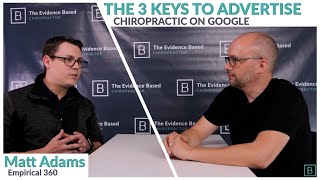
Jeff Langmaid and Matt Adams of Empirical360 break down Google Ads for chiropractors: match ad copy and landing pages to patient intent, track clicks through to revenue, and use dashboards to monitor performance. Small practices typically spend $1,000 to $1,500 monthly and target a 15 to 20 mile radius.
Questions this video answers
November 7, 2018.
About $1,000 to $1,500 per month.
About a 15 to 20 mile radius.
(1) Optimization, (2) Reporting, (3) Data visualization.
A performance-visualization application (dashboard) and a CRM.
Chapters
Hey, what's going on, everybody? I am back this week again with Matt Adams from Empirical 360. We're going to talk about advertising on Google advertising online and things you can do to make your outreach successful. Really three key items we're going to focus on today. So Matt, I'll have you kick us off. What is one item that docs should look for or should keep an eye out for when they're marketing on Google or online?
So in marketing, especially in online advertising, with search engine marketing, there's a kind of a, I don't know, it's a general consens. Search engine marketing and pay per click is kind of like George Foreman girl. Set it and forget it. So you can just put in the keywords, you put in your bid strategy and it's just going to take care of itself. One fundamental concept that we focus on in our marketing campaigns is optimization. And how do you actually optimize? There's a lot of different variables to it, but ultimately you want to be able to take a look at what your performance is and make some changes along the way to your ad copy. So when we talk about pay per click advertising, when you search a keyword, I'll give, for example chiropractor near me, the top four spots that show up in Google or Bing ads is going to be pay per click advertising. That's chiropractors who are actually bidding on keywords to position themselves so they can actually get a click. You're competing for clicks and get a new patient to come on board with your practice. So how do you actually optimize that? You take a look at what the ad copy is. You take a look at, you know, the relevance factor that's in the advertising copy. So, you know, in Tampa here, for example, if somebody types in chiropractor near me, you want to have ad copy that might say something to the effect of number one chiropractor in Tampa Bay area. And then here's all the details about your practice, all the things that you offer. Spinal decompression, whether or not you actually have any kind of specials going on right now, a new patient special, a free session of spinal decompression and changing that up as you go to see what's performing better, you might actually come to find that ad copy that relates to urgency and availability of an appointment is going to perform better than actually having efficacy of your treatment options. So there's that aspect of it. And then also we talked about last week landing pages and making sure that they're relevant to what the consumer is looking for. So if somebody types in the keyword here, spinal decompression Tampa Bay. Making sure that they end up at a landing page that has spinal decompression in Tampa Bay. Urgent appointments available so that there's that relevance. And they know that you as a practitioner can offer exactly what they're looking for. So that's part of the optimization process.
Yeah. And I think that's an interesting thing I'd like to go a little bit deeper on. And that's really writing what I'll call copy that converts. So if you. And matching it to the landing page, which I think is a huge opportunity missed by many chiropractors. Meaning this. If you have copy that showcasing that you're a sports chiropractor that loves taking care of rotator cuff issues and then you're dumping somebody, they're clicking on the link, you get them to take the action, but they're. You're dumping them onto your generic page front end. That doesn't really showcase that you're a sports chiropractor. And certainly nothing about the rotator cuff. You're in a difficult situation to get that patient to then pick up the phone.
Sure.
And have you seen that the more linear your call to action is on a Google Ad and how that copy almost can mirror exactly what's on the landing page helps increase conversion.
Absolutely. All day long. So there's kind of steps in the process here. So when it comes to man, I could go all the way down to the URL. So for somebody who's searching for spinal decompression, you want to have your website address spinal decompression so that there's that relevance factor in your advertising copy. For example, like rotator cuff, a sports chiropractic in your advertising copy. Number one sports chiropractor in Tampa Bay area specializing in treating rotator cuffs. You can even go so far. And we do this for our clients all the time because we want to have the best performance is create micro sites that have everything about rotator cuff, everything about the pathologist, everything about what your symptoms would be. So that even if a consumer is searching for symptoms that would be associated with a rotator cuff injury, when they type those symptoms into Google and you show up with your advertisement. Now they land at not just a landing page, but an entire site that's completely dedicated towards rotator cuff treatment and what can be done in chiropractic. So absolutely linear from start to finish. It goes to the URL it goes to the ad copy. It goes to the actual site that they land at as well.
The URL, I think, is something a lot of docs probably overlook as well. They might have something pointing to a blog post, which is better than nothing. They might have it pointing somewhere else, which is again better than nothing. But the more specific, I think that's take home message, really, the more specific you can be on what's the patient type that you're looking for, who are you looking to reach out to with your message on that ad that day, that bit of information, and then tying that as closely as possible to the end point of when they would theoretically click the email or click the call now button. It helps the process all along. And what are some factors that you've seen kind of optimizing that outreach? When you talk a little bit about, you know, you want to keep a close eye on what's going on with your ads and monitor what's going on. What are a few key performance indicators that a doc should be attuned with to whether their ads are performing well or not so well?
So there are specific variables that you can look at within the Google Ads platform. Click through rate is one of them. Your click through rate is going to go up the more relevant your ad copy is and the better that it's performing. So that click through rate means that your ad is now seen. And out of the four advertisements that every chiropractor who's in the PPC space is bidding on now, your ad is the one that's getting clicked on. So a marginal percentage improvement in that is how you can actually optimize your campaigns and say, all right, well, so I've done, and this is kind of a more granular and detailed term, I've done a split test where I've said I'm going to put this ad copy out versus ad copy that is more specific and urgency based versus efficacy based. But this one's performing better. The click through rate is higher and therefore I'm going to go and click on that advertisement or I'm going to start pumping more dollars into that particular advertisement because it's yielding more clicks and more conversions for my actual patients who are arriving at that landing page or that microsite for that matter.
And with that, I've seen this is kind of getting into a little bit of advanced strategy. But for the docs out there that have been in this for a little while, one thing that I've heard, I'm curious if you've seen this to be true is when you do perform an AB test or a split test really just to change one item. So if you're changing headline, picture and the whole page and everything else, you're almost not comparing, you're comparing apples to oranges at that point.
Exactly right.
So what's the, what's a good place when you are AB testing? Where's the best place to start? I know there's no, there's no one size fits all, but what have you seen?
So you know the ad copy is a good place to start. One of the most significant things that we actually did an A B test on is the positioning for the photo of a physician. It's pretty remarkable to me and that's actually. So if you don't have, and I'm just going to throw this out there as an aside, if you don't have a bright beaming photo of yourself, your best professional photography, like right smack dab top of your page, you're missing out because people, consumers, people who are in need of medical care, they want to know who their doctor is, they want to know who they're going to be going to meet with. So get that smiley pearly white, you know, out there and put that right smack dab on your landing page. We saw conversions that went through the roof and that goes to just your homepage and organic traffic, it goes to the landing pages and the micro sites as well.
Okay, so you would encourage, if the doc can get a professional headshot done that looks nice, it looks clean, it puts them in a good light, literally and figuratively speaking. You know, that's a good thing to put front and center on the website.
Absolutely, yeah. Get the news anchor, makeup artist out there, get the best professional photographer that you can find and make it look good. Absolutely.
What are some other things that docs can look for or keys to performing well?
So we talked about three things here. So we went over the optimization. Let's talk about the reporting as well. So if you don't actually build the systems for yourself to be able to report on, and I'm going to go off on a kind of a tangent here, but if you don't have reporting to actually look at this data and see how it's performing and you don't have the full picture in front of you, you're not really going to be able to make any kind of effective decisions. Split testing can get you so far and seeing a difference in your click through rates and your quality score going up and things like that and your cost per click going down, that's one thing. But reporting in terms of the overall start to finish. So I'm talking about keywords, click through rate and then return on ad spend. So actual revenue generated. Did you get a patient that came in for spinal decompression treatment? Did you get a patient that came in and booked multiple appointments? Did you get a patient who came in and had laser therapy? But tying back in what the end result was and the yield in terms of, you know, potential revenue for the practice and the overall lifetime value, if you're not pumping that data through a report back into your pay per click campaigns, you're missing the boat. Because that revenue generation, it's kind of like grandma's spaghetti recipe. And so grandma's spaghetti recipe wasn't perfect from day one, minute one. She did this through testing, analysis, writing it down and then making modifications as she went and changing it over time. And then at some point Grandma said, I've got the perfect recipe. It's the same thing when we're talking about ppc. Marketing is getting to that point where you've got the perfect spaghetti and now you just make it for everybody all the time. So, you know, keyword all the way to revenue. You need to be able to visualize that in your reporting.
When you're on that path of, you know, starting at just what the keyword is, you're working through what's the ad copy that's working, what's the call to action? And you're really trying to get to that. What's this doing in terms of return on investment? Can you, can you play with it too much or is more better?
Yes. So we want to, there's, there's a term in the industry called statistical significance. So we test to a point where we get to statistically significant data that says this is performing better. And if the data says that we should make this decision to go towards this ad copy and this landing page and this microsite and this kind of relevance, then that's the decision that we're going to make. Anything short of that is testing too much too fast and you can't really get direction from it. So that's kind of the way that we handle things with it. And it's also kind of challenging as well. In ppc, from what we've seen in working with the majority of the chiropractors that we work with, about the most that you can spend in PPC is about $1,000 to $1,500 per month, depending upon your geographic location. You want to have about a 15 to 20 mile radius that you're targeting and so you don't have a whole lot of data that comes in quickly. It's a little bit more challenging to make good decisions when you have limited data. Some of the smaller budgets that we have actually take a lot more oversight because we have to use a little bit more insight and foresight to decisions. When we're managing the big accounts that are spending a half a million dollars per month. The speed at which we see data come in allows us to make decisions faster. So you almost have to have constant vigilance when you're talking about your reporting and being able to see things and make decisions on it. Going off on a tangent with this here at Empirical360, we actually just created our own platform for performance visualization. We created our own CRM as well to do just that for our clients so they can actually see return on ad spend all the way from keyword all the way to revenue being generated in every single industry that we're in. And then additionally above and beyond that, we created a performance visualization marketing performance visualization application which shows how your analytics are doing, what your click through rate is, what your impression share is, and everything that you would want to know about your marketing. But you don't have to have a PhD in marketing to be able to understand it. We wanted to break it down to be very easy for our clients because it needs to be. You want to have constant eyesight on how your marketing is going and that's why these were created. We're really excited about it.
Yeah, I think the reporting is really important because what I've seen in the industry, specifically with chiropractors, is there's a lot of chiropractors out there that get involved in pay per click advertising. They want to advertise in Google, they know they need to be there, but they might work with a company and they put in the money and they're just trying to track, trying being the keyword, trying to track who comes in their front door, but they really don't see anything of what's going on. And I think, you know, even as a practicing doc who's busy day to day, being able to look down at the data, see where things are working well, noticing trends and then be able to dive deeper if you want is very, very important because you know, as you guys are on the marketing side and the company really doing a lot of that legwork, the doc is still the boots on the ground. And when those two minds can Come together through the data. I would imagine that that's where there's, you know, real success as opposed to each one guessing what the other's doing.
Absolutely. You've got to have that kind of bilateral accountability. So, you know, we'll call out our, you know, clients that we're working with as well to say, hey, what happened with this lead that we sent over to you? What did it convert to a new patient for you? What was the treatments that they got from you? You know, that kind of stuff. So that we can say, all right, you know, we want to actually make sure that, you know, we're putting more ad dollars into the things that are performing for you. You got to have that bilateral accountability for sure.
No doubt. And reporting was number two. Number three, what's the third key that Doc should be on the lookout for?
So being able to visualize your data.
Talk me through that.
Yeah. So one thing that we find is kind of a huge problem within the industry is marketing companies out there that just leave you at the fact that, well, we generated a lead for you. And so that's a problem because if the end game for them is to generate a lead or a new patient for you, well, a lead, a phone call, a form being completed, that doesn't really yield results. That doesn't really yield exactly what you're looking for with your practice. Your whole goal as a medical practitioner is to get more patients, get people healthy, and help them stay healthy as well. Our goal as a marketing company is to find those patients for you, get them into your ecosystem. We know you, we trust you as a practitioner. We know that once they meet with you and they're going to have a great experience, you're going to get them feeling better and they're going to continue on. If we don't have real time visualization and eyes on your marketing at all times. And the same goals in mind, not just leads being generated, but the same goals that we want to expand your practice as the end result, then there's a disconnect there. And that's part of the reason for the performance marketing visualization application. It really helps us get to that end goal.
I love it. So if I break down a couple of things that we talked about today, I'll kind of say them to you and you can make sure that I'm saying it correctly. So number one is make sure that you have a really linear path between what your call to action is and where you are driving your patients. The cleaner that is, the better at patient experience, User Experience it is and the more likely they are going to be to take action.
Absolutely.
Number two is make sure that you have good reporting. Don't just throw your dollars out to a company and hope for the best at the end of the month and not really have any data go. But the data is what is a key indicator as far as future success. As you can tell, the hits and misses.
Yep.
And then being able to visualize that data because many of us in the healthcare field, you know, infinite spreadsheets aren't the best way to do it. So really being able to look at a nice visualization at what's going on, check the pulse of it also will help drive everything back towards the front end.
Yeah. One thing that I would tell you right now, so Google Ads has a really cool function with it. There's your change history. So within the change history you can see how many changes, either you as the chiropractor, if you're doing PPC yourself, how many changes you've made to the account or how many changes your marketing company has made. And so if you go into Google Ads and you see that your account has existed for, I don't know, six months and you see a big fat zero in that change history, you know that you've got a problem. On the other hand, if you have too many changes in a short amount of time, guys, hey, let's pump the brakes here. Let's make sure that we're isolating things here and doing things the right way. But you want your marketing company to be able to show you that kind of stuff, to be able to, you know, when we talk about visualization, don't hide it from me. You know, it got me a lead, got me a, you know, a possibility, an opportunity there. Tell me about it. Tell me how things are actually going on and break it down for me so that I can actually understand it.
I love it, Matt. I appreciate it. We'll be back next week. We'll be talking even deeper about Google pay per click, advertising, things that docs can look for, be on the lookout for to make sure they're maximizing their impact. Thanks a ton for coming by. Appreciate it, man.
Thank you, Jeff.
Got it.
It.










