A Chiropractor's Guide to PPC and Google Advertising
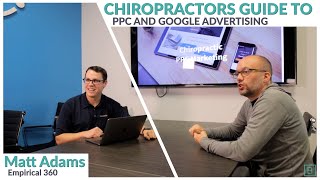
Jeff Langmaid and Matt Adams of Empirical360 walk through a new PPC guide for chiropractors. They cover keyword selection, account structure, ad copy that matches landing pages, and conversion tracking with CallRail. Start with a modest budget and use negative keywords to cut wasted spend.
Questions this video answers
December 17, 2018
About $500 to $1,000
CallRail
Chapters
Hey, what's up, everybody? Jeff Lengmaid here and I am talking with Matt Adams at Empirical 360. We are in their turf today. We're going to talk some PPC advertising. Google, you probably have seen Matt and I talk the last couple weeks about some interesting points that you need to keep your eye on and how you can maximize your results. But today they just released a guide specifically for chiropractors. That's what we're going to dive into. And first, Matt, I'll ask you, who is this guide for?
I think it's kind of dual purpose. I think that it's specifically for chiropractors, number one. But number two, it's for chiropractors who might have an agency relationship or it's for chiropractors that don't have an agency relationship but want to get into PPC marketing. If you have an agency, this might offer some checks and balances to make sure that they're doing their job. If you're a chiropractor that's not doing PPC right now, this could be extremely beneficial to you in terms of navigating how to set up a PPC campaign and do it in the right way to actually monetize and get some new patients coming in.
Cool. And I know we put a link in this video, so if you want to download this or check this out on your own, be sure to do so. Click the link and you can get all the information that we're going to cover today. What was the impetus to put it together?
So the impetus to put it together is I've worked in medical marketing for quite some time. Chiropractic has been a big portion of that. Coming to work for Empirical360 as their director of client success. I really kind of see a market in need and a market that can benefit from having something like this to really help great chiropractors, great physicians who actually want to treat and make people feel better, help them actually find patients and get them into their practice. That's the impetus for this. It's just having that kind of commonality, that rapport that I've built in the chiropractic community and understanding how great and effective their medicine is and wanting to help them build their practices. That's why I'm doing it.
Cool. And as we break this down in a moment, step by step, just recap for anybody that didn't check out the previous videos, what's PPC advertising in a nutshell?
So PPC advertising is pay per click, basically. When you search a term in Google, like for example, if you're looking for a chiropractor near me or something like that, typically speaking, the first four or the first four results that come up, those are going to be advertisements. That's a chiropractor who is in PPC marketing. They're actually bidding on those queries so that their site can come up and a consumer can find them when they actually need them.
Cool. Well, let's dive in and take a look. And what you see up on the screen right now, this is something that you guys can visit. Just check out the link and you can get all of this information as well. But Matt and I will take a few minutes to break it down.
I recognize those guys. That's the first time that we've seen this happen. So basically this is gonna be a step by step guide to PPC marketing. And again, we didn't wanna make this overly technical, Jeff. I mean we want it to be technical enough so that you're going to do things the right way and you get what the point behind it is. But we want to drill things down enough to a basic standpoint so you can actually get into it, understand it. And again, if you have questions about it, our contact information is in there as well so you can reach out to us. We basically go in a very linear map here. So the first thing that we're going to be talking about is so what is pay per click? It basically kind of drills down what pay per click is all about. Pay per click is used in pretty much every market really. We are predominantly leveraged in insurance marketing, but we've done quite a bit in meta as well. There's E commerce that uses this. Anybody who wants to be found on Google, they're going to be using pay per click typically. So moving on down the line here we kind of get into the genesis of a campaign which is your keyword selection strategy. And there's a couple of things that we get into that are going to be for things that you want to avoid, things that you want to do. We've actually got links to content in here as well that are specifically for, you know, additional information. But really it's just kind of like here's the nuances of PPC for a chiropractor. Here's things that you want to look at. We talk about the keyword planner in there. I don't know if you're familiar with that. Have you done anything in PPC yourself?
I've done a little bit and I think the keyword is absolutely essential. I mean, it's really where everything else stems from. And regarding that, what's the biggest misstep you see chiropractors taking or anybody really out there regarding keyword.
It's really, I think, leaving things too broad, really. If you're going to start with a campaign, and we always recommend starting small, really in most markets. When it comes to PPC for chiropractic, depending upon the size of your demographic area, you're going to be talking about differences. Like if you're out in a very rural area compared to like Mecca Tampa with chiropractic and you've got a ton of people in the space, things might be a little bit different in terms of the overall budget. But for most chiropractic markets, about 500 to $1,000 is going to get you pretty far. But you want to keep things narrow. You want to be looking for chiropractor near me. If you're a practice that has spinal decompression. Spinal decompression near me. Just using terms that are not super, super broad. Because if you. I'll give you an example on this. As a chiropractor, typically you're going to treat things like shoulder pain or knee pain or back pain. But if you leave things to back pain, you're going to be lumped in with not only other chiropractors but spinal surgery practices. You're going to be lumped in with interventional pain management. And you probably want so that you don't spend a ton of money all over the place. Just focus on people who are looking for chiropractic care.
I think that's a key component. I almost think of it like reverse engineering. And the tools like this help so tremendously because it helps this process of reverse engineering what people are searching for. If you're the answer to what they're looking for, that helps in every aspect. Number one, you don't need to feel cheesy or corny trying to sell them on something or getting into any weird territory. But it's like if an individual is looking for a service that you offer, being present when they're looking for it is absolutely crucial. So, yeah, keyword strategy is awesome. What else do we have?
So we get into structuring the account. This probably is. This is legitimately one of the most important things in setting up a PPC campaign. So if you're going to read one section of this, pay particular focus to structuring the account. And the reason for this is when you segment an account the right way. And we talk about segmentation here. Segment out by campaign, segment out by device, segment out by the actual match type. This will help you to drill down. If you have a campaign that is specifically for a chiropractor near me and you realize that chiropractor near me is performing particularly well on mobile and we've actually seen this happen in a lot of our campaigns on mobile is performing really, really well, then you cut out some of the budget for your other campaigns that are running and you funnel that bigger budget back into what's performing the best. It's going to help your cost per click go down. It's going to help the actual cost per lead go down as well. And you should be getting more new patients because you're using the money the right way. So a great adwords campaign and structure, you gotta start with segmentation.
That's great. And I think that's important because a lot of times I think it's overlooked. I mean you have here all the different factors, campaign, device, match. I mean there's a lot of information here which is awesome. But even just picking out just what you said and I just want to say it again for emphasis, being able to understand if something's converting better if somebody's on their phone, whether they're searching on their desktop versus let's say some other device, that's really important because it helps you gain efficiency. And the way that you structure your ad can also be fine tuned to how people are searching for it. And I think that's a key, key component for anybody that's out there already involved in PPC advertising. Understanding. Are they fine tuning campaigns, not over tuning them, but are they fine tuning them to what's working and then driving a little bit more spend there just as if you were doing advertising and you say, man, I do great at this in person event. I'm gonna do 10 of those next year because hey, I had great results last year. Same thing applies here where if you're seeing benefit on one specific ad type and then drill down to one specific device, doubling down on the areas that are working help gain exactly as you said, efficiency and reduced cost.
Yeah, absolutely. It's a lot. Kind of like the stock market in diversifying your portfolio, right? So if you've got money in the stock and you are in one particular fund and you see, hey, this fund's making me a lot of money right now, I'm probably going to take some of my money from my other allocations and put it into that because it's doing so well. If you don't have that diversification in your AdWords portfolio, you're not going to be able to allocate things the right way. This is paramount. If you read this here, spend all your time on it.
Sweet.
What else do we get writing the actual ad copy? So this in particular really want to talk about relevance. So if you're going to use. I'll just give you a case in point with this. If you're going to use spinal decompression, we'll just take that as an example. Your advertising copy needs to be specifically related to spinal decompression and the efficacy of the treatment, the nuances that go into spinal decompression and then actually having your offers, if you're going to offer like a free consultation or something like that, or if you're going to be able to offer something that says urgent appointments and what your call to action is from it. So, you know, having relevant ad copy is going to increase your quality score in Google and thereby you're going to get a lower cost per click, lower cost per lead and new patients coming in.
Yeah, I think that anytime I think about copywriting, it's about. It's. There's a ton. This is a great example of it. It's good to be creative, not good to be cute. In other words, you can be creative with how you structure things and how you talk about it, but you need to be direct. It's not the time to get drastically esoteric. You have to be able to lead the person from, I'm looking for this. They actually get to your, as we'll talk about in a minute, landing page and they're seeing that copy. And then that's the point where you are trying to engage them to take an action. And if the action is not clear, indecision will not be your friend.
Yeah, no, absolutely.
Let's talk about landing pages.
Let's talk about landing pages. So to that exact point, when we're talking about landing pages here, if you have ad copy that specifically related to spinal decompression, you really want somebody to land at a landing page that talks about spinal decompression and breaks it down. They see the spinal decompression apparatus, they see a patient that's actually getting spinal decompression, they see a testimonial about a patient that benefited from spinal decompression, and then they've got a form to be able to contact you right there, dead center, so they can actually communicate with you. And actually engage in getting a spinal decompression consultation with you.
Sweet.
Yeah.
And once you get those landing pages up, what's some of the next steps as far as optimizing them?
So optimization. There's a whole lot that can go into optimization. So optimization. This talks about campaigns as a whole, but it's. These are things that you want to do on an ongoing basis. So we talked about adding negative keywords here. Negative keywords are going to be for things that might have come up that you don't want to actually be bidding on. So let's say, for example, somebody searched for chiropractic university, right? You probably don't want somebody to click on your advertisement if they've searched for chiropractic University. So you're going to go back into your account, you're going to add a negative keyword which will exclude your advertisement from being shown anytime that chiropractic university is searched going forward. So this is done on an ongoing basis. You're going to deal with competitors. So somebody's searching for a specific chiropractor. You want to exclude that specific chiropractor as a negative so that you can refine your strategy within Google Ads.
And I think that's a really, really key point, especially when we talk about the competition on some of the large pain management groups, some of the large surgery groups. These are people that have very deep pockets that can dump a ton of money into their online advertising. And quite frankly, unless you're, you know, a top.001% chiropractic office in terms of revenue and marketing, you just can't compete dollar for dollar. It's very difficult. So understanding, as you just said, and that's why I'd encourage anybody that, you know, has interest in this, is doing it, is planning on doing it, or just wants to learn more, which I think everybody should be sure to click that link and check this out yourself, because understanding where you can make gains and where you can find a strategy to get in, right? You're not going to overtake dollar for dollar some of these other people, but you can be way more nimble and way more specific and still get good results.
Well, and the other piece of that puzzle as well is if we talk about this, it's not just the big pocket competitors that you're worried about. You're actually worried about Google as well, because Google's job, let's not forget that 92% of Google's revenue comes from paid search. They are getting paid billions and billions of dollars for their Advertising in the Google Ads platform, if you don't put checks and balances in place and you don't have those negative keywords, you're not doing things based upon exact match and you don't actually set in a budget. Google's going to say, hey, you have money to spend, I'm going to spend it because that's how I get paid as Google. So this guide here gives you the opportunity to put in those checks and balances so that Google just can't run wild with your budget and spend your money without getting results for you.
That's very, very, very well said. As we get towards the conclusion here, what else do we have going on?
So conversion tracking is basically really making sure that you have visibility to what's yielded a result for you. So we use a particular platform called CallRail. CallRail is called dynamic call tracking. And if you have a consumer that has reached a landing page and they dial a phone number on there, that's a unique phone number that we can attribute back to the actual advertisement. So that call tracking data we want to pump back into AdWords. Because now if we have the right conversion tracking in place now we can see that this particular campaign is doing really, really well in terms of generating calls for you. So when a campaign is doing really, really well, the next step is to say, all right, perfect, this is working great. We've got the right recipe. Let's go ahead and funnel more of our budget into that campaign and we should expect to yield the same results. So it's rinse and repeat.
Love it. Well, that has been a complete breakdown of the entire chiropractic guide to pay per click. Matt Empirical360. Huge. Thanks for putting it together. I think it's awesome. And if you're a doc that's been checking this out and watched our series, we have a lot more videos to come as the weeks roll on. But if you are doing pay per click advertising currently, if you have interest in it for next year, or even if you are not ready for it yet, I'd encourage you start learning, start getting the information. Click the link. Check out this guide that really, as we went through, puts everything together A through Z. And Matt and I will be back next week talking more about pay per click advertising. Have a great.










