CBD Uncovered: What We Know (and Don’t Know) with Dr. Alyson Evans of Fringe
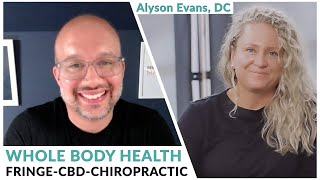
Dr. Alyson Evans, who spent 11 years at Rock Tape, launched Fringe to educate health professionals about CBD. She's addressing misconceptions like CBD as a cure-all and the myth that full-spectrum is always necessary, while developing water-soluble powders and topicals with food scientists.
Chapters
That is right around the time that we started seeing CBD literally everywhere. The industry has grown so quickly. I feel like we see a lot of fads over a lot of years, but this I knew was not one of them.
All right, and as promised, I am here with Dr. Allison Evans. Allison's been a friend for a while. She has a brand new company that really is built on community and education. I am super excited that she's on to talk about what she's up to, because I think it's going to make a big difference for, for your practice and for your patients. Alison, how are you doing today?
I'm great. How are you doing?
I'm doing fantastic. And let's pick it up. Right. What are you into these days? I know you and I have talked a little bit behind the scenes, but many docs out there might recognize your name, but not sure exactly what you're up to. So what are we gonna be talking about today?
Yeah, we are two months now into the launch of a new company centered around, like you said, education, community. And our first product line has been hacked heavily centered around the CBD industry, actually. So just trying to do what I know I'm good at, which is to bring information and education to an industry that needs it in order for it to succeed in our profession. So that's. That's what I do, Jeff.
I like it. So what, so what got you interested? I know you know we're going to break down a lot of what CBD good for, what are the benefits, what are the misconceptions? I want dive into all of that stuff. But let's peel it back one more layer. When you thought about CBD and how it fits into fringe as a whole, what got you interested? Why is that the first product you're leading with? And maybe talk a little bit about the story behind the brand and really the community you're building. Because I think that is one of the most important parts about it.
Yeah. So the story essentially goes that I am probably more well known, but I was kind of behind the scenes. But I am probably more well known for being affiliated with Rock Tape. And I worked for rock tape for 11 years and I had a two year contract that I was finished up at Rock Tape after their acquisition. So it was a nice space. Very rarely are we sort of given a long lead time to go think about what we would do next. Oftentimes it hits us over the head and we're having to make decisions, you know, in the spur of the moment. So I had A couple of years to start thinking about what would I really go do next after Rock Tape. And my role at Rock Tape was very similar. You know, to bring education to that health professional community centered around a product that was incredibly helpful, very innovative, very fun, and disruptive to some degree, too, within the industry. So that is right around the time that we started seeing CBD literally everywhere. And by I mean everywhere, gas stations, grocery stores. But it also is interesting because the industry has grown so quickly, and I feel like we see a lot of fads over a lot of years, but this, I knew, was not one of them. So I at least had enough of a background knowledge to know that the cannabis plant had been used for, you know, thousands of years by humans medicinally. And so I just basically started learning. And it was really nice because I had a year where I got to casually just learn about the cannabis industry, about the CBD industry, about what people were being told, about what people were buying, about the wildest amount of CBD products you could ever buy, all sorts of crazy things from Amazon, gas stations, grocery stores. And I just dove in and I had time to think about it and really experiment. And one thing I knew for sure is that I was seeing CBD boosts at chiropractic conventions and not really good information about how it worked, why it worked, what mattered. Like, what should we be actually, you know, learning as doctors, where people come in and talk to us about their pain and their stress and their inability to sleep. So for me, that's a light bulb moment where I see an industry exploding and I know that the education isn't super authentic. You could tell it had a big marketing flair and, you know, jazz hands around it, like it wasn't really substantial what people were being told. So for me, that kind of brings me into this area where I know, I know what to do, I know I love to do it, and I know that there's, you know, a path for me on that. So really I just dove in and started taking a bunch of cbd. And the nuts and bolts of it is my experience was good sometimes and other times not good. So sometimes it would help with some. Some chronic neck stuff that I have, sometimes it would help with sleep, sometimes it wouldn't. The enjoyability factor of taking the CBD was super low for me. I'm not a good supplement, nasty supplement tasting person. I know some people are good at that. I was not. And so I really sort of started diving into trying to make the experience better. Not necessarily. First focused on the reliability of my experience. And I quickly, you know, ended that journey by finding a group of food scientists who were making tasteless and odorless CBD that was water soluble. And one of the main reasons they were doing it was to improve the absorption of the cbd, the predictability of the experience of the cbd, the value of the cbd. And that was kind of it for me. I was realizing, like, you now have a group of food scientists who understand not only what happens when you ingest it, what happens when you metabolize it, like, what is actually going on in your body. The experiences went from being pretty gross to a very great experience because you don't taste it or smell it. And then realizing that having a partner like that would be amazing to bring education to the chiropractic community. So just like that, fringe was born. And I think it's interesting to sort of backpedal. And I do tell people this very regularly, that rock tape was the most fun. I learned so much and just was like one of those experiences that I wish everybody could have with the community that we built and the instructors that we had and the people that I worked for and that I worked with, it was just amazing. But it wasn't. I'm not a big crossfitter, right? I'm not a endurance athlete. So from a standpoint of representing the me as a brand, it wasn't my brand, you know, and fringe to me. And the name fringe is an interesting thing because it came about by me one late night, being on a couple chiropractic Facebook groups and realizing that within our own profession, we try to push people out of this defined accepted center and reference them as the fringe of our profession. So the interesting thing about the name is that it really just means unconventional. It means, you know, on the edge, which is interesting because it really represents the chiropractic profession as a whole. But came over me in an environment in which the chiropractic profession, you know, was sort of against each other and referencing the fringe of our profession. And I was like, oh, my God, am I the fringe of our profession or am I in the center? Like, I didn't really honestly know. And it was just kind of one of those moments where I thought, that name is amazing. It's totally used in a negative fashion, politically, religiously, you know, professionally, personally, that people who don't fit the norm are on the fringe. And I was like, I don't think that's where the world's going. I mean, I think that more people identify with being unconventional than they do with being, you know, mainstream. And I think it's silly that that delineation even exists. So that was a roundabout way to answer the question of the name, the brand, the story.
I think. I think it's awesome. Then as soon as I heard the name, I was like, that is fantastic. So, so well done. Well done with that. And you kind of alluded to, you know, just so much misinformation out there. And I'd love for you to break down maybe, you know, those top couple misconceptions that most stocks either hold true or don't know about. What are those biggest misconceptions in and around cbd? And after that, I'd love to get into more about how it works in patient archetypes and benefits. But let's start with misconceptions, because there is so much misinformation out there.
Yeah. You know, I think the hardest what people are learning is essentially from marketing departments versus like, combining clinical expertise with the evidence that we have available and then also factoring in patient, you know, values and preferences. So what? Gosh. I mean, the misinformation is massive. I would say probably one of the. On a collective whole for consumers and people just in general, is that, you know, CBD is the panacea that might, you know, solve all of our problems moving forward. And that alone, people touting that, you know, no matter what problem you have, just take CBD and it'll help it. And it's very interesting because without substantive information to support that, it obviously just falls on deaf ears in our profession. There's a lot of information that I don't want to label it as misinformation, but it's what I would consider conclusive information when this industry is anything but conclusive at this point. So there is information that you have to use a full spectrum oil in order to have any benefits from the hemp plant at all, which is. It is not true. You will have to bring information on a cadence that I'm not familiar with. I'm used to updating courses once a year and recording them and set it and forget it and call it good. This situation is very different. So there's a lot for people to learn. So CBD is an incredibly compelling health industry. It is very complex and it is way more promising than I thought it was when I started exactly what you want to happen. I mean, I was of the belief that it could really help people sleep. I knew that it could really help people with stress and anxiety. And I definitely knew that CBD and inflammation and pain, and were going to be a really good part of our business. But I'm now realizing obviously that the impact can be greater for people.
So I think that's fantastic. And you talked about a little bit about kind of broad spectrum and not, I know you guys launched with the topical and then two of the powders. What's the difference between those two? What do docs need to know and what are the basics of how this stuff, I guess, works?
Right. So in general, when you look at CBD products, there's generally three types of products. There's a full spectrum, a broad spectrum, and then an isolated product. So if you're ingesting cbd, it'll probably fall in one of those three categories. Full spectrum means they remove the waxes and the chlorophylls from the plant and they try to keep as many compounds that are natural to the plants in the plant. Keeping in mind that hemp is a form of cannabis. It's just really high in CBD and very, very low in thc. So hemp legally in the US in order to have a full spectrum product, you have to have less than 0.3% THC. So a full spectrum product has mainly CBD because it's the dominant compound in the plant, a whole bunch of other cannabinoid or active compounds, bunch of terpenes which make it smell and taste, kind of how it, how it tastes, and then a bunch of flavonoids which actually give it its color, and a bunch of other health benefits. And Then THC under 0.3%. A broad spectrum product means that the company who made the broad spectrum product pretty much removed THC from the product. So they went in with that oil compound. They did. There's a bunch of different ways you can remove compounds. A lot of it has to do with boiling points or pressure points or, you know, alcohol washes, whatever it may be, and they remove thc. So that's a broad spectrum product, which is the product that we have. We opted to remove THC with our first product lines because we're pretty much going to wait for THC to be federally legal before we go down the road of including it in our products. And I can kind of speak to that a little bit too. And then obviously isolate, which is one of the misconceptions of that, is that isolate doesn't work. And isolate is pretty much pure cbd. They extract just cbd, they concentrate it. And the truth of the matter is, you know, for me, I love the isolated product. I also use our broad spectrum product. It could very much so be true that for a person that a broad.










