Chiropractors: You're Leaving $150/Month on the Table
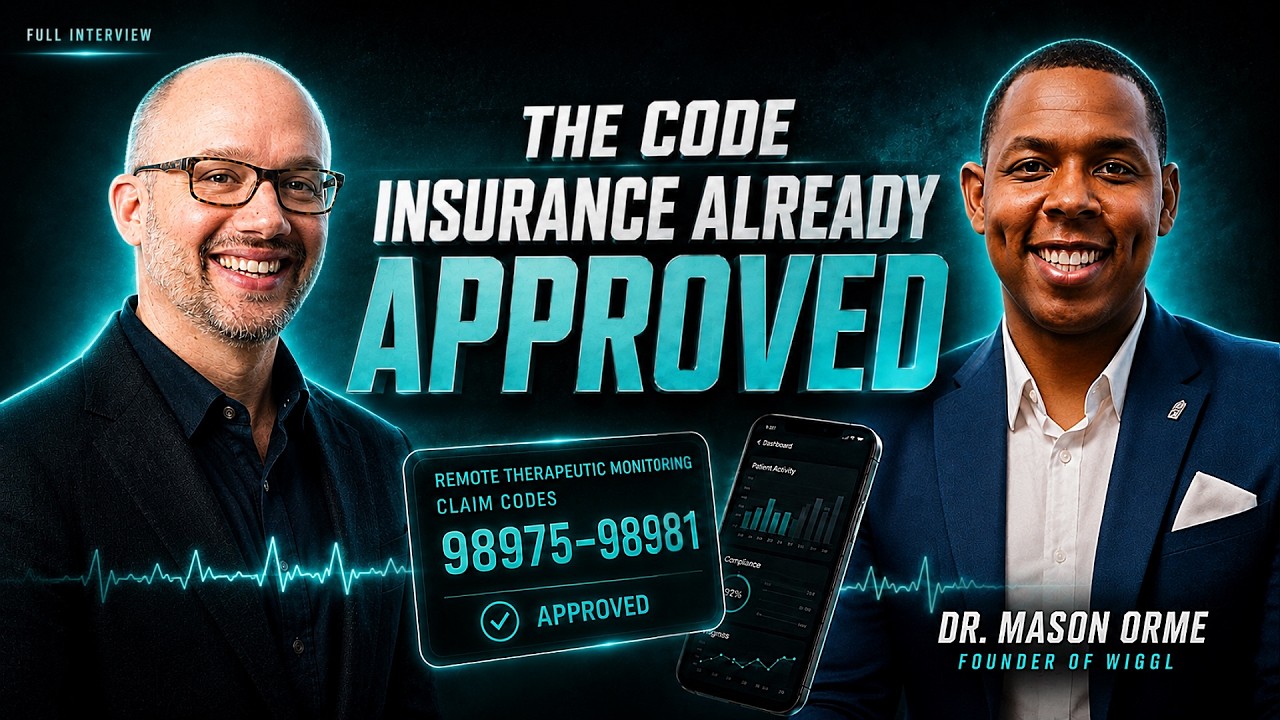
In this interview, host Jeff Langmaid talks with Dr. Mason Orme, CEO and founder of Wiggle, about how remote therapeutic monitoring (RTM) can transform chiropractic practice. Dr. Orme explains that RTM—distinct from remote patient monitoring (RPM) and traditionally used for cardiovascular or respiratory conditions—now includes musculoskeletal care after Medicare expanded its use in 2022. Wiggle was born from a personal experience when Orme’s mother suffered a low‑back injury during COVID‑19, prompting him to develop an AI‑driven wearable platform aimed at injury prevention for employers. The company later pivoted to a patient‑facing app and provider portal that let chiropractors track pain scores, exercise adherence, and daily check‑ins in under 30 seconds, with alerts for non‑compliance and built‑in messaging/video calls. Design was emphasized as a key differentiator, aiming for a modern, engaging user experience to boost adherence. Dr. Orme outlines the revenue opportunity: Medicare‑style CPT codes 98975‑98981 allow billing $50‑$150 per patient per month for RTM services, though chiropractors are currently excluded from Medicare reimbursement and must rely on commercial insurers (e.g., Blue Cross, Aetna, Cigna) or cash‑based models. He highlights that RTM positions chiropractors for value‑based care, offering passive income and richer clinical data. The conversation concludes with a call to action for chiropractors to adopt Wiggle, noting upcoming demo videos and the broader shift toward integrating technology, AI, and the “touch” of chiropractic into the future of musculoskeletal health.
Chapters
Physical therapists, they already have a digital musculoskeletal platform. They're already playing within the future of where healthcare is. But the one thing they're, they're, they're not good at yet is that touch.
Hey everybody, I am super happy to be sitting here with Dr. Mason Orme. Mason is the CEO and founder of Wiggle, a company I'm personally involved in. I met Mason a long time ago. He has worked at some of the largest tech companies as a chiropractor in the world. And now he's bringing his own technology to chiropractors all around the world. And this is a super important conversation that can potentially really transform the way that you practice, how you think about patient engagement, and ultimately you can dive into some revenue on the back end. So, Mason, I appreciate you chatting with me today.
Thanks for having me. I'm excited to be on here.
It is my pleasure. So let's start at the top. I brought up the term remote patient monitoring. Many chiropractors may be totally unfamiliar with that term. What does it mean?
Yeah, so remote therapeutic monitoring, a lot of chiropractors actually have not heard of this, but it's pretty much the ability to monitor your patient's progress, exercise adherence, pain patterns, and recovery between visits. So a lot of times what we see is we have our patients come into our practice, And we have our subjective findings, our objective findings, and they're only based on what we see in the clinic. But we only spend about either 20 minutes to 45 minutes with our patients inside, whereas remote therapeutic monitoring allows us to see outside of the clinic. And that's what's the beautiful part about remote therapeutic monitoring.
I love it. And I use the term remote patient monitoring. I'll ask a question that I don't know. Is there a difference between RPM and RTM?
There is. There is a big difference, and it's based on devices. Give you a little bit more background about RTM. RTM has been around for a long time, and RPM is slowly coming around, and it's more for intensive care. RTM is actually— was built for like cardiovascular issues, or even respiratory issues. They have these devices that allows you to monitor the heart or monitor your respiratory outside of the hospitals. It wasn't until 2022 that Medicare actually started to release the RTM platform for musculoskeletal providers. It's been more educated for physical therapists and occupational therapists. However, chiropractors are underneath that umbrella of musculoskeletal providers. We just have not had a platform that is suited well for us until now with Wiggle.
Well, let's go right there. So when you first talked to me about Wiggle, I literally remember I said, I want to be involved. So, so, so here we are many months later, and there's good reason for that. So for the docs that maybe have not heard of Wiggle or are not following you online yet, let's just start at the top. Clearly, Wiggle is going to be in the category of remote therapeutic monitoring. But talk about some of the background and history of Wiggle, and then we'll dive into some of how it applies to chiropractors literally today.
So what we did is we created— I founded a company called Wiggle. The reason why it actually occurred is because back in 2020, when we were all in COVID, my mom actually suffered from a debilitating low back pain. And unfortunately for her, she collapsed while working remotely. And so a little bit about myself, if you haven't known me on LinkedIn or whatnot, I've had the privilege to being in corporate healthcare for the longest time. Treating a lot of people at these tech companies. And the one thing that I realized when my mom was going through that, I wasn't able to help her at that moment. And I was trying to figure out, not from a, like, a treatment perspective, but how can we predict these things? How can we create a way for her to know that that was going to happen ahead of time? And so that's where the birth of Wiggle came in, is where We wanted to prevent injuries from happening by utilizing AI and wearables. And we took this to the market and we focused more so on employers. So we've had a chance to work with organizations like Facebook, Amazon, and a few smaller organizations to sit there and say, how can we prevent these injuries from happening? And how can we work with even just ergonomics? Because A lot of people at the time did not have those ergonomic solutions for remote employers, or employees, should I say. From then, what we did was we entered that market and we were like, this is great, this is awesome, we're helping the employers. But somehow there's still that disconnection from the employee to the provider. And so that's where remote therapeutic monitoring came in because we were realizing On one end, the employers wanted the data, but we didn't have the data. We were predicting data. So predicting data and having data are 2 separate things. On the other hand, we didn't know who were the providers who were treating the employees. And so when we were finally sitting up looking at how can we bridge the gap together, We stumbled across remote therapeutic monitoring, and the cool thing about that is just recently in 2022 or excuse me 2026 Medicare allowed the tracking of RTM to be more favorable for PTs, chiropractors to get reimbursed. So now we're starting to see a lot more of our profession being interested in this because of the fact that. The monitoring of the data is less harsh, should I say, compared to what it was when they first came out with the guidelines.
Yeah, that makes sense. So for the docs listening and saying, you got my attention, let's dive in. So how does Wiggle work?
That's a great question. So Wiggle, again, is that device that— it's an application, actually. And we make it very frictional for your patients to download the app. And then we have a portal system for the providers to track. And the whole thing is, like I mentioned to you, is we need to be able to learn how to track our patients outside of the clinic. And so with our app, we're able to monitor your patient's pain, a pain score, their adherence to exercises. And it's really simple. We do like a daily check-in that takes less than 30 seconds for your patients. to check in and to let you know how they're doing with their care. And then from there, you're able to interact with them through messaging or through a video call or chat to sit there and say, hey, how are you doing with the exercises I prescribed you with? And how are you doing with the functional— your functional daily living life? I think a lot of times we give these surveys, In the office, but we all know about 80% of the patients, they're lying to us when it comes to survey. So when they're outside the office, we start to see better adherence on that and better engagement with the plan because they're not under stress of like doing it in office. So we're going to get real-time data from that. Very simple with that.
So what I'm hearing is that once the patient downloads the application, they can go in and report how they're doing in a variety of different ways, and the doctor can access on their end a portal of all of their different patients. And I think what you showed me behind the scenes is there's even some alerting systems to really help doctors understand what patients might have some yellow flags going on, what maybe some need some attention. Is that correct?
That's absolutely correct. So when it— when you're looking at monitoring your patients, it's really awesome because when you have that data from their end, you're able to get these nudges to know that, hey, You know, Steve has not been consistent with the prescribed exercises that I've given him. So instead of waiting, you're able to go in and see that alert and be able to talk to Steve and figure out what happened that caused you not to be very consistent with your exercises. And maybe Steve just like, oh my God, I forgot to tell you I was out of town. I'll get back to them once I get back home. Even that communication is huge for you because now you're able to personalize Steve's prescription plan differently because you know he's out of town. And so it just allows that communication to be more open and flexible compared to waiting for the next time or the next visit that they actually come into your office.
That's awesome. And one of the things I'll kind of shout out, we'll share some, some screen overviews as we talk through this. Also, if you're listening and watching, be on the lookout in the next couple of weeks, we're going to release a video that's a full demo showing you inside. But one of the things that stood out to me immediately when I saw what you were working on was the design element. This does not look like MS-DOS, right? You know, this does not look like 1994, which bluntly a lot of software in the healthcare space and definitely in the chiropractic space does look like. So, and design does matter, you know. Is this a great user experience, not only for you, Doc, which is absolutely critical, but for the patient as well. So how do you think, I'll ask you a question I wasn't planning on asking you, but how do you think about design and where it fits in with engagement?
I think design is very, very important. I think for us as a company, that was our first initial start to building. You know, it's easy to have a platform where you have all your questions and exercises on, but we looked at all of these amazing companies that are drawing the attention of us all day long. We wanted to get that feel and say, how can we get your patient back into our platform engaging more? Because we knew engagement is the key to not only business, but applications and whatnot. And we had to learn outside of our whole industry because the designs of our industry right now is just more of how can we make this functional and how can we get this to the patient? Whereas when you look at it from the other side, it's like, how can we extract from the patient so that we can get better and better and better? And that's where engagement is. And that's where we went in that route early on.
I love it. So the reason docs are going to use Wiggle with their patients is because of the clinical benefits. But I'm going to take off our clinical hats and put on our business hats, because one of the other things that many docs are completely unaware of is the revenue opportunity with this. So I'd love for you maybe just to highlight, of course, results may vary, insurance plans may vary, all of those things that we know. But in terms of the revenue opportunity, why don't you give Doc some insight into what you've seen and learned so far?
Yeah, absolutely. So to give you a little bit more context of where the revenue comes in is this. So Medicare created these CPT codes, And their, their CBT codes from 98975 all the way to 98981. And these codes are billable codes. And they're billable codes based on just managing your patients outside of a clinic, educating your patients on RTM inside your clinic. of checking in on them. And these check-ins are not— you have to do a call or also you have to do like a video call. But these new codes, from a bare minimum of just getting them to have this management, monthly management, is minimum of $50 a month that you can get based on just the regular codes. And it can go all the way up to $150 per month per patient if you're managing them on RTM. Now, like you mentioned, Jeff, It definitely varies. I could tell you now, if you're thinking of, hey, I take Medicare, let's, let's use this. Unfortunately, even though Medicare created this for musculoskeletal providers, as chiropractors, we need to create better outcomes and data for them to take us as an RTM platform. So we're excluded from Medicare, but a lot of other commercial insurance like Blue Cross Blue Shield, Aetna, Cigna—all of those types of insurance companies are very friendly for chiropractors to use RTM. In fact, they really want us to use it, and I think we should because the more we're utilizing this platform, the more we're going to be able to not only get better outcomes and collect outcomes, but it's going to be able to show the insurance the value of chiropractic and how we can be utilized to increase the fees. So. From the benefits of revenue, I look at this as already we have fee-for-service when a patient comes in. RTM is your value-based care/passive income here. And if you know where the way the world is working, we're slowly leaning more into value-based care, which I believe chiropractors will soar in because of the fact that we're really, really good at value-based care. We're really good at creating plans, really good at prevention. And so, RTM, remote therapeutic monitoring, is just our new level of playing field in the healthcare system. And I think the more people are on it, the more it's going to justify itself.
Yeah, this is a really, really big deal. And I want to come back around and make sure everybody listening and watching heard what you said. You got to check with your own plans, your own municipalities, all of those caveats apply. But there are official codes that allow you, when the process is done correctly, in many cases, to be able to have billables of $50 or more, depending upon what you're doing, based upon the engagement with— you're having with the patient. That does 2 things. One, it provides a better patient experience, in my opinion, because the patient's more connected to your practice. 2, it allows you to extend beyond the 4 walls of your practice. It allows you to be able to generate revenue without necessarily having to just be bent over the table doing that. Nothing wrong with being bent over a table. Care of all the people. But man, what about all that time between visits that we know is so critical? Your ability to monitor that can be monetized in many cases. And that's where we go to that monthly recurring revenue model. You think about how many— we'll just make it basic and easy— how many primary insurance-based patients are coming into your practice each and every month. Many of them will likely qualify for the opportunity to have this remote monitoring. So that can stack up over time as you continue to engage with your patients, guide their recovery. And in my opinion, Mason, you correct me if I'm wrong, but this fits very well in with doctors who are movement-based, using movement assessments, which, yeah, everybody's gonna— many patients feel better within a few adjustments. But I always say you have to continue care to create change in habits. How do you think remote monitoring plays a role in that?
Big role. It plays a big role in it because now, like we mentioned earlier, now you're able to see more and be able to correct better beyond the clinic. And I want to add something that I failed to mention earlier. These codes are just not for in-network insurance. You can also use this in a cash-based practice and just bill your patients monthly or create In our platform, we created a super bill. So that super bill will print out and you can just send it to your patients and they can send it to their insurance. But at the end of the day, when you're looking at the future of care and how we are right now, remote therapeutic monitoring is placing chiropractic into the forward of healthcare. As we are in this shift, wherever we are, we all know that there's a shift. We're hearing about AI, healthcare tech, It's all happening right now. And, you know, as a chiropractor, we were really, really good in the industrial phase of things, and that— and we were really good at cracking necks and taking checks. And it's great. There's nothing wrong with that. But as we move more into this tech era, we have to be able to know how to play in this era. And remote therapeutic monitoring helps us play. I don't know if a lot of chiropractors have heard, but Physical therapists, they already have a digital musculoskeletal platform. Sword Health, Hinge Health, Chira Health—they're already playing within the future of where healthcare is. And so it's already planted that they are really good at exercise. But the one thing they're they're they're not good at yet is that that touch. And if we blend our chiropractic skills. With technology, I have no doubt within the next 2 to 3 years, we will continue to forward thinking of what musculoskeletal injuries should look like compared to just focusing on exercises and AI. So I'm really excited about this opportunity that remote therapeutic monitoring has for chiropractors, not only for outcomes, but how do we get restructured into the healthcare system as being a point solution For musculoskeletal injuries. Yep, that is very, very well said.
Docs listening and watching, if you would like to connect with Mason and his team over at Wiggle, we're going to drop some links down below. You can check things out, connect with the team, and learn about next steps. I think this is a massive change, a massive shift. I am personally involved because I see the vision that Dr. Mason has, and I see what Wiggle has. Is already doing and where it's going in the future. So if you are a doc who considers yourself future-facing, if you're a doc who would love to have more clinical information, if you are a doc who would love to have a little bit more revenue by doing the right thing in your practice, then Wiggle is definitely a software, a tool, a technology you are going to want to implement. Again, we will drop all of those links down below. Please be on the lookout in the next few weeks. I will be hopping on with Mason again and we will be going through the Wiggle platform screen by screen, detail by detail, so you can see exactly how this can be applied in your practice. Mason, I really appreciate you coming on and chatting today.
Thanks for having me on. This was fun.
Thanks so much for checking out that interview. If you liked it, we have plenty more available. You can check out the next interview right here.










