Comparing Foraminal and Spinal Stenosis | Podcast Ep. 159
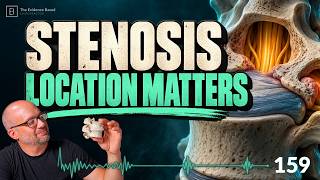
Dr. Jeff Langmaid explains the difference between foraminal and central spinal stenosis, how each presents in patients, and why they lean or move the way they do. Foraminal stenosis causes one-sided pain with a sideways lean; central stenosis causes bilateral symptoms and neurogenic claudication. Chiropractic adjustments can relieve symptoms by opening the canal space even a millimeter.
Questions this video answers
Over 250,000 downloads.
April 13, 2019.
About 10 millimeters is described as perfect; under 5 millimeters is described as severe central stenosis.
Chapters
Foreign hello and welcome to the Evidence Based Chiropractor. I AM your host, Dr. Jeff Langmaid. Happy New Year or soon to be new Year. We are kicking things off with a great episode this week. We are breaking down central stenosis versus foraminal stenosis from a clinical point of view. We're just gonna talk it down and make sure that you have a complete and full understanding of the differences, the presentations and also how the chiropractic adjustment, how what we do works within that to see the benefits that we all see through our patients day in and day out. I also wanna start out this episode by saying thank you. Thank you for tuning in and listening, whether this is your first week or your second year listening to the podcast. This year we were fortunate to have over 250,000 downloads of this podcast. So I say it gratefully, I say it humbly. Thank you for tuning in, thank you for listening and as always, I love to hear from you. If you have any feedback, any topics that you'd love to hear addressed, you can hit me up jeff@the evidencebasedchiropractor.com and I will be happy to do my best to accommodate your wishes for sure. Also, I am super pumped. I am headed to Berlin in March. If you have not picked up your tickets for EPIC 2019, be sure to do so. There's another couple weeks before the early bird pricing goes away. It is going to be a seminar that if you listen to this podcast, you do not want to miss. And who doesn't want to go on a nice trip to Berlin and be able to expense that out. But anyway, be sure to check out EPIC 2019. I recently did an interview with Dr. Richard Brown, the Secretary General for the WFC. And that's gonna be actually also pulled as a podcast that you'll be able to check out soon if you did not see that live. But for today, we are talking pyramidal stenosis versus central stenosis. And for a lot of us, this is what we see day in and day out with our patients in practice, right? There's really three places when I think of it, three places that you can be pinched, right? That you can have nerve compression up and down, which is on the central spinal cord, right? Central stenosis, spinal stenosis side to side, which is foraminal. And where the two meet in that. What I think of as the shoulder. If you think of your body as the central cord and your arms going out as the nerve roots, the shoulder is the lateral recess, which is that break point, right where the Nerve root is breaking off the central cord and going in to become into the foraminal canal. That's the lateral recess. So really there's two primary pinch points, up and down and side to side. Central stenosis, up and down, Foraminal stenosis, side to side. I like to break things down very, very simply and very easily because it makes it a lot more simple and a lot more impactful when you're explaining things to your patients. Now, what we see clinically with foraminal stenosis versus central stenosis is typically in a foraminal stenosis type situation, you're going to see an antalgic position. So you're gonna see somebody bent forward slightly, but then they'll be bent to the left or the right. Strictly mechanical. They are literally trying to open up the IVF on the side of compression. So they lean away from the pain. Right. Leaning away opens up very slightly. I mean, we're talking probably less than a millimeter. In some cases, opening up that ivf, taking a little bit of pressure off that nerve root, can provide tremendous relief. So that's typical in foraminal stenosis. Now, central stenosis or spinal stenosis, that antalgic position is going to typically be straight flexion, meaning the patient's not going to have any lateral component of left or right bend. They're going to just strictly bend forward because a strict flexed or forward bent posture opens up the central canal maximally. So you can have both of these, right? Of course, you could have, as a surgeon I used to work with, said, you can have fleas and lice, you could have pyramidal stenosis and central stenosis. But as hallmarks, when you see a lateral flexed antalgic position, that's going to give you a good indication that there's something in the foraminal canal going on. When you see it's just straight up forward, just flexion with no lateral component, that's a good indication that central or spinal stenosis is occurring. Now let's take that one step farther. Presentation. How are you expecting a patient to tell you what's going on? Well, normally with foraminal stenosis, we associate that with unilateral radicular symptoms. Right straight up. You know, just as we remember in school that what dermatome is it going down? So if it's down the arm and hand, you're looking at, of course, a cervical spine issue. If you're going down the legs, typically you're looking at a lumbar spine issue. So radicular symptoms that are Usually unilateral is a good indication of foraminal stenosis. Now let's break back the other way. Right. Central or spinal stenosis, it's very, very common to see bilateral symptomatology, and we'll take that one step further in a second. But if things are equal side to side, that's very indicative of a central issue. Now, you could have bilateral foraminal issues, don't get me wrong. But we're kind of talking about the middle of the bell cur. So you would expect, if the symptoms are bilateral, that there's a central component to the challenge on the nerve. No doubt. Now let's take that one step farther. From a clinical presentation standpoint, what are our expectations? So, you know, what is the patient going to tell us? They're not gonna say, I have ridicular symptoms down the C5, C6 Dermatome. Very few patients say that. Right. But what they might describe in foraminal stenosis, his pain, numbness, tingling and or weakness along a specific dermatome associated with the compressive site. So. Well, again, that's going to be, my thumb is numb. Hey, my ring finger feels great, but my pinky hurts like heck. There's a lot of different variations of that, but they're going to describe things quite specifically in terms of where the pain is. Again, because that is in hallmark case that we're speaking about. That's because a disc, ligament or bone spur are compromising the foraminal canal, therefore providing compression on the nerve root that's exiting that nerve root terminates at a certain point in the body, that dermatome. Right. So the distribution will go along that specific or exact path. Very straight up, very simple, but important to keep these things in mind from a clinical context point of view. Now let's break back again to central or spinal stenosis. The hallmark again is going to be that flexed forward posture. And there's a very, very key question that you can ask anybody that comes into your practice that you suspect of having spinal stenosis, that I, I've just seen this question to have very, very high reliability when asked. I've asked this question of literally hundreds of people, probably thousands, if I actually thought about it. And what I have found is I ask them, how is your endurance? And if a patient has spinal stenosis, I have not had a single person that didn't exactly put that together and say, it stinks. And here's what I mean by that. So if you're not suffering from spinal stenosis, that might seem like a rather esoteric question to just ask, how's your endurance? But individuals, this is why I found it to be so reliable. Individuals suffering with spinal stenosis. From spinal stenosis, this rings true. So they usually have an inability to ambulate any distance without taking a break. So they're gonna have weakness or numbness in their leg or their feet. What is that called? Neurogenic claudication. The pipes are being shut off, right? Their spinal cord is compromised. It's being pinched. It's turning off the flow of information, for lack of a better way to say it, going on down below that. So the information's not being transmitted correctly. So they're going to have numbness and weakness. And typically, the time between chairs keeps getting shorter. I used to be able to walk around Walmart one time or the grocery store one time before I had to take a break. Then it became one aisle. Now I can't get from my car to the front door without having to take a break. The other thing that you'll hear from these individuals is they love shopping carts. If they are leaning on a shopping cart and can go forever, but you take that cart away and they're looking for a chair. These are very indicative historical reports from patients that are suffering with or from spinal stenosis. So that's kind of breaking down the hallmarks of what we see in practice. Now let's take it one step farther again and talk a little bit about how a chiropractic adjustment interplays with this. In a chiropractic adjustment, what we do as chiropractors, active rehab. We're not gonna dive down that today. I'm gonna stay straight up on the spinal manipulation or the adjustment. But if you think about a rotational component in an adjustment, let's think about it in terms of the cervical spine, right? A diversified adjustment in the cervical spine. We don't wanna over rotate, but when you get in there and open things up a little bit, just think about the fact that somebody's positioning, of just being bending their torso a few degrees can provide tremendous relief when you get in there with an adjustment, decrease the muscle tension in the area. That is going to inevitably give a little more breathing room, increase the range of motion, and also provide probably a little bit of traction in that area as you go through your care. That can provide a tremendous amount of relief. And these are some of the reasons why I believe chiropractic has such fantastic results when taking care of people with foraminal stenosis. Because of all of those attributes of what we do when we give an adjustment or a manipulation. They all play really directly in to the things that can make a big difference in somebody that has a compromised IVF or a compressed nerve trying to travel out of that foraminal canal. Now, in central and spinal stenosis, a lot of the same things hold true, right when you get somebody down. It's why flexion distraction as a technique works so well with people with central stenosis. They just wanna stay there all day because you literally are opening up the canal in a millimeter or provide a tremendous amount of relief for individuals. Now, additionally, when you go through, let's say, not in a flexion extension or flexion distraction capacity, but in a traditional adjusting capacity, you deal with a lot of the same things and you can decrease muscle tension in that area if inflammation is able to decrease, if you're able to provide some amount of traction and the facets are now moving a little bit better range of motion for the individual. Overall, these things make, I can't say it enough, a tremendous amount of improvement in what's going on with them. Because less than a millimeter, a millimeter or two can make the difference practically between drastic symptoms and no symptoms. Remember, when we look at the central cord for central stenosis, 10 millimeters is perfect, you know, and under 5 millimeters is severe central stenosis. So you kind of break down 1 millimeter. Changes make a huge, huge difference in what somebody experiences in their daily life. So that's a breakdown on pyramidal and central stenosis. You have any additional questions regarding that, feel free to hit me up. Jeff. The evidencebasedchiropractor.com Additionally, if you have not checked out the clinical series, I've been breaking this down on mri, so if you haven't had the opportunity to check that out, you can go to the YouTube.com the evidencebasedchiropractor and see it there. I hope you have a great week in practice and I will talk to you soon.
We appreciate you joining us for this episode of the Evidence Based Chiropractor. Learn more tips for explosive practice development@the evidencebasedchiropractor.com youm can also join the Premier MD monthly membership, enabling you to use what you just heard to maximize results in your office.










