Everything You Need to Know About Ligaments and Their Healing Process | Podcast Ep. 269
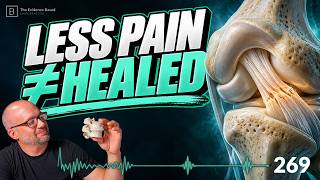
Dr. Jeff Langmaid reviews a 2013 Open Rehabilitation Journal review on ligament injury and healing, explaining ligament anatomy, composition (mostly water and collagen), and the clinical importance of ligaments for joint stability and proprioception. He outlines injury causes (intrinsic vs extrinsic), explains the three healing phases (acute inflammation 48–72 hrs, repair over weeks, remodeling up to ~1 year), emphasizes that healed ligaments remain structurally different (more type III collagen, disorganized matrix), and strongly recommends controlled motion/rehab while warning that NSAIDs and corticosteroid injections can impair soft-tissue healing and worsen long-term outcomes like osteoarthritis.
Chapters
Foreign hello and welcome to the Evidence Based Chiropractor. I AM your host, Dr. Jeff Langmaid. On today's episode, we are talking all about ligaments. I read this incredible study this week and probably learned more about ligaments than I ever knew before. And hopefully in the next 15 to 20 minutes you're going to learn more about ligaments than you've ever known before. This was a study that came out in 2013 in the Open Rehabilitation Journal and it's titled Ligament Injury and Healing A Review of Current Clinical Diagnostics and Therapeutics. This is one for the ages. I'm going to link it down in the show notes. You can check it out there, but let's pick it up with what is a ligament. Ligament is a dense band of fibrous connective tissue and it connects two or more bones in our musculoskeletal system. Bone. They may appear as long sheets of opaque tissue or short thickened strips in joint capsules. And they can vary in size and shape and orientation and location depending upon whether it's in the spine, depending upon whether it's in the shoulder, the knee, the hip, the ankle. Ligaments cross joints that have both wide ranges of motion and joints that have small ranges of motion and function primarily to provide stabilization of joints when at rest and during normal range of motion. So that's what a ligament is. Now, this is a little bit surprising to me is ligament injuries are some of the most common causes of musculoskeletal joint pain and disability encountered in primary practice today. That's interesting. I don't think it's the first thing that we would think of, but I guess when you think about sprain strain and the commonality of that and quote, unquote, mechanical back pain, things like that, it makes sense. Ligament injuries can cause disruptions to the balance between joint mobility and joint stability. And that sort of imbalance can lead to abnormal transmission of forces throughout the joint and can result in damage to other structures in and around the joint. So this is a foundational piece of the joint. I think about disc, I think about muscle. Yeah, I know ligaments in there, but I don't actually normally, day in and day out, think about it as something that really does provide the balance of mobility and stability and that ultimately if there's ligament disruption, everything else is going to fall apart. And that's so important to keep in mind as we dive into some of the stats and some of the healing properties amongst ligaments, because it's just so clinically relevant. So ligament injuries they can be classified basically as two categories, either intrinsic or extrinsic. And they can occur basically due to improper motion within the joint or by external factors. Those are the difference. So in athletic settings, ligament injury injuries are caused by collision between people. You know, car accidents. We see this all the time. AOMZ Diagnostics, a spinal imaging company that I own, we see that all the time in the cervical spine, post whiplash, partial ligament tearing in the cervical spine and excessive translation. But the bottom line is these things can happen either intrinsically or extrinsically. Extrinsically means that there's a force driven into the joint, there's a trauma, there's some sort of acute phenomenon that ultimately has caused that damage. Intrinsic. This is more biomechanical, it's more repetitive. Stress and ligaments can be injured in either way. Now here's one of the shocking pieces from this study that I found incredibly impactful and I didn't know, I guess it makes sense, but I just hadn't really thought about it. Osteoarthritis remains the long term consequence of ligament injury and continues to be the most common joint disorder in the world. So as far as this paper is concerned, there's absolutely no question. Ligament injury that remains unhealed, that's suboptimally healed is a direct factor in osteoarthritis. Long term. That is important. That's important as we go through understanding people that have oa, you know, has there been previous damage, what is that damage, when did it occur, how long has it been going on? But also on the other end of the spectrum, individuals who come in with acute injuries, maybe personal injury, again, the first thing that comes to mind for me, but could be sports, et cetera. Very important to keep in mind proper healing. We're going to talk about three phases of healing as we go through, but proper healing can make a world of difference in terms of whether somebody 5 years, 10 years, 20 years down the road, whether they end up with osteoarthritis in a joint or not. And that is impactful, it's powerful and it's very important for all of us to keep in mind as providers. So what's a ligament composed of? How does all this play out? Well, ligaments are composed primarily of water, collagen and amino acids. 75% of the dry weight of a ligament is collagen. The remaining 25%, proteoglycans, elastin, glycoproteins and other proteins. So majority is collagen. I think most of us know that. But where do they get their strength from? Well, fibroblasts are located between the rows of the collagen fibers. Fibroblasts between those fibers, they produce and maintain that extracellular matrix. Now proteoglycans, they reside in the extracellular matrix and they store water and contribute to the viscoelastic properties of the ligament. So a lot of cellular things going on here, but bottom line is ligament is meant to provide the balance between mobility and stability. Bottom line is that ligaments are comprised mostly of water and of collagen. And it's the matrix of that collagen that does the work, if you want to think of it that way, that provides us the ability to move, that provides us the ability to have the, the stability supported by ligaments. So when ligaments are stretched or elongated past a certain point for a long period of time, they can lose their ability to regain their original shape. And when this occurs, the ligament can become lax, you lose stability, it's unable to support the joint and it can lead to pain and eventually OA of the joint. So again, this is chronic by nature when we're defining that right, prolonged period of time. But when a ligament is stretched or elongated, it can create damage and ultimately it's not going to get back. There's those elastic properties, but there's a point of no return. And when you get past that point of no return, the structural stability of the ligament deteriorates, the opportunity for the joint to deteriorate. Remember we talked about the ligament being foundational. The ligament stability and mobility goes away or is impacted, the homeostasis of that ligament is no longer there, the integrity of it, and you end up with further joint damage. You also end up with a long term prospect of oa. So while ligaments are predominantly known really to stabilize the joints, they also have an equally important role as sensory organs. And in the ligamento musculoskeletal reflexes, as sensory organs, ligaments are able to protect the joint and prevent injury when the ligament and joint are under stress. So sensory component, of course, our body's always actively communicating brain to body, where are we in space, what's going on, and millions of functions every second that we don't have to think of, luckily. And ligaments are an important component of that. So when we think about a joint, we think about the joint's ability to function in space. And when we consider how a joint's functionality, I mean, at peak performance we're talking about athletics, but even activities of daily living, we're Standing up, we're sitting down, we're doing things at a computer, maybe we're at an assembly, delivering boxes, whatever it might be that those individuals in your practice do day in and day out. The sensory component of the ligaments, not only a stability and mobility issue, but it's also a sensory component giving constant feedback to that person's brain as far as where they're at in space, what's going on with the ligament, and really gives the ability to function at the highest level possible. And if a ligament is not doing its job, if a ligament is sub optimal, we end up with those cascaded consequences. So when a ligament gets injured, the question is, then, okay, ligament gets injured, it happens. Could be extrinsic or intrinsic. What happens and how can we expect the healing process to take place? It actually takes place in three distinct phases that happen over time. An acute inflammatory phase, a regenerative or repair phase, and then a tissue remodeling phase. So the acute inflammatory phase begins within minutes after that initial injury. As you can imagine, it kind of cruises along for the next 48 to 72 hours. Blood collects at the injury site. We see that swelling, platelet cells interact, and matrix components are interacting with those blood cells. You're changing their shape, initiating clot formation, basically getting everything under control. That's that inflammatory phase. Not too much different than would happen almost anywhere in the body. But that happens just over the first two to three days. Now, as we get beyond that third day now we start to get into that repair phase. And that starts when immune cells release growth factors and cytokines in the area. This starts the fibroblast proliferation and signals for rebuilding of that matrix. So the tissue that forms initially appears to be disorganized scar tissue. It consists of more blood vessels and fat cells and fibroblasts and inflammatory cells than a normal ligament would. So the body's just trying to get its, you know, what together at that point, right? Inflammation, you know, inflammatory phase is done. Okay? Body's saying I'm out of acute injury, now I'm in repair phase. But when the repair phase starts, it's messy, right? With a ligament, the matrix is messed up, there's scar tissue, it's disorganized. The integrity of that ligament is not there. And that can continue for several weeks at a bare minimum, as we get into the remodeling phase. And the remodeling phase is exactly what it sounds like. The tissue matrix starts to resemble normal ligaments as best as it can you, even though there's still some pretty critical differences. This can take months or up to a year. So I want everybody to keep this in mind when we think about this. From a clinical sense, we have inflammatory phases over the first, you know, 48 to 72 hours. Then we dive in and we're seeing that repair phase over the course of weeks. That's weeks, not week. And we have the remodeling phase taking place over the course of up to that first year, year. So keep this in mind. Again, I think to the docs, maybe you listening to this show, docs that are on the quote, unquote, more evidence based side of things, they're treating and releasing in two to three visits sometimes. And that person probably may not just barely be beginning the repair phase. So helping guide them through proper movement, helping establish proper biomechanics, they are not healed. They might be feeling better after the inflammatory phase calms down. And after you've done things to reduce inflammation in your practice. But to make no mistake about it, that tissue is far from perfect. That tissue is barely beginning to reorganize. And I'm gonna say it's at a heightened place. In my opinion, it's at a heightened place for continued injury. So keep that in mind and setting expectations for patients as well. When you suffer a ligament injury, you're probably gonna feel well within a week or so, especially after that initial injury. Things calm down, you'll be moving a little bit better. But you can expect it's gonna take a few weeks for really your body to repair on the inside. And that repair process is a little bit messy now. You don't need to worry about that. That's what your healing system, your immune system, that's what your nervous system, that's what it's designed to do. But things don't get back to quote, unquote normal for up to a year. Having people understand that sets expectations. So normal ligaments we expect to see that's collagen's aligned, it's densely packed. We see mature cross links, we see primarily type 1 collagen. These are things that we see rare cell division, low cell density and a high matrix to cell ratio. That's all in normal ligaments. But as ligaments heal, there's scar tissue, the collagen's disorganized, there's flaws between the fibers, there's smaller fibrils of collagen, there's immature cross links, there's a higher cell density, there's a lower matrix to cell ratio. These things are very, very important. As somebody's going through that healing process. And if you're a doc who's doing active rehab, active care in your practice, keep this stuff in mind. That tissue, even six weeks out, there's probably a matrix there, but it's pretty messy. So take it slow, don't overdo it, consistently get feedback, monitor the movement, assess movement, understand biomechanics. These are the things that are going to help you help that patient long term. So where normal ligament tissue is primarily composed of type 1 collagen, which is the protein responsible for the stiffness and strength of the tissue, that's not the case when something's remodeling, we see a lot of type 3 collagen, which is not the same as type 1. So ultimately, you know, ligaments are never going to be the same after they're injured. But the most important point, and we're going to talk about in a moment, is how about that healing and how do you heal in the best manner possible, understanding that it's never going to be as if it was untouched. And that's an important component as well. Patients who are treated with ligament injuries with motion, motion's the key. They return to work quicker, they resume sports quicker, and ultimately have better long term outcomes. Motion is key. Now, that's wonderful news for us as chiropractors, but I wanna be really careful when you're collaborating with other medical doctors, et cetera. There is a very big push many times early on for NSAIDs and corticosteroids, and they are not the right thing to do. Let's just be very clear about that. NSAIDs have been a mainstay treatment in ligament injuries for a long, long time. But not only are they only mildly effective at relieving symptoms, and there are potentially, they're detrimental to soft tissue healing. NSAIDs are detrimental to soft tissue healing. There's no way around it. Cortisone injections, same thing. They inhibit histological, biochemical and biomechanical properties of ligament healing. Corticosteroid injections in the ligaments and tendons have been known to inhibit fibroblast function and collagen synthesis, even to the extent of causing collagen necrosis at the injection site. So be warned, be careful, communicate with your other healthcare providers, but know and understand how ligaments heal, the time that it takes for them to heal, and that controlled motion and activity is by far the best way to go about it. When you start introducing NSAIDs, when you start introducing cortisone injections, these are things that inhibit healing. They might feel good for the moment, but they're gonna inhibit healing long term. So get out there, do your movement assessments, set proper expectations for those patients coming in with ligament injuries, and let me know how you like this episode. Shoot me an email jeffevidencebasedchiropractor.com if you have not left a review for this podcast on itunes, I'm gonna ask you to please do so. If you're listening on your iPhone, you can swipe or scroll on down and tap how many stars you'd love to give us right there and then it is easy to do. It helps more and more docs. Find out about this podcast and as we come to a close. If you're looking to get factory direct pricing for your braces, tens units and more, check out shield@supersecretsales.com ebc that link is down below. Supersecretsales.com ebc Their founder Dr. Stephen Br, he was on here a month or two ago and he is offering you complimentary tens estim unit. He'll give you a tens and e stem unit for free plus free shipping along with your first order. Fast shipping, factory direct pricing and a great selection of products available right now@supersecretsales.com EBC be sure to check out SHIELD and everything that Dr. Steven Brown has going on. Thank you for tuning in. Make it a fantastic week in practice and I will talk to you soon.
Thank you for joining us on this episode. The Evidence Based Chiropractor if you want to grow your practice, come back for next week's episode. If you want to grow faster, visit theevidencebasedchiropractor.com and join our MD Marketing membership today.










