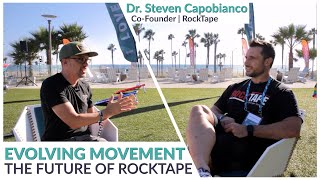
Interview (Rock Stock 2019) between Jeff Langmaid and Dr. Steve Capobianco about RockTape's move to integrate digital movement-assessment technology with their FMT education. Key points: Rock Tape is partnering with Posture Screen to build an FMT Connect app that digitizes movement and produces objective reports, links assessments to corrective strategies via WebExercises (a library of >3,000 exercises, with hundreds of Rock Tape exercises uploaded), and will be tied into a new FMT Movement Specialist two-day course. The Movement Specialist reframes movement assessment by combining biomechanical screening with psychosocial evaluation (fear/anxiety of movement). Expected launch timeframe cited as late 2019 → full launch in 2020; upcoming courses listed on rocktape.com.
Questions this video answers
Posture Screen
FMT Connect
FMT Movement Specialist, two-day course
More than 3,000 exercises
Hundreds (unnamed exact count)
Chapters
The majority of med pros and fit pros are trained with a biomechanical lens. We're not taking into account the person attached to the mechanics that might be fearful of a movement. So we're really taking the psychosocial approach, identifying methods of assessing someone's fear of moving and then applying that into the intervention. So we put someone in a safe environment to be able to accomplish it.
Hey, everybody, what's going on? Jeff Langmaid with the evidence based chiropractor and I am fortunate to be here with Dr. Steve Capo Bianco, the education director over at Rock Tape and we are at Rock Stock 2019 and they have some exciting things coming up in the technology space. So I wrangled your arm, talk a little bit, maybe reveal a little bit as far as what you guys are up to at the end of this year. Certainly coming into 2020 from education where it meets technology and some of the exciting things you have on the calendar.
Yeah, well, I'm excited because we've been working on this project for, gosh, quite some time. I don't even want to reveal how much time. But technology for us is new. We've obviously had education for the last eight to 10 years. What we've done following in alignment with our movement pyramid, which is foundation by a screening process and an assessment process, we formally didn't have a system of approach that we taught. So now what we're going to be doing is partnering with a company called Posture Screen and we're creating our own FMT Connect app. And the app is going to allow us to utilize some of the software technology that posturescreen offers to be able to digitize movement and provide more of an objective assessment of how someone's moving their body. So we're going to be lacing the FMT Connect app into our newest addition to our FMT education, which is titled the Movement Specialist.
Okay.
And in this course, it's a two day course and we are going to be introducing our method of approach of visual screening and utilizing the digital app to assess human movement from conscious movement like a squat to subconscious movement like gait.
Okay.
So I'm really looking forward to the addition of the FMT Connect app to really objectify human movement, to be able to provide some really slick reports on how someone may or may not be moving, and to be able to link a corrective exercise strategy where they use webexercises.com to be able to push or prescribe the corrective exercises via email to the patient or client.
That's awesome. And that was gonna be one of my questions, and it sounds like you have it covered. Is it's not only about assessing the patient, but it actually ties into potential rehab or care on the backside.
Yeah, it's such a slick program. I've been using digital analysis for years. There's multiple platforms are available. One of the reasons we chose this platform is because of the seamless integration of the assessment to the corrective strategies. Within that library of web exercises, there's got to be more than 3,000 exercises. And we've uploaded hundreds of our rock tape corrective exercise library, including tape. So then the practitioner or the trainer could quickly identify which exercises or correctives are necessary, click on them, and easily email them to the patient or client in an encrypted way. So it's in alignment with our healthcare acts.
Nice. And with that, I guess I'll peel it back to the highest level. What's a movement specialist mean to you?
Gosh, it's the culmination of what I really envision. Our FMT education providing is capturing the audience and the community that we've built over the last 10 years, our people that are cultivating this environment where we want to get people to move more authentically. And so the movement specialist allows us to take all the concepts and theories that we put together over the last decade and apply them for not only the clinical practitioner, but also the fit pro or strength and conditioning coach to be able to better identify faults in human movement and to be to provide actionable corrective strategies to get people to move in a more diverse fashion.
Right. When you think about people going through normal, everyday movements, whether it's sport, whether it's activities of daily living, do you find that more challenges come because of mental or more challenges come biomechanically?
Yeah, it's one of the discussions we had earlier this morning where we had the conversation about the biopsychosocial approach to human movement. And I'd say in a general rule, as a general rule, the majority of med pros and fit pros are trained with a biomechanical lens of looking at someone moving and utilizing more of a linear mathematical model to identify is the person moving well or not. But we're really not taking into account, at least in my opinion, we. We're not taking into account the person attached to the mechanics that might be fearful of a movement that might have some anxiety of performing the movement due to a potential for future injury. So we're really taking the psychosocial approach, identifying methods of assessing Someone's fear of moving and then applying that into the intervention. So we put someone in a safe environment to be able to accomplish it.
I love that. And I guess diving into, let's say I go through, I become FMT certified as a movement specialist, what are the benefits? What can I expect to learn? What are some of the benefits I can hope to have with my patients by understanding more?
Yeah, I think what it provides is a reframed way of looking at human movement where we don't necessarily believe that there's one size fits all to human movement. So in saying that it. It's good to say that, but then we have to be able to provide some clarity of what that really means and how we could use that information to apply it to the individual. What we're doing is we're creating some standards that have an acceptable variance to it, that allows for individuality in how you move your body, but making sure that we don't spill over one way or the other. So what the movement specialist would get in this course is looking at the psychosocial components of movement and then the biomechanical components is going to allow for some variance, but to be able to be very clear on when someone would be at risk or not.
Gotcha. Gotcha. Awesome. And when can docs expect to see the courses coming in their town? And when can we hope to see the app in action?
Yeah, so we're at rock stock 2019 and so I'm suspecting that the course will have full launch in 2020. You would be able to find upcoming courses on rocktape.com, look for the FMT Movement Specialist badge. And as we launch the FMT Movement Specialist, I would assume that the same timeline would be for the FMT Connect app. Late 2019 and early 2020 for sure.
I'd encourage everybody keep an eye out for the app. We've seen sort of Rock Stock. You always see a sneak preview of what's to kind of come for the following year if you didn't make it out or you haven't made it out to Rock Stock yet. It's an event. I say it time and time again. You want to put on your calendar because it's a lot of fun. The education is absolutely top notch and it's really nice to see where the professions as a whole are going. What are some of the thoughts and where may things go in the future. So if you haven't had the opportunity, it's always a great time. Again, the education's always awesome. And I always have a good time connecting with people that are of, like, mindset and sometimes even challenged. And that's awesome because that's how you grow.
So.
So be sure to check it out. So for Steve and everybody at Rock Tape, I'm Jeff Langmaid and we'll see you soon.
Thanks, bud.
Hey, what's going on? If you loved that video, be sure to subscribe to this channel. The evidence based chiropractor puts out videos all the time at the intersection of marketing and research, showing you how to grow your practice while also growing your knowledge base. So if you liked it, be sure to comment down below or hit subscribe and I'll see you in the next video.