Exploring Outpatient Surgery & MD/DC Collaboration with Dr. Flip Clifford
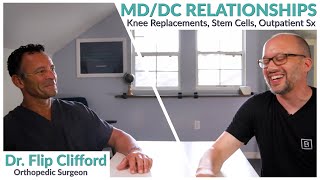
Orthopedic surgeon Dr. Flip Clifford discusses same-day hip and knee replacements, which show lower infection rates, fewer readmissions, and higher patient satisfaction than traditional surgery. He covers who qualifies, his outpatient protocol, and why insurers are pushing toward this model.
Chapters
Same day outpatient surgery actually showed lower complication rate, lower readmission rate, and higher patient satisfaction in the outpatients.
Hey everybody, what's going on? Dr. Jeff Langman with the evidence based chiropractor. And we have a special guest and we're gonna talk md, DC relationships, we're gonna talk outpatient surgery and a bunch of other fun stuff. So as you watch, leave those comments down below, but I am happy to introduce Dr. Flip Clifford. And thanks for taking some time today.
Appreciate you having me.
You got it. You primarily focus on outpatient surgery. And for any of the docs listening out there, I guess where we start right there. What are some of the benefits of outpatient hip and knee replacement surgery?
Well, what's interesting is so many people don't know that it's out there. Both docs and patients benefits are. Well, first off, I always prefer sleeping in my own bed. So coming in, having a surgery, avoiding the hospital stay, which actually in many situations can actually markedly decrease your risk of infection. Because everybody knows first place to get sick. You want to get sick, go to a hospital. Addition to that, many of the providers, excuse me, payers, actually can have bundle payments where it's actually cheaper for a patient to have a surgery done in an ambulatory surgery center. And a lot of times the attention that they get in an ambulatory surgery center is so much more personal and so much more time intensive. You get up, you move, you get dressed, you go home. It's pretty awesome.
That's a huge benefit. And I guess when we take it even one step back from that and say, how is outpatient surgery defined? Like, what does outpatient surgery mean?
Great question. And actually if you look across the Internet, it's actually defined differently by different people and, and differently by different payers. Some of the payers define it as a 23 hour or less stay in a facility, whether it's an ASC or a hospital. Docs, for me, outpatient means you come in, you have it done, and you're home before the sun goes down. Okay. Same day. So truly a same day surgery. And you'll start to see those terms in the literature as well. Same day, which is more outpatient. Many of the of the payers consider Anything less than 23 hours to be outpatient.
Gotcha. Gotcha. Cool. And if we pull the veil back really far and say, how did you get interested in being a physician and specifically then becoming a surgeon?
Oh, wow. Nine years old, skiing, broke my fibula was run into by another skier.
Okay, you Ever find him or her?
Yeah, we did. And actually the orthopedic surgeon who took care of me, like, took the 10 minutes to sit with me and explain to me, like, what happened, how my body was going to heal. And I was just immediately fascinated by bones and how they heal. And so I literally, from nine, spent that entire time thinking, oh, my gosh, this is what I want to do. Surgeon wise, is like fixing stuff.
Okay.
Literally just taking someone who's incapacitated, debilitated, can't get out, can't walk, can't enjoy life, and then giving them that freedom of life back. You get these little ladies who give you a hug at six weeks because they're back with their friends and doing what they want to do. It's pretty awesome.
And when you started to get into that and you said, okay, now I'm gonna go towards hips and knees, how'd that come about?
It's sort of the ultimate fix, honestly. And then secondarily, every case is so specifically different. Like, everybody sort of thinks that what we do is repetitive and over and over the same thing. And the reality is that each case has a nuance or a change, something that's different, that if you're awake and you're paying attention, you catch and you can make that case come out better.
Love it. And you and I were talking. This is a little bit off script. We were talking before we came on pre roll, a little bit about medical tourism and how, you know, really with the outpatient model, it enables you to see people beyond just 10 to 15 miles around your practice. So you're going to be located here in Tampa, Florida, close by to me, which is why you're here today. But talk about the impact that that has maybe on some of the docs and some of the chiros listening around the country and patients that they might have that you know, are scared of inpatient surgery, that are exploring outpatient options and maybe even how your clinic might fit in with that.
Absolutely. Many of the regions across the country haven't even begun to work on moving towards the outpatient realm. We've been working on this for five years, really literally started it five years ago, and have refined a protocol that's very unique that just works so well that it really facilitates people coming in, getting things done, a hip or a knee, and truly going home that afternoon. The area here is a fantastic one to visit, so it's very easy for people from up north, even some of the Canadians. Wintertime, come down, have your joint done, stay at the local Hotel with a nice reduced medical rate, get transportation arranged, stay for a week and fly on home.
What are some of the people that outpatient surgery. Just some of the clear markers where outpatient surgery is not right for them.
Absolutely. Great question. Advanced medical disease problems or medical problems that are teetering on being poorly controlled atrial fibrillation patients, we typically tend to do those in the hospital so they can be observed on a monitor overnight. Patients with significant sleep apnea who honestly will come in and say, you know, doc, I don't use that machine. It drives me nuts. Or it keeps my. Keeps my wife up. Those folks should be done in a hospital because they're not going to use their machine. Their narcotic use, which is minimized with our protocol, still puts them at risk for problems. And then patients with any other major, other advanced problems, such as advanced kidney disease, where they might go into a more significant level of renal failure, they should probably watch overnight or for a day or two in the hospital.
And with that, like, I think about it from a chiropractic perspective and just saw so many patients that, you know, hips and knees just. They just underwent degenerative changes throughout time, old injuries, you know, longer lifespan, all of that fun stuff. And people were just, you know, quite scared to go into a hospital setting quite often, especially if they were relatively healthy, let's say. And then, you know, the recovery time sort of inhibited there. You want to get up and moving safely and, you know, but you want to do that as quickly as possible.
Correct.
And you don't want to be belabored with that. And I think that that's, to me, anyway, coming from the conservative care perspective, it's really the advantage of outpatient speaks volumes to me because as a provider that says to me, my patients can stay moving longer and they can get moving quicker. And I think that that's a big deal. And I'd be curious to know from your perspective, what's been your experience with chiropractors and chiropractic? Have they been big referral sources for you or from you and kind of, what's your take on the profession at large?
I've always had great respect for chiropractors in general. I've had the blessing and fortunate experience to work in a town previously in North Carolina where there were two or three that really were wonderful. They would take the time to do a very good physical exam on their patients. Somebody sent to them with a back problem or who comes in with a back problem. And the reality is they do a Decent physical examination, which doesn't really take too much just to move the hips around. The next thing you know, they clearly can elicit pain. They'll shoot a quick picture and then see the. See the bad hip and then refer them. And then in my practice, I encourage that patient to utilize that connection with that provider. Go back to their chiropractor after pt, because the reality is during their initial recovery period, yeah, the physical therapist is working on them, but we all know that during that recovery period, stuff gets thrown out of whack. Their leg maybe was 6 or 7 millimeters too short. You bring them back where they belong, and then all of a sudden they get a little abduction deformity, or they get a functional leg length discrepancy that throws their spine a little bit out of whack. So the chiropractor can help them get through that.
Going down that road a little bit farther and saying, if a doc was, you know, from a surgeon's perspective, you know, what. What's the best way that a chiropractor can build a relationship? Is it, know, swinging by? Is it trying to do a day like, what's your busy guy? And most herchins are. I mean, I guess, what are. What are some thoughts of something that would stand out for a doc as they were trying to build a relationship with you?
That's a tough question, but yeah, you know, exchange of information. You know, I always say every day is a school day. I have a lot that I can learn from chiropractors, so I'd be happy to give. Give a talk if that would help. And we plan on doing that a fair amount around here, so we can actually maybe educate folks about what's available. Because again, so many people, patients are shocked when they realize you can have this done and go home the same day. Yep.
Kind of going back on the clinical side of things. You know, again, as a chiropractor, I see so much as far as. Is it stem cell prp? Obviously, you know, surgeries in the mix. Regenerative medicine is. Is blowing up in terms of popularity. But I see it also that there's so much confusion. It seems like the wild West. And this probably won't be clarified in our conversation today, but when we look at surgery, let's say PRP and stem cell, give me a quick breakdown on kind of the differences or patient archetypes for each.
Absolutely. You have your surgical candidates that are over here. They're the ones who are so worn out that the joint is stiff, they cannot really move it adequately. So it's not as if they've maintained a range of motion yet have advanced arthritis. That's a different category. Those functional problems that those patients have is so severe, it's rare that anything's going to help them except surgery because the joint's so worn out and they're stiff. Then you have a group that's right behind them who's maintained some mobility and enough mobility to be functional, yet they have pain and they have moderate to significant arthritis. And that's your group where if they're not quite committed yet, then that group, as well as the prior group, which is the group that's more mild to moderate arthritis, those two groups can at least sit and talk about PRP and stem cells. Both of those remain out of pocket because a lot of the data really doesn't support their use yet. There's anecdotal support from a lot of patients that in the early group, especially the mild arthritic group, where, you know, it only hurts when they run six miles, but if they run three miles, they're okay. So the old answer was, well, just run three miles and maybe bike, you know, cross train, where some of them really are committed to running. So they take a shot at stem cells.
Yep. Yep. What's the biggest misnomer in the regenerative medicine space?
I think the biggest thing is that, you know, as we've discussed before, there, there are sort of some physicians who stand on a line and then they jump on one side or another. And so it's either you have these folks that are preaching just regenerative medicine, surgery's terrible, surgery's bad, surgery's bad. And then you have the surgeons who are saying, no, you gotta have surgery, you gotta have surgery and stem cell doesn't work. And I'm standing on the fence. And I think you have to sit with a patient and talk to them about what the options are, what the likelihood is that it's gonna help, and what each of those treatments is likely to do for them based on what their specific situation is.
That's good way to put it. And you mentioned about the stem cell and prp, a lot of the regenerative medicine still out of pocket, whereas some of the surgical solutions are covered for outpatient surgery. Are most insurances covering outpatient procedures for patients?
They are, they are. And more and more, the payers are starting to realize how much money they can save by doing it in that arena. There's a great Blue Cross article that came out that actually looked at comparison between Inpatient and outpatient and outpatient truly was same day outpatient surgery actually showed lower complication rate, lower readmission rate and higher patient satisfaction in the outpatients. That study actually tried to match the groups so that they were very similar groups. So they were trying to eliminate a selection bias associated with the group because obviously some of the hospital group, you might think to yourself, well, maybe they needed to be in the hospital anyway. But in actuality, really that group did better.
I think that's awesome with the outpatient surgeries and with the patients that you're looking at and the patients that you look to help. As a practicing doc, if I kind of looked at my patients, what are some things that I could look for that might indicate this is a good patient for to have a conversation with you.
First off, anybody with a bad joint. But the specific outpatient subgroup, healthy, motivated, supportive family and somebody who wants to get well, who has a very worn out joint.
And let's drill down on that. Is it pain and functional disability or is it more one or the other? Is it the imaging? I mean, combination of both, I imagine. But what are some key indicators within that?
It varies from patient to patient. You know, we see the variety of pain tolerance that exists in the population. You have some people who come in and we get an X ray and we look and we think, why aren't they hurting more than they are? And we're amazed by it, you know, and that's all. What are our bodies? Secrete interleukin 2. If they're a person who doesn't really secrete the interleukin 2, then they're not going to have that pain response. So then it's a functional situation because they sit and they wait and they've heard before, wait as long as you can, wait as long as you can. And the mistake there is that they become stiffer and tighter. And so their functional recovery afterwards, they have a stiffer joint in the end because they maybe wait too long. Then there's the subgroup that's the other direction, which is even more scary, which is the people who hurt a lot and you look at their phones and you're thinking it doesn't really look so bad. So that's a great person to go down the regenerative path and see if maybe that helps.
Yeah, that's great. With performing everything outpatient from the business side of things. Does that become challenging for you at the hospital systems? I guess just a little bit of insight from a chiropractic perspective, who we don't have to deal with this, whether that's a good thing or a bad thing. But as you do outpatient procedures and obviously these hospital systems are growing, they're eating up practices, does that provide a lot of opportunity for you because of the specialization or does that become a challenge from a business sense or a little bit of both?
Both. Definitely. The hospital affiliations which, which were actually again new down here, we're affiliating with several of the different, different, different arms or different, different hospital, you know, parent companies. The idea being to get, get the, get the idea out there. I'm also looking for the best hospital to take my patients to because you look at the population and the best case scenario is that in the Medicare population at least 30% of those patients will still need to be done in the hospital. So the mistake I think is even though I'm an outpatient surgeon and I think that the vast majority of people can be done outpatient, there are some people who are going to be safer in the hospital arena. And I think that, that when, that when you narrow your focus down and you don't take care of the sick patients, you start to look like somebody who's trying to skim off the top and only do healthy patients. So I plan to still do revisions, I plan to still take care of those patients that are sick and I'll do them in a hospital. And the idea will be to still use the same protocol that we use for outpatient surgery, which is rapid mobilization, get them up. And so if their surgery is first thing in the morning, they're going to get a shot, short acting anesthetic, they will be up and moving, you know, at lunch, before lunch, after lunch, depending upon, you know, whatever. However quickly I can get the therapist there, they will get up and move because that's the way you avoid blood clot, that's the way you avoid other complications, pneumonia, urinary tract infection, all of that. So even this, so this, and this is where this outpatient protocol helps to decrease complications with everybody, including the hospital setting, because your moving them and you're getting them going.
Last question, Favorite procedure, whether due to technical aspects of it or patient outcomes. What is it?
Oh, it's easy. Total knee.
Total knee. Why?
Getting back to what I said earlier, everything's different and because it's a constant attention to detail and it's a puzzle for each, each case. And again, everybody thinks that they're just cut and dry and you follow the protocol and you do the same thing every time. But that's a statement that implies you don't understand the surgery and you don't understand anatomy. So everybody's so different. And that nuance is so much more apparent with a total knee. And that's the mental challenge to make that knee perfect.
I love it. That's been a lot about outpatient surgery. If you have any questions for Flip, leave them down below. I'll also drop a link. If you have questions about his clinic or if you have any patients that you think might be, you know, applicable to have a conversation or review, I'll be sure to leave all of his information in the comments down below. Feel free to reach out and I'm going to twist his arm after we get off this. After this, Facebook Live to make sure we can get into his clinic. Once that's up and running in just a of weeks, couple, couple short weeks, we can kind of take you behind the scenes, show how they do things day in and day out, answer more questions and learn together. Thanks.
Thanks, man.
You got it. You got it. Bye. Bye, guys.










