How Inflammation Affects Disc Resorption & Chiropractic’s Role | Podcast Ep. 215
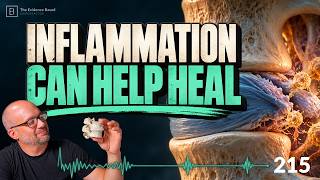
Host Dr. Jeff Langmaid reviews the 2018 Arthritis Research & Therapy paper “The Inflammatory Response in the Regression of Lumbar Disc Herniation.” Key points: lumbar disc herniation affects ~10% of people, up to 40% of herniations are asymptomatic, and larger/sequestered herniations paradoxically have higher rates of spontaneous regression. The proposed mechanism: extrusion of immunoprivileged nucleus pulposus into the epidural space triggers immune cell (macrophage) infiltration, angiogenesis, matrix remodeling and enzymatic phagocytosis leading to resorption. Clinical implications emphasized: exhaust non-surgical options (including chiropractic) before surgery in absence of red flags; inflammation in this context is a prognostic sign and should be modulated rather than indiscriminately suppressed.
Questions this video answers
About 10%.
Up to 40%.
Arthritis Research & Therapy, 2018.
April 29, 2020.
Chapters
Foreign. Hello and welcome to the Evidence Based Chiropractor. I AM your host, Dr. Jeff Langmaid. This week we have an awesome research study we are going to review. It is titled the Inflammatory Response in the Regression of Lumbar Disc Herniation. This is as clinically relevant to your practice as it gets. This paper came out in Arthritis Research and therapy in 2018, and it is one of the most fascinating studies I have read in a while. We're gonna break it down and make it actionable on this week's episode. So this paper is super, super interesting. There is a lot of meat, a lot of science to dive into. So let's get right into it. We know lumbar disc herniation affects about 10% of people around the world. So about 10% of people out there will have a lumbar disc herniation. So now here's the good news. Herniated discs are found in up to 40% of people that are asymptomatic. So as we well know and has been well documented online, with a lot of people yelling back and forth on imaging. You know, imaging doesn't always mean that is the cause of the issue. It shows everything that is structurally not perfect. But it's our determination as the clinicians to determine what's the problem. And that's the way I historically went through imaging with patients as well. I said, hey, your picture's gonna show you everything that's not perfect. My job is to find which of those not perfects is actually your problem. So those are just some of the stats regarding lumbar discs and how many are out there and how many are asymptomatic. Now, what's also interesting is that although it's super controversial for a number of years, it's now widely recognized that large size and sequestered lumbar disc herniations tend to regress more than other subtypes. So again, it's almost, you'd almost think it's contraindicative, right, that the larger the disc, or even a sequestered disc seems to have the greatest opportunity to regress. And when I mean regress, I mean it kind of takes care of itself over time, it heals up, so to speak, and it becomes less prominent on the imaging. So the larger the herniation. Ironically, there's often many times when you see primary care physicians get imaging, they're like, oh, it's a huge herniation. You have to go to have surgery. It's too much to overcome in the conservative space. Well, actually the research shows the complete opposite. Large scale disc herniations and or sequestered discs have a much higher likelihood of regression than just a simple disc bulge or anything that is of a smaller hernia herniation. So that's really, really interesting. Now, the most extensively studied with preclinical and clinical evidence to support it on how this occurs is that the gradual hernia resorption happens through enzymatic degradation and phagocytosis induced by the inflammatory reaction in neovascularization. Wow, that's complex. But the gist of it is the inflammatory process that's causing the pain is actually also part of the healing process. So this inflammatory reaction is supposed to be triggered when the disc content extrudes into the epidural space and is then recognized as foreign. So this gets back to what they refer to as the privileged immunity of the intervertebral disc, meaning the inside of that disc, the nucleus pulposus, is sort of wrapped in that annulus fibrosis. It's what's considered in the body an immuno privileged site, which is very, very interesting. And I did not know this. The intervertebral disc is the largest avascular organ in the human body, and it's considered, again, to be an immunoprivileged site. So the immunoprivileged environment of the nucleus pulposus is really the pillar of the theory of the inflammatory reaction behind resorption. So the theory proposes that the extrusion of the nucleus pulposis tissue into that epidural space. Right. So it breaks through, it gets into the epidural space, that evokes an autoimmune reaction that leads to the infiltration of immune cells, which, which interact with the intervertebral disc cells and secrete a variety of molecules initiating the resorption process. The key player there seems to be a macrophage. So this starts to get pretty complex, but also super, super interesting. So I'm gonna recap where we're at so far. We know about 10% of individuals will have a lumbar disc herniation. We also know up to 40% of those individuals will be asymptomatic. But that still leaves a percentage that will become symptomatic. Right. So what we've seen over time and what the research is showing is that the larger the disc hernia, if it's even sequestered, that increases the likelihood that there'll be an inflammatory response, and it also increases the likelihood that it will resorb over time. And how does this occur? Well, they're proposing that it occurs because the inside of the disc, nucleus pulposus, is an immunoprivileged site. And if that breaks through the annulus, fibrosis gets into the epidural space. It actually stimulates the healing process in a way that doesn't happen in a simple disc bulge. So that's kinda where we're at so far. A lot of science there. And macrophages incidentally, seem to be the key players. Now again, how does this really go about? Well, evidence for the mechanism of lumbar disc resorption is associated with a cascade of inflammation, matrix remodeling and angiogenesis. So it seems to be this crosswalk between angiogenesis and inflammation which really leads to the regression of the disc. So angiogenesis, there's the formation of new blood vessels. Again, historically that disc tissue is avascular. It's the largest avascular structure or organ in the body. But when it breaks through and it gets into the epidural space, that stimulates the formation of small blood vessels or angiogenesis around that fragmented material and thereby stimulates the inflammation process as well. All leading to drumroll, please. The ultimate resorption of that disc. Now, the clinical application of this becomes super, super interesting. That's pretty technical from a patient or from a consumer point of view probably wouldn't get into all of those specifics regarding macrophages and avascularity. But the fact that they can be reassured that, hey, yeah, I see you got a pretty darn big disc herniation on this MRI incidentally, and I know it hurts incidentally, that increases the likelihood that you're in the right place and that with our care you are going to get where you need to go without having surgical intervention. Now that's of course with the absen are red flags, but that's really the truth. And that becomes exceptionally powerful when I think sometimes chiropractors, but definitely primary care physicians get super, you know, it's like a hot potato. They see a big disc and they immediately want to get the person to a surgical consult. They immediately want to get the person to an injection pain management doc. And that might not be actually what is best evidence, informed care. So these researchers found different forms of non surgical treatments should be exhausted before considering surgery in acute stages of lumbar disc herniation unless conservative treatment is contraindicated for reasons such as neurological deficit and intolerable pain despite administration of meds. So again, I want to focus on a Couple different aspects of what they said, different forms of non surgical treatment. This does not mean, oh, you tried an aspirin and you went to three sessions of physical therapy. No different forms. People need to be. We've seen this time and time again. I know we talk about it so much on this podcast, but I want to emphasize it and continue to emphasize it is that chiropractic absolutely has to be in the mix pre surgically in the absence of red flags. It is what we see in the research. It's what gives the individuals the best opportunity for success. And we've even seen those individuals who go through other care and fail, then go through chiropractic care, have a high likelihood of success. And then those that don't succeed in chiropractic actually have a high rate of success in surgery, much higher than if they skip the step of receiving chiropractic care. That is super important. And many people don't want to have surgery. But what happens is they get differing opinions from different people and in many cases it's not based upon the latest evidence and the latest of what we know what happens inside the body. You listening to this podcast, you're going above and beyond. You know more than many primary care physicians in your community. But with that, you know, with that knowledge comes a responsibility that you have to be able to share it. Right? So the researchers also found, quote, it is clear the inflammatory response that occurs associated with lumbar disc herniation is crucial to its spontaneous resorption. Therefore, inflammation in this specific clinical context is a good prognostic indicator and should not be halted. Still, it's exactly the inflammation response that causes a harmful effect on the nerve roots causing pain. The control of the inflammatory reaction in this setting is an important challenge when treating patients with lumbar disc herniation. Combination of knowledge from the biological mechanisms behind lumbar disc resorption and the detailed personalized diagnosis will be the determining determine it to tailor treatment to each individual patient and may ultimately lead to the reduction of costs. A lot to unpack there as well. They're talking about the fact that an inflammatory response can be a good thing. It's a good prognostic indicator that there will be lumbar disc resorption, but also the catch 22 that that's what's causing the patient's pain. And in cases where there's a lot of pain, the patient might be wanting to jump preemptively and maybe some clinicians as well jump preemptively to advanced interventions. But Really, I love this as well because it ties back to what we know happens as far as a mechanism of action with an adjustment or a manipulation. This is about reducing inflammatory response, which we've seen cited time and time again. Right? Mitigating or modulating, you don't necessarily want to take a medication and eliminate all of the inflammation because that can actually halt the healing process is what I'm taking from this. But modulating that through the central nervous system could provide some relief while still giving the body the ability to do the healing necessary to get on the road to relief, if that makes sense. So a lot to unpack. This paper is pretty exciting because I think it touches on probably two hours worth of podcast material, considering what they cite and what they touch on in this paper. But the big take home messages from my respect to you as you communicate with your patients is just because a disc herniation is large doesn't mean it's not going to heal. It actually increases the likelihood that, that it's going to heal up without surgical intervention. That's a big take home message for your patients, but also for the other providers in your community. This is definitely a paper we're gonna put into the evidence based chiropractor for all of our members so they can use it to bridge that gap and use it as, you know, sort of ammunition, so to speak, to get out there to the other people in their community and educate the other healthcare providers because it's just so, so important that they understand. This second aspect of this study that I think is super important is the fact of, you know, with the eye, with the disc itself, with the nucleus pulposis being avascular. It's really when it breaks through in the epidural space that causes the inflammation response. So this is why you might have multiple disc bulges, hang out on a film for a long amount of time, meaning doesn't look like much is happening, but they might not be the problem. Right? It's a not perfect, it might not be the problem. But when there's a big disc hanging out in that upper little space, good indication that the body's taking proactive steps to heal it. The other aspect of this is the different forms of care pre surgically and being emphasizing the fact that chiropractic should be in that mix. And then of course the modulation of the inflammation response, wiping out the inflammation altogether through hardcore medication might not be the best idea regarding lumbar disc herniations. However, modulating the response to that inflammation might through the central nervous system through non pharmacological care is probably a really good idea and guess where that falls to? That falls directly to you and your practice. So with so many people struggling with lumbar disc herniation, the impetus is on all of us to get out there to tell that story, to make sure people understand who we are, what we do and the benefits we can provide. Papers like this continue to support who we are and what we do. So I hope you take it to heart. You get out there and have great conversations with your patients this week. And if you're looking to bridge the gap and get referrals from other healthcare providers and use the literature and the research to do it, to have a system and a process to get you where you want to go in 2020 with your marketing, then visit us at the evidencebasedchiropractor.com, become a member today and hopefully in that case I will be talking to you very soon. Even if you decide not to become a member, keep on listening to the podcast. I appreciate everybody that listens and all of the feedback I receive. If you have any questions, comments, you can always email me. Jeff the evidencebasedchiropractor.com I hope you have a fantastic week in practice and I will to you soon.
Thank you for joining us on this episode of the Evidence Based Chiropractor. If you want to grow your practice, come back for next week's episode. If you want to grow faster, visit theevidencebasedchiropractor.com and join our MD Marketing membership today.










