How Your Sitting Posture Affects Low Back Pain | Podcast Ep. 313
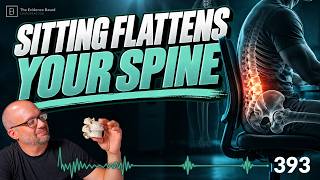
Jeff Langmaid breaks down a 2015 study on how sitting positions change your lumbar spine. Standing gives you 47 degrees of lordosis, but cross-legged sitting flips it to negative 7 degrees. Lumbar support in a chair preserves the curve better than sitting without it.
Questions this video answers
2015, Asian Spine Journal.
30 healthy volunteers.
Shoulder flexion at 30 degrees.
Segmental lordosis at L1–2, L2–3, L3–4, L4–5 and L5–S1 measured using Cobb's method.
Pelvic incidence, sacral slope, and pelvic tilt.
Chapters
Foreign hello and welcome to the Evidence Based Chiropractor. I AM your host, Dr. Jeff Langmaid. On today's episode, we're talking all about posture and how standing versus sitting affects posture. This is a really, really interesting and cool study that came out just a few years ago in the Asian spine journal in 2015. And I think it ties directly to what we do day in and day out in pract and it answers a lot of questions that I personally had regarding what goes on with lumbar lordosis when somebody's sitting versus standing. What are those changes and what are the potential, potential clinical implications. So we're going to cover all of that and more on today's episode. I hope last episode was helpful for you to set those smart goals for 2022. So critically important, I think from exercise perspective, fitness perspective, health perspective, business perspective, you, you name it, super important. But today we're back to the research and this study is titled the Effect of Standing in different Sitting Positions on Lumbar Lordosis. Radiographic study of 30 healthy volunteers. Couple key things there. Number one, we're comparing standing to sitting positions and specifically relative to lumbar lordosis. Second part about it is there's 30 healthy volunteers, these people that do not have active complaints. And why is this important? Well, it's pretty important because we know that spinal pelvic alignment is important for maintaining an energy efficient posture. And even beyond that, it's an important risk factor for low back pain when we're talking about prolonged sitting. So with a lot of people sitting a long time, the question becomes, how do you mitigate those risks? How do you decrease the likelihood that as those days become weeks, become months, become years, you, you're ending up in a troubled situation down the road. And this paper puts out a lot of great information that helps to start to answer that question. So low back pain, we talk about it week in and week out on this podcast. We know that the lifetime incidence rate is 90%. Almost everybody's gonna have about a low back pain at some point in their life. However, what's interesting is that recurrence rates are estimated to be up to 90% as well. So even though low back pain is self limiting and doesn't require you advanced interventions an overwhelming majority of the time, which is a good thing, it comes back often. So, you know, if you have it in the past, which most people are going to, you are probably going to have a reoccurrence in the future. We also know that sitting on a chair is one of the Most common positions for people across the world, US children and adults spend approximately 55% of their day, or equivalent to 7.7 hours in a sedentary posture. So 55% of working hours. Seven, you know, almost eight total hours per day we're spending in these sedentary postures. And that's gonna add up over time. You know, sitting with patients in the orthopedic groups I worked with, a lot of times people would come in, and I think the same thing holds true in chiropractic practices. Like, they have no clue why they're in pain and they're sitting there, you know, overweight, don't exercise, don't necessarily eat right, Their biomechanics are terrible. And they're spending all day, every single day, in that seated position. They're sitting on the to work, they're commuting in 45 minutes, they're sitting there eight or nine hours. They're doing the same thing on the way home, and they're moving to the couch and sitting there the rest of the night. And that is going to take its toll. You could get away with it, and depending upon who you are, you might get away with it for hours, you might get away with it for weeks, you might get away with it for months, or most people get away with it with years. However, as decades march on, that starts to become super challenging. So sitting may contribute to the flattening of the lumbar curve and an increase in intradiscalcal pressure. So now we're getting to those things as far as saying, well, how does this negatively affect. What's the deal? Well, sitting for a long period of time, sitting for any period of time, can flatten that lumbar curve and increase intradiscal pressure. That's going to take its toll. So the purpose of this study was to find an ideal sitting position by measuring the changes of lumbar lordosis and pelvic parameters in various seated positions. So all the participants were healthy volunteers, 30 of them, as we talked earlier. And for each participant, a lateral lumb radiograph was taken, and the five sitting positions with shoulder flexion at 30 degrees were evaluated. So they did shoulder positioning at 30 degrees to get those arms out of the way. And the five sitting positions were as follows. Number one, sitting on a chair with lumbar support accommodating the subject's lower lumbar spine. Number two, sitting on a 90 degree angled chair. Number three, sitting on a chair with anterior support, number four, sitting on a stool, and number five, sitting cross legged on the floor or basically on a, I guess on a chair as well, just to get the image. So those were the five positions and they wanted to see, okay, well, what goes on when we track lumbar lordosis standing versus these five positions. And they measured lumbar segmental lordosis at L 12, 2, 3, 3, 4, 4, 5 and 5:1 using Cobb's method. The pelvic parameters that they took a look at included pelvic incidence, sacral slope and pelvic tilt. So those were the statistical measurements that they used to analyze the changes in lumbar lordosis and those other things as well between standing and sitting. And what they found was the mean angle of lumbar lordosis while standing was 47 degrees. The lumbar lordosis in the five seated positions was 36 on a chair with lumbar support, 17 on a 90 degree angled chair, negative 4.9 on a chair with anterior support and just about 0/2 a degree on a stool and negative 7 when sitting cross legged. So we can see that's a big swing right there. Right? We haven't even got into the findings in terms of their discussion, but man, we're going from standing angle of 47 degrees to with a lumbar support, we drop down to that 36 degree. Okay. Like that's, you know, lumbar support certainly sounds, at least based on that, that it's mitigating that. Wow. Then a 90 degree angle chair, we drop down to below 18 and the rest are either negative or zero in terms of the angle. That is quite a change. So compared with standing, apart from 1, 2, 2, 3 and 34 on a chair with lumbar support, all segmental angles decreased significantly. So there were big, big changes in terms of people standing versus sitting. And can that have an effect on somebody over time? I don't think there's any question about that. And should people potentially be more proactive with how they're supporting themselves when they're sitting? Maybe a standing desk? I think all of those things are super important considerations for us as their healthcare professional, as their chiropractor to at least bring up, especially for those individuals. These are asymptomatic people. If somebody's coming in with pain already, then they have a functional deficit. More than likely. If they have pain, right, pay attention inside and out, they have some sort of problem going on. So if they have a problem going on, they're already compromised. If they're sitting all day long and they're just stacking on top of that pain you're gonna be fighting an uphill battle as you go through your clinical treatment, right. If you're going through and you're helping that person do everything possible within your practice and in that whatever it might be, 10 minute visit or 30 minute visit, you're doing all this wonderful stuff, then the next day they're going out and spending eight to 10 hours doing the same thing that draw them into your practice to begin with. That's going to eventually the rubber is going to meet the road. There's going to be a challenge, it's going to be a conversation that's uncomfortable because the bottom line is you can't control their life. But what you can do is you can get out there and really showcase, hey, here's what's going on as you sit. It's changing everything about the angles of your spine. And I think about it, I used to describe it like this and practice it. You know, the curves of your spine are like Roman architecture. It's curved so that every segment does a little bit of the work. If it were straight and not curved, the guy at the bottom would be super unhappy because everybody else is sitting right on top of him. Most patients understood that, hey, curves add strength, curves add stability, and curves disperse forces. But when something is straight up and down, wow, the bottom is gon get very unhappy because everybody else is loaded right on top of them. Simple explanation, but it's powerful and I think a lot of people understand that. And the same thing holds true as we're talking about these lumbar lordosis angles. When somebody's standing up and they have that nice angle that's telling us that the forces are being hopefully accurately and efficiently distributed. That also is telling us when that flattens out to near 0 or 17%, 5% negative, 7% going kyphotic at times. That's a non efficient position, number one. But number two, it's gonna create challenges. So clinical observations suggest that aberrations of posture might play a role in the development of low back pain. I really don't think it's a May at this point in time or might. I think it does for sure. And abnormal. Why? Well, abnormal posture places strain on all the ligaments and muscles, which indirectly affects the curvature of lumbar spine. These things play together right when the curve is flattened out. Now we're either adding load force or really compromising the integrity of the ligament and muscle. Now again, our bodies are meant to be dynamic. There's nothing wrong with that over a short period of time. But when we're doing that eight hours a day, day after day. It's gonna add up. So when sitting, the knees and hips are flexed, the pelvis rotates backwards in lumbar loaderosis flattens. That's why we see that decrease in angle. At the same time, there's an increased load on the spine as indicated by those measurements of intradiscal pressure. So really no surprises here, but I had never seen it laid out in this fashion. So what were the conclusions? The conclusions were this sitting caused a reduction in lumbar lordosis and sacral slope when compared to standing and healthy volunteers. These changes in lumbar lordosis and pelvispina parameters could cause a pelvispinac imbalance and may result in chronic low back pain. In practice, it is better to select a sitting position that results in minimal changes to lumbar lordosis. In our study, sitting on a chair with back support demonstrated the least amount of change to lumbar lordosis and the sacral slope. So patients sitting for a long period of time, should they get up and move throughout the day? Absolutely. Is it wise to have a standing desk? Absolutely. At the bare minimum, should they have a lumbar support? Absolutely. So as you see these patients that are coming in with low back pain, especially those with recurrent bouts or chronic low back pain, really dig deeper on those ergonomics at work. Ask them about their chair, understand, are they getting up and moving? Ask them how do they feel the lumbar support is in their chair. Do they feel as though that's the case? Do they have fatigue as time goes on? All of these things play a huge role in their ability to have low back pain or their ability to be well. And I think us as chiropractors really need to lead the charge in terms of this discussion. So this is a study I'm probably gonna put in the evidence based chiropractor for our MD marketing research briefs next year. I just love the data, I love the graphs. I love the opportunity to showcase the differences in postural, you know, lordosis between standing and sitting positions and really be able to document and say, man, we are going from 47% to 17 to zero real quick. And that is suboptimal long term. So hopefully you had some takeaways here in order to have great conversations with your patients. Understanding a little bit more about their spine, understanding a little bit more about how they can mitigate these forces and ultimately how they can be healthier and reduce their risk for low back pain in the future. But as we Wrap up today's episode. I also want to give a shout out. We have open enrollment going on with the Smart Chiropractor right now. So if you're on my email list, you've probably seen a lot about this. But if you are not, head over to smartchiropractor.com if you would like to dial in your new patient acquisition, you really to improve your patient retention and you'd like to reactivate more patients. As we Cruise through into 2022, we have open enrollment for the Smart Chiropractor going on right now. We can help you with all of those things. The Smart Chiropractor guides your patient journey from acquiring more new patients to retaining patients through their active care plans and reactivating patients consistently. That's why we use the tools of email marketing, social media, video streaming, handouts, video scripts, you name it, we'll give you all of those tools. We automate an overwhelming majority of it to make things really, really easy on you and your team. We help hundreds of chiropractors around the world literally reach millions of people. In last month we had 20,000 plus individuals go into our Smart Chiropractor member offices based upon that content that we're putting out there. So you know you need to communicate consistently to your audience, to those people who follow you online in your email list. And if you're like most chiropractors, you are not communicating as consistently or as effectively as you could. And every time you're not doing that, you're leaving opportunity on the table. Opportunity to earn revenue for your practice and also opportunity to help more people in your community. Which I think is what it is all about. So if you would like to again step up your new patient acquisition, improve your active care retention and ensure that you are maximizing in getting consistent reactivations, we have the toolkit for you at the Smart Chiropractor. Head on over to the smart chiropractor.com and check it out. Other than that, have a fantastic week in practice. I know with Cairo Matchmakers if you have not put in coverage request currently for the end of the year. If you're taking time out of your practice, don't close your doors. You can earn revenue and be profitable by using chiropractic coverage through Cairo Matchmakers. If you have not done that, I know our space is filling up super, super quick and time is running thin. So if you're going to be out of the pract over the holidays and you would like to keep your patients care plans active and you'd like to earn some revenue. Head on over to Chiromatchmakers.com have a fantastic week in practice and I will talk to you soon.
Thank you for joining us on this episode of the Evidence Based Chiropractor. If you want to grow your practice, come back for next week's episode. If you want to grow faster, visit the evidencebasedchiropractor.com and join our MD Marketing membership today.










