Improving Chiropractic Care with Movement Assessments with Dr. Benjamin Fergus
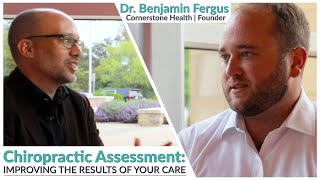
Dr. Benjamin Fergus explains GRIP, a movement assessment system that helps chiropractors distinguish between motor control problems and structural damage. The approach uses a clinical hierarchy to guide diagnosis and treatment, with adjuncts like strength training and shockwave therapy.
Questions this video answers
Chicago (2020).
Miracle Wave (shockwave therapy).
About 6 cm deep.
About 40–60% of cases.
About 80% (then 81–81.5%).
Chapters
Instead of starting with just treat and then progressing to complexity, why don't we spend more time in evaluation and say let's get it right day one every time and then we can feel like a hero with every treatment because it's always going to work at that point.
Hey, everybody, how's it going? Dr. Jeff Langmid of the Evidence Based Chiropractor. I am sitting with Benjamin Fergus, the developer of grip Approach. We're going to have a great conversation about movement assessments, tools you can use in your practice, and some exciting things going on in his. Ben, thanks for taking the time, man.
Thanks. I appreciate being here and being on some of your videos.
You got it. So grip Approach, it is all about movement, it's about assessment. What's kind of for anybody that hasn't heard of it, how would you describe it and kind of its unique place in the assessment world?
Yeah, well, in respect to chiropractic chiropractors, we're used to assessing joints for motion in three planes. Right. We do that by palpation or motion palpation. Grip takes that same framework and says instead of just what we can do, palpating, can we ask the patient's nervous system to create movements in all three planes? So our movements with palpation might be micro, one or two joint segments. In grip, we're a little bit more macro. We might look at the shoulder and say, let's judge your ability to move the shoulder to the side, internal rotate, extend. But it's not as macro as the full movement of the open overhead serve, for example, in tennis. So if we have a patient come in and their problem is throwing overhead serve, we know the macro movement, then we're going to get a little more specific and we're going to say from a brain perspective, can you do all the things that the shoulder has to do to do the overhead serve? And we can assess and create a plan based on that. And then another set might be the micro palpations as well.
Gotcha. What was it? Sounds like this was probably developed on a pain point that you experienced.
Oh yeah.
What did you come across where you said, man, I need to look at this another way because I think that tailors into a lot of docs what's frustrations that they might have right now in clinic. The grip might be kind of the perfect thing that they're looking for and they don't know it.
Ultimately it's a system that doesn't have a lot of gaps in it. So we need a system that's broad Enough that we can fit different tools into, but one that's specific enough that we say we don't need three systems for this, we can look at one classification system. So previously, when I'm going around collecting, let's say a DNS approach of assessment treatment, or a motion palpation approach or any other technique that you like, there is an assessment that's specific to that technique that you learn. But if I want to use neurodynamic solutions and I want to use motion palpation, I want to use DNS, I want a system that all of those things plug into, but I can still be objective with. So that was the need for grip is saying, how do I evaluate everything? And then say, okay, this becomes something where I can use a DNS exercise, or this becomes something where I can use a fascial manipulation and this organization.
Gotcha. So what I'm hearing is that kind of regardless of the technique set that a doc likes, regardless of whether it's an adjustment, ambulation or soft tissue work or exercise and rehabilitation, really grip is a foundational aspect that can set them in the right direction.
That's right.
Taking a look at a body region.
It'S going to give you better eyes for evaluating movement. And yeah, you can plug anything into it. However, we don't want to say, here's a test, go use your stuff and fix it. We want to say, here's a few options that for us consistently work to address the problem and you can bring your experience in.
Okay, and let's dive into that a little bit. What's kind of the lens that you, what's the, the lens of the tool set, so to speak, or how do you approach, hey, here's a restriction, here's a challenge point, here's something that's not moving optimally, let's say. And what's the thought process behind how do you address that?
Okay, so let's take a leg based movement, for example. Let's say you see somebody walking and they're not extending their hip and they have back pain. That's a pretty common presentation, right? So if we say the hip's not extending, the first thing we want to identify is is the hip not extending because the hip can't move in flexion extension or because the ankle can't move in dorsiflexion extension? So once we know exactly what joint we're addressing, the first question is are they not doing this because it hurts, because their brain is avoiding that movement, or because there's either a Strength or structural limitation. So you got to know what the problem is, and then you need to know why the problem's there, and then we can choose the right treatment. So we go in a hierarchy of saying, first we're just going to assume that the brain doesn't want to use that movement, and if I can teach the brain they can do that movement again in a minute or less, then we have a pretty good idea that this is a motor control issue. We just need to address the motor system. If that has no effect, then we have to peel back and say, let's see if we need to do a joint based therapy or a tissue based therapy to allow the brain to be comfortable with that again. So that's the basic hierarchy.
Okay. And I think strength is pretty clear. But when you talk about a structural issue, how would you define that?
Two ways. One, it can be the actual shape of the articulation where just the shape of the ball of the hip does not quite fit congruently with the socket. That happens. You can overcome it to an extent. In fact, when you have that structural limitation, you probably, motor control wise, use less than what's actually available to you. So step one, we would probably want to say, even with the structural limitation, let's get as much out of it as we can. But another structural issue would be a loss of extensibility in tissues, scar tissue, fibrosis. And then finally, there's this category that fits really well for chiropractors, which I believe Dr. Lenfei might call the functional articular lesion. Let's say a joint that currently doesn't do triplanar movement and it needs an adjustment.
Okay, yeah, I gotcha. And I guess with all that being said, when you look at a dysfunction, let's say the hip and the ankle, you're talking about earlier, how many times do you think docs that maybe aren't using a good assessment might be going to, let's say, the wrong joint, or it might actually be a compensatory issue versus a primary issue. What is some of what you've seen and what you think in relation to that?
Well, there's good news and bad news there. The good news is, fortunately, as compassionate providers, most of what we do is going to work for 40 to 60% of cases. You know, I could come and treat your shoulder and your hip might feel better. Is that going to work for the other 40% of patients where they need a more specific therapy? I would venture to say you need to be more specific and treat the right Joint and treat, the right classification system. So because my practice focuses entirely on patients that have failed the general approaches of just treat, we say, instead of starting with just treat and then progressing to complexity, why don't we spend more time in evaluation and say, let's get it right day one every time, and then we can feel like a hero with every treatment because it's always going to work at that point. So it's not necessarily a bad thing to treat a joint that's not moving, that's not contributing to hip extension, because if the joint's not moving, it's probably contributing to something else. But if you want to change hip extension for an athlete that needs to perform next week or for a patient that can't walk without pain, we just need better specificity.
Yep. And you and I are talking a little bit pre roll about, you know, you're going through some clinic changes right now in a great way. But I know you talked about, you know, hey, we. We focus and specialize on those cases that. Where other people have failed, where the patients are frustrated. And I know you're also looking at some really cool and interesting technology and maybe some new ways of looking at. I'd love you to dive into maybe some of the things that you're bringing into your clinic and just some different things that maybe docs out there could or should look at. And some things that you're looking at in terms of, hey, this might be something that's a little off the radar, but might actually be a perfect tool set for those challenging patients.
Okay. I'd say we have three things. And I should preface, initially, I thought modalities. No way. I'm a guy that thinks, I evaluate, I touch, the patient gets better. And ideally, that's the way it works. Right. But there's some things that help us do that better. The first is not technology, it's strength training. So if you're familiar with Dr. Josh Setterle, he's got this great program, Clinic, gym, hybrid. We are a medical fitness facility. And what's unique about us is we're applying that model that might be best suited for general population to a very specific chronic complex caseload. And we found that where we were consistently getting people to 80% recovery and then 81%, then 81.5%. So it just kind of peaked off. It's strength training that brings us all the way to completion. So that's one thing we're adding in. Can't recommend it enough. This program is great. And if you have questions about how to do that with chronic and complex. We're the clinic to chat with now. Technology. Two things that we love. One is shockwave therapy. We use the miracle wave miracle wave technology. The reason I love this is without cutting, we can send a mechanical force pretty deep into a joint, pretty deep into a tissue. So it's not a light wave, it's a mechanical force that can go 6cm deep. So if you're talking about a hip labrum, it's pretty hard to get there by pushing on it with your thumb. Maybe it can happen, but the research doesn't support that. However, if I know I can get to the labrum, if I can get 6cm deep, then I can apply that force to try to get a proliferative effect. It works great for fasciopathies, plantar fasciitis, epicondylitis, and it's a bigger tool than what we can do with our hands, as long as you apply it in the right place at the right dose. So I love miracle wave and shockwave therapy. Really effective. The final new one. I'm not sure if this is in a lot of clinics right now, but maybe it will be because the research is really strong. Infrared sauna. So we were thinking of a specific problem in our clinic. The problem is we know that patients with chronic pain get better, faster and more completely if they exercise. However, how many times have you seen a patient that needs exercise but hasn't gone for more than a one block walk in over a year?
Too many.
Too many. That's part of the problem. So we can very gradually build up and their exercise might be six minutes with a goal of 13 minutes when we really want them to be working out for 45 minutes a couple days a week. So that can be slow and steady before we really get that sea change where everything flows in right direction and cardiovascular ability is part of that problem. So we have found with a lot of great articles that you can use infrared sauna as a cardiovascular tonic. So in using three sessions a week for two weeks, we can actually get them to a cardiovascular state where they can handle a bigger dose of strength training. So it's going to accelerate the process of recovery. And then there's some great studies out of the Netherlands that show it to be cardio protective, actually preventing stroke and lowering cardiovascular risk.
That's cool. And with that, do you view shockwave and infrared sauna as something that just kickstarts a program or do you find it's going to be something that might be a maintenance as well?
Yeah, Good question. They might be on opposite spectrums. I think Infrared Sauna is a great Kickstarter because for most people, it's only going to feel good and it's going to get them beating their heart and moving faster. So that's like a Kickstarter Shockwave. I kind of put it on the other spectrum. If we are getting a Roadblock, it's gonna get us through the roadblock. So it's the heavy tool to bring. I don't bring it out on everybody. I could at a low dose, but I say, you know what? Our exercise didn't break through. Our joint manipulation didn't break through. We need a deeper, stronger tool in a specific dose, and that's what that's for. Now, in an athletic setting, if you're working with a. A CrossFit athlete or a baseball player, we have people that come to us specifically between competitions and say, you know what? I felt amazing with Shockwave Therapy. And we can do that between competition to loosen up the arm, but we try to apply it for the right condition, which is something that's stuck. Yep.
And I guess kind of coming full circle back to it starts all with the assessment.
Right.
And understanding what's going on. Where's a place that docs can either learn more about Grip Approach? Find out where. I know you teach it live as well. You know, how can docs learn more?
Thanks for asking those questions. First place, GRIP Approach, www.gripapproach.com. we're also on Facebook and Instagram. I've heard the website's outdated. Maybe we'll work on that. But I do have some information online. I'm usually available via email and social media. And then we teach regional courses, some international courses. But 2020, if you want to learn this in 2020, it's all going to be in Chicago. So the full clinical track, full performance track, and our sweet new facility in Chicago.
If you have not checked out his facility, he's been posting some pictures online. It is almost done. It is an event that you're definitely gonna wanna check out. If you're somebody out there that's maybe struggled a little bit on the assessment side, or if you know a lot and you just wanna refine some more, Ben's facility is gonna be absolutely awesome. I love what you're doing. I appreciate it. And I'd encourage everybody be sure to check out Grip Approach and hit Ben up with any questions that you have. I know he'd be more than happy to help and make you a better clinician. Help more people in your community. Thanks, Ben.
Thank you. That was great.
Hey, what's going on? If you loved that video, be sure to subscribe to this channel. The evidence based chiropractor puts out videos all the time at the intersection of marketing and research, showing you how to grow your practice while also growing your knowledge base. So if you liked it, be sure to comment down below or hit subscribe and I'll see you in the next video.










