Inside Jane.app: Building Relationships Through EHR with Jonathan Friesen
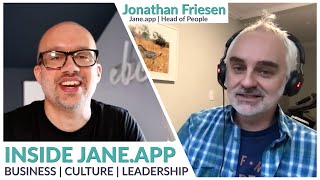
Jonathan Friesen, Head of People at Jane, discusses how autonomy, mastery, and purpose drive both company culture and product success. He uses weekly check-ins, OKRs, and paired metrics (quantity plus customer satisfaction) to monitor performance without managing to the numbers. Rituals and storytelling help remote teams stay connected to the company's mission.
Chapters
Over the past few years, Jane App has taken the EHR world by storm. And a big component of that is the culture that they've built internally because that translates to how they interact with their customers and clients externally. I had the opportunity to sit down with Jonathan, their head of people, and dive into the aspects of team building, coaching and training that make the difference between businesses and practices that are successful and those that continue to struggle. Here's my conversation with Jonathan, head of.
People at Jane when it comes to getting people excited and feeling like they're really contributing at work, a lot of it comes back to me to this. Well, a lot of the stuff I've read from a few different folks. Adam Grant from Wharton School of Business, Dan Pink is an author and writer and both of those guys do tons of research. Another fellow, Bob Sutton, does some great writing based on evidence based management. So there's just lots of kind of theories and lots of experiential based stuff. And certainly experience has a role to play. But I find there's also a lot. I was talking to one of my staff today about this, just especially on the HR side of things. A lot of just like pop business lit. That's like really when you look at it, just like oh, here was my experience and it seemed to work for me. And some of that might be true, but some of it might be more so. Like oh, it just happened to be that you were successful and you did those things, but they actually contributed nothing to what you did. And so I've had the privilege of learning from a couple of these folks. And I think it was Dan Pink. He talked actually about the concept of flow and how when we get in, into this space when we're working that we lose track of time because we're so engrossed in the task. I think I can't barely pronounce his name. Mihaly Csikszentmihaly was the author of this book called Flow and he kind of coined the term but really flow was then around finding these three things. Autonomy, mastery and purpose. Where autonomy is just the right amount of, of autonomy in your work. You get to make decisions about how you do your work. And mastery is this Goldilocks amount of knowledge about a task. You've got some knowledge about your craft but not enough that you're bored. You're still like excited by the thought of doing it. And then finally purpose, both big P purpose that you align with the organization but then as well that you little P purpose that you, you, you get a sense of Progress along the way, like, oh, what I'm doing here is actually making a difference even on a day to day basis. And so certainly for me, those have really helped guide me in shape. How do, how do we want to do things? And, and then of course I have the benefit of working with Trevor and Allison, who actually I've known Trevor for years. I went biking with him years ago and we actually started talking about this concept of flow. And so it gives me the space knowing that these are the kinds of things that they want to implement at chain to do.
So how do you think about that? I'm totally in alignment. I've read some of those books and followed some of those people. But one thing that I think is super interesting is understanding the concepts and putting them into practice. Right. So when you think about leading a team, when you think about management and operations and so many of the different hats that you literally personally wear in the organization at any given moment, at any given day, how do you think about implementation and empowerment with your people? How do you put it into practice?
Yeah, that's a good question. Really, it's like the million dollar question, right? Because your ideas are only as good as their implementation throughout the organization. I think I definitely see Trevor and Allison as having laid the groundwork and made the SP for that. And to some degree that's you as the leader get to have that input where you can't be involved in every conversation all the time. And so what you can do is help make space for people to do that. So certainly it starts by modeling that behavior, that the people around you, you're giving them autonomy where you can. But then it's then doing the little around, particularly around culture, I think that enable that. And culture is always a fuzzy word. I see it very much as like rituals and behaviors. So what are the rituals that you help instantiate in the company that reinforce that behavior? And so even today we're doing a little bit of planning around budgeting for our people team at Jane. And so we're going back to the question then, well, what do we want to spend our money on? Because certainly inevitably, I mean, when you talk about operations, it winds up talking about, okay, where are we actually going to spend money? And so particularly now as we're transitioning to the pandemic, or we've transitioned from the pandemic to being a fully remote organization, I get nervous about the lack of connectedness that is there inherently in a remote encounter, particularly with people who join Jane and have never like physically been in the Same space as another person. And so I think then when it comes to spending money to help create this culture that we want, for me, a lot of that comes back to then, okay, well, what do we want to create here? Let's spend our money along those lines. We were talking about, should we do this or should we do that? And even from the next level down, we said for our people, operations team, what we want to do is enable people to connect. Why do we want to do that? I always like to answer that. Ali always is pushing us. Why? Why do you want to do this? And for us in this regard, then it's like, well, we want to allow people to connect because connection helps give shared understanding. And shared understanding leads to trust. And trust is like the lubricant through your business. Right. If you're struggling trusting other people, it's almost like I've heard it described as a tax on your organization. And, you know, you've got a. You're paying this additional fee to get stuff done. And so by linking back to the why, which is like the purpose bit, it helps give people that sense of, oh, yeah, we're doing this because it's actually a legitimate reason, and I'm on board with that.
So I love that. And when the rubber meets the road, as they say. So let's think about it. And I'd love to hear your thoughts around how that meets in with goals and accountability. Right. Especially for the docs out there. They might have team members, might be doing some various marketing tasks. Maybe they're checking people in and checking people out. They have sort of those key performance indicators that they're keeping an eye on. They're curious about. How do you think of it in terms of relationships, trust, autonomy, all of those things that you brought up that I think are so incredibly important. Yet balancing that against the accountability and the goals set by the organization, how do you go through the thought process on that and ultimately, how do you sort of execute against it?
Yeah, I really appreciated. My last role was with the large electric utility here in bc, and my boss there was great about drawing us in to be a part of that process. And so I think that's one of the first things. He obviously got to have the final word about where we were going to go. And if we thought we were going totally off kilter, he could certainly weigh in, but he actually had us just write down all the stuff that we thought we might be able to do as a team. And actually, I thought that was even just an effective technique in itself. Rather than having it as like a discussion, everyone got to write it on a post it note and like paste it on the board. That way, you know, the loudest talker doesn't immediately dominate the conversation. And some of the introverts get their stuff out onto there and then we begin to dialogue. Then what as a team do we want to be able to do? And one thing we've done here at Chain, I really like the, it's called the OKR methodology for objectives and key results. And it kind of puts it into perspective. Instead of just saying okay, here's the stuff I want to do, we get to think about how, what is it like the little bigger picture that we want to be able to accomplish. That's our objective and then how do we know that we've done that and that's the key result. So it's a little more outcome based and just by articulating it in that frame you get to say, well then you know, so and so I'm going to actually ask you to be responsible for this key result. And the powerful part about that is that they get to have the autonomy then to figure out the how you've told them the what say, you know, here's our, yeah, here's our metric that we really want to hit and it's all in service of this bigger picture goal that we want. But now you go figure out what tasks need to get done to get there. And so that helps align then that that purpose along with the autonomy then to help get that done.
And then with that I think that's incredibly impactful now as that starts to take shape and you know, the person gets to it. How. How do you go about following up? So do you. Let me ask two questions regarding this. One is that is every person have one one OKR that they're responsible for or can there be multiple. And then number two, what's the leeway of our autonomy that you found to be comfortable with? Is it a weekly check in, is it a monthly check in, Is it just a quarterly? How have you gone about that?
Yeah, I think I'll answer the second part first. So in kind of getting that set up, I like a weekly check in in terms of just checking back to see, you know, here's what we said we were going to do. What are you planning for the week that is going to align with that? And that seems like a decent cadence to go through especially with some folks. They really want the daily kind of. I need a little bit more guidance about what I'm doing in particular, I find people who are a little newer in a role, they just don't know quite what they should be doing. Other folks are fine just to kind of go do on their own. Although even with some of them, I found they actually quite like just like a quick report at the end of the day. But I find at a weekly basis you can kind of align back to what you're doing. And then I borrowed this from one of our teammates who joined on he set because oftentimes, especially on an organizational side, you kind of live in quarterly chunks three months long. And he actually set a six week mark in between to say at the six week mark, let's really evaluate how we've done against these things that we said we're going to do. I like that because it also says at that point you might, might just scrap some of the stuff that you started. Like think back to where we were back in February in our ignorance about what was coming up. By the middle of March we sent everyone home and by the first week of April we're scrambling around. But it was pretty neat. We had this telehealth module that we'd done a little bit of work on getting up and running. And I credit the team. All of a sudden Trevor and Ali were like, we got to pivot and get this thing going. Our practitioners are depending on us to find an avenue to keep working. And so that's a great thing about having a flexible system where instead of being like, oh no, we set this three months ago. Come hell or high water, we're going to make it. Which it just doesn't make sense some of the time when the world moves underneath you. And I'd say in terms of then on your first question, how many things are there? It really depends on, I think the breadth of scope for the individual. Often a couple of things are good, especially I find a couple of key results that are balancing both quantity and quality are important because finding a quantity metric usually is pretty easy. But that can often lead you, you know, some, some nasty side effects where especially if you're mixed. Yeah, totally right. I, I remember sports analogies are overdone. But I still, I can appreciate the one I heard where I think it was an NFL quarterback had been throwing some interceptions quite frequently. And so someone, you know, some enterprising middle level exec said why don't we, you know, alter his contract, penalize him financially every time he throws an interception. Well, sure enough, the guy stopped throwing the ball together because that was the incentive. And you know, the team's performance just nosedive even further. And that's a classic example of just like that quantity metric driving everything. And so that's where I like to pair things up, quality and quantity. To make sure you're actually getting the result that you're looking for, just drill.
Down on that one step farther. So give an example of sort of. I think quantity is pretty easy to tell. How would you think about quality as opposed to quantity? What's maybe an example or two that you utilize in terms of being able to. Sometimes it's easy to tell what the quality is. Sometimes it's a little bit more gray. How do you get creative with it?
Totally. Well, a lot of it is just thinking about what is our objective overall and how will we know that we've met that Jane, for sure. One of the main quality metrics that we use is what people are reporting back to us about their customer service experience. We want those customer satisfaction numbers to be really high so that instead of just saying, oh, you know, Sally, support person or Joe, support person, you know, keep those emails going, crank them out. I've heard Allison say, you know, we keep an eye obviously on how our folks are doing in terms of phone calls and emails, but she's like, way rather have someone spend five extra minutes making sure they actually solve the problem than a two minute conversation that clicks the button of numbers. Because pretty soon you'll be able to see those numbers. If you're asking your customers about their experience, they'll say, oh, so and so didn't actually really help me out. Or conversely that, you know, they went above and beyond and did more than I was expecting. And so to think about things in that, like I can see from a chiropractor's perspective, what's the, you know, what's the outcome of the patient? What are the patients telling you? Another great quality one is could be patient referrals. You know, if a patient is really satisfied about their experience and they're telling others that's a great quality metric because not only are they just telling you they're satisfied, they're actually proving to you that they're satisfied, which is even better.
That's a fantastic example. Thank you for breaking that down. The six week thing. I think I've heard Jason Freed from Basecamp, the CRM tool, talk about six week sprints a lot and really think his business upon that. So as a doc starts to think about, okay, so now trying to get my organizational in line and what are maybe some of the pitfalls that you maybe have experienced personally or that you've seen others be challenged with Maybe what are the two or three most common pitfalls from an organization, a management, a team perspective that just seem to happen time and time again that everybody listening and watching maybe should keep an ear and an eye on?
For sure. Well, I think one I already was touching on and I'll make it very specific. And that is when you're implementing any type of goal setting mechanism, it all depends on your perspective and approach to doing that. If the way you use goals is as a, or, sorry, let me rephrase that. The way you use metrics is as a goal, you're for sure gonna run into problems. And I think it was Bob Sutton who said that any goal setting program should come with a warning label like may lead to side effects. And so instead I like the approach that metrics are a monitoring tool. They tell you when things are going off the rails. And so instead of then managing to the metrics, you use the metrics to help manage things. To say, oh, this is an indicator something's not right. You've got to use your experience, your business intuition to know, oh, and start asking questions, why is this happening? And so that's where the metrics can be used effectively. But, but certainly it can totally take you down the rails. The other thing I think is just that this process often is messier than people expect, especially as you're engaging your staff into being a part of it. For sure, it's cleaner to be cut and dry and just say, this is what we're doing, this is how we're going to do it. And people are messy. Right, where all of us come with our own baggage. And so the more you engage with that, the more you open yourself up to that. You just have to be prepared. It's probably going to take a little longer than you anticipate even I can say with asset Jane, like, we really started doing okrs as a methodology, gosh, like a year and a half ago. And surprising to me. I've done other stuff before with goal setting, but it just, it takes some time to kind of get into the rhythm of things like, and you, you need to be patient with folks. But I think the good part is when, when you, when you pick something that you know has some good validity, you can stick with it. Certainly you can hear from folks where things are working and where they're not. And like, we've definitely adjusted our, our weekly procedure. Jane does, especially now, remotely does a ton of written communication back and Forth, we use slack a lot. And I think because of that, even, like for our weekly meetings, we'll actually have everyone write their weekly reflections. And then we just spend 15 minutes quiet reading at the beginning of the meeting instead of forcing people that, you know, some people might have time to read, others might not just say, okay, maybe let's have 50 minutes quiet reading. And that's something we've learned along the way in a little practice we've implemented that's helped make us more successful. And I think that's where you just have to have patience to tweak things that work in a way for your own organization.
That's interesting with that, I guess. How do you view communication in terms of. This is an old school way to put it, but hierarchy versus flat. Do you view it as people should, you know, everybody should be involved in every aspect? Do you think that this sort of natural siloing can be a good thing? How do you think about organizational structure?
Yeah, I think it's a mix there for sure, because certainly people want to hear from their leaders as to the direction of things are going. And particularly where there's challenges to the organization, people really look to the leaders. Even in flat organizations, they'll be de facto leaders that will have emerged and people want to hear from them. Because I think that's certainly from my experience and from the stuff I've read, it's anchoring for folks. And when things are tumultuous, you kind of want someone to help guide you, like, what is our purpose, where are we going? And yet at the same time, there's tons of stuff that happens along the way where there's lots of back and forth. And I think one of the things that can help make that effective is knowing a little bit about what's sticky, what communication tends to stick. Well, one of the number one business books I always recommend to folks is a book by Dan and Chip Heath called Made to Stick. And they go through. They've got a great little checklist for what makes communication stick. And I'll give you the last one they say is story. Stories actually help us simulate along with people. And so certainly from an organizational leader perspective, as you tell stories that impact the business, they stick. People remember those things and they can become really good framing tools to say, here's what's happened, here's where we're going to go. And people remember those things. And those things can then drive behavior, the kind of things that you're looking for in the organization.
I love it. Jonathan, you're a wealth of information and I really appreciate you taking some time and sharing what I think the more that I keep learning what makes Jane unique. It's not only the product and the company, but as you've sort of elaborated on today, it's the people. And that's the number one thing. And I think you're a great example of that in terms of how you think and certain in terms of how you execute. And I really appreciate you sharing.
Thanks. Well, we've got some fantastic people right from the top. Trevor and Allison have done a great job setting up the organization and then we just have great people. Right. And this is the neat part. When you help structure things in a way that allows people to flourish, it's really fun to be a part of that environment. And I get to then have the benefit of working alongside of great people. Learning from them as well too, makes my job really enjoyable.
Hey, what's going on? If you loved that video, be sure to subscribe to this channel. The Evidence based Chiropractor puts out videos all the time at the intersection of marketing and research, showing you how to grow your practice while also growing your knowledge base. So if you liked it, be sure to comment down below or hit subscribe and I'll see you in the next video.










