Movement Assessments: Why Concepts Matter More Than Protocols with Dr. John Campione
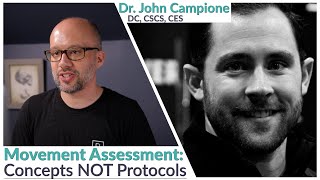
A recorded interview (YouTube) where Dr. John Campione (Rock Tape instructor and faculty at National University of Health Sciences) and Jeff Langmaid discuss the new Rock Tape Movement Specialist course and the organization’s teaching philosophy. The course emphasizes teaching movement concepts (not fixed protocols): day one focuses on conscious movement using the squat as a model, including interventions and communication strategies (True Colors personality test); day two covers subconscious movement patterns (breathing, gait) and introduces cerebellar screening as a movement-relevant assessment. Campione also describes practical tool integration (taping, blades, floss, bands), names floss as a favorite versatile tool, and points listeners to rocktape.com and his Instagram (DrJohnCampione) for schedules.
Chapters
And it goes back to one of our tried and true principles. Within Rock Tape is we teach concepts, not protocols. So if you understand the concepts, you can pretty much do anything you need to do.
Hey, everybody, what's going on? Dr. Jeff Langmid here with the Evan and space chiropractor. And I am super proud and excited to be chatting with a new friend of mine, Dr. John Campione. And he is a Rock Tape instructor and he is a faculty member at National University of Health Sciences. We're going to talk a little bit of both today and how you can apply some of what he's learned in his career to you and your practice. So, John, good to see you as always. Thanks for taking a few minutes for us today.
Hey, Jeff. More than happy to. Happy to be here. Thank you.
You got it. And I was doing a little bit of digging on you and I saw that you've been kind of involved in strength and conditioning world, specifically relative to kettlebells. And I want to pull that into 2020 and then we'll trace it back. So, you know, the FMT Movement specialist courses are a big push within Rock Tape. I'm assuming, based upon your experience that's near and dear to your heart. Can you give some insight into what is the movement specialist with Rock tape coming in 2020? What gets you excited about it? And maybe a little bit of a sneak preview of what docs can expect if they come to a course.
Yeah, the movement specialist course is brand new. Like you said, we've had a couple courses throughout the end of this past year and kind of the hard launch is going to be next year. We've done it several times and I've gotten the chance to sit in with a couple courses and help out with some of the instructors. The movement specialist course is completely different than any other movement assessment or movement screening course that anybody has ever taken. I guess the best way to sum it up is day one. We look at what we refer to as conscious movement. We look at how human. Human bodies can form a shape and be efficient and effective within human movement. We try to make it as digestible as possible. So we pick one particular movement and we really dissect it. We choose the squat. And it's not so much that we want people to be better squatters or to really nitpick the squat and say everybody has to squat. We use it as an example of this is a shape that for generalized purposes, everybody should be able to kind of be able to form this shape and do it efficiently and effectively. Think about just sitting down, getting in your car, et cetera, et cetera. But we look at it from a conscious perspective, from how the brain functions to send that motor information out into the body. So we take a really big dive, day one, into conscious movement patterns. And the really cool thing is we start to intervene a lot within this coursework where, as a lot of our other courses, the intervention is very specific to the tool that we're using, like tape, obviously we tape blades, obviously we use the tools. But with the movement specialist course, we have a lot of toys that we get to play with and we get to use it for that conscious movement pattern. What's really cool, though, is that we incorporate a number of different. What we. We kind of look back on the biopsychosocial model, a lot of. With how we treat people and how we work with people. So, you know, this class is geared towards a lot of trainers, but we look at, you know, how do you talk to the individual you're working with? Because outside of the biological realm, can they do this? Can they do that? Are they in pain? There's a lot to really consider with the human being you're working with. So we actually incorporate personality tests. We have everybody in the course take personality tests and it's called the True Colors Personality test. And we kind of identify the color and then we break out and say, hey, talk to your partner. And as their color, what sort of language would you use for them? You know, I'm a blue. I'm very anal retentive. I need things a particular way. I need details. I need things explained to me before you want me to do it. My wife just took the movement specialist course this past weekend. She's a red. She's very. I gotta win. I gotta, you know, be in charge and I'm gonna go, go, go, go. So, you know, how do you talk to those individual people? On day two, we get into what we refer to as the subconscious aspects of movement, which to me is really fun because as this class is geared towards a lot of trainers, it has a lot of applicable clinical applications. And day two is one of those great examples. We go into breathing and we go into gait. And those are, yes, we could consciously override breath and gait, but they are really more subconscious than anything. So these are patterns that we have to look at. It's on a subcortical level for, for the most part, if you give someone a task, they're going to do what they do. So we look at gait, we look at breath we talk about cerebellar screening, which I'm particularly proud of because it's kind of my contribution to the class. I'm a huge fan of the cerebellum. I read about it all the time and I love it. But we really took this movement specialist course to try to make it unique from other aspects of screening and try to teach people about the concepts rather than just give them this protocol based system. So you will essentially go through the weekend looking at the squat and understanding how a person should form a shape and do a particular movement. And then you can adapt it to whatever movement you choose it to be. And then in day two, we look at more of that subconscious aspect, gait, breathing, and really illustrating how important the entire brain as a whole has to function while, albeit consciously or subconsciously, to be able to get someone to move better and feel better.
That's awesome. So tell me a little bit, I'm going a little bit off, off my script here, but what was the. Tell me a little bit about the cerebellum. Like why is it, why is it important? Why is it a passion for you?
Kind of.
How does it fit in from, from the science side of things? I'd love to know more.
The cerebellum is such a fascinating brain structure that admittedly I don't think we get enough of as far as practical application in school. And I've talked to pts as well as my, my chiropractic colleagues and they kind of all say the same thing. It's, it's almost like uncharted territory. You know, strict neuroscience knows a ton about it, but they don't necessarily understand or implement very specific practical applications. So the cerebellum really dictates all movement or at least modulates all movement. It's involved with all movement. We can talk about voluntary movement coming from the cerebral cortex, but we have to understand that that all gets checked through the cerebellum. Every move you make gets feedback information, whether it be proprioceptive information from the muscle spindles or the joint receptors, it's all getting fed into the cerebellum. So your cerebellum is there to check our movement and make sure it's coordinated, make sure it's smooth and it talks to almost every part of your brain to make sure that there's no threat and there's no danger. And I just, I can't even remember when I really. I'm so far down the rabbit hole I can't even remember how I started. But it was just some really introduced the cerebellar and cerebellar testing into looking at it from a movement perspective. And I'm like, I never understood it from that perspective and it just started to fascinate me. And the more I read about it, you know, you see that there's, there's aspects of cognition involved with it. There is aspects of sensory information. When, when we, when we put our hands on our patients as clinicians, you know, there's a component that, that's involved with the cerebellum. And then just if we deal with movement, we need to look at the cerebellum.
I think that's a, that's a great point. And so to me, it sounds like the movement specialist course kind of fits above or on top of almost everything else. Like, if you've taken a taping course, if you've taken a, you know, a rock blades course, if you've taken really any of the individual courses, this sounds like it kind of ties things together. I mean, how would you describe where it fits in either with, on top of or however you want to define it? The other educational courses, such as the flagship taping course, that's one of my.
Favorite things about all the rock take tape, I guess you can call it curriculum now is I think it all fits together. And one thing we try to do in every single class is incorporate one of the other tools. So for instance, we have, you know, in our, in our taping course, Maybe it was 2018, we started introducing floss. So, and what I mean is we, we have a section where we talk about floss and we do one simple application and we incorporate it with taping applications. Blades. We do a demonstration on tape pods. We do stuff with bands. Floss, same thing. So every course we try to show people how you can use tools together. And of course, there's a, there's a component of, hey, try this course us out too, as well. You know, it still is a business, but I think the movement specialist course is the way to put everything together because you really can say, okay, I know this about this individual. I have a list of exercises. You know, I can do some of these fun exercises with a lot of the cool skills equipment that you get at the course and your. In your trigger point stuff. But, hey, maybe this is where blades could go. This person could actually benefit from doing some downregulation and relaxing that tissue to gain a little bit more range of motion before we do this exercise. And I could reinforce that with a tape application or I could pull up my floss which floss is one of the tools that you will get to play around with at the movement specialist course and be like, okay, how can I use the floss? Do I just need to wrap it up and do some manual work, or do I need to do maybe a helical application that gives them this kind of cueing that they need to be able to get the movement pattern that I'm looking for. So I, I think, and I, I won't speak for Steve because Steve is so brilliant, but I have to believe that Steve Capo Bianco really has always wanted something like this throughout the years as he's built the FMT curriculum to bring it all together and have that movement assessment course. And I think it was a big. I don't think risk is the right word, but I'll use the word risk is. You know, there's a lot of screens out there. There's a lot of assessments out there too. So us doing our own, you know, it is a bit of a risk and a challenge just to kind of make it unique and then also make it valuable to a lot of people. But I think that's where its value is, is it starts to bring in everything that you do. And it goes back to one of our tried and true principles within Rock Tape is we teach concepts, not protocols. So if you understand the concepts, you can pretty much do anything you need to do once you have those concepts understood.
Yeah, I love that. And with that, I know you've been able to, you know, kind of play with experience and utilize nearly all the tools and techniques, you know, under the umbrella there. So I'll put you on the spot and ask you, what's your, what's your favorite tool or technique under that umbrella? Just personal favorite, like what do you, what do you enjoy using either for great results? It just ties in with what you're passionate about. You know, when you, when you're taking care of an individual, I'll open it up.
You know, I, I asked that question on my own podcast and I've always thought about what happens if I get asked that question myself. Wow, that's. I feel like I honestly use almost everything kind of equally, but if I had to pick a favorite tool, it would be the newer tool, which is Floss. Okay. And it's just. Floss is just, it's this little rolled up band and if you kind of understand what it can do, it's tactile sensation, but it's also compression. It can do so much. And if I just had that in my bag, which I always do because I'm one of those people. I could wrap up someone's body in certain areas, and I can use it for, you know, some tissue manipulation or even mobilization of a joint. But then I could also wrap it up loosely and provide sensory cueing to an area and just put someone through some movement patterns and make it a little bit more comfortable. I could wrap it in a spiral around a limb and help guide somebody's movement to cue them in a certain way. I could use it like a traditional band and do some re. Some reactive neuromuscular training. Somebody squats and their knees cave in. I could wrap it around their knee and say, hey, push against the band when you squat out. It's just so versatile. And the fact that it is, you know, essentially pocket size, if you will, is just amazing. You know, it's kind of like smartphones. It's like when I see someone using a smartphone as a phone, only I'm like, you're missing so much potential. My phone does everything I need it to. You know, the floss is kind of one of those tools. I can do so much with it in this just little pocket size kind of shape. It's pretty fascinating to me.
Yeah, I think that that's awesome. And as we. As we're Moving forward to 2020, what are you most excited about? Whether it's a location, maybe that you're teaching at, maybe something personal, maybe something in the academic realm. What are you pumped for as we move forward into 2020?
I have always had. I was a bit of a geography nerd when I was a kid. Like, I just loved looking at maps, and it was like my way of traveling. And now I travel a ton. And one of my biggest goals in life is to just go to all 50 states. And with rock tape, I've had that advantage. So I'm going to get to go to some newer places in 2020, and I'm really excited for that. I'm going to Idaho. I. I've been to South Dakota twice working for rock tape. I never thought I'd go to South Dakota. No, nothing against South Dakota. It's beautiful out there. I just never thought I'd have a reason to go there. But being able to travel is so cool, as rough as it can be. But also I am going to be teaching a lot of the movement assessment courses. So, you know, we've. I've only got my feet wet a little bit for that. You know, I'm prepping, and we'll have the Movement instructor. The instructor summit rather in a couple weeks, actually, and get prepped for it. But the majority of my course load in the early part of the year is this movement assessment course. So I'm really excited to get in there because if anybody watches, like Ethan doing a lot of his courses, he posts really unique and fun videos of the games that they play as part of, you know, rehabilitation and some of the interventions. And to me, that's one of the funnest things is because I get to put it out there for the participants is like, let's, let's come up with a game. Let's make it our intervention. Let's play. And it's fun, but you're also actually doing what you need to do based on the assessment. And I learned as much from the participants as they do from me. So it's also a learning experience for me.
I love it. That's awesome. So where can everybody. Listening and watching, where can they find out more of either where you're going to be, where the courses are, what's the. Where's the best place they can head to? Also drop it in the comments and show notes as well.
I am going to be much better this year. I say it now at posting my schedule up on Instagram. Instagram's the only social media I really use. I only use Facebook because I have to for our instructor's page. But Instagram is the only thing I'm really on frequently. So if ever you want to host a course, you can always check me out at Dr. John Campione at Dr. John Campione. And I can help you get something set up. But you can also check out my schedule there as well, too. But the easiest place is honestly. Rocktape.com go to rocktape.com. pick the education tab, pick whatever class you're interested in and just scroll through. You know, I'd love to see everybody come see me wherever I am, but we have so many amazing instructors. You're never going to go wrong with whoever you pick. So what I should tell you, though, is the best way to know if something's coming to your area. If you want to travel and see me, I'll give you a big hug. I love that. But if there. If you want to know something's coming to your area, sign up for the newsletter. The newsletter will send you an email when it's in your area or nearby. And you don't even have to think about it. I'm still on the newsletter when it comes to my area. It's like, hey, rock tapes, come to Chicago. And I'm like, oh, I knew that. But whatever. So that's the best way to do it. You can always just unsubscribe when you need to, but go to rocktape.com that's the best place to see where all the courses are going to be. Not everything's out there for, you know, the whole year. We still keep adding courses throughout the year. So I think the latest I've seen thus far on the schedule is like into March. So just keep an eye out for it. If you're looking for something in the summer, it'll be up asap.
That is awesome, John. I really appreciate you taking the time. We're going to reconnect and we're going to talk about the, the balancing between what you do in the sports performance world and the academic world. But I think this is a great jumping off point. To let everybody know. Head over to rocktape.com check out John on Instagram. I will leave links for that whether you're watching this as a video or whether you're listening as a podcast. And we will both talk to everybody very, very soon. John, thanks a ton.
Thanks Jeff.
Hey, what's going on? If you loved that video, be sure to subscribe to this channel. The Evidence Based Chiropractor puts out videos videos all the time at the intersection of marketing and research, showing you how to grow your practice while also growing your knowledge base. So if you liked it, be sure to comment down below or hit subscribe and I'll see you in the next video.










