NeckCare Proprioception Test: Hidden Neck Issues Exposed in SECONDS!
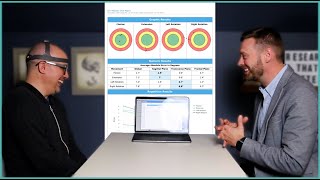
Jeff Langmaid demonstrates a software test that measures neck proprioception by having patients close their eyes, move their neck, and return to neutral while the system records error in degrees. Results show objective measurements for patient education and tracking treatment progress, and front-desk staff can run the test without a clinician present.
Chapters
So let's take a look at what's next here in the software proprioception.
Let's do the joint positioner and further, once you know, familiar with the laser, the head mounted laser, it's a hassle to set up. Again, it's not very objective. You have a printout on the wall, you have to mark that. Then you have to calculate the degrees so the people that are used to that know the paints and know the difficulties in using that. What we have done is exactly like the range of motion assessment that we went through.
Okay.
It's straightforward. So the only thing you need to do right now is be neutral, close, close your eyes. And then if you go again, flexion, chin to your chest and then come up to your neutral position. And then I mark that with the spacebar.
Okay.
And then I will reposition you like that. If you go down again, flexion and then come back to neutral position. Great. And then I will reposition it to your neutral and then go down and then up to neutral position. But here we are actually looking at how well are you able to find your neutral.
I don't know.
And for, for anyone that has had a whiplash or, you know, a blow to the head or is, you know, suffering dizziness and vertigo, it's super important to look at this because it could actually be a cause for, for those symptoms.
Right, right. Yeah. And I think about this in terms of also like fear, avoidance behavior. If somebody comes in, in neck pain and they're just so fearful about moving in, being able to establish, you know, wherever they're at, right. They might have some work to do. But being able to establish, okay, you can move through a range of motion and get back to that, you know, that centeredness, that neutral position or hey, here's a little bit of an opportunity to improve. That is also something I could see having that conversation with a patient that's really fearful about, you know, about moving and being able to guide them through a proprioceptive exercise and, and then be able to showcase again as time goes on that improvement. But also being able to showcase even just the baseline of, okay, you can do this. Right. And that, that, that's a diagnostic tool that leads into the therapeutic aspect. Right. Where it's like, for sure, okay, I can accomplish, I can accomplish this task. It's not perfect.
Nope.
But I have the opportunity to improve. So.
Absolutely. Yeah, great point. And then we do this for the other, you know, directions as well. We do extension and then left, right, rotation. That might also be an indicator. Okay. I'm completely off in my right rotation. Hey. And often that's actually correlated where. Where you hit your head.
Got it.
So. So, yeah. You ready for the next round? Sure. So close your eyes. Relax. And then now we do extension. So up and then come back to neutral. So actually more alfier. So, yep. Again, next session. Okay. Okay. Play with Dr. Here. There we go. Good job. And as people might have seen as well, you can actually see when they're performing the test, are you leaning towards one or the other direction?
Interesting.
So. So. So that gives an indication of how are you actually moving. Are you moving straight or, you know, are you moving predominantly in one side like I was? Yeah. So now we do left rotation. So if you go to the left and come back to neutral. Yeah, definitely something up here. There we go. Left and back to neutral. Interesting. Let me come to the other side here.
Oh.
So this would be the typical mu.
Your bro.
And then left. Perfect. And then, you know, find your neutral position. And then last but not least, right? There we go.
All right.
So how did this feel?
Interesting. Yeah. I feel like I would have guessed that I was doing better until I started.
But now, again, we do get the objective data right away.
Love that.
So this is how. And this is a heavily researched test as well, called the joint position error test. Okay. And here we can see how well do you actually hit that bullseye.
Right.
You're good in the flexion. When we started the extension and left rotation, you actually had a tendency to overshoot, so you went too far down.
Interesting.
When coming back. Yeah, so actually I was looking at you, and you actually, this. This is where you started. You ended right here.
Interesting. Yeah, yeah, yeah, yeah. Very consistent with the extension.
So consistently bad.
Yeah, this is fantastic. Because this enables, you know, me, you know, I think as a clinician, I can look at this very quickly and be able to ascertain. But I think about this from a patient perspective as well. I mean, the highly visual. I've never seen anything plotted like this book, Right. Where it's just like. Okay, this is super clear, super quickly in terms of, like, where you are overshooting, undershooting, where you're doing well, and where you have a high degree of variability. So, yeah, I love this. So talk a little bit about that table down below.
Yeah. So here we have the numerical data. So. And also there's a difference between the visual people and then, you know, the numbers people.
Right.
So here we have the actual, you know, degrees of error. So how far is an individual off? And then we also have that again, in the different plane. So am I off in the primary plane or am I off in a compensatory plane or associated plane? And then we also do have the repetitions. So what you want to see ideally is an individual, because I'm giving you some proprioceptive input when I'm repositioning your head. So you want to see that trending downwards because ideally you want to be learning, adjusting a bit to, oh, no, I overshoot here. Let me not do that again.
I didn't learn very much.
But yeah, this is the appropriate job to the test.
Yeah, It's a couple of things that come to mind for me. One is the speed at which you can get this much data is something I haven't seen before. Two is again, the ease of use. Right. You're able to go a few times and get very reliable data in terms of how somebody's moving. And then. And the third component, as you kind of illustrated, is you have the visual aspects of it as well as the hard numbers. So regardless of whether you're using this as a teaching tool with your patient, where the visual component might be easier, or whether it's something where you're doing objective documentation that needs to be highly specific, you have both available at a moment's notice. Which is also awesome that by the time we finished the test and you walked around the table, everything's already ready. You know, also that speed is just so critical when you're thinking about, okay, how do I implement something that I know is going to give me awesome data that I know I should be recording maybe a little bit more specifically than I am. But workflow issues. This eliminates that workflow issue, which is awesome.
Yeah. And you know, talking about workflow, I think the, you know, the best cases we have seen really is where know, there is, you know, an assistant, a chiropractic assistant or a, or, or, you know, attack or even front desk. Yeah. So it's a great way for, for, for them to be more involved, but also for the doctor to, hey, they, they see the patient, they already have that, you know, we call it blood work on rest. So, you know, the doctor doesn't draw the blood work, they get the results. So to, to have the results on your desk before seeing a patient or at that first visit is, you know, can be really, really valuable.
Yeah, yeah, I can see the power in that. Yeah.
Awesome. So. And maybe I can show you like one of the, you know, just case studies from, you know, pre and post. So here's the job positioner. This is an actual patient from one of our customers. You know, this is what healthy looks like. How you know, you should have been right. This is an individual that came in, they were so far off in the right rotation, they didn't even hit the rep. Eight weeks into treatment. They're actually within pretty normal ranges in all.
Yeah, yeah. Again, I think, you know, being able to show objective proof of functional improvement is so critically important. And that feels like it's always this sort of nebulous idea. I feel like as a chiropractor it's like, okay, I, I know I'm going to do maybe my, you know, sfma, my squats, my, you know, I'm, I, I feel like many docs do a really good job ironically, almost outside the spine with many of those things. Whereas we look towards the spine and being able to have functional improvement data has always been challenging. But this is, you know, this is clear as day in being able to show, hey, this is functional improvement. Now, hopefully the care that you're delivering, if they had pain, the pain's going down as well. But there is something to be said irregardless of pain in terms of functional improvement because how we move is how we live. And if somebody's having a ton of difficulty with restricted range of motion or hypo or hypermobility, if somebody's having proprioceptive issues that are literally off the charts, that's going to impact when they go and play a sport, when they're at work, when they are doing whatever activities of daily living that they are, that's going to impact their ability to do that and potentially even increase their likelihood of injury. Absolutely. So I love being able to quickly see exactly what's going on in an easy to follow yet highly specific way is absolute bullseye.
Yeah.
Awesome.
Good to you.
Thank you so much for watching this video on the evidence based chiropractor channel. If you don't want to miss a single thing, please subscribe to our YouTube channel so you can get notifications of every video we put out. And we put out new content each and every week, so be sure to subscribe.










