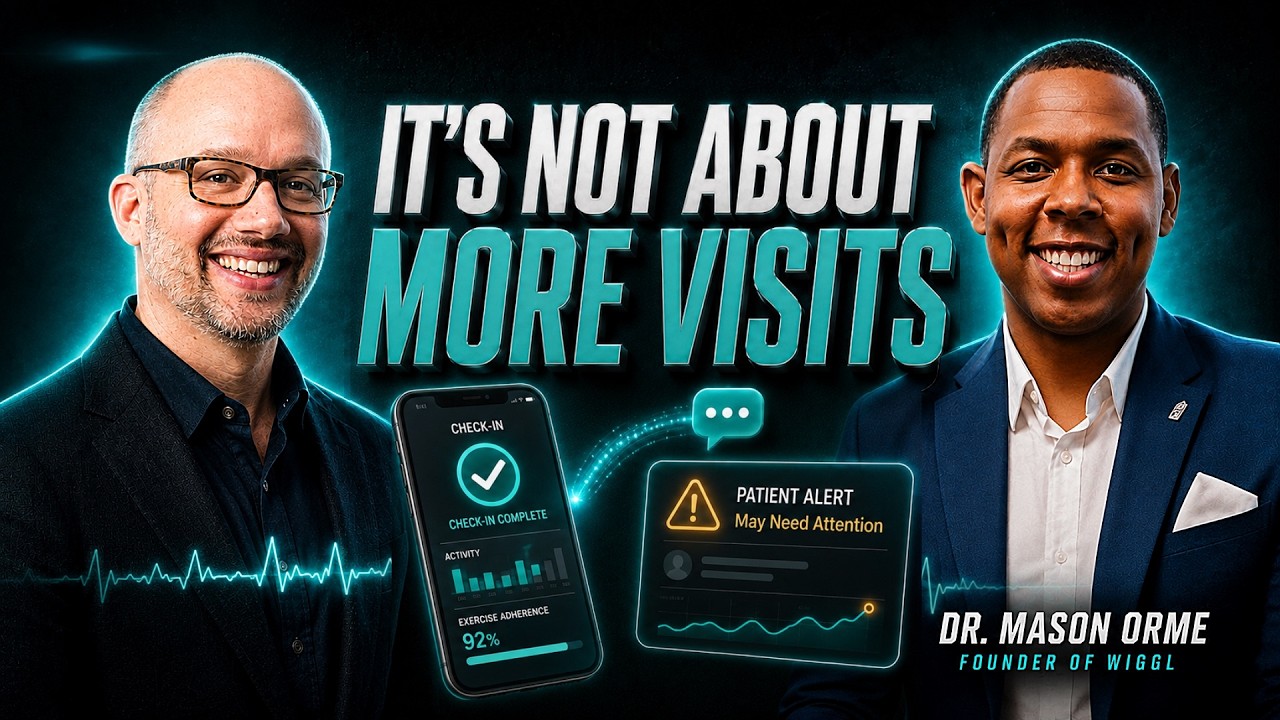
Jeff Langmaid discusses a remote monitoring platform for chiropractors that tracks patient adherence and generates $50 to $150 per patient monthly through billable CPT codes. Commercial insurers like Blue Cross and Aetna cover it, though Medicare excludes chiropractors. The app's modern design drives engagement compared to dated healthcare software.
Chapters
So what I'm hearing is that once the patient downloads the application, they can go in and report how they're doing in a variety of different ways. And the doctor can access on their end a portal of all of their different patients. And I think what you showed me behind the scenes is just even some alerting systems to really help doctors understand what patients might have some yellow flags going on, what maybe some need some attention. Is that correct?
That's absolutely correct. So when it— when you're looking at monitoring your patients, it's really awesome because when you have that data from their end, you're able to get these nudges to know that, hey, you know, Steve has not been consistent with the prescribed exercises that I've given him. So instead of waiting, you're able to go in and see that alert and be able to talk to Steve and figure out what What happened that caused you not to be very consistent with your exercises? And maybe Steve just like, oh my God, I forgot to tell you I was out of town. I'll get back to them once I get back home. Even that communication is huge for you because now you're able to personalize Steve's prescription plan differently because you know he's out of town. And so it just allows that communication to be more open and flexible compared to waiting for the next time or the next visit that they actually come into your office.
That's awesome. And one of the things I, I'll kind of shout out, we'll share some, uh, some screen overviews as we talk through this. Also, if you're listening and watching, be on the lookout in the next couple weeks, we're gonna release a video that's a full demo showing you inside. But one of the things that stood out to me immediately when I saw what you were working on was the design element. This does not look like MS-DOS, right? You know, this does not look like 1994, which bluntly, a lot of software in the healthcare space and definitely in the chiropractic space does. does look like. So, and design does matter. You know, is this a great user experience, not only for you, Doc, which is absolutely critical, but for the patient as well? So how do you think— I'll ask you a question I wasn't planning on asking you, but how do you think about design and where it fits in with engagement?
I think design is very, very important. I think for us as a company, that was our first initial start to building. You know, it's easy to have a platform where you have all your questions and exercises on, But we looked at all of these amazing companies that are drawing the attention of us all day long. We wanted to get that feel and say, how can we get your patient back into our platform engaging more? Because we knew engagement is the key to not only business, but applications and whatnot. And we had to learn outside of our whole industry because the designs of our industry right now is just more of, How can we make this functional and how can we get this to the patient? Whereas when you look at from the other side, it's like, how can we extract from the patient so that we can get better and better and better? And that's where engagement is. And that's where we went in that route early on.
I love it. So the reason docs are going to use Wiggle with their patients is because of the clinical benefits. But I'm going to take off our clinical hats and put on our business hats because one of the other things that many docs are completely unaware of is the revenue opportunity with this. So I'd love for you maybe just to highlight, of course, results may vary, insurance plans may vary, all of those things that we know. But in terms of the revenue opportunity, why don't you give Doc some insight into what you've seen and learned so far?
And their, their CBT codes from 98975 all the way to 98981. And these codes are billable codes, and they're billable codes based on just managing your patients outside of a clinic, educating your patients on RTM inside your clinic. of checking in on them. And these check-ins are not, you have to do a call or also you have to do like a video call. But these new codes, from a bare minimum of just getting them to have this management, monthly management, is minimum of $50 a month that you can get based on just the regular codes. And it can go all the way up to $150 per month per patient if you're managing them on RTM. Now, like you mentioned, Jeff, It definitely varies. I could tell you now, if you're thinking of, hey, I take Medicare, let's, let's use this. Unfortunately, even though Medicare created this for musculoskeletal providers, as chiropractors, we need to create better outcomes and data for them to take us as an RTM platform. So we're excluded from Medicare, but a lot of other commercial insurance like Blue Cross Blue Shield, Aetna, Cigna—all of those types of insurance companies are very friendly for chiropractors to use our team. In fact, they really want us to use it, and I think we should because the more we're utilizing this platform, the more we're going to be able to not only get better outcomes and collect outcomes, but it's going to be able to show the insurance the value of chiropractic and how we can be utilized to increase the fees. So. From the, from the benefits of revenue, I look at this as already we have fee-for-service when a patient comes in. RTM is your value-based care/passive income here. And if you know where the way the world is working, we're slowly leaning more into value-based care, which I believe chiropractors will soar in because of the fact that we're really, really good at value-based care. We're really good at creating plans. really good at prevention. And so it— RTM, remote therapeutic monitoring, is just the— our new level of playing field in the healthcare system. And I think the more people are on it, the more it's going to justify itself.
Yeah, this is a really, really big deal. Thanks so much for checking out that interview. If you liked it, we have plenty more available. You can check out the next interview right here.