The Basics of PPC and Google Advertising for Chiropractors
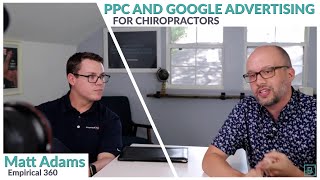
Matt from Empirical360 explains PPC advertising for chiropractors: what it costs per lead, why Google search ads work, and how landing pages and same-day appointment offers turn clicks into patients. The key is matching ads to specific services and tracking results closely.
Questions this video answers
Over a half a million dollars per month.
92% market share in pay per click.
Initial average cost-per-lead was about $100; after optimization they cut it in half (~$50).
Bi-weekly reporting and almost-daily feedback/engagement.
Chapters
Hey guys, how's it going? I know a lot of chiropractors out there have questions regarding Google advertising and pay per click advertising. So I wanted to bring in one of my friends and an expert in that field, Matt, at Empirical360. They manage over a half a million dollars in ad spend per month. We're gonna break down some of the basics on what is pay per click advertising, what do you need to know, what's a good lead, and some really important building blocks for you to have success with your campaigns. Matt, thanks for coming by.
Yeah, thank you very much for having me, Jeff. I'm excited to be here.
You got it. So what is if we break what is PPC advertising?
So PPC advertising is pay per click advertising. It is probably one of the most effective manners in which you can drive targeted traffic to your website. This is Google search engine. This is Yahoo, this is the Bing network, it's Baidu. Everything that's related to search engines, and basically what it is, is you're looking to find the search queries that a consumer is searching for in chiropractic space. A patient is searching for and drive that search to your website, your brand, your domain, so you can hopefully acquire a new patient.
Okay, and with that, you mentioned a few different ways that patients or people might be searching. Now, we've all heard of Google. Why is that considered the dominant force?
I mean, Google is 92% of the market share in pay per click. I mean, of course you've got Yahoo, you've got Bing, but you know, for those platforms it's about 2% of the market share. So Google pay per click is going to be the king and there's nobody that's going to knock them from that for the foreseeable future.
Gotcha. And with that, a lot of times when we hear as chiropractors about advertising on Google or pay per click advertising, we hear about in the context of getting like a good lead or how many leads did you get per month? So what would be, as docs hear that, like what is in your experience, how does a doc determine what's a good lead versus a not good lead? What do you, what do you take on that?
So, you know, with empirical 360 and pay per click in general, finding a good lead is specific to your practice. Is it, you know, a good lead is looking for spondy compression or do you offer a certain type of adjustment that a consumer would be looking for some sort of cervical decompression, upper cervical. What services do you offer within your practice that we can expect that a consumer would be looking for. And is it traffic that you can actually convert on and convert like to a long term relationship? You know, part of this here is not just about getting a lead, it's about getting the right leads. And so pay per click, if done the right way, can actually segment out your marketing efforts and break things down on an extremely granular level so that you're not just getting some traffic, you're getting the right traffic.
Right. And I think that, you know, converting those leads is extremely important. And I mean this from not a cheesy sense of like you're trying to get a patient that shouldn't be in your practice, but if somebody's searching, they have a neck problem, they're looking for a chiropractor in the area to check them out. What are some of the challenges that you've seen with offices when they get that lead? Converting them into a patient, getting them in because somebody, you know, seeing your name is one thing, there's value in that and brand recognition. But the goal is to get them into the practice, get them in front of the doc to help make a decision.
So, you know, in pay per click, we look at a lot of different factors. Relevance factor is one of them. So does your marketing, does your brand actually speak to what the consumer is looking for? So, you know, for example, the patient who is looking for I've got neck pain, do you position the marketing the landing page that somebody would end up on to actually speak to that particular consumer? That patient that says, okay, Dr. Langmaid, you know, I see him treating this patient who has a neck problem. He's probably somebody that I want to look into that can actually get this taken care of for me. Beyond that, you mentioned, you know, kind of retaining the patient. There is such, I don't want to call it a disconnect, but a need to be able to extend out email sequences. Actual patient, maybe onboarding is the right word for it, but understanding that a lead coming in is something that you should work towards fostering a long term relationship with. I think that that's getting them on your social pages. I think that that's getting them on email sequences in constant patient engagement for a variety of different reasons. Once you get that patient in house, you know as well as I do, word of mouth is probably one of the most effective ways that you can get more patients. So if you capture that lead that did not know anybody within your ecosphere before, and you actually convert them to somebody that says this Is the chiropractor. He knows what he's doing. He fixed me. Then everybody else in the surrounding neighborhoods is going to have that same feeling. And you're going to guide even more traffic for just that one lead that came in.
Yep. And with that, you mentioned landing pages. So is your experience that, you know, all leads should go to the same place, should it be split up depending upon their interest? What should docs be looking for?
Yeah, so landing pages and websites are entirely different things. You know, with our approach to online digital marketing, we like to break things down to a number of landing pages for the specific reason that if a consumer is looking for spinal decompression and they search into Google looking for spinal decompression service near me, I want to guide them to a page that specifically shows spinal decompression. It shows the doctor doing spinal decompression. It shows testimonials for somebody that actually benefited from spinal decompression that I know that they have what I'm looking for and that if I go to this place, it's relevant. And that actually helps to increase your quality score with your advertising. It helps to get your ad served even more, which means that you're going to get more patients and more patients and more patients. So you can't generically market to the same exact website. You have to actually break out into detail different landing pages so you can capitalize the most and actually speak to the audience.
And with that, so you've seen, I take it, much higher conversion when somebody says we're going to use neck pain for an example, you talk about neck pain and then it drives them to a page that has a testimonial about specifically neck pain or low back or spinal decompression, whatever the service offering or challenge might be. That's definitely increased conversions as far as what you've seen. Absolutely gotcha. And when a patient visits like a landing page like that, what typically is a good or useful call to action? Is it to email the practice? Is it to call the practice? Is it to collect an email and send a PDF? What have you seen with that?
So what we have mostly seen in the chiropractic space is that the, the call to action that's the most effective is the immediate access to relief. So that call to action needs to speak to. Book your appointment today. Same day appointments available. Call now for free consultation. But people want to get in to be seen by somebody because more often than not, a matter of going to see a chiropractor is I need Help today, right?
Yeah. You're looking for a relief?
Absolutely.
I got you. And with that, you know, a lot of docs also, you know, they're pitched multiple ways on how they should advertise on Facebook, on Google, all these different ways, and they hear the lead figure and, you know, people promising X amount of leads for X amount of dollars. And you know, what have you seen for what should a chiropractor expect to pay for a lead to their website or a click through? And how does somebody determine somebody that's trying to take them for a ride versus somebody that's giving them good information about that type of advertisement?
Yeah, we find this in pretty much every industry that we work in. There's a lot of marketing companies out there that give people essentially a boilerplate solution. They say that one size fits all and you need SEO and you need pay per click and you need to have social and you need to have brand awareness campaigns out there. What you want to look for in having somebody come in to do marketing for you is somebody that's actually going to take the time to sit with you. We have a business knowledge phase with us where we actually sit down with the client. Learn as much as humanly possible about your practice and your business. Let's talk about what's worked for you so far. Let's talk about your reputation, the community. Let's talk about the things that we can actually leverage to put into a paid search campaign if we need to go that route, or a social campaign, or do we put research out there for you? There's a variety of different ways that we can take it, but what we end up doing is figuring out the business, going through every granular detail and coming up with a plan that is not boilerplate. It's specific to you. Some practices don't offer spinal decompression, so we're not going to advertise for it. Some practices, they've already hit their limit with the amount of patients they can actually take in. You really don't need it at that point. Maybe it's just about keeping your patients on board with you and engaging them in different ways. In terms of cost per lead. It's a variable question as well. When we first started getting into chiropractic marketing, the average cost per lead that we're getting in terms of somebody reaching out and making a phone call, because it was a newer space for us, was about a hundred dollars. Not the best. But in partnership with our chiropractors and the entities that we've been working with talking to them day by day and saying, what was your feedback here and what was this patient? Were they close by? What were they looking for specifically? And optimizing landing pages and getting things corrected, we were able to cut that lead cost down in half. And it takes partnership for that. It's bilateral partnership, both from the side of the medical practice and chiropractic and for us as well.
Yeah. And managing that. When a doc goes into a program and they're gonna start doing some advertising in the pay per click world, is it fixed? Is it like they have to spend this amount for this much duration and how does the monitoring of that go? Do they see results, you know, once a. Once a quarter, do they get a report? Do they see. Should they expect to see results once a month? Like how should they go about monitoring their success?
Well, you know, so it's an interesting question. There's a lot of agencies out there that simply leave the relationship at the fact that, okay, well, we've got a lead for you. And whether it converted or not, that's not our problem, you know, but what we look to is having a long term relationship or we can actually help grow your practice. So with Empirical 360, we actually do bi weekly reporting. We're also heavily engaged in almost daily feedback so that we can say, okay, what did we do right here? What do we actually need to work on? And so that's the kind of symbiotic relationship that you need to have with the practice.
Sweet. I love it, Matt. I appreciate it. Obviously we're breaking down pay per click advertising, the basics of it today, over the next months and weeks, we're going to do multiple interviews and we're going to chat about this. Various strategies, techniques, really things that you can take home and make good decisions for your practice. I appreciate Matt Empirical 360 for coming by. Thanks.
Yeah, absolutely. Thanks. Got.










