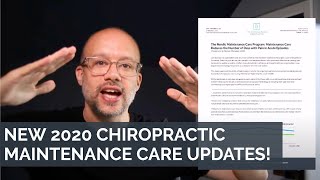
Dr. Jeff Langmaid (The Evidence Based Chiropractor) presents a brief YouTube talk summarizing the Nordic Maintenance Care Program study on maintenance chiropractic care for low back pain. He highlights that the study showed fewer days with pain and longer time between recurrent episodes, and urges chiropractors to use this research to build relationships with primary care physicians through case notes, research-sharing, and meetings to stay top-of-mind and increase referrals. The video also frames maintenance care as a conservative, non-addictive option appropriate for patients with recurrent low back pain who responded well to initial care.
Chapters
Hey, what's going on, everybody? Dr. Jeff Lingmate here with the evidence based Chiropractor. And I wanted to talk a little bit about what you see on your screen right there, which is our May research. It came out last week, so if you did not see it in your inbox, be sure to comment below or shoot me an email and let me know. It was released on the 25th of each month, just like every research brief. And this one is a great one. This was a paper that came out just this year, the Nordic Maintenance Care Program. This study got a lot of press within and outside of chiropractic as well. I think it's a great piece for you to stimulate conversations to further those relationships and ultimately to showcase your practice, which is what it is all about. So I'm going to talk a little bit about that research, also break down a little bit of what I am hearing and seeing out there in the relationship building world. I know the last few months have been crazy, there is no question about that. However, what I have seen and heard time and time again is that now is the time to bridge the gap and build those relationships. The volatility in the marketplace gives you an opportunity to get out there and get attention. We have seen a ton of primary care offices whose volume kind of fell off a cliff. So guess what that means. That means that you have more opportunity to get your name in front of those docs. There is less noise in the marketplace, but you have to be willing to take those steps, right? Case notes, research and meetings. Make sure that you are stepping on the gas with all of those. Now meetings might need to take place digitally, right? It might be a Skype, an eCamm session, something like that. But please make sure that you are continuing to get out your case notes. If you are seeing patients in practice, which I think most docs are back to building, or make sure that you are getting this type of research out there. Because what I have seen and what I have heard is there are some hospital systems right now that are back to doing 75, 80% of their evaluations. However, their surgical capacity might only be 40 or 50%. So there's a huge gap there and those patients are struggling. So when you can let the docs know in your community, those primary care physicians who are having, you know, they've recommended a patient, maybe to go see a physiatrist, maybe to go see a surgeon. Now that patient's coming back saying, I have to wait who knows how long to get anything done. Doc, this is Killing me. What can I do? You want to make sure that your practice and you are the answer to that. But in order to be the answer, you need to stay top of mind. And ultimately you need to continue to step on the gas when building, bridging the gap. Excuse me. And building those relationships. So with the Nordic Maintenance Care Program study, I found this to be supremely interesting, right? Not only do we see that there are a reduction in the number of days with pain, but. But also the time between episodes gets longer. And I can tell you there is no patient less welcome in a primary care doctor's office than a patient with spine and musculoskeletal issues. They just don't like taking care of it because their tools historically stink. All they have is medication or basically referral. So when the patient's continually going back in, saying, gosh, this is killing me, the pain down my arm to pain down my leg, whatever it might be, the primary care physicians are really put between a rock and a hard place. However, you can be their solution, but you need to keep telling them you need to stay top of mind. I'll get back into the research in a moment, but it makes me think about the old marketing adage of you need seven to nine exposures of your brand for a consumer, a prospective patient, a referral partner, to ultimately really grab onto that and make a decision that was like pre Internet and pre social media. It might require a lot more now, but it doesn't mean you need to stress about it. It means you need to get your case notes out, you need to make sure that you get your research out, and you make sure that you schedule those meetings when you can. So when we look at this maintenance care study, what are some of the highlights and high points of it? Well, you can see them marked as bullets, obviously, on the paper itself. There's a couple key aspects of this that are really important. Number one is we know that low back pain is recurrent and episodic, meaning if you have it once, you're probably going to have it again in the future. And almost everybody gets it. So there is. It's episodic by nature. It's also recurrent by nature. So when we see a research study that showcases the time between episodes can be elongated and the curve essentially, as far as how bad the pain is, is flattened. It's flattened and pushed out. That is a huge, huge win. That cannot be overstated. That is a huge, huge deal. So showcasing this exact type of research to the docs in your community, critically Important they are going to understand when they can get more time between episodes and the intensity of that pain goes down. That is a huge win. And to do it with chiropractic care, to do it with care that's conservative, that's non addictive, that doesn't require medication, surgery, changes in biomechanics, all of these things are hugely, hugely important at making sure the primary care doctor is saying to him or herself, well, I'm going to have less spine patients complaining to me in my practice and if you can unload some of that burden, then you're going to be in a great spot. But to unload that burden, they obviously need to know who you are, which is a reminder, right? You need to stay top of mind with your research. They also need to trust you. That's the design of this as well. The design of this is to showcase trust. It's to build trust and rapport. And then those things like showcasing results through case notes, building that personal rapport in a meeting, those start to go the extra mile to get you exactly where you want to be, which is their number one referral Source. You get 5, 10, 15 docs that you build relationships with in your community that are referring in two, four, six patients a month. You are going to be in great shape and I've seen it happen time and time again. But you need systems and processes. That's why you're here with the evidence based chiropractor. But let me know if you have any questions regarding this study. If you do, drop them down below. Get out there, utilize it, have fun with it. You can talk about this study with your patients as well. And again, a study like this doesn't say carte blanche. Every single patient that's ever seen a chiropractor should come in three times a week. It says the opposite. It says for patients that have recurrent pain, for patients that get that have gotten great relief on initial care or treatment plan, maintenance care is a fantastic option. Now you, as the chiropractor, you can make the decision, does that care require adjustments? Does that care, as with almost everybody, require exercise? Biomechanics, those are things that you can dive into depending upon the specificity of your particular practice. But get out there, have those conversations, have fun with it, bridge the gap and build relationships. Now is the time to do so. And if I can help you in any way, you know how to find me, please feel free to reach out. Jeffeevidencebasedchiropractor.com or you can comment right here in the group. Make it a great day. Have an awesome weekend. I'll talk to you soon. Bye. Bye. Hey, what's going on? If you loved that video, be sure to subscribe to this channel. The evidence based chiropractor puts out videos all the time at the intersection of marketing and research, showing you how to grow your practice while also growing your knowledge, basically base. So if you liked it, be sure to comment down below or hit subscribe and I'll see you in the next video.