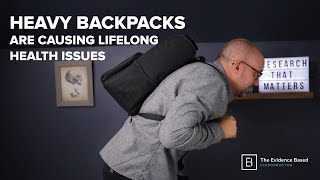
Dr. Jeff Langmaid explains how heavy backpacks compress kids' spines and round their shoulders. Up to 30% of children experience back pain from them. Keep the pack to 10-15% of body weight, use both straps, and fit it snug.
Questions this video answers
10–15% of the child's total body weight.
Up to 30% of children.
Chapters
Hello and welcome to Research that Matters TV where each week we explore the health topics that matter to you and your family. My name is Dr. Jeff Langmaid and I am your host. This week we are going to talk about how heavy is that backpack? If you would like this information as an article, simply type research down below in the comments. It will deliver it to you immediately. So over the course of this video we are going to talk about a couple things that you need to keep in mind if you see your child carrying a heavy backpack, how it could potentially affect their future and and then some action steps you can take to mitigate that stress and eliminate any future back pain in an ideal world. So backpacks, even though an iPad itself can carry a library full of books, it only takes driving down the street to see tons of kids wearing super heavy backpacks, getting on or off the bus or walking to school. Challenge with wearing a heavy backpack is it places a tremendous amount of stress and strain on the shoulders and on the mid back and on the low back that very often in up to 30% of children can lead to back pain. So when you have a heavy backpack, a couple things happen. There's a tremendous amount of compression on the spine. These are the bones or the vertebra of the spine. In between are the discs. The muscles, tendons and ligaments hold everything together. When a child wears an extraordinarily heavy backpack, it places a tremendous amount of compression on these structures. And what happens from there is quite often children round their shoulders. You probably have seen this posture on a lot of people around their shoulders they have to bend forward to compensate and then their chin comes up. And during the development process of adolescence that is an awkward posture to be in. It can affect development future, but it can also cause pain today. So what are some things you can do to mitigate the risks and take proactive steps to lighten the load on that backpack? Well, one is to keep in mind the total weight. Experts would say 10 to 15% of your child's total body weight is the maximum that should be in that backpack. So if your child weighs 100 pounds, you ideally want the backpack to be in the 10 to 15 pound range. If it's pushing 30 or 40 pounds, you know that is way too much and you want to look for items that you can take out to lighten the load. Second thing you can do is keep both shoulder straps on and across those shoulders. Messenger bags or carrying with one strap can cause a great deal of imbalance and compensation and that can lead to pain later on down the road. So make sure your child is wearing both shoulder straps across the shoulders. And then the third thing is make sure those shoulder straps are snug. You do not want to see the weight of that backpack hanging down at their buttocks or even lower. That causes a very great pullback and guess what you do in that case? The child has to lean forward and all of those nasty postural compensations begin. So if you can keep the total weight to 10 to 15% of your child's total body weight, it's an awesome place to start. Secondarily, you want to make sure both shoulder straps are worn. And the third piece of the puzzle, you want to make sure that they are snug and keeping that weight up right at the child's midsection. You don't want it hanging too low. Those are a couple action steps you can take to eliminate any postural changes due to backpacks, and it also can reduce the likelihood of your child suffering from back pain. Again, what we see is over 30% of children have back pain as a result of extra heavy backpacks and we've all seen the postural changes that can occur due to that chronic overload and overstress over the course of their schooling and education. So taking a few proactive steps today can make a huge difference in your child's health and wellbeing down the road. And again, if you would like to have this in a beautiful PDF that you can reference at home, simply type research down below and we'll be sure to send that right over to you. My name is Dr. Jeff Langmid and I will see you next week for another episode of Research that Matters TV.