The 'Holy Grail' of Neck Care: UNBOXING Revolutionary Tech for Chiropractors!
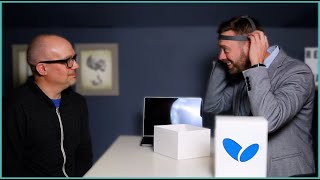
A YouTube interview (Jeff Langmaid with Orey from Net Care) demonstrating and unboxing the Net Care 'Nectar' neck assessment device. The discussion covers device design and usability, FDA testing/fit, clinical uses (range of motion, proprioception, sensory-motor integration), reporting features (range-of-motion, joint position error, 'butterfly' sensory-motor integration report), and the role of objective data in chiropractic/personal-injury care and education.
Chapters
Hey, everybody. You are live in studio right now, and I'm happy to have Orey from Net Care in. In the house, quite, quite, quite literally. And he brought over one product that I spoke of a few weeks ago on the podcast, and it really got my attention not only because of the design, but also because of the ease of use and the extent of the information that can be gleaned from the neck care unit. So you brought out the box. I'd love for you to do a little unboxing right now as well, because as we've discussed, I love great design. And not only is the design great in terms of its user functionality, but even the packaging. So for docs that might not have tuned in earlier, as you unbox that, talk a little bit about what the Netgear device is and how it helps practicing docs.
Yeah, no, absolutely, Jeff. Great to be here. Some people talk about the Apple look and feel. It's definitely a compliment. Right. So as we open it up here we have the Nectar device. This is the hardware device and goes on the patient's head. You do the honors later when we go through the assessment. But what it does is objective assessments of the cervical spine.
Got it.
So anything from range of motion, proprioception in the neck, and sensory motor integration.
Got it.
For chiropractors and other clinicians seeing patients with dizziness, with balance issues, with vertigo, post concussion, post mba, any case that needs objective data.
Right.
And further extensive assessments of the neck, we're here for you.
One of the things that I really like is, and we've discussed it, is there's so many docs out there that are just doing. They're using goniometers, which might be, in my opinion, a data technology. They might also be just using kind of an eyeball test, which is just so subjective as opposed to objective. And some of the reasons why, in my opinion, is dated infrastructure, right? You have tools that the oneiometers are just like a pain in the butt to use. You got wires everywhere. It's just uncomfortable to use in a patient setting. And the other aspect is just not having something that's giving the data the doctor wants. In other words, can I cleanly and easily do the test, obtain the data, process the data, and make a clinical decision without having to become a PhD to be able to figure it all out. So one of the things as you kind of pick this up, and I will right now as well, is, you know, this is such super lightweight. It's flexible, so you really are able to fit it Nearly instantaneously to most people, most of the time where they're able to slide it on and then you can just get after it as opposed to feeling like you're in this quagmire of technology. I know we all love the results that technology can provide for us, but when it becomes a hindrance to being able to get the test, that's a real pain in the butt. And quite often it makes us shy away from things. So talk a little bit about the design of the unit. I know this has gone through an evolution as time has gone on as well. So talk a little bit about the design and why the design in terms of the flexibility and in terms of being able to have good ease of use is important.
Yeah, no, absolutely. So what we are going for and from a design perspective is obviously it has to work. The number 1, 2 and 10 and just effing works, like we say internally. Right. You don't have to think it should just be intuitive and work in a couple of minutes. So we know time is so, so limited in a busy office, no matter who you talk to. So you have to be able to rely on the technology and it has to work and be quick and efficient. And then as for the design, obviously as well, it has to. You know, we've done extensive tests on this as well from an FDA perspective, so we have that covered. But also we have like this, you know, BOA system, pretty, pretty neat. So, you know, we haven't had a patient that this hasn't fit it yet, but super easy, intuitive, and that's what we're going for.
I love that. And talk a little bit about if docs out there. Visit and we'll drop the links down below. Please visit the website and connect with the team. But you really take education seriously, whether it's partnerships with institutions, whether it's with technique and learning institutions. Talk a little bit about how research and how real implementation at an educational level informs back to being able to make it good for just an individual practicing doc.
Yeah, so I mean, research is, you know, the core of what we do. So, so we really like to be on the forefront there. But what our, you know, customers and clinics and clinicians are also asking for is, hey, educate me like I want to learn more. What does proprioception in the neck even mean and how can that help in my clinical decision making? And, and also that ortho and neural world, you know, in my experience, those have been very, two very different schools and professions. You know, if there's a neural case Like a concussion. You know, the typical orthopedic chiropractor or professional just pushes that out, refers that out. What we've been able to see is actually people don't have to refer out as much because hey, they are now getting comfortable in looking at those cases. And the same for the neuro people, hey, I can actually look at the neck because the neck is involved in so many of those cases. The cervicogenic dizziness, cervicogenic headaches. You can't actually suffer a concussion without having a neck related trauma as well.
And let's dive a little bit deeper on that specifically related to the docs out there. Whether you are 100% personal injury, MVA or maybe it's just a portion of what you do, but it's an important component. We always make the jokes. We'll ask a doc, you know, what percentage of your practice is personal injury. And if they say 20%, we say, oh, it's 80% of your revenue. Yeah, 20% of the volume might be 80% of the revenue. So it can be a small. Even in practices that are MBA specific, it can be an important part of their ability to earn, you know, earning income. And, and we all know that tying objective proof of injury and objective data is so critically important. When you're putting together that narrative at the end of the case, talk a little bit about how nat care, how the data that this produces really can make an impact in a case.
Yeah, so I think everything from that initial assessment, but also to tracking progress, so you know, to continue to get that authorization as well or for, you know, prolonged treatment, you have to be able to document. Why is that additional treatment needed? Well, you show that on the data. So, so to be able to objectively document that and then with, you know, the butterfly test as an example, you know, the signature of the neck that we'll go into later, it's not just range of motion, it's actually looking at the, you know, how the eyes, the neck and the head are actually, you know, working together. So I think from that perspective, anyone, a patient, an insurance company or a lawyer can actually look at that data and say, okay, this is off or this is in the right direction or in the wrong direction. Right.
And when you look at reporting within the software, we're going to do a deep dive in a few minutes, but maybe highlight a few of those key reports that are or can be generated.
Yeah. So range of motion reports in under two minutes, proprioception, so joint position error tests, you know, for, you know, probably remember from school, but you know, taught with a laser head mounted laser. The patient closes their eyes and they try to find their neutral position. And then the butterfly report as well. The sensory motor integration that I had night coordination.
Got it. And talk a little bit about that butterfly report. Many docs listening and watching might be familiar with the range of motion, the proprioception, but the butterfly might be new to them. So maybe first define sensory motor integration as you see it. And I'll ask you secondly to point out how does the butterfly test showcase that and why is it important?
Yeah, it's, you know, common to just look at things in a silo. Like look at eye movement, for example, just on its own. Well, the neck and the eyes are actually very connected and there are muscles in the neck here that, that are directly tied into, you know, ocular motor and the vision. So you cannot just ignore the whole system and just look at things isolated like just, just look at the neck or just eyes or you know, brain activity as well, like from a cognitive perspective. So to be able to perform the butterfly test, you really have to and perform well on it. All these systems have to work and they have to work well together.
Thank you so much for watching this video on the evidence based chiropractor channel. If you don't want to miss a single thing, please subscribe to YouTube channel so you can get notifications of every video we put out. And we put out new content each and every week, so be sure to subscribe today.










