Tiger Woods Back Surgery Explained!
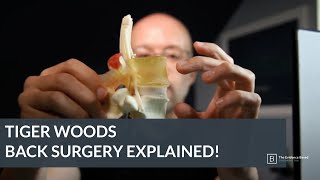
Dr. Jeff Langmaid breaks down Tiger Woods' spine surgeries: a bulging disc at L5-S1 that led to multiple microdiscectomies over 3.5 years, then a final fusion with implant and fixation. Recovery takes 6 to 18 months, with risks like adjacent-segment disease, but intensive rehab helped Woods return to play.
Chapters
Hi, My name is Dr. Jeff Langmaid with the Evidence Based Chiropractor, and I am on this video going to showcase to you exactly what happened with Tiger woods low back. He is arguably one of, if not the greatest golfer of all time. But in the last few years, he has been plagued with low back injuries that have resulted in multiple procedures that culminated with a spinal fusion he had just a couple years ago. Now, he has been fortunate to bounce back and perform exceptionally well after that fusion. I'm going to showcase to you exactly what was going on with his low back, exactly the type of surgeries that he had, and even offer some theories on how he was able to bounce back, recover so well, and ultimately go on to win additional Tour Championships. If you have any questions whatsoever, feel free to leave them down below. I'll do my best to answer. And if you like this video comment, hit that like button and subscribe to this channel. Tiger woods back issues go back many, many years. So us, me as a spine physician, we know that golf is one of the most stressful movements that you can place upon the spine. And a lot of that is due to shearing forces. Your spine does not mind compression or direct downward pressure you, nor does it mind bending. But when you combine motions and you sort of have that lift, twist and bend, which is exactly what happens with every single golf swing, those shearing forces can create an unbelievable amount of stress and trauma on the discs of your low back. And as his training regimen is very well known, he got after it. So. So those millions upon millions of golf swings that he took, and you're always swinging the same direction, that can place an unbalanced load and an incredible amount of stress on your spinal joints. This model here showcases the bones, or the vertebra, and the disc directly in between. Down the backside are where the nerves run, and then between each vertebra or bone is a hole that we call the foraminal canal where the nerve travels out. So one of the greatest challenges that Tiger had was he was having incredible pain that was traveling from his low back into his buttock and leg. That pain is what we call radiculopathy. And all of that means it all started with a pesky disc. So his disc in the low back at the L5S1 level, that's the last or lowest level of the low back, right as it meets the pelvis, he had a disc bulge. That's what started all of this. And the disc bulge was pressing backwards. The disc had bulged out and was pressing into the Space where the nerve travels out. That is a very, very delicate space, and that creates compression and irritation of the nerve itself. So that creates pain wherever the nerve's traveling to. And at L5s1, that nerve runs all the way down the back of the leg, into the calf, and ultimately into the foot and ankle. So Tiger had a disc bulge that was pressing right back in to where that nerve travels out. So the first thing that he had done was what became a series of what's referred to as a microdiscectomy. A microdiscectomy is a minimally invasive spine surgery procedure where somebody goes in with a small tube and very delicate instruments, and they trim back the piece of the disc that has gotten into the space of the nerve. You trim back that disc a little bit, and then you can seal or cauterize the edge of the disc to give the nerve space to travel out and down to take the pressure off the nerve and decrease the pain associated with that compression. Challenge with that is that it doesn't work every time. And when Tiger went back out and continued to play golf, continued to go through his training regiment, he struggled and had multiple setbacks. So actually, he had three microdiscectomies in a matter of about three and a half years. Those three microdiscectomies are actually more than many doctors recommend. Usually, once you touch a disc twice, if you have two microdiscectomies, you really don't have any other option but to go to a spinal fusion, because Tiger is Tiger, and he had the opportunity and the Dr. Team necessary to try three microdiscectomies. But ultimately, the more that they kept chipping away at the disc and taking portions of the disc out, that further contributed to the likelihood that the disc was going to continue to have challenge. You just can't work on them forever. Additionally, when you start taking pieces of the disc out, it creates a situation where there can be advanced degenerative changes. And the more that you take of the disc out, the more compression occurs, bone to bone. The holes where the nerve travels out close down even more, and you start ending up in a really bad cycle of taking out disc bone, collapsing, temporary improvement, but ultimately suffering the same fate, which is compression and pinching on the nerve, causing inexplicable pain traveling down the leg and buttock. So where he ended up with was a spinal fusion. That spinal fusion is called an alif, an anterior lumbar inner body fusion, A L, I, F, anterior lumbar inner body fusion. Now, that procedure of Fusion is always the last resort, because effusion is changing the biomechanics. It is getting one bone to fuse to the bone next door to it in an effort to stabilize that area and reduce the problem. So when they do an anterior lumbar antibody fusion that takes place through the front, so anterior with Tiger, by all accords, they made a small incision in his abdomen or on the front side to access the disc, which is sort of an interesting way to think about going about it. But in some cases, it can actually be more safe and effective to go from the front to access the disc as opposed to the backside. And especially in the lower lumbar spine or the lower low back, which is exactly where he had his issue at L5S1. That last low back vertebra, as it sits on top of the first sacral vertebra, which is really part of the pelvis. What they did at that point in time is they can go in and clean out as much of that remaining disc material as possible. They take all of that disc material out of the way. But then you have to think about, well, if there's no discipline that is gonna collapse one bone on another. So what they do, the surgeon will do, is put an implant in there. They utilize an implant, which is a small box that essentially takes up the space of the disc, that enables there to be disc height so that the holes on the backside can open up, and you can trim back any of the overgrown bone or disc at the same time. That takes care of the issue. Now, that implant is designed for the bone to eventually grow through it. It has a variety of proteins and growth factors that enable one bone, the top bone, to, through that implant, fuse to the one below and stabilize that area so they'll no longer be any pinching or compression. And once you remove most of the disc now there's not the opportunity for that disc to poke back anymore because the area is stabilized and most of the disc material has been removed. But that fusion process takes 6 months to 18 months to really take hold. So that's why screws are also used at the same time to hold everything in place as the bone or the allograft forms from the one vertebra to the other. The goal of all of that is to take the pressure off the nerve to stabilize the area, to reduce the pain, and ultimately to prevent things from happening again. Now, in Tiger's case, he is a miraculous recovery story from spinal fusions, because historically, spinal fusions can be very difficult to recover from and quite Often they do not give the desired result that many people expect, which is full pain relief and no problems moving forward. Tiger seems to have gotten an unbelievable result. But one of the challenges that he'll have to look out for long term, as well as anybody that undergoes a spinal fusion, is that when you fuse two bones together, it places additional stress and strain on the levels above and below each vertebra. Each bone in your low back is designed to move a little bit, and they all balance the load that's placed upon the spine through gravity and motion. What we do each and every day, when you fuse two bones together, it basically acts as one bone over time. And that places additional stress and strain above and below that surgical site. We call that adjacent segment disease because we can see accelerated or advanced degenerative changes above and or below a fusion site as a result of the fusion itself. So that's something he'll want to keep an eye out for as time goes on. It certainly seems like with his conservative care team of therapists, of chiropractors, of the massage of acupuncture, his care team, I'm sure, is guiding him in the best way possible to mitigate any of those challenges long term. But ultimately, that is the case of what occurred with Tiger woods surgery. That's explained. He had multiple microdiscectomies, he ended up with an alif, and he's playing great right now, but he's going to want to keep an eye out for his future. If you have any questions about spinal fusions whatsoever, feel free to leave them down below. If you like this video, hit the like button and be sure to subscribe to this channel. My name is Dr. Jeff Langmaid with the Evidence Based Chiropractor and I'll talk to you soon.









