Top 3 Reasons to Avoid Epidural Steroid Injections | Podcast Ep. 449
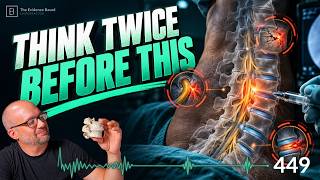
Podcast episode by Dr. Jeff Langmaid (Evidence Based Chiropractor) discussing why epidural steroid injections (ESIs) are often a poor choice for neck, mid-back, and low-back pain. Main claims: ESIs are not FDA-approved for epidural/spinal use, have limited and diminishing effectiveness, and contribute to joint deterioration and increased fracture risk; movement-based care/chiropractic care is presented as the preferable approach and follow-up after injections.
Chapters
Foreign hello and welcome to the Evidence Based Chiropractor. I AM your host, Dr. Jeff Langme. Today's episode we are back with more research. I recently had a reel go semi viral and it was all around epidural steroid injections. It struck a nerve, no pun intended. And on today's episode I wanted to revisit one of my favorite episodes that really deals with this topic in depth. So today is going to be all about epidural steroid injections. Why? Quite often they might not be the best idea and we're going to get into that much more in today's episode. Before we get started, I want to say a few words about Patient Pilot by the smart chiropractor. Patient Navigator is launching tomorrow night, Tuesday, 6pm Eastern. Please join me where I'm going to show how patient navigator within patientpilot makes patient reactivations faster, easier and better than ever before. Additionally, if you're looking for objective assessments of the cervical spine, neck care is where it's at. Neuromusculoskeletal control, proprioception, range of motion and sensory motor integration. They're doing all of that and much more in the best technology suite I have seen in a long time, neckcare.com and finally jnapp. It is the EHR and clinic management software I use in my practice and I'd encourage you to check. Why? Because the Jane team knows that when your workday is spent providing care to your patients, you can feel like there aren't enough hours in the day for the rest of your admin tasks. Their software makes it super easy. It is a joy to use, which is rarity in the EHR world. And I'm going to encourage you to click the link down below, have a conversation with them, schedule some time, see if you can streamline your workflow to free up time for yourself in your practice. But without further ado, today's episode is all about epidural steroid injections. The top three reasons Epidural steroid injections are probably not a good idea if you are somebody that has neck, mid back or low back pain. And this is an important component for us as chiropractors for a few different reasons. One is that we have patients that come to us and ask us questions straight up, do you think I should do this or not? And that's a very real thing. Number two is we see patients who are currently getting injections elsewhere. We all have it go on whether we want to admit it or not. It's the way that life works. And we need to be aware of what some of those side effects are, what some of the challenges are so that we can take care of our patients in the best way possible. And then number three, it's important to be able to guide a patient through a pro, even if they're not currently getting injections and they haven't asked the question yet. It's really important for us to be able to guide our patients as clearly and as effectively as possible through the challenges that they might have. And here's why this is so important. Before we get into the three reasons, and I've seen this happen before and I've seen it happen many times, is a patient comes in, they get great results with the care that you deliver, they move along with their life, the pain comes back because something else occurred. And then they go to a medical doctor, a pain management doctor, a physiatrist, and start getting injections. And if you see them or you ask them, or chances are if you ask them, they won't give you this answer. But if they ask their friends, they, they'll tell their friends, chiropractic didn't work, the pain came back. Now, lo and behold, they went back to the same lifestyle, the same negative thoughts, the same lack of movement and exercise. This is just real life. But many times these people, I wouldn't say hold what we do accountable, but they have unrealistic expectations and then they go another direction. You want to try to thwart that as much as you can before it gets to that point through great communication, kind of a conversation for a different day. But this sets the stage for why understanding these top three reasons is so important for all of us. As chiropractors and as somebody who practiced in multiple multidisciplinary practices, I've been around physiatrists, pain management doctors, orthopedic surgeons, neurosurgeons, day in and day out. I've co managed thousands, literally of patients with them. So I understand how they go about their care and treatment at a pretty good level that I feel really comfortable with. And I've seen how they take care of patients and quite often movement based care is not exactly highlighted. And it's not because they don't like their patients or trying to give bad advice. It's quite often because of their training, lack of experience and knowledge specifically with who we are and what we do as chiropractors. So while they might refer to physical therapy for a short bout, that's really in many cases, I'll just say it as it is in orthopedic groups, that's a stopover on the way to Injectionville. So that, that, that's something we all need to be aware of, all have the context for. So when we're building relationships, if you're a member of the evidence based chiropractor, you're out there building referral relationships, or whether you're a member of the smart chiropractor and you're getting out there to your community with great information about who we are and what we do, you kind of know what's going on across the street, so to speak. That helps you be able to communicate at a higher level and at a more realistic level to where your patients are at. But let's dive into the number one reason, and these are in no particular order, but number one reason is gonna be probably the most surprising reason you've heard. Believe it or not, epidural steroid injections are not FDA approved. Now, I don't believe that FDA approval in and amongst itself is this wonderful stamp of approval. There are plenty of awesome tools, technologies and treatments that are not FDA approved that probably should be. There's a lot of politics that go into that. But, but most people have no clue about that. And if you asked the average person out there, if you asked the average person who's already got injections, hey, were the epidural steroid injections, esi, spinal injections that you received, is that FDA approved? They'd say, of course it is. My doctor would never do anything that's off label. Every time that that is done, it is done off label. The FDA has never cleared cortical steroids to be put in an epidural space specifically relative to the spine. It has not happened to date. 99% of the public, in my opinion, is completely unaware of that. And it's an important thing that people should be aware of that. It's, that's an off label. And there's, I'm not saying good or bad, but it is what it is and many people are completely unaware. So that might be a reason to think twice more than not to have it. But it's an important component that people need to understand. Number two is really a good reason not to have it. And that is absolutely limited effectiveness. We have seen a preponderance of research come out over the last 10 years showcasing just the inadequacy of epidural steroid injections. Now, in my opinion, some of the cases where they are advantageous are people with very clear pathology. Breakthrough 8 9, 10 out of 10 pain that is acute and they need to get over the hump just to have any chance of getting moving. And they don't want to wait weeks or months to be able to really loosen up to begin movement. Now that is thankfully rare. Many people out there, millions of people utilize these. Or I get my three injections a year, right? And they go in each, you know, quarter roughly and they have an injection to tide them over till the neck. Those are ineffective in and they're actually counterproductive one, because they deteriorate the joint as we'll talk about in number three. But number two, they don't address the cause of the issue. If somebody has a structural issue and you're dumping steroid on it, chances are they're gonna feel a little better for X amount of time because that's the way steroids work. But it's not addressing anything to do with the pathology and the cause of the challenge. That is why movement based care over the last 10 years as research has absolutely crushed epidural steroid injections and rightfully so, it's also highlighted and put on a pedestal movement based care because that's where healing actually occurs. Dumping steroid on something is, chances are it's going to make it feel better for a short amount of time. And guess what? That time continues to get shorter. There's also the law of diminishing returns with steroid injections. I have seen one person in my entire career who I saw at the orthopedic group. They came in, I, I asked them about their history of, I believe it was a low back issue, not a neck issue. But I remember them saying very clearly said, I had one injection 25 years ago and I've been feeling great until last week. That was one person in 25 years. And that was probably because almost anything would have helped them at that point in time. I don't think it was the injection doing a great job. So my point of this is that injections do not address the cause. If somebody has a structural issue, they have a disc getting into a cavity that it shouldn't be, whether that's the spinal canal, whether that's the foraminal canal, whether that's inside of the lateral recess, if they have pathology, disc, bone or ligament getting into a space where it shouldn't be irritating a nerve causing radiculopathy, they have a structural issue. Now can that dumping of steroid make things feel better for a short amount of time? Again, probably so, but you're going to have diminishing returns, you're going to have sensitization and it's just not a long term fix. The other component of this going hand in hand is number three, which is joint deterioration. Steroids break down joints over time. And that is something that us as chiropractors need to be very in tune with. Many of us don't dive deep enough, in my opinion, with our patients understanding just how many injections they've had. And why is this important? Because when spinal injection takes place in epidural steroid injection, ESI, there's an increased risk of spinal fracture by over 20% every time an injection is given. So those individuals coming in after a decade of three shots per year, you need to be cautious. I'm not saying don't adjust them hands on. Most of the time you should. But you need to be aware of the fact that they are going to have potential challenges and they need to be aware of as well. Because if something happens, understanding the history is super important. Because quite often they might be walking into your practice a fracture risk because they've received 27 injections over the last X amount of years, as opposed to coming in and taking maybe an NSAID or something to that effect that just hasn't shown that fracture risk to date. So understanding that and taking that to heart is important because there is joint deterioration. Corticosteroids break down joints over time. It is why you can't live on them. Not only are they relatively ineffective, not only are they not FDA approved, but they're actually counterproductive long term to healing. And some of this goes even deeper into the biochemistry, which I am not an expert in by any stretch of the imagination. So I'm gonna oversimplify it a little bit right now, but in general, when you put the corticosteroid in a space, the healing process actually completely stops. And it's not until the body really flushes out the steroid and the remnants of it that you're able to start the healing process. So it actually prolongs the healing process while deteriorating the joint while increasing the risk of fracture on top of the fact that you can end up with other complications and risks as well. Now, the risks for steroid injection clearly are not as large or as extreme extensive as the risks for a surgical intervention. But they are way more than going in and getting a spinal adjustment, that is for sure. So kind of recapping here and setting the stage one spinal injections, ESIs are not FDA approved. They have ridiculously limited effectiveness and most clinical guidelines at this point are not recommending them in any meaningful way. And number three, there's joint deterioration. Now the other side of this coin is there still are 10 million plus of these injections performed each and every year. So they are happening each and every day in your community. Should most of those people be in your practice? Absolutely. The question is, what are you doing to get out there, bridge that gap and help people understand who you are and what you do? That's where I'm gonna encourage you to look towards. If you're into relationship building with other healthcare providers, check out the evidence based chiropractor. We've helped hundreds of chiropractors generate tens of thousands of referrals. Happy to help you. Or if you're interested in getting out there more to your community, you're looking to increase new patients, improve your attention and get more reactivations without spending money on advertising. Head over and check out the smart chiropractor. But it starts with understanding some of this research, some of this literature, and understanding how you can communicate it to your patients, not in a fearful way or with fear tactics, but in an understanding way that helps them make an informed decision. When people are getting injections each and every day, that don't address the cause whatsoever, that really address nothing more than a temporary pain relief, and sometimes it can be super temporary, almost non existent, and increase fracture risk on top of the other challenges. This is something everybody needs to be aware of as they make an informed healthcare decision. Because the bottom line is this, I'm just gonna get, I'm gonna level this straight out. Is that even if they choose to get an injection, the first place they should go after they get the injection is back to your practice to start movement based care. So out of those 10 million plus people per year, 10 million injections plus per year, I think it's 25 million. All of those people should be coming back to chiropractic practices with very rare exceptions. Because even if they receive an injection, that does not mean you stop movement based care. That means you should actually be doubling down on movement based care. Because the injection, all of the challenges with it need to be overcome. So that is why this topic is so important. I hope you can tell I'm passionate about this topic because there's too many people out there that go through that journey of professional indifference. If you've ever heard me speak of this before, person has a little bit of numbness and tingling in their arm or leg, they notice it at work, they go into their primary care, physician Primary care physician prescribes medication. The medication, quote, unquote, doesn't work because they have a structural issue. They become sensitized to that medication super quick. They go back to the primary care physician. At that point in time, an MRI is ordered. Primary care doctor says, ah, a disc issue, which they should have picked up on before they even prescribed the medication. At that point, they ordered over to the pain management doctor because it's a quote, unquote disc issue. And at which point the pain management doctor gives a series of injections while that person is essentially on the fast track to surgical intervention. I like to call that the journey of professional indifference. It is what happens every day in all of our communities, like it or not. But that challenge is our opportunity to get out there, get out there to our community, help them understand, as I like to say, proactive. If you're not proactively answering the questions people in your community have about their health through your emails, through your social channels and through every channel you have available, then you're probably doing them a disservice. And that's a raw reality there. But all of us need to be stepping up our communication, ensuring that we get out there to other healthcare professionals and our communities so that they can avoid that journey of professional indifference. And for every person that does that is a huge win for all of us, for all of them, for their families and for our communities. If you're a doc looking for the next step in your career, so visit us at Chiro Matchmakers if you're looking to have a new position. We have over 100 positions available right now, paying $85,000 plus base salary. Chiromatchmakers.com or if you are looking to hire a new DC or a CA before the end of this year, have a conversation with us. Far too many chiropractors waste a ton of time and money and have way too high a turnover because they don't have a proper system and process. They don't do behavioral testing, they don't source, vet and interview in a way that makes sense. Our team Chiro matchmakers, they have 14 recruiters working full time that do this all day, every day to make your life so much easier. And people tend to stay long term when you hire the ideal person instead of just a warm body. So if you're looking at building your team CA or DC, head over to chiromatchmakers.com, hop on a call, chat with somebody, see if we can help. Otherwise, I thank you so much for being a Chiropractor for tuning in and listening. If you haven't left us a rating or review, please do so. That helps more and more docs Find out about this podcast. Have an awesome week in practice and I will talk to you soon. Thank you for joining us on this episode of the Evidence Based Chiropractor. If you want to grow your practice, come back for next week's episode. If you want to go faster, visit the evidencebasedchiropractor.com and join our MD Marketing membership today.










