Transform Chiropractic Care: Range of Motion Portable Assessments!
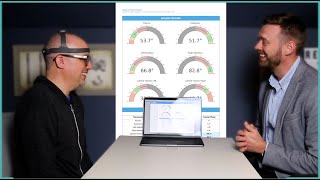
Jeff Langmaid demos a portable ROM assessment system that measures joint angles to a tenth of a degree and color-codes results against normal ranges. Athletes get baseline testing on the sideline, patients see their progress in printable reports, and clinics can bill using CPT codes for the measurements.
Questions this video answers
44 grams.
53.7 degrees.
Lateral flexion left: 33.7 degrees; rotational-plane compensation: 8.4 degrees; sagittal-plane compensation: 12 degrees.
97750.
97112 (neuromuscular re-education) and 97110 (therapeutic exercise).
Chapters
Yes.
Take a look at some of the software. Let's take a look at some of the reporting. And also I'll, I'll do a few tests.
Yeah, no, absolutely. So let's put this on so, you know, you can do the hours. Okay, Just gonna turn this on in.
Good to go.
Yeah, put it on and then you can tighten it. Yep, just like a snowboarding there.
Yeah, There you go. Okay, great.
Okay. It feels nice. Yeah.
Is that a good position?
Yeah, absolutely. You can be an accurate model. So what we have here is web based platform, so accessible from anywhere as long as you have Internet connection.
Love that.
And super portable as well. What we have actually seen, I mean, just, you know, yesterday we got news from, from one of our customers up in New Jersey. They went out to a college and did a baseline assessment of all the athletes.
Right.
So the baseline concussion assessments for, for the, you know, whole team being able to generate additional revenue.
That, that's awesome.
And new patients as well. So once someone suffers a concussion or you know, contact, who are they going to go to?
Right, right. The doctor that made those baselines. And I want to point out, I just want to highlight as you, as you dive in here, for everybody listening and watching exactly what you just said, this is ridiculously portable. I mean, we're talking about a device that probably weighs an ounce or two. I can't.
Yeah, 44 grams.
There you go. And then, you know, a laptop, a tablet that the doc is already going to have with them and being able to get out, I see one of the biggest areas of growth and everybody that's following me knows, I talk about how many young dogs fancy themselves as sports chiropractors. So being able to have another really technology driven, yet foundationally data backed way to do objective assessments with and around sports teams in your community is a massive opportunity to be able to get your name known, to be able to have a little bit of an advantage as other dogs may be competing for that attention with those teams, but also be able to provide it ridiculously high value service that doesn't require you as a dog to have to bring a ton of gear. I mean, you literally bring a piece of equipment that weighs 44 ounces or 44 grams. Excuse me, and the laptop or tablet you're going to have with you anyway. And you can provide, we're going to look at in a moment, a variety of tests in short succession that can be really, really meaningful for those athletes long term and are super meaningful for you as a practitioner if they decide to come in to see you in the future. You have baselines pre injury or pre. Whatever that reason is. That's a massive value add. So I hate to take you off topic, but I love opportunity to be able to connect and engage on the sideline, in, you know, in the locker room, wherever it might be with these teams in a simple, easy and fast fashion. Cannot be overstated.
Absolutely. And there's another element there, you know, is the relationship with parents, you know, or for those. Those, you know, student athletes.
Yep.
So to be able to have a documentation that, hey, there's actually something wrong.
Right.
It's not the overly eager dad. Like, hey, there's nothing wrong with him. Let's put him back on the field. And to be able to show the dad or the parent, hey, do you really think that this looks right? Right.
All right, so this is the portal. So your patient information on the front page. Easy clean. The other thing I love is the design not only of the hardware component, but the software as well. Super clean, super easy to see what's going on, which is so valuable in a busy practice, being able to use the system as you said. So take it away.
Yeah. So we have assessments and exercises. We'll start a new assessment here. And we have different assessments. You know, pain scale, it's a subjective rating to know what's your neck pain today. But then we have range of motion geoposition error for the proprioception and the butterfly test for the sensory motor integration. Let's start with the range of motion. Everyone does range of motion measurements. You know, measurements. But, you know, that eyeball test is. Is obviously the, you know, most widely used. The goniometer. Yeah, it's still being used. But let's. Let's see how you do here in a very objective way. Oh, boy. So the only thing you need to do is sit still. Relax in neutral position. You ready? Okay. So we will start you with flexion. So chin to your chest. Great. And then come back to neutral. And then extension. Look up to the ceiling. Yep. And then track down and then up to extension. Perfect. So you may now relax. So how did that feel?
Good. It's rare that I push to the end point, so I'll be interested to see the data because I'm like, oh, boy. I probably never look up that far. So it's interesting. I'm excited for sure.
So now we do rotation. Sure. So the only thing that you need to do now is turn left. Yep. And then right. And then left. And then right. That was that awesome. And then last. But not least the lateral flexion. So in a neutral position. And lateral flexion left. Lateral flexion. Right. And we will see that.
Yeah, yeah.
So that was that.
All right.
Easy. Yep. And now, even though you love documenting things manually, we do it for you here. We will actually see your results. Okay, so let's zoom out just a bit here. So we also then compare it to normative data.
Got it.
So tell me what you see.
Okay, so it looks like my flexion is within the normal range of motion, which is great at 53.7 degrees. My extension A little bit less, you know, just one standard deviation or less out of norms. Just a couple degrees up.
Yeah.
My left rotation looks good. And within normal data. My right rotation is cooking. We're doing really good. I'm at the top end there. And then my lateral flexion is just about within normal. You know, lateral right is more normal than lateral left, but lateral left is just off.
Yeah.
How's my interpretation?
No, great, Great. And the only thing that I would probably point out here is that your right rotation is doing fantastic. You are actually pushing towards hypermobility.
Interesting.
And that's another data point that a lot of people are so happy to have here. And that wouldn't be visible with the naked eye.
Right.
And so the discrepancies here between your left and right rotation might actually be something we want to look at and something that, for example, might be needed.
Yeah. And I want to just point out, as you kind of showed, put me on the spot to read that. I've never really read a report, so it tells how intuitive the report is that I can literally go through it that quickly and be able to identify. Two things that I want to point out for everybody as we bring this up on the screen is one, you're going to get the degrees to a tenth of a degree, which is awesome. There's a lot of specificity there, and it's objective specificity. The second component is what I was looking at cheating a little bit not knowing the numbers off the top of my head is that the graphical representation of what I'm going to say is your red zone, your orange zone, and your green zone. Red being, you know, clearly dysfunctional, yellow being close to normative, and green being within the normative data set. That was a massive help for me because I'm not somebody who particularly thinks about these numbers day in and day out. So being able to have a visual cue on what's normal. Also, you know, pretty much everybody knows red, yellow, green. So even from a lay Perspective. If they don't know, your patient, as you're discussing this, doesn't know the exact degrees, they don't need to. To be able to know, okay, great. Where am I doing great? And where do I have areas of improvement?
That's awesome.
Great.
Yeah. And you're spot on there. Also, from a patient perspective, you know, they will not understand 53.7, good or bad, they will know that a green is good.
That's right.
And for the clinician, we also have additional data here, and you alluded to it there. When you did lateral flexion left, there was some rotation or some flexion extension actually going on. So you had 33.7 degrees in the lateral flexion left. However, you also had an 8.4 degrees in the rotational plane and 12 degrees in the sagittal plane. So you were not doing this. You were actually doing this.
If you can see, I was really shading. Yeah.
You were compensating.
Yep.
And that's also, you know, something that. That a clinician would definitely take a look at.
Yeah, this is. That. That's really interesting. I'm going to say specifically from a chiropractic perspective, you know, and I'm not a chiropractic technique expert, but when I think about lines of drive and when I think about when you're getting in there to deliver an adjustment and not only knowing, okay, you know, many people will eyeball it, okay, they're a little restricted to the right, but being able to have the specificity of, okay, they're restricted to the right, but they're also compensating in the sagittal plane, they're compensating with some rotation as well. To me, I think about that from a. From a technique perspective and say, okay, that can actually impact how I deliver the adjustment and the line of drive based upon where I know either the restriction or compensations are happening, or where I know that there's a little bit, as we saw with some of the rotation, maybe a borderline hypermopolitan. And now I'm able to increase. I always feel like when you increase the specificity of the adjustment that you deliver, you give yourself the opportunity to at least improve the result of that adjustment. So I love that because that's a data point I can say I have literally never seen before is, okay, great. When I'm doing a range of motion test, I'm used to seeing the data for that play in, but never the compensatory data for the additional planes. That's awesome.
Yeah, we hear That a lot. And like you said as well, after adjustment, you might actually go slightly down here in the right rotation, but you might be isolating the movement way better. So you're becoming healthier with a better posture. But you'll be able to see that black and white on the day.
That's awesome.
So yeah, any, any questions on the, on the range of motion report?
So if I have this, what do I do with it from here? So is this something where I can easily print it out? Can I make a PDF and attach to a chart? What are my options?
Yeah, so normally, you know, we have both the print and the download functionality right here. So normally what people do is, is they download it and you know, upload it into the patient's file in the EMR system.
Right.
So yeah, if that's.
Yeah.
Doesn't matter what, what BMR system, you're.
Like, great, love it.
And then print it out. And for the patient to take home with them, they feel added value. And then also just to be able to explain here, you know, the patient doesn't have to explain, understand everything. But hey, this is my justification of your treatment and why you need to do this and this and this. It's right here.
That's a really great point. I think about this in terms of the impact it can have in a report of findings. Whether your report of findings is a, is a digital packet, whether it's a phys packet, you know, whatever case it might be being able to highlight. Again, I think this is a challenge that many chiropractors out there have and it's challenge that I've had in the past as well. How do I deliver my message simply right where there's enough there that a patient can understand what we're doing and why they're here, aside from just the pain, but that also it's not overly complex where now it just becomes that's a hindrance. Right. So I always think about how do you get to. And I think you've done a great job at the recording here. Simplicity. On the other side of complexity, this is obviously doing a lot in real time with very good specificity and being able to communicate that in a simple to digest chart is really impactful because to your point, that's something that is not only great from a clinical perspective, technique, choice, et cetera, but it also gives you an opportunity from a patient education perspective to highlight things in a way that can resonate with people. Oh, I'm orange here, I'm red here. That tells me that there's a problem. And it's not, you know, made up. It's literally specific to a tenth of, you know, to a tenth of a degree in terms of where they were at at that moment in time. And then you're able to show, knock on wood, that positive progression over time as well, which again, further reinforces, you know, the healthcare buying decision.
Right.
When somebody's like, cool, I made a great decision, not only do I feel better, which is important, but I'm functioning.
Yes.
So I love it.
And because we all live in the world of insurance, you know, that's also not to be forgotten, that to be able to have documentation that you can also attach to a case file in an NDA case or when you submit your CPT codes, hey, you attach that report as well. Just you have the documentation objectively. It wasn't just something that you eyeballed and came up with.
Yep. So let's talk a little bit about how range of motion proprioceptive testing plays a role with insurance reimbursement and where you've seen this help doctors be able to get paid for their overall services. But also, is there a CPT code for this or how does that work?
There is. So, you know, the CPT code typically being used is a 97750, okay. Physical performance test with a written report.
Okay.
So it's an underused code. So it's a new code to a lot of clinics that has been, you know, a great addition. And then you have 97112, neuromuscular re education and 97110, when you use the system as an exercise.
Okay, all right. And let's talk about that a little bit. So when you describe the diagnostic versus the therapeutic, so to speak. Right. The exercise versus the testing itself, we. I know this from the strength and conditioning world. Often the test is then, you know, then the exercise. So how does that play out typically in a provider's office that you've seen, is this part of a daily treatment plan? Is this something that's done only on evaluations and re evaluations? How does that work?
Yeah, I mean, it obviously depends on the workflow. However, where we've seen people being able to generate additional revenue is when they incorporate it into their, you know, treatment plan.
Got it.
So you come for the initial assessment, then you come in for. For an adjustment. And then after the adjustment, hey, you go over here to the Necare station, you do some exercises and, you know, the line of sight over oversight, obviously. And that way you can generate additional revenue while the patient is stimulating those exercises.
That's awesome. And could I be doing these exercises while doing other therapeutic exercises as well? Beautiful.
Yeah.
Great.
Absolutely.
Thank you so much for watching this video on the Evidence Based Chiropractor channel. If you don't want to miss a single thing, please subscribe to our YouTube channel so you can get notifications of every video we put out. And we put out new content each and every week, so be sure to subscribe today.










