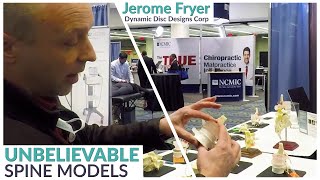
Dr. Jerome Fryer of Dynamic Disc Designs built handcrafted lumbar spine models that show how discs bulge under load. His L4-5 model, still a bestseller, includes detailed pathology like radial fissures and nerve-root encroachment to teach patients how spinal mechanics work.
Hey, Jeff Langmaid with the evidence based Chiropractor. I'm here at NCLC 2017 Dynamic Disc Designs. Dr. Jerome Fryer, unbelievably handcrafted models of the spine. Everybody needs to check it out. He's going to give us some insight into two of his most popular today. Thanks, Rob.
Hey, thanks a lot. This was the very first model that I ever created. This was the first one and it still continues to be the best seller because I've tried to pack in as much anatomical detail into this model as I possibly could for the user. So these are patient education models. So engaging in patients in getting them to understand their own anatomy. And so and I wanted to first of all show a model that had reasonably good disc height because we wanted to show disc height changes under load. And we know often symptoms are related to load whether they're bent forward or they're sitting. So anyway, so I, so I recreated an L4.5 and I worked on getting the disc in an elastomeric form. So now it actually will bulge in a realistic way. And then inside there's, I've created, you know, innervation on the outer third of the annulus. So you can see there's granulation tissue on the posterior annulus. There's radial fissure, a concentric fissure. We've got neo innervation, new nerves that grow into the inner 2/3. That's at Lance Study in 99 by Fremont. Partial radial tear. We've got the end plate. That's what Stuart McGill talks a lot about, the end plate. Little micro fissures in the end plate. And there's end plate pores and there's materials within the nucleus. So you can see which way the nucleus actually migrates under different vector loads. And we know now that disc herniations are very often progressive in nature. So we can teach patients now about what it means to flex, what it means to extend. And when you look at this bolt annular fissure, flexion, load will actually extrude the nucleus.
That's awesome.
So patients can quickly understand that, you know. Yeah, okay. When you change the end plate angles, you don't have to use that language. But if you take the spine into flexion, the nucleus pushes back and you can see that this is the first anatomical model to show the appropriate nerve root getting encroached.
That detail is something I have not seen on anything else, which is big kudos to you because I think that that's awesome.
Yeah. And I think it just helps us explain our findings simply in a way that patients can really connect with their own anatomy. And then they get. Then you have compliance. Right. You know, when patients understand, they comply and when they comply, very often you get better outcomes. So, anyways, that's why I developed that professional model. Continues. There's other. You can get the Ligamentum flavum added to it, so there's extra features you can get. There's actually an audible release feature as well that I've developed, too.
All right. So, Jerome Dynamic Disc Designs. There will be a link below. Check it out. Unbelievable models. You definitely have to use these in your office. Patients are going to have a better understanding of their conditions. They're going to be more compliant as a result of the education. And there's no better education than showing them exactly what's going on in their bodies.