Understanding the 3 Types of Stenosis and How to Find Relief | Podcast Ep. 188
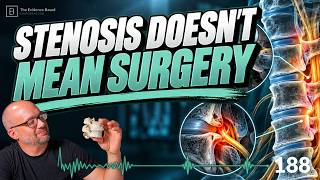
Dr. Jeff Langmaid breaks down the three types of spinal stenosis: spinal canal, foraminal, and lateral recess. Each causes different pain patterns, from bilateral leg weakness to one-sided nerve pain. Research shows chiropractic and physical therapy can help without surgery.
Questions this video answers
About 10 millimeters tall and about 8 millimeters wide.
Over 137% increase in surgeries for lumbar spinal stenosis between 1998 and 2008 (phrase in transcript: 'Between 98 and 2008, that increased by over 137%').
About 80% of patients reported improvement described as good or excellent; nearly 90% reported their outcome as either excellent or good.
Chapters
Foreign hello and welcome to the Evidence Based Chiropractor. I AM your host, Dr. Jeff Langmaid. This week we are talking all about stenosis. We're going to break down the three primary types of stenosis and you'll also learn about the unbelievably great research supporting what you do as a chiropractor for foraminal stenosis and spinal stenosis, and that dives into lateral recess, that third catego. So this is an episode that has practical application and you're gonna be able to have these conversations this week with your patients. Also, big shout out if you're listening during a workout, if you're listening on your commute into the office. Thanks for tuning in. I really, really appreciate it. This is one of the largest chiropractic podcasts in the world based on listenership and it could not happen without you. So thanks for tuning in each and every week. I definitely appreciate it. And huge shout out to everybody that sent in emails with topic requests or feed. I love seeing that and it keeps me motivated to keep going for sure. So thank you a ton for tuning in. This week we are talking all about stenosis, as I said at the top. So let's break things down step by step, work and walk through it and then we can talk about the awesome research supporting what you do. So stenosis simply means pinching or compression, right? We know that no matter where it's happening in the body, stenosis, pinching or compression. So when we look at the first word of that spinal foraminal or lateral recess, all that does is just tell us the location of where that pinching or compression is happening, right? So our three main types of spinal stenosis, or excuse me, of stenosis, are spinal stenosis, lateral recess stenosis and foraminal stenosis. Spinal stenosis we're probably all super, super familiar with that is pinching or compression on the spinal cord or on the cauda equina if you're below that kind of T12L1 area. So the hallmarks of spinal stenos stenosis, pain in the spot of the stenosis, right? If you have spinal stenosis in your neck, typically your neck hurts. If you have spinal stenosis in your low back, typically your low back hurts. But consequently, it also results in symptomatology that goes down from there. And what I mean by that is the classic hallmark of spinal stenosis is fatigue and numbness and tingling in both legs. So you're looking for symptoms that are bilateral by nature, right? Pain, numbness, tingling in both lower extremities is kind of that hallmark of spinal stenosis. Now, incidentally, we also see people with spinal stenosis have a forward flexed posture, meaning when they bend forward, they find relief. They also find relief when they are sitting down. So this is that classic person who goes to the grocery store and is walking around leaning onto the grocery cart. That is like the classic presentation for spinal stenosis because not only when they lean are they able to bend forward, which physically opens up the space to its maximum capability. So it gives them literally sweet breeze breathing relief of the spinal cord. But secondarily, they also lean with their arms, right? So they're taking literal weight off of their legs and off of that, almost like a little traction that they're giving themselves and that provides additional relief. So spinal stenosis, you're typically looking for, again, bilateral symptomatology. You're looking for pain, numbness, tingling, running down both legs. And additionally, people that have what I'll call endurance issues, meaning they have fatigue. They used to be able to walk a mile, then they could only walk a half mile. Now they can barely get out to the male without having to kind of bend over or get into a squat position for a minute to relax. Then they keep going the same amount, but that amount keeps diminishing over time. That's the classic hallmarks of spinal stenosis. And that's taking place, of course, on the spinal, in the spinal canal, on the spinal cord or cauda equina. Then we look at foraminal stenosis. This is really your pinched nerve, right? As people say, I have a pinched nerve. When they say that, they're almost always talking about foraminal stenosis. That's happening in the foraminal canals, left and or right side, where the nerve roots are traversing out the side of the vertebral body. So that takes place kind of behind the disc, posterior to the disc, and the nerve roots traverse out and down. Those canals are only about 10 millimeters tall and about 8 millimeters wide. So if you have a 2 or 3 millimeter disc protrusion or bulge, or you have osteophytes getting in there, or you have facet, excuse me, ligament hypertrophy, just a millimeter or two can start to take up 10, 20% of the overall dimension. And that happens real quick. So foraminal stenosis, hallmarks of that are pain that is unilateral, right? You can have bilateral foraminal stenosis, but by and large, typically people have one sided, oh, I have pain shooting down my arm, I have Numbness and tingling that goes down one of my legs. Those are your classic hallmarks of foraminal stenosis. And then finally, with lateral recess stenosis, it's probably one that's talked about the least amount, at least as far as when I was in school, it was talked about the least amount. But lateral recess stenosis is if you think of your arm like the nerve root and you think of your body like the spinal cord, then the lateral recess is your shoulder. So it's right where the nerve root exits off of the spinal cord. That, that spot right there, that corner, that elbow, that shoulder, however you want to think about it, that is the lateral recess. So that is a super, super tender area. My experience clinically is that people that have lateral recess stenosis typically have really aggressive, really acute sh. Pain. Now, I'm oversimplifying this a little bit, but I believe that a lot of that is because the nerve root yet doesn't have a myelin sheath then. Right. It's not extraforaminal, but it has left, so to speak, the spinal. The protection of the dura and the protection of the spinal cord. So it seems to be the lateral recess is a super sensitive area. Now, typically when people have foraminal stenosis or spinal stenosis, it can kind of meld in, right? There's a little bit of a gray area on the lateral recess there because it's that spot right between the two. So it usually can come along with one or the other. But that's lateral recess stenosis. Now, how do these pinches occur? When we talked about stenosis, pinching, or compression, how does that occur? Well, really, there's, you know, naturally I'm taking out people that had previous fusions or things that are broken inside their body, so to speak. So, you know, failed back surgery syndrome, for instance. But when we look at what causes spinal stenosis, there's really three primary things and three primary things only. Disc, bone, and ligament. There's only about three structures that can get into that space, typically disc, bone, or ligament. So disc can do that by, you know, bulge disc, herniation, disc protrusion, disc extrusion, you name it. Anything where a disc is extending beyond its natural space posteriorly, that is a high likelihood for stenosis, whether that's foraminal, lateral recess or spinal. Secondarily. We look at bone, right? You could have a huge osteophyte, osteophytes that are anterior on those vertebral bodies. No big deal. Plenty of space up front, typically. But if there's an osteophyte that extends posteriorly off the end plate. Oof. That can become a real tight spot. It's like, oh, this hawk's claw kind of sticking right into the spot where the nerve's traveling out. That's an unpleasant situation to be in. Takes decades to get that way most of the time. Or a bone spur coming off the facet. Right. So often we can see facet disease, facet hypertrophy. These sort of things take place as we age and go through the degenerative process. And if that takes place, you know, in an extreme fashion, or, you know, typically we all have some form of degeneration as we age. But if one area starts to really gain osteophytic material, or the facet really starts to look nasty, they could become really big. And that extends into that space where the foraminal canal is, and it can cause a pinching or compression. Or then finally, we talked about ligament, right? Ligamentum flavum hangs out on the inside on the posterior aspect of the spinal canal. The ligamentum flavum typically becomes hypertrophic as time goes on. Now, not every level is the same, and again, it depends upon, are you exercising, what's your diet look like, have you had previous injuries? All of these things, it's sort of the branch grows as the twig starts kind of thing, right? So if you had an early injury that wasn't taken care of, well, as decades progress on and you've compensated, et cetera, a lot of times that can add up to certain areas of your spine looking, quote, unquote, a lot worse than others. And sometimes that causes problems. So ligamentum flavum in the posterior aspect of the spinal canal, I've seen that grow real thick at times. I mean, I've seen that obliterate. Looking at 20 MRIs a day for a couple of years, I saw that obliterate 80%, 90% of the canal in some instances. So ligamentum flavum can become real thick due to load due to injury, et cetera, and that can take up a heck of a lot of space and really pinch or compress that spinal canal. So those are all things to keep in mind. That's sort of the bad news, right? But let's look at the good news. I don't care whether a patient has compression caused by a disc. I don't care whether they have compression caused by a bone spur. I don't care whether they have compression caused by a ligament. There's no reason, in the absence of red Flags not to still go through conservative care. And that's what we're gonna break down next is some really cool research showcasing that. So physical medicine and rehabilitation, part of the journal American Medical association, put out a great paper in 2019. We featured it for all members of the evidence based chiropractor. So you definitely wanna check that out if you wanna bridge the gap and build relationships. But basically what they found was lumbar spinal stenosis accounts for the fastest growth in lumbar surgery in adults in the United States. Between 98 and 2008, that increased by over 137% surgeries for this condition. That's crazy. Now the interesting thing is they also found, quote, it appears that the chiropractic physical therapy intervention has better short term outcomes at two months than non conservative. Right? So really, that's awesome. They also found mounting concern over the rising cost of spine surgery and opioid use make a compelling case for new evidence about safe and effective non surgical and non pharmacological treatments for lumbar stenosis. Well, who do we know that is safe, that's effective, that is non opioid and non pharmacological? That's us, right? So these are the conversations we should be having in our community. The evidence gets even stronger when we look at radiculopathy in the foraminal canal. So a non surgical approach to management of patients with lumbar radiculopathy secondary to herniated disc. So this was a huge disc pressing into that foraminal canal causing radiculopathy. Quote, they found improvement was self described as good or excellent in 80% of patients who received non surgical treatment. Clinically meaningful improvements in pain and disability were found in nearly 80% of patients as well. And nearly 90% of people reported their outcome as either excellent or good. So this is a really, really big deal. And I want you to keep in mind a lot of this stems from the point and from the fact that we're talking about 10 millimeters, we're talking about 8 millimeters, right? These are small space. So if you can decrease inflammation, if you can improve segmental motion and range of motion, just getting a millimeter back, so to speak, for individuals can often make a huge difference in their symptomatology. It's why many cases of spinal stenosis, foraminal stenosis and lateral recess stenosis respond so favorably to what you do as a chiropractor. But please keep that in mind. Please get out there, lead these conversations. You are the best option. You are the best first line option for this bar none medication is going to take the pain away, but it does not do too much in terms of rehab and healing. That is where you come in and that is where you can make a huge impact on the people's lives in your community. So I'd encourage you get out there, have these conversations. If you want this sort of information to get out publicly, so to speak, meaning on your social media channels, on your website, check out what we have going on at the smart chiropractor, thesmartchiropractor.com because that's exactly where we supply that. Or if you're interested in getting this out there to the other healthcare professionals, B2B professional to professional, then check out what we have going on@the evidencebasedchiropractor.com this is the kind of material that we go through in both of those programs each and every month for either the public or other professionals. And we really lay it out in a fashion that enables you to bridge the gap, that enables you to build relationships and that enables you to get more new patients into your practice, but in an evidence informed, in a patient centric in a way that you can be proud of. To me, that's what it's all about. Looking at the literature, understanding what it says and then applying it to how you can build and grow your practice. That's what we do every week here on this podcast, as you well know. I thank you for tuning in. I hope you have a great week in practice and I will talk to you soon.
Thank you for joining us on this episode of the Evidence Based Chiropractor. If you want to grow your practice, come back for next week's episode. If you want to grow faster, visit theevidencebasedchiropractor.com and join our MD Marketing membership today.










