What is a Laminectomy? | Spine Surgery Basics
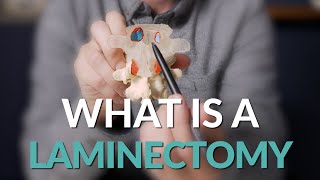
Dr. Jeff Langmaid explains laminectomy, a surgery that removes part of the spine to relieve nerve compression from disc herniation. The procedure can often be done as outpatient minimally invasive surgery, but risks include muscle injury, scar tissue, and potential spinal instability. Conservative care should be exhausted first.
Chapters
What is a laminectomy? My name is Dr. Jeff Langmaid, and over the next few minutes, I'm going to describe to you exactly what a laminectomy is. What are the diagnosis that might lead a doctor to recommend a laminectomy? And finally, why you should maybe think twice before going under the knife. We're going to start right here with this vertebra. These are the bones or vertebra of your back. In between them sit your spinal discs. If you've had a disc bulge, a disc herniation, or a protrusion, these are things that start to tick the boxes that you might have been recommended to have a laminectomy. Because when your disc bulges or herniates, it can place pressure on the nerves that travel out your spine. So on this model, those nerves travel out the holes right here. And if your disc bulges or pushes back, it can create a tremendous amount of compression or pressure on your spinal nerves. So that pressure can lead to pain, numbness, tingling, weakness that travels down your arm or your leg. If the pressure or the disc herniation is happening in your neck, that's what leads to symptoms in your hands and arms. If that pressure or disc herniation is happening in your lower back or lumbar spine, that can lead to compression that causes radiculopathy or pain, weakness and numbness into your buttocks, legs and or feet. If your doctor has spotted this on an MRI and maybe you've gone through conservative care as well and not gotten the relief you've been hoping for, then they might recommend a laminectomy as a surgery to take care of your issue. So what exactly is a laminectomy? A laminectomy is when the doctor or surgeon removes some of the bone on the backside of your vertebra, specifically the bone that's referred to as the lamina. These are your spinous processes right here. It looks sort of like dinosaur bones sticking out the backside. This is what you can feel if you touch the back of your neck or low back. So this, the bones sit in you just like this. Now, if you go to the left or to the right of that spinous process, you'll find this gutter or this gully. That is where your lamina resides. That's the lamina right there. So when a doctor goes in and performs, or surgeon performs a laminectomy and ectomy is removal of lamina is the piece of the bone, and there you have it right there. It's a removal of the lamina the goal of that procedure is to remove a portion of the backside of that bone to allow extra space. So they might also go in and trim back a portion of that disc. But when they remove the lamina, it's like taking the roof off the house. It lets the pressure off and takes the pressure off of the spinal nerve that's being compressed. The goal of that is if you take the pressure off the nerve, it should no longer be inflamed and yelling at you. And your numbness, weakness, tingling or pain is supposed to go by the wayside. So a laminectomy typically is done on one side or the other, left side or right, depending upon where your symptoms are. And normally these procedures can be done outpatient or minimally invasive. That means for many people that undergo laminectomies, and you don't need to stay in a hospital overnight or multiple days. Now, some of the challenges of laminectomies are it's still a surgery, and anytime you're going under surgery, there are significant risks and significant dangers. I want to preface this by saying if you have a disc bulge or herniation and you've been recommended a laminectomy, you want to ensure that you follow the clinical practice guidelines which recommend that you go through and exhaust all conservative options before you even entertain the idea of, of having a surgical intervention. Movement based therapies such as chiropractic exercise and physical therapy are typically recommended. And quite often, if you have a disc bulge or herniation, can help set you on the road to relief. However, if you're in that small percentage of individuals who are unable to find relief naturally, then a surgery might be recommended for you. So some of the challenges when you undergo a laminectomy is anytime that there's an incision made on your skin and the muscles are pulled apart, that creates blood loss and scar tissue. When your muscles are moved, there's all muscles densely packed in here. So when your skin is cut and those muscles are pulled away with calipers, that can create tearing on the muscles. Quite often this is what generates recovery time that is no fun. When a muscle during surgery is torn, when it's pulled apart, when it's aggravated, yes, it can be stitched back together, but, but quite often if it's only a small tear, it's left alone, that can be very painful during the recovery process. And your muscles are ultimately there to help stabilize that segment of the spine. So if a doctor goes in and removes a portion of your bone, they are essentially destabilizing your spine to a certain extent. And if they've torn the muscles on the way in and caused scar tissue on the way out, as you can imagine, this puts that area of already being injured into a very precarious situation moving forward. Additionally, anytime you remove something from the body, such as a piece of the bone, in the case of a laminectomy, your body is going to try to fill in that hole. The body does not like having empty space on the inside. So quite often that area where the lamina is could either be filled with fluid that would be a fluid collection or a seroma potentially, or it would be filled with scar tissue. Scar tissue, if is of course not as pliable as muscle, it's not as functional as muscle. It's and the matrix or density of scar tissue is just such that it can create challenges down the road. So anytime that you've been recommended a laminectomy or removal of a portion of your spine to decompress or take the pressure off of a nerve root compression caused by a disc herniation or disc bulge, you want to ensure again that you've undergone all conservative measures before you entertain the idea of having surgical intervention. Now, if you've gone through all of those measures, a laminectomy in some cases can be unbelievably successful in reducing symptomatology and keeping you pain free for a long time to come. But be sure to ask your doctor about all of the risks, the benefits, and ultimately ensure that you are going about your care in a way that is in line with the current clinical guidelines. My name is Dr. Jeff Langman. If you have any questions about laminectomies, leave them down below. I'll be happy to answer them. Subscribe to this channel if you want to learn more about your body and how to live a higher quality of life. And I'll see you in the next video. Bye bye. Hey, what's going on? If you loved that video, be sure to subscribe to this channel. The evidence based chiropractor puts out videos all the time at the intersection of marketing and research, showing you how to grow your practice while also growing your knowledge base. So if you liked it, be sure to comment down below or hit subscribe and I'll see you in the next video.










