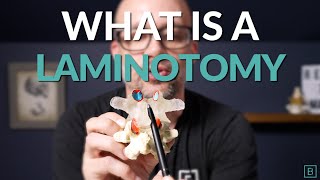
Dr. Jeff Langmaid explains laminotomy, a spine surgery that removes part of the lamina bone to relieve nerve compression from disc herniation or stenosis. The procedure is often outpatient and minimally invasive, though risks include instability and reherniation. Conservative, movement-based care is tried first.
Chapters
Hi, my name is Dr. Jeff Langmaid, and today I want to explain to you exactly what a laminotomy is. We're going to go over what is a laminotomy, what's the difference between a laminotomy and a laminectomy? What diagnosis leads somebody to needing a laminotomy? And what are some things you should consider before having the procedure done on your spine. We're going to start right here with this model of your spine. These are the bones or the vertebra of your spine. The and in between each set of bones is a spinal disc. That disc is meant to take up space. It's meant to provide some absorption of the compression as you walk around each and every day. However, as we age, or if you've had injuries, you could sustain a disc bulge or a herniation. Disc bulge, herniation is when your disc pushes back beyond where it is normally supposed to reside. And that can take up a lot of valuable real estate. So if your disc pushes backwards, it can take up space in this hole. And that hole right there is called a foraminal canal. If your disc pushes back up and into that hole, it can put on a big pinch onto the spinal nerves that travel out those holes. We call that foraminal compression or foraminal stenosis. If you looked at an mri, what can that cause? Well, if you have foraminal stenosis in your neck, it can cause pain, numbness, tingling, and weakness into your shoulders and arms. If that's going on in your low back or lumbar spine, you, you might feel pain, numbness, tingling, or weakness into your buttocks, legs and or feet. So when a disc herniation or a bulge is spotted on an mri, and when you have pain that is shooting down your arms or legs, we call that radiculopathy. This is when the conversation about a laminotomy might start to come up. So for disc bulges, disc herniations, pyramidal stenosis, spinal stenosis, these are all indications that a laminotomy might be right for you. But don't jump to conclusions. Just because you have a disc bulge, a herniation, or you have nerve root compression does not mean your only solution is surgery. As a matter of fact, surgery is the last resort. Unless you have red flags or what we call emergency situations, laminotomies should never be explored before you've undergone conservative care. The latest clinical guidelines recommend movement based care such as chiropractic care, exercise, physical therapy, all of those things should actually be explored. Even before you take any medications, never mind before you entertain the idea of surgical intervention. So let's break down exactly what a laminotomy is. If we look at the bones or the vertebra, we have the disc that hangs out in between, and we flip things around to the backside of your spine, we're going to see these big projections coming off the backside. Those are called your spinous processes. And if you go to the left or to the right of your spinous process, you're going to have this big gutter or gully. Those are your lamina. Those are the lamina of your spine. So a laminotomy is when a small portion of that lamina is removed, and the goal of taking that small portion of bone out of the way is to relieve the pressure on the nerve. The goal of a surgery when somebody does a laminotomy is to remove a portion of that bone to give space so that the nerve is no longer compressed and your symptoms, in an ideal world, start to subside. Now, the difference between a laminotomy and a laminectomy is quite simple. A laminectomy is the removal of the entire lamina from north to south, from top to bottom. A laminectomy is a larger procedure. It's the removal of the entire lamina from. As opposed to a laminotomy, which is simply a small removal of the bone. So that is the difference I like to think of. A laminectomy is like taking the roof off of a house. A laminotomy is like creating a couple doors and windows. Now, some things you want to keep in mind if you've been recommended a laminotomy. Quite often laminotomies are done outpatient, and they can be performed minimally invasive, which is definitely bigger than a large invasive procedure. But. But don't be fooled. Anytime that you are having surgical intervention and it's around your spine, there are substantial risks and dangers. When you remove a portion of that lamina, you are inherently taking away a portion of your body and spine, and that can lead to an increased likelihood of instability long term. Also, laminotomies and laminectomies aren't forever. Quite often we see re herniations. 20, 30, 40% of individuals who go through a laminotomy or a laminectomy end up with a re herniation at that level, which might require a further intervention. If you undergo a laminotomy or a laminectomy, it's commonly known that you get two opportunities to take care of that issue before the joint is so unstable that your only choice is a spinal fusion. So these are all reasons why before you have anything done to your spine surgically, you want to ensure that you follow those clinical guidelines, go through those conservative care channels and ensure that if you have to have a procedure like that done, you you have exhausted every option and that there is no other way for you to find relief. So if you have any questions about laminotomies or laminectomies, drop those questions down in the comments below. I'll be happy to take a look and answer. Stay healthy out there. Stay safe. My name is Dr. Jeff Langmid and I'll see you in the next video. Hey, what's going on? If you loved that video, be sure to subscribe to this channel. The evidence based Chiropractor puts out videos all the time at the intersection of marketing and research, showing you how to grow your practice while also growing your knowledge base. So if you liked it, be sure to comment down below or hit subscribe and I'll see you in the next video.